PART 3: THE LIFE SHE CHOSE
“Daniel,” I said quietly.
Chapter 3
PART 3: THE LIFE SHE CHOSE
“Daniel,” I said quietly.
“What did you do?” The words came out strangled, caught somewhere between anger and disbelief. “What the hell did you just do?”
I didn’t answer right away.
I let the silence stretch between us, the same way he had let silence stretch when I stood outside that restaurant door.
“I showed people the truth,” I said finally.
“You ruined everything,” his voice cracked. “Do you understand that? You just destroyed my marriage, my reputation—everything I’ve worked for—in front of everyone we know.”
I felt something cold settle in my chest.
Not guilt.
Not regret.
Just a clear, sharp awareness of how far apart we had drifted.
“I didn’t ruin anything,” I said. “I revealed it. There’s a difference.”
“You embarrassed us,” he said, and now the anger was winning over the disbelief. “You blindsided us in front of our friends, our family, Kayla’s parents. Her dad is talking about calling
a lawyer. Our friends are asking questions we can’t answer. Do you have any idea what you’ve done?”
“Yes,” I said simply. “I do.”
“Then why?” His voice rose. “Why would you do this? Why would you humiliate us like this?”
I took a breath.
Outside the coffee shop window, a couple walked past holding hands. A man checked his watch. Life continued, indifferent and ordinary.
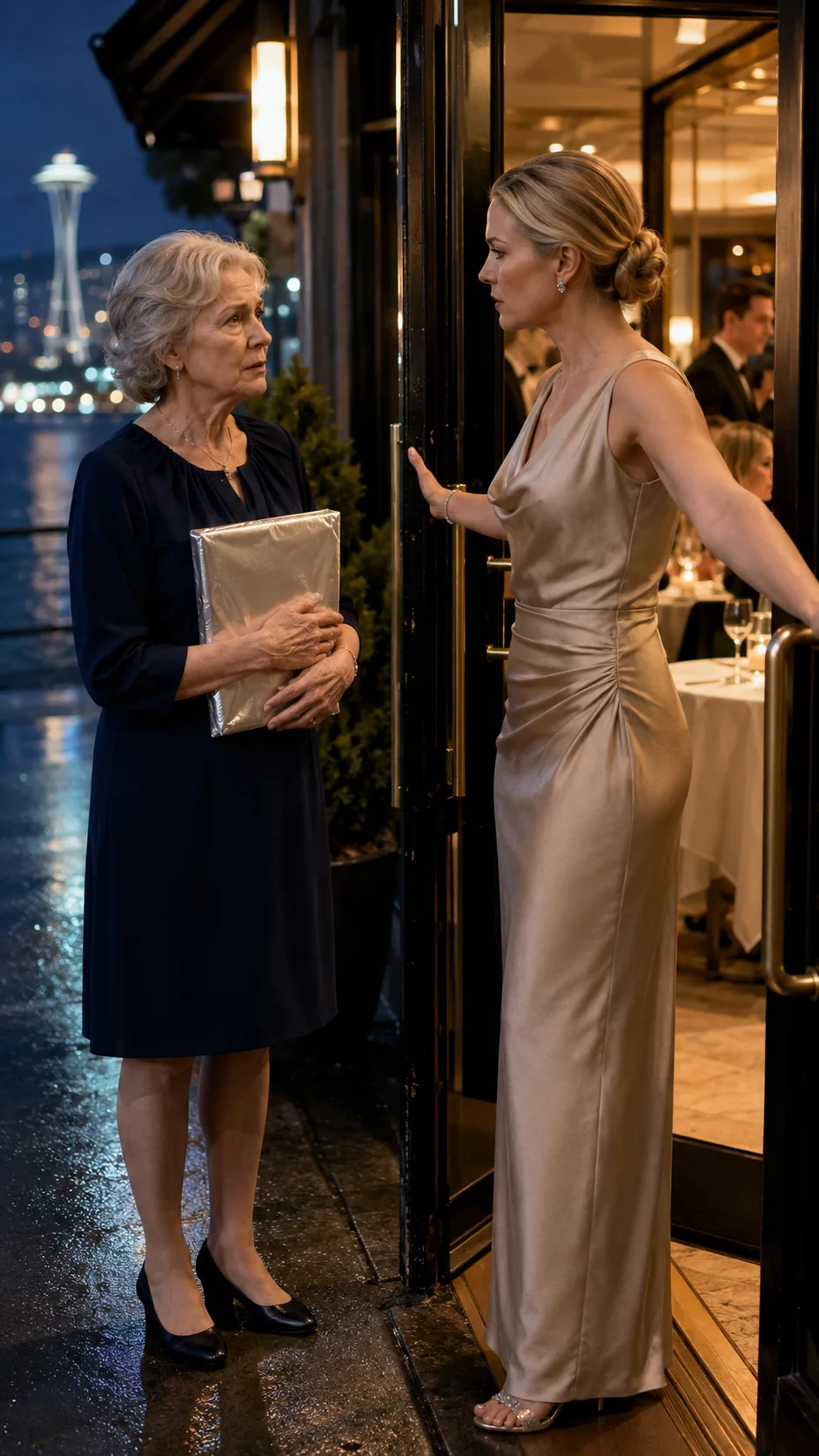
“You told me to stay outside,” I said. “You stood there and watched while your wife told me I wasn’t family. After I flew nine hours to be there. After I spent two thousand dollars I don’t really have. After everything I’ve given you.”
“That was Kayla’s decision,” he said quickly. “I didn’t—”
“You didn’t stop her,” I interrupted. “You looked at me and looked away. You made your choice, Daniel. You chose her version of family. The one where I exist only to
write checks and sign documents.”
Silence on the other end.
I could hear him breathing fast, unsteady.
“I heard the conversation,” I continued. “The one you forgot to mute. The one where you both talked about me like I was a problem to be managed. Where you discussed getting me to sign over my house so you could get the equity. Where you agreed that visits would be optional once you had what you wanted.”
“That was taken out of context,” he said, but his voice had lost its edge.
Now he just sounded tired.
“What context makes that okay?” I asked.
What possible explanation turns that into something other than exactly what it sounded like?
“You were planning my future like a project. My house. My assets. My final years. And you were doing it behind my back while asking me for more money.”
“We were trying to help
you,” he said weakly.
“No,” I said, and the word came out harder than I intended. “You were trying to help yourselves. You wanted me to cooperate without asking questions. You wanted me to hand everything over and be grateful for whatever scraps of attention you threw my way afterward.”
I heard something crash in the background on his end.
A door slamming.
“Kayla is leaving,” he said, his voice dropping to barely a whisper. “She’s packing a bag right now. Her parents are taking her to their place. She says she can’t be married to someone whose mother would do something like this.”
Part of me wanted to feel bad about that.
Part of me wanted to apologize.
But the larger part, the part that had been growing stronger since that unmuted phone call, refused.
“I’m sorry your marriage is suffering,” I said. “But I’m not sorry for what I did. You made me feel like nothing. Like background noise. Like a wallet with a pulse. And when I finally stood up for myself, you’re upset because it wasn’t quiet enough. Because it wasn’t private enough. Because people saw who you really are.”
“You didn’t have to do it that way,” he said.
“What other way was there?” I asked. “Telling you how I felt? I tried that for years. Asking for respect? You stopped answering my calls. The only time you contacted me was when you needed something. Money. Signatures. Permission to take more.”
Another silence, longer this time.
“What are you going to do now?” he asked finally.
Something in his voice had shifted. The anger was gone.
Now he just sounded scared.
I looked down at my cold tea, at the table that wasn’t mine, in a city that wasn’t my home.
“I’m going back to South Dakota,” I said. “Tomorrow morning. And when I get there, I’m calling a lawyer. I’m putting my house in a trust that has nothing to do with you. I’m making sure no one but me has access to my accounts. And I’m going to spend whatever time I have left living for myself.”
“You would really cut me off?” His voice broke on the last word. “After everything?”
“You already cut me off,” I said quietly. “You just wanted to do it slowly, with paperwork and polite distance. I’m just making it official.”
“Mom, please.”
“I loved you more than anything in this world,” I said, and my voice finally wavered. “I gave you everything I had. My time. My money. My dreams. I worked myself to exhaustion so you could have opportunities I never had. And you repaid me by planning to take the last thing I owned and put me somewhere I could be visited when convenient.”
“We were not—”
“Yes, you were,” I interrupted. “I have it recorded. Your wife said it clearly. Assisted facility. Optional visits after you got my house. Those were her exact words.”
He didn’t try to deny it this time.
“I’m hanging up now,” I said. “Do not call me from unknown numbers again. If you need to reach me, you can go through my lawyer once I have one.”
“Mom, please.”
I ended the call.
My hand was steady as I set the phone down.
The messages were still coming, but slower now. The initial wave had passed.
I sat there for another few minutes, just breathing, just existing in the strange calm that had settled over me.
I wasn’t happy.
I wasn’t victorious.
But I was something I hadn’t been in a very long time.
I was free.
I left Seattle the next morning on the earliest flight I could book.
The hotel checkout was quick. The taxi ride to the airport was quiet. I moved through security, found my gate, and sat in one of those uncomfortable plastic chairs that seem designed to make you grateful when boarding finally begins.
Around me, people rushed past with coffee cups and carry-on bags. Businessmen checked their phones. Families with small children tried to keep everyone together. A young couple slept against each other, their heads touching, completely at peace.
I watched them all and felt like I was observing life from behind glass.
Present, but separate.
There, but not really.
When they called my boarding group, I stood up slowly. My knees ached from yesterday’s walking. My back was stiff from a night of restless sleep.
But I made my way down the jetway and found my seat near the back of the plane.
The window seat.
The same one I had sat in on the way there, full of cautious hope and the belief that maybe, just maybe, things could get better.
Now I was going home with that hope buried somewhere over Seattle.
As the plane began to taxi down the runway, I pressed my forehead against the cool glass and watched the city shrink beneath me.
Buildings became smaller. Streets turned into thin lines.
Soon there was nothing but clouds and sky and the low hum of the engines.
I thought about the decades I had spent building a life around my son. The years of sacrifice that had felt so natural at the time, so necessary, like breathing.
After James died, Daniel became everything.
My reason for waking up.
My purpose.
Every decision I made was filtered through one question.
What does Daniel need?
He needed food, so I worked extra shifts.
He needed school supplies, so I skipped buying myself new shoes.
He needed opportunities, so I sold land my husband and I had planned to retire on.
And I never questioned it.
Not once.
Because that is what mothers do.
We give.
We sacrifice.
We build scaffolding around our children so they can climb higher than we ever could.
But somewhere along the way, the giving became expected.
The sacrifice became obligation.
And I stopped being a person and became a resource.
I didn’t notice when it happened.
There was no single moment when everything changed.
It was gradual. Slow.
Like water wearing down stone.
The phone calls got shorter.
The requests got bigger.
The gratitude got thinner until it disappeared entirely.
And I told myself it was normal.
That this was what happened when children grew up and built their own lives.
That distance changed relationships.
That I needed to be grateful for whatever connection remained.
But sitting on that plane, watching South Dakota grow closer beneath me, I finally understood the difference between loneliness and being used.
Loneliness is missing someone who isn’t there.
Being used is missing someone who is right in front of you, taking everything you have, and still making you feel invisible.
I thought about James, about the man I married when I was twenty-three and buried when I was thirty-four.
He had been gone for so long now that sometimes I struggled to remember the sound of his voice.
But I remembered his hands. Rough from work, but gentle when he touched my face.
I remembered the way he would dance with me in the kitchen when Daniel was asleep, humming off key while I laughed.
He would have hated what Daniel became.
Or maybe he would have seen it coming sooner than I did.
James was always better at reading people, at seeing through the performances to the truth underneath.
I wondered what he would say if he could see me now, flying home from the worst family gathering imaginable.
Seventy-one years old, and finally standing up for myself in the messiest way possible.
Maybe he would have been proud.
Maybe he would have told me I should have done it sooner.
Or maybe he would have just held my hand and told me it was going to be okay.
That I was going to be okay.
I felt the tears coming before I could stop them.
They slid down my cheeks silently while I stared out at the clouds.
Not loud crying.
Not the kind that draws attention.
Just a quiet release of everything I had been holding in for months, years, maybe my entire adult life.
I cried for the mother I had been.
The one who believed love and sacrifice were the same thing.
I cried for the son I had raised.
The one who had been kind and grateful and loving before money and marriage changed him into someone I barely recognized.
I cried for the version of myself that had stood in that hotel room two days ago, still believing that maybe this trip would fix things.
That maybe if I just showed up and smiled and played my role perfectly, they would remember they loved me.
But mostly, I cried because I knew that version of myself was gone.
And the woman who replaced her was harder.
Colder.
Less willing to bend.
I didn’t know if that was better or worse.
I just knew it was true.
By the time the plane began its descent into South Dakota, my tears had stopped.
I wiped my face with a tissue from my purse and looked out at the landscape below. The fields, the small towns, the wide-open spaces that felt like home even from thirty thousand feet up.
When we landed, I collected my bag and made my way through the small airport.
Outside, the air smelled different. Cleaner. Simpler.
Like something I could finally breathe.
I took a taxi back to my little house on the edge of town, the one I had left three days ago with hope in my suitcase, the one I was returning to with nothing but truth and exhaustion.
Mrs. Lester was walking her beagle when I pulled up.
She waved.
I waved back.
Everything looked exactly the same. The neighbor’s truck in the driveway. The flowers in the window boxes. The quiet street that never changed.
But I felt different.
I unlocked my front door and stepped inside.
The house smelled like the lavender sachets I kept in the closets. Afternoon light came through the kitchen window at the same angle it always did. My chair sat in its usual spot by the window.
Everything was exactly as I had left it.
Except me.
I set my suitcase down and stood in my living room, just breathing, just being present in this space that was mine, that had always been mine, that no one could take away from me.
For the first time in years, I was not waiting for the phone to ring.
The morning after I returned home, I woke up at six o’clock like I always did. I made coffee. I sat at my kitchen table.
But instead of reaching for the phone to check if Daniel had called, I reached for the phone book.
Old-fashioned, I know, but in a town this size, the yellow pages still worked just fine.
I found a lawyer three towns over.
Harold Mitchell.
His ad was simple.
Estate planning.
Trusts.
Elder law.
Exactly what I needed.
I called his office as soon as it opened at 8:30.
“Mitchell Law Office,” a woman answered.
“Hello,” I said. “My name is Helen Ward. I need to speak with someone about protecting my property and setting up a trust.”
She scheduled me for that afternoon.
Harold Mitchell turned out to be a man in his sixties with gray hair and reading glasses that sat low on his nose. His office smelled like old books and coffee.
He listened without interrupting while I explained everything. The phone call I had overheard. The recordings I had made. The money I had sent over the years. The conversation at the restaurant door. The video.
When I finished, he sat back in his chair and was quiet for a long moment.
“Mrs. Ward,” he said finally. “You did the right thing coming here. What you’re describing is a textbook case of financial exploitation. It happens more often than people realize, especially with older parents and adult children.”
Older.
The word sat strange in my ears.
I still didn’t think of myself that way.
But I suppose seventy-one qualified.
“What I need,” I said, “is to make sure they can never touch my house or my accounts. Ever.”
He nodded.
“We can do that,” he said. “I recommend putting your property into an irrevocable trust. You’ll still live there, still control it, but legally it will be protected. No one can force you to sign it over.”
“We’ll also set up a durable power of attorney, but you will name someone you trust. Not family. A neutral third party, or a professional fiduciary.”
“What about my bank accounts?” I asked.
“We’ll contact your bank and add security measures,” he said. “Alerts for unusual activity. Remove any authorized users. Make sure everything requires your direct approval.”
We spent two hours going through paperwork, signing documents, making decisions about who would have access to what if something happened to me.
By the time I left his office, I felt lighter.
Safer.
Like I had built a wall around the last things that belonged to me.
The next day, I went to the bank.
I sat down with a manager I had known for fifteen years and explained what I needed.
She didn’t ask for details.
She just nodded and made the changes.
Removed Daniel’s name from my emergency contacts.
Set up alerts.
Changed my PIN.
Made sure every transaction over a certain amount would require me to confirm it in person.
“You’re doing the smart thing,” she said as I was leaving. “Protecting yourself isn’t selfish. It’s necessary.”
I thanked her and walked out feeling like I had reclaimed something that had been slowly slipping away from me.
But the legal protection was only half of what I needed to do.
The other half was harder.
It meant rebuilding a life that had been entirely focused on someone who didn’t want me in his.
That first week back, I started small.
I took long walks every morning before the sun got too hot, down the quiet streets where everyone knew my name. Past the houses with their neat lawns and front porches.
I had forgotten how much I liked walking.
How good it felt to move without rushing toward something or away from something.
Just moving because I could.
I went back to bingo at the community center on Wednesday nights. I had stopped going two years ago because the games always happened right when Daniel used to call.
I had prioritized those calls over my friends, over my routine, over my own enjoyment.
But the calls had become less frequent anyway, and I had just stayed home out of habit.
Now I sat at my usual table with Louise and Margaret and Carol.
We played our cards and laughed at Carol’s terrible jokes and split a plate of cookies someone had brought, and it felt good.
Normal.
Like putting on an old sweater that still fit.
I started visiting places I had always postponed. The little museum two towns over that I had driven past a hundred times but never stopped at. The café that made cinnamon rolls people talked about. The park by the river where I used to take Daniel when he was small.
I sat on a bench and watched the water move past, steady and indifferent.
And I realized something important.
My life hadn’t ended when Daniel walked away.
It had just been on hold.
Paused.
Waiting for permission I didn’t actually need.
Daniel tried calling twice that first week.
Once from his regular number.
Once from another number I didn’t recognize.
I didn’t answer either time.
He left voicemails.
The first one was angry, accusing me of overreacting, telling me I owed him a conversation.
The second one was different.
Softer.
Almost pleading.
Saying we needed to talk.
That family doesn’t just give up on each other.
I deleted both without listening all the way through.
Then he tried a different approach.
He sent a letter.
It arrived in my mailbox four days after I got home.
Cream-colored envelope.
Handwritten address.
I recognized his writing immediately.
I held it for a long time sitting at my kitchen table.
Part of me wanted to open it.
To see what he had to say.
To find out if maybe, just maybe, he had realized what he had done and wanted to make it right.
But the larger part of me knew better.
Whatever was in that letter, it wasn’t going to be an apology.
It was going to be another manipulation.
Another attempt to pull me back into a dynamic where I gave and he took and we both pretended that was love.
So I did something I had never done before.
I took the letter unopened and put it in a drawer in my bedroom.
Not thrown away.
Not returned.
Just set aside.
Acknowledged.
Not answered.
Three days later, another letter came.
Then another.
Then two more in the same week.
I put them all in that drawer, unopened, unread.
People at church asked me how Daniel was doing.
I smiled and said he was fine and changed the subject.
I didn’t offer details.
I didn’t explain what had happened.
I just let them assume everything was normal while I quietly rebuilt the boundaries that should have existed all along.
Mrs. Lester asked if Daniel was coming to visit soon.
I told her probably not and left it at that.
The truth was, I didn’t know if I would ever see my son again.
I didn’t know if he would keep trying to reach me or if he would eventually give up.
I didn’t know if Kayla would leave him or if they would somehow patch things together.
And for the first time in my adult life, I realized I didn’t need to know.
His choices were his own.
His consequences were his own.
And my peace was finally my own.
They had taught me through years of coldness and calculated distance that they didn’t need me.
And sitting in my quiet house with my morning coffee and my afternoon walks and my Wednesday night bingo games, I finally believed them.
The news from Seattle came in pieces.
Not from Daniel.
From the edges of our family.
People who had been at that dinner.
People who knew people who had been there.
Small-town gossip traveling across state lines, finding its way back to me through phone calls and chance meetings at the grocery store.
The first call came from Daniel’s cousin, the one who had texted me that night.
She called on a Thursday afternoon, her voice careful like she was trying not to step on a landmine.
“Aunt Helen, I just wanted to check on you after everything that happened.”
“I’m fine,” I said.
“I heard Kayla moved out,” she said, and I could hear the question underneath the statement. “She went to stay with her parents temporarily. But people are saying it might be more than temporary.”
I didn’t respond.
I let the silence sit there.
“Her father is apparently furious,” she continued. “He was talking to people at the dinner about lawyers, about financial abuse, about how you’d been sending them money for years and they were planning to take more.”
“He was right to be furious,” I said quietly. “They were planning exactly that.”
She went quiet for a moment.
“People are talking, Aunt Helen,” she said. “About the recording. About what was said. Some people think you went too far.”
“But a lot of people… they’re saying you did what you had to do.”
“I appreciate you telling me,” I said.
We talked for a few more minutes about nothing important.
Then she hung up.
But the calls kept coming.
Other relatives.
Old family friends.
Each one bringing a new piece of information about the aftermath I had left behind in Seattle.
Kayla’s parents had apparently stood up halfway through the recording and walked out.
They hadn’t said goodbye to Daniel.
They hadn’t made a scene.
They had just left.
And according to people who had been there, Kayla’s mother had been crying.
The guests had split into camps.
Some sympathized with Daniel and Kayla, saying the whole thing was a private family matter that should not have been aired publicly.
Others sided with me, saying that what I had revealed was important.
That people had a right to know who they were celebrating.
The recording had been shared.
Someone filmed it on their phone, and it made its way through group chats and social media.
Not viral.
But enough that people in their circle knew.
Enough that there were consequences.
Daniel’s workplace had apparently heard about it.
Nothing official.
Just the kind of whispered awareness that changes how people look at you in meetings.
Friends were asking questions.
Not confrontational.
Just pointed.
About the money.
About my house.
About how long this had been going on.
And through it all, Daniel kept trying to reach me.
The letters continued.
One arrived every few days, each with his handwriting on the envelope.
I stopped reading his name on the return address.
I just recognized the shape of the letters and added them to the drawer with the others.
But then, about three weeks after I returned home, the tone of the letters began to change.
I know this because I opened one.
Just one.
I told myself I wouldn’t.
But curiosity got the better of me.
Or maybe it was the part of me that still hoped he might actually understand what he had done wrong.
The letter was five pages long.
Handwritten.
His penmanship messy, rushed, like he had written it in one sitting without stopping.
It started with an apology.
“I’m sorry for how things happened. I’m sorry you felt hurt. I never meant for any of this.”
But by the second page, the apology had shifted into justification.
“You have to understand, we were under a lot of financial pressure. Kayla’s student loans, the kids’ expenses, the cost of living out here. We were just trying to plan ahead.”
By the third page, the justifications had become accusations.
“You didn’t have to humiliate us like that. You could have just talked to us. You could have said no if you didn’t want to help anymore. But instead, you destroyed our reputation. You hurt our marriage. You turned our friends against us.”
And by the final page, it dissolved into guilt.
“How could you do this to your own son after everything we’ve been through? After Dad died and I was all you had, I needed you to be better than this. I needed you to be the mom you used to be.”
I read that last line three times.
I needed you to be the mom you used to be.
The mom who said yes to everything.
The mom who never questioned.
The mom who gave until there was nothing left and then found a way to give more.
That mom was gone.
And he was angry about it.
I folded the letter carefully, put it back in the envelope, and placed it in the drawer with the others.
The letters kept coming.
I stopped opening them.
I could feel the weight of them accumulating.
Seven.
Ten.
Fifteen.
Each one an attempt to pull me back into a role I had finally walked away from.
And then one morning, I decided I was done carrying them.
I took the entire stack from the drawer and brought them to the post office.
I put them in a padded envelope with Daniel’s address on the front and a note inside that said simply:
“I received these. I am returning them unread. Please do not send more.”
I kept only one letter.
The one I had opened.
The one that showed me exactly where his mind was.
Not in understanding.
Not in genuine apology.
But in blame and manipulation dressed up as hurt feelings.
I kept it in the drawer, but not as a reminder of him.
As a reminder of how far I had come.
Of the moment I stopped letting someone else’s version of who I should be determine who I actually was.
The package went out that afternoon.
I didn’t feel victorious.
I didn’t feel satisfied.
I just felt clear.
They had shown me who they were.
And I had finally stopped pretending they were anything else.
Six weeks after I returned from Seattle, I drove to the lake.
It was a place I hadn’t visited in years, a quiet spot about thirty minutes from town, where the water stretched out flat and blue under an open sky.
James and I used to bring Daniel here when he was small. We would pack sandwiches and sit on the shore while he threw rocks and chased dragonflies.
I hadn’t been back since James died.
It felt too heavy.
Too full of memories I wasn’t ready to revisit.
But that morning, I woke up and decided it was time.
I packed a thermos of coffee and drove out there alone.
The road was the same.
The trees looked older, but familiar.
And when I pulled into the small parking area and saw the water glittering in the morning light, something in my chest loosened.
I walked down to the shore and sat on one of the old wooden benches someone had built years ago.
The lake was calm.
A few birds moved across the surface.
The air smelled clean and simple.
I thought about the life I had built.
Not the one I had now.
The one that had come before.
The years of working double shifts and skipping meals so Daniel could have what he needed.
The sacrifices that had felt so natural at the time.
So necessary.
I had defined myself by my ability to give.
By how much I could endure.
By how little I could need.
And somewhere along the way, I forgot that I was allowed to be more than that.
I was allowed to want things for myself.
To make plans that had nothing to do with being needed by someone else.
To say no without apologizing.
To walk away when love stopped being love and became something colder.
Sitting there by that lake, I felt something I hadn’t felt in a very long time.
Not happiness.
Not yet.
But possibility.
The future was mine again.
Not perfect.
Not without grief.
But mine.
I stayed there for over an hour, just watching the water and letting myself feel everything I had been holding back.
Sadness.
Relief.
The strange freedom that comes from finally putting yourself first after a lifetime of putting yourself last.
When I finally drove home, I stopped at the local shelter on the way.
The one that helped women reconnecting with their children after difficult circumstances.
I had volunteered there years ago before life got too busy and I stopped making time for anything except Daniel.
I walked in with the photo book, the one I had made for the anniversary.
The one I had never given them.
The director, a woman named Patricia, who I had known for years, greeted me with a warm hug.
“Helen, it’s been too long.”
“I know,” I said. “I wanted to donate something.”
I handed her the photo book and explained what it was.
Pictures of a mother and son.
Memories of better times.
A reminder that relationships were built on moments, not money.
“I thought maybe someone here could use it,” I said. “Someone trying to rebuild something that got broken. Maybe seeing these pictures will remind them that it’s possible. That love can be real, even when it’s hard.”
Patricia took the book gently and flipped through a few pages. Her eyes softened.
“This is beautiful,” she said. “And very generous. Thank you.”
I left the shelter feeling lighter, like I had given that chapter of my life a proper ending instead of just walking away from it.
Over the next few weeks, I started making plans.
Real plans.
The kind that excited me instead of scared me.
I signed up for a watercolor painting class at the community center, something I had always wanted to try but never made time for.
I booked a bus tour through New England for the fall. Six days visiting small towns and seeing the leaves change.
Something James and I had always talked about doing but never got around to.
I joined a book club that met every other Tuesday at the library.
We were reading mysteries.
I had always loved mysteries.
And slowly, piece by piece, I started building a life that belonged to me.
Not a life defined by who needed me.
Or what I could give.
Or how much I could sacrifice.
Just a life.
Simple.
Quiet.
Mine.
Daniel stopped sending letters after I returned them.
The calls stopped, too.
For a while, I waited for the next attempt, the next guilt trip, the next manipulation dressed up as reconciliation.
But it never came.
And eventually, I stopped waiting.
I didn’t know if I would ever hear from him again.
I didn’t know if he would ever understand what he did.
Or if he would spend the rest of his life blaming me for the consequences of his own choices.
But one evening, sitting in my living room with a cup of tea and a book I was actually enjoying, I realized something important.
It didn’t matter.
His choices were not mine to carry anymore.
His anger was not mine to manage.
His version of who I should be was not mine to become.
I had spent seventy-one years being the woman everyone else needed me to be.
Patient.
Giving.
Selfless to the point of disappearing.
And in one night, in one moment of choosing truth over silence, I became someone else.
Someone who knew her worth.
Someone who refused to be treated like background noise in her own story.
Someone who understood that love without respect is not love at all.
They shut the door on me that night in Seattle.
Literally.
Completely.
But in doing so, they gave me something I hadn’t had in years.
Permission.
Permission to open another door.
One that led forward instead of backward.
One that led to a life built on dignity instead of desperation.
I am seventy-one years old.
I don’t know how many years I have left.
But I know this much.
Every single one of them will be mine.
They shut the door on me.
So I opened another one.
One that leads only forward.
THE END.
Chapter complete
You have reached the end of this chapter.
Continue reading
A few more worlds to get lost in after this chapter.




