PART 2: THE RECORDING THAT SILENCED THE ROOM
To understand how I ended up on that sidewalk in Seattle, you need to know how I got there.
Chapter 2
PART 2: THE RECORDING THAT SILENCED THE ROOM
To understand how I ended up on that sidewalk in Seattle, you need to know how I got there.
Not just the flight or the hotel reservation, but the years that came before.
I became a single mother when Daniel was nine years old.
His father, my husband James, had a heart attack while fixing the fence behind our house. One minute he was laughing about something Daniel had said at breakfast, and the next minute he was gone. Just like that. No warning. No goodbye.
I buried him on a Thursday and picked up an extra shift at the care facility by Monday.
Not because I was strong or brave, but because the bills did not stop coming just because my heart had stopped working properly.
I was a nurse’s aide in a small town outside Pierre, South Dakota. The pay was modest, the hours were long, and the work left my back aching and my feet swollen by the end of every shift.
But I did it.
I did it because that is what mothers do.
We keep moving forward, even when the ground beneath us has disappeared.
Daniel was everything to me. He had his father’s smile and my stubborn streak. He was a good student, not brilliant, but determined. Soccer. Debate team. Weekend jobs at the grocery store. He was the kind of kid who made you proud without even trying.
By the time he turned eighteen, I had counted every dime twice for so long that numbers lived in my bones. I knew exactly how much a gallon of milk cost. How many more shifts I needed to cover new school shoes. How far I could stretch a pot of soup.
When Daniel got his first job offer in Seattle at twenty-six, I was so proud I could barely breathe. My boy moving to the big city. My boy making something of himself.
But
the move required money he did not have. A security deposit. First and last month’s rent. Moving costs. A professional wardrobe.
He called me one night, his voice tight with stress, and explained that the opportunity was perfect, but just out of reach.
I did not hesitate.
I sold the last piece of land my husband and I had owned, ten acres with a rusted red barn that we had always planned to fix up someday. The developer who bought it paid cash, and I wired Daniel the down payment for his first condo without a second thought.
He cried on the phone when the money came through.
“You’re the best, Mom,” he said, his voice breaking. “I’ll pay you back as soon as I’m settled.”
He never did.
I never asked.
That is when the pattern started, though I didn’t see it then. I just saw my son building
a life, and I wanted to help him build it strong.
Three hundred dollars here for an unexpected expense. Six hundred there for a car repair. A plane ticket so they could bring the kids to visit, which got canceled at the last minute three different times.
Every time the reason sounded reasonable.
The market was volatile. The company was restructuring. One of the kids had a cough. They were saving for the future.
Little by little, I started to feel like an overdraft account with a heartbeat.
Then he met Kayla.
The first time I saw her was on a video call. She had perfect makeup, a sharp blazer, and that smooth tone people use in office presentations.
She leaned into the frame and said, “We’re so grateful you helped, Helen. You’re like a foundation we can build on.”
At the time, I took it as a compliment.
I smiled.
I told her I was happy to help.
I meant it.
But looking back now, I can see the red flags I ignored. The way she always positioned herself slightly in front of Daniel during our calls. The way she would interrupt him mid-sentence to clarify something he had just said, as if he couldn’t be trusted to speak for himself.
The way my name started dropping out of their social media posts, even though I could see photos of her parents at every holiday gathering.
Over the next five years, my help became a quiet habit. Not a choice anymore, but an expectation.
The calls grew shorter. My name disappeared from family updates. Photos of the grandchildren stopped coming unless I asked twice, and even then, they arrived weeks late with vague captions.
When I mentioned maybe spending a few months in Seattle so I could help with school pickups, Kayla’s voice went flat.
“It’s just—we have our routine,” she said carefully. “Your town is more your speed. Out here is different, and Daniel really needs to focus on his career right now.”
I swallowed that like I had swallowed everything else, with a smile and a reassurance that I understood.
But one night, sitting alone at my kitchen table, I decided to run the numbers.
I pulled out old bank statements, receipts, copies of wire transfers I had saved in a folder. I laid them all out and started adding.
The pen paused over the paper when the total came into focus.
Over the last seven years, I had sent them just over fifty-four thousand dollars.
Fifty-four thousand dollars.
That was my husband’s life insurance. My emergency fund. The cushion I had once dreamed would let me drive to see the ocean, or take a simple bus tour through New England when I finally retired from changing bedpans and lifting patients who weighed twice what I did.
Instead, it had turned into their safety net while I worked overtime to keep my own bills paid.
I could have made peace with that. Maybe if the love had matched the withdrawals. If the warmth in Daniel’s voice had stayed constant. If Kayla had ever once called just to ask how I was doing instead of leading into another request.
But the gap between what I gave and what I received started to widen in ways you can’t measure with a calculator.
I thought about the last time Daniel had called without needing something.
I could not remember.
I thought about the last time I had received a photo of my grandchildren without having to ask three times.
It had been months.
I sat there at that table staring at the numbers, and I felt something crack open inside my chest. Not anger yet, just a slow, creeping realization that the love I had been clinging to was not love at all.
It was a transaction.
And I was the only one still paying.
The call came on a Sunday afternoon in late spring, one of those ordinary days when nothing feels particularly important until suddenly everything changes.
I was folding laundry in my living room when my phone rang. Daniel’s name lit up the screen, and I answered with the kind of automatic hope I had not yet learned to question.
“Hey, Mom,” he said.
I could hear the familiar sounds of his kitchen in the background. Plates clinking. Small feet running across the floor. The hum of a life being lived far away from me.
“Hi, sweetheart,” I said, tucking the phone between my ear and shoulder so I could keep folding. “How are the kids?”
“Good, good. Busy as always.” His voice sounded distracted, like he was doing three things at once. “How about you? How’s the weather out there?”
We talked about nothing important. The neighbor’s new puppy that kept digging under my fence. The church raffle coming up next month. Small talk that felt comfortable in its predictability, even if it lacked any real substance.
I was telling him about Mrs. Lester’s beagle when I heard the doorbell ring on his end.
“Hang on, Mom,” he said, and I heard a soft thud as he set the phone down on the counter.
I should have told him I would call back later.
I should have hung up.
But the phone was already down, and I was still holding mine, and so I waited.
I could hear voices in the background, muffled but getting clearer.
Then I heard Kayla.
“Did you tell her about the anniversary yet?” she asked.
“Not exactly,” Daniel replied.
Something in his voice made me go very still.
I knew I should make a noise. Cough. Say something so they would remember I was there.
But I did not.
I just stood there in my living room with a half-folded towel in my hands, listening.
“It’s supposed to be a special evening,” Kayla went on. “My parents paid for the private room. It’s for close family. Do you really want your mom there fussing over the kids and telling nurse stories?”
The towel slipped from my hands onto the floor.
“She would be hurt if we didn’t invite her,” Daniel said.
But his voice was weak. Resigned.
“She gets hurt if you breathe wrong,” Kayla snapped. “She’s already given us enough money. That’s her role. She doesn’t have to be in every photo.”
I sank slowly onto the arm of my couch. My legs had stopped working properly.
There was a pause.
When Kayla spoke again, her voice dropped lower, quieter, like she was sharing a secret.
“She’s not really our family unit,” she said. “Your real family now is me and the kids and my parents. She is background.”
My hand tightened around the phone.
“And anyway,” Kayla continued, “once we get her to sign over that house, she’ll be taken care of. A good assisted facility, right? Just get her to put it all in your name for emergencies. After that, visits are optional.”
My house.
My last asset.
The old place I rented out now to a young couple who kept the lawn neat and paid on time. The place that had climbed in value because some developer wanted to turn the edge of town into an outlet mall.
Daniel had called it our nest egg just a week earlier.
Our nest egg.
Like it belonged to both of us.
I heard him sigh through the phone.
“Fine,” he said.
That single word felt like a door closing.
“We’ll invite her to the post-dinner brunch,” he added. “Say the kids are too tired for a late night. She can’t complain if she’s included in something.”
“She’ll complain anyway,” Kayla said. “Just remember what I told you. She signs what we need, we get the equity, and if she wants to visit twice a year from South Dakota, that’s more than enough. You’re not a little boy anymore.”
A chair scraped. Feet moved across the floor. The phone shifted.
“Mom.”
Daniel’s voice came back bright and strained, like someone flipping a switch.
“Sorry about that. You were saying something about your church raffle.”
I opened my mouth.
Nothing came out.
“Mom, you still there?”
“Yes,” I managed finally. My voice sounded strange even to my own ears. Thin. Distant. “I’m here.”
“So, what were you saying?”
I could not remember.
I could not remember anything except the words I had just heard.
Background.
Optional.
Sign over the house.
“I should go,” I said. “I have something on the stove.”
I didn’t have anything on the stove. I hadn’t even started dinner yet, but I needed to get off that call before my voice broke completely.
“Oh, okay. Talk soon, Mom.”
“Yes,” I said. “Soon.”
I ended the call and sat there staring at the wall.
For a long time, I didn’t move. I just sat there with the phone in my hand, trying to convince myself I had misunderstood.
That there was some other explanation.
Some context I was missing.
But there was no other explanation.
They had been planning this. Planning me. My future. My house. My final years. All laid out like a project they needed to manage.
And Daniel—my son, the boy I had sacrificed everything for—had agreed to it with nothing more than a sigh and a fine.
That night, I lay awake staring at the ceiling fan, counting every rotation like I used to count heartbeats during my shifts at the care facility.
By morning, something inside me had snapped into sharp focus.
The grief was still there, heavy and real. But underneath it was something else. Something harder. Clearer.
For the first time in seventy-one years, I allowed myself to be suspicious instead of understanding.
I became the woman who would finally say enough.
The morning after that phone call, I made myself toast and coffee, the same breakfast I had eaten for forty years, and I sat at my kitchen table making a list.
Not the kind of list I usually made, full of groceries and errands.
This was different.
This was a plan.
I needed proof. Real proof. Not just my word against theirs. Not just hurt feelings and suspicious phone calls.
Something solid.
Something undeniable.
The problem was I barely knew how to use my phone beyond making calls and sending the occasional text message. I certainly did not know how to record conversations or save files or do any of the technical things people half my age took for granted.
But I knew someone who did.
My neighbor, Mrs. Allison, had a grandson named Kyle, who was sixteen and spent most of his time fixing computers for half the town. He was quiet, polite, and never asked unnecessary questions.
I called Mrs. Allison that afternoon and asked if Kyle might have time to help me with my phone. She sent him over after school with a backpack full of cables and a patient smile.
He sat at my kitchen table with his laptop open while I poured him lemonade and tried to figure out how to explain what I needed without explaining too much.
“I’ve been getting some calls from my doctor’s office,” I said carefully. “They give me instructions about medications and appointments, and sometimes I forget the details. I was hoping there might be a way to record the calls so I could listen back if I need to.”
Kyle nodded like this was the most normal request in the world.
“Sure, Mrs. Ward,” he said. “That’s easy. Your phone already has a voice recorder app. I can show you how to use it.”
He spent the next twenty minutes walking me through it. How to start a recording. How to save it. How to name the files so I could find them later.
He even showed me how to transfer them to a small flash drive.
“You should keep backups,” he said. “In case something happens to your phone.”
Watching him do it, it looked simple.
But I made him show me three times, writing down each step in my notebook with the careful printing I had learned in school sixty years ago.
When he finally left, I sat at my table with my phone in one hand and the flash drive in the other, feeling like I was holding something dangerous and necessary all at once.
I didn’t have to wait long for another call.
Kayla phoned me four days later. Her voice was sweet, almost cheerful, the way it always was when she wanted something.
“Helen, hi. I hope I’m not catching you at a bad time.”
“Not at all,” I said, my finger hovering over the record button.
I pressed it.
“How are you?”
“Good. Really good.” She kept that bright, breezy tone. “Listen, Daniel and I have been talking, and we think it might be time to help you with some estate planning. You know, just to make sure everything is organized, make things easier for you down the road.”
My hand tightened around the phone.
“Estate planning?”
“Nothing complicated,” she said quickly. “Just some basic paperwork. Power of attorney, that kind of thing. Daniel could handle everything for you if something happened. Medical decisions, financial stuff. It would give you peace of mind.”
Peace of mind.
As if handing over control of my life would somehow make me feel safer.
“And we were thinking,” she continued, “it might make sense to transfer the deed on your rental property into Daniel’s name. Now. For tax purposes. And honestly, managing a property from so far away must be stressful for you. This way you wouldn’t have to worry about it anymore.”
There it was.
Exactly what I had heard on that unmuted call.
Only now she was saying it directly to me, wrapped up in concern and practicality.
“I’ll think about it,” I said, keeping my voice neutral.
“Of course, of course. No pressure.” She hurried on, already moving to the next step. “But maybe we could send you the paperwork soon, just to review. Daniel has a friend who is a notary. It would be so easy.”
We talked for another ten minutes. She told me about the kids’ school projects. She mentioned a vacation they were planning.
She never once asked how I was doing, or if I needed anything.
When we finally hung up, I sat there for a long moment before I stopped the recording. Then I played it back.
Her voice came through clearly.
Every word.
Every careful suggestion.
Every lie dressed up as help.
I saved the file, named it, and transferred it to the flash drive.
Over the next two weeks, there were more calls. More gentle pressure. More “helpful” suggestions about how much easier my life would be if I just let them handle things.
I recorded every single one.
Each recording made me angrier, but it also made me more certain.
I was not imagining this.
I was not being paranoid or oversensitive.
This was real.
They were really trying to take everything from me while pretending to care.
The invitation arrived on a Wednesday in early fall. It came in a cream-colored envelope with gold lettering, the kind of stationery that costs more than my weekly grocery budget.
Inside, the card announced the fifth wedding anniversary celebration of Daniel and Kayla at an upscale restaurant in Seattle.
Dinner would be served at seven.
Dress code was cocktail attire.
There was a handwritten note at the bottom in Kayla’s perfect script.
“We would love for you to join us for this special evening. It has been too long.”
I read that line three times.
It has been too long.
As if the distance between us was just a matter of time and geography, not the calculated freeze-out I had been living through for years.
I set the invitation on my kitchen table and stared at it for a long time.
This was it.
This was the moment I had been preparing for without fully realizing it.
They were inviting me into their world, into their celebration, expecting me to show up grateful and smiling and ready to play the role of adoring mother one more time.
They had no idea I was coming with something they had not planned for.
I picked up the phone and called the restaurant.
A man answered on the third ring, his voice professional and warm.
“Good afternoon. Thank you for calling. How may I help you?”
“Hello,” I said. “My name is Helen Ward. My son and daughter-in-law are having their anniversary dinner at your restaurant next month, and I wanted to arrange a little surprise for them.”
“Of course,” he said. “What did you have in mind?”
“A video,” I said. “A slideshow, really. Just some family photos set to music. Something sweet to play during the dinner. I thought it would be nice to show everyone how far they have come.”
He loved the idea immediately.
“That sounds wonderful,” he said. “We can absolutely arrange that. Just bring the file on a flash drive when you arrive, and we’ll have our tech person cue it up. Would you like it played before dessert? After the main course?”
“After the main course would be perfect,” I said. “When everyone is relaxed and settled.”
When I hung up, I felt that same clarity I had felt the morning after the unmuted call.
I knew what I was doing.
I knew it was going to hurt.
But I also knew it was necessary.
The next step was creating the actual video.
I drove to the print shop in town that following Saturday. It was run by a woman named Carol, whose daughter did wedding slideshows and anniversary videos on the side.
Carol’s daughter, Jessica, met me in the back room where they kept the computers and editing equipment. She was in her late twenties, kind-faced, with gentle hands that moved carefully through my photos.
I brought a shoebox full of old photographs. Pictures of Daniel as a baby. His first day of school. Birthday parties in our tiny kitchen. Christmas mornings when money was tight but love was abundant.
I also brought the flash drive with the recordings.
“These are beautiful,” Jessica said softly, looking at a picture of Daniel at age five, covered in mud and grinning like he had just discovered gold. “You want them set to music?”
“Yes,” I said. “Something soft at first. Maybe a piano melody. Nothing too sentimental.”
I took a breath.
“And then I need you to add something at the end.”
I handed her the flash drive.
“There are audio files on here,” I said carefully. “I need them added to the end of the video. After the photos. Just a black screen with the audio playing.”
She looked at me, and I saw the question forming in her eyes.
But she didn’t ask it.
She just nodded.
We spent three hours building it. Then we got to the end.
She played the audio files I had selected: the conversation between Daniel and Kayla about me being background, about getting me to sign over my house, about visits being optional once they had what they wanted.
Jessica went very still as she listened.
When it finished, she looked at me with something I had not seen in a long time.
Not pity.
Not sympathy.
Understanding.
“Are you sure?” she asked quietly.
“I’m sure,” I said.
She exported the video onto two flash drives without another word. When she handed them to me, she pressed them into my palm and held my hand for just a moment.
“Good luck,” she said.
That night, I packed my suitcase: the navy dress, comfortable shoes, the gift I had already wrapped, and both flash drives. One tucked into my purse, one taped carefully inside the lining of my suitcase.
If life had taught me anything, it was that you always needed a backup.
Three days later, I boarded the plane to Seattle.
The flash drive was safe in my purse.
My heart was steady.
My hands did not shake.
I arrived in Seattle on a Thursday afternoon, two days before the anniversary dinner. The hotel was modest but clean, the kind of place where the staff smiled without really seeing you.
The next morning, I took a taxi to the restaurant.
The manager I had spoken to on the phone was there, a man in his forties with kind eyes and a name tag that read ROBERT.
“Mrs. Ward,” he said, shaking my hand warmly. “It’s so good to finally meet you in person. Your son is a lucky man to have a mother who cares so much.”
I smiled.
It felt strange on my face.
“I brought the video,” I said, pulling the flash drive from my purse. “For the anniversary. You said after the main course would be best.”
“Perfect timing,” he said. “We’ll dim the lights, announce it as a surprise from you, and let it play on the main screen. I think your family is going to love it.”
He had no idea what was actually on that drive.
And I did not tell him.
The next evening, I got dressed slowly. The navy dress fit the same way it had when I tried it on at home.
But somehow it felt different now.
Heavier.
More real.
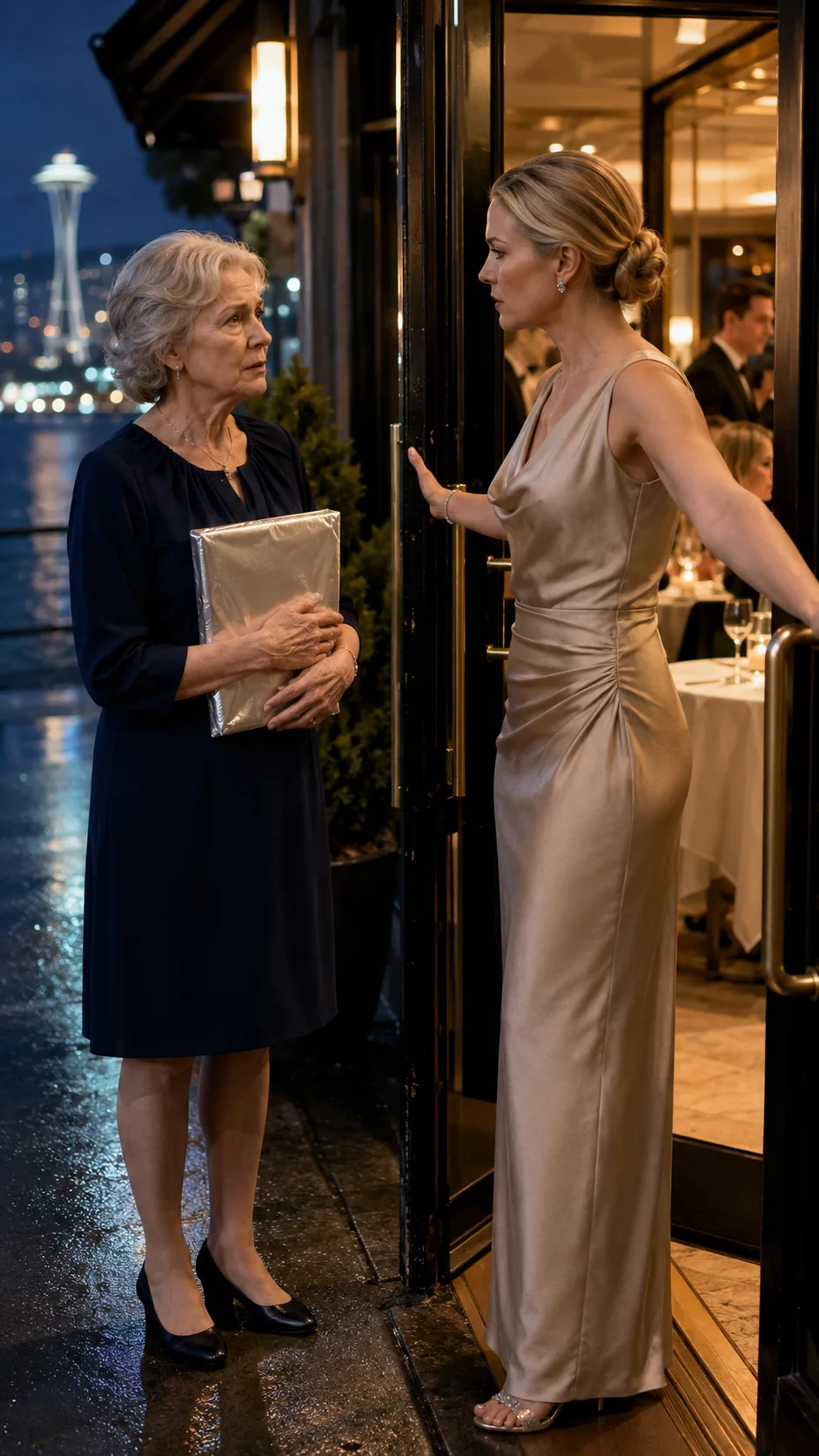
I arrived at the restaurant early. The gift was in my hands, wrapped carefully in silver paper.
My heart was beating faster than it should have been.
I stood on the sidewalk for a moment, watching people arrive. Couples in nice clothes. A family with two small children. Laughter floating through the open door.
I smoothed down my dress one more time and walked toward the entrance.
The door opened before I could reach it.
And there she was.
Kayla.
In a dress that probably cost more than my rent.
Her hair was perfect, her makeup was flawless, and her smile disappeared the second she saw me.
Everything happened exactly as I said.
The cold greeting.
The dismissal.
The words that cut deeper than any knife.
“This dinner is family only.”
I looked past her and saw Daniel standing inside. My son. The boy I had raised alone.
The man I had sacrificed everything for.
And he looked away.
He pretended not to see me.
Kayla was still blocking the entrance, waiting for me to leave.
Part of me wanted to push past her. Part of me wanted to demand answers.
But I didn’t.
Because a scene was not necessary.
My work was already inside.
So I nodded once, turned away, and walked back down the sidewalk with the gift still in my hands.
The door clicked shut behind me.
That sound echoed in my ears as I walked.
Click.
Final.
Absolute.
I kept walking until I found that same coffee shop I mentioned before. I sat near the window, ordered tea I knew I wouldn’t drink, and waited.
My phone was on the table in front of me, face down, silent for now.
But I knew that wouldn’t last long.
Inside that restaurant, in about twenty minutes, they were going to dim the lights. They were going to announce a special surprise video from Daniel’s mother.
And everyone was going to see exactly who this family really was.
I didn’t feel triumphant.
I didn’t feel victorious.
I just felt tired and sad and strangely calm.
They had made their choice at that door. They had chosen cruelty over kindness, exclusion over inclusion, money over love.
And now they were going to live with the consequences of that choice in front of everyone they had invited to celebrate with them.
I checked my watch.
It had been eighteen minutes since they closed that door in my face.
By now, they would be finishing their main course, wiping their mouths with cloth napkins, laughing at something someone said, completely unaware of what was about to happen.
I thought about standing up and walking back to my hotel. Leaving before the fallout started. Disappearing quietly the way they had always wanted me to.
But I stayed.
My phone was still face down on the table, silent, waiting.
And then, at exactly twenty-two minutes after I had walked away from that restaurant, it started.
The first buzz was a text message.
Then another.
Then three more in rapid succession.
My phone began vibrating against the table with such force that it nearly slid off the edge.
I picked it up and turned it over.
Seven new messages.
Four missed calls.
Notifications stacking faster than I could read them.
The first message was from Daniel’s cousin, a woman I had not spoken to in almost three years.
“What on earth did you do, Aunt Helen?”
The second was from a family friend whose number I barely recognized.
“Please tell me that audio is edited. Tell me they were joking.”
Another one came from someone whose name I didn’t immediately recognize.
“I can’t believe what I just heard. Are you okay?”
The messages kept coming.
My phone was lighting up like a firework display, buzzing, ringing, notifications pouring in so fast I couldn’t keep track.
Then my phone rang.
A number I had saved, just in case.
Robert.
The restaurant manager.
I answered on the second ring.
“Mrs. Ward,” his voice was tight, careful, like someone trying very hard to stay professional in the middle of chaos. “I am so, so sorry. Are you all right?”
“I’m fine,” I said. “What happened?”
He hesitated. I could hear noise in the background. Raised voices. Movement. Controlled chaos.
“We dimmed the lights like we discussed,” he said slowly. “We stopped the background music and announced a surprise video from Daniel’s mother.”
“Everyone turned to watch the screen. The first part was beautiful. Really beautiful.”
“People were smiling. Some of the guests were wiping their eyes. Your son looked happy. His wife looked pleased.”
He paused.
“And then the last section started,” he continued. “The audio from that phone call.”
“It was very clear. Everyone heard every word.”
I closed my eyes and could almost see it.
The restaurant full of people in their nice clothes.
The screen glowing in the dim light.
Then Kayla’s voice, smooth and cold, explaining exactly what I was to them.
“She’s not really our family unit. Your real family now is me and the kids and my parents. She is background.”
“Someone at one of the tables dropped a fork,” Robert said quietly. “It hit the plate and the sound echoed. That’s how silent it got.”
“The kids at the family table froze. Some of them looked confused. Her parents—they looked like they’d been slapped.”
“What happened after?” I asked.
“There was an argument,” he said. “Your daughter-in-law stood up so fast her chair tipped over. She walked toward the exit. Her father followed, and he was shouting something about manipulation and elder exploitation.”
“A guest who works in banking said very loudly that using elderly assets that way is not a family misunderstanding. It’s a legal issue.”
My hand tightened around the phone.
“People started talking all at once,” he continued. “Some were recording on their phones. Others were just staring.”
“Your son—he just sat there. He didn’t move. He didn’t try to stop his wife from leaving. He just sat there with his head in his hands.”
There was another pause.
“I tried to stop the video when I realized what it was,” Robert added. “But it was over before any of us could move.”
“And honestly, Mrs. Ward, even if I could have stopped it, people were already recording. It wouldn’t have mattered.”
“I understand,” I said.
“I can tell them it was my mistake,” he offered. “That I played the wrong file. If you want me to take responsibility.”
“No,” I interrupted gently. “You did exactly what I asked. This is not your fault.”
When we hung up, I set the phone down and stared at it as more messages came through.
More calls.
More notifications.
Friends and relatives weighing in. Some supportive. Some shocked. Some angry.
A whole chorus of opinions about something that had been private until twenty minutes ago.
But I did not feel the need to respond to any of them.
Not yet.
I just sat there in that quiet coffee shop with my cold tea and my still shaking hands, absorbing everything that had just happened.
For seventy-one years, I had swallowed words. I had made excuses. I had told myself that staying quiet was the same as keeping peace.
But twenty minutes of truth had done what decades of silence could not.
It had shown everyone exactly who they were.
And exactly who I was willing to become when pushed too far.
I was not proud.
I was not celebrating.
But I was not sorry, either.
I was still sitting in that coffee shop when my phone rang again.
A number I didn’t recognize.
No name attached.
Just digits on a screen.
I almost didn’t answer. I was tired. My head was pounding. The messages were still coming, one after another, and I wasn’t sure I had the energy for another conversation.
But something told me to pick up.
Some instinct I had learned to trust over the past few months.
I answered.
“Mom.”
Daniel’s voice.
But not the version I knew.
This was raw.
Hoarse.
Like he had been yelling for an hour straight.
To be continued… Click “PART 3” to read the final part: 👉 PART 3 👈
Chapter complete
You have reached the end of this chapter.
Continue reading
A few more worlds to get lost in after this chapter.




