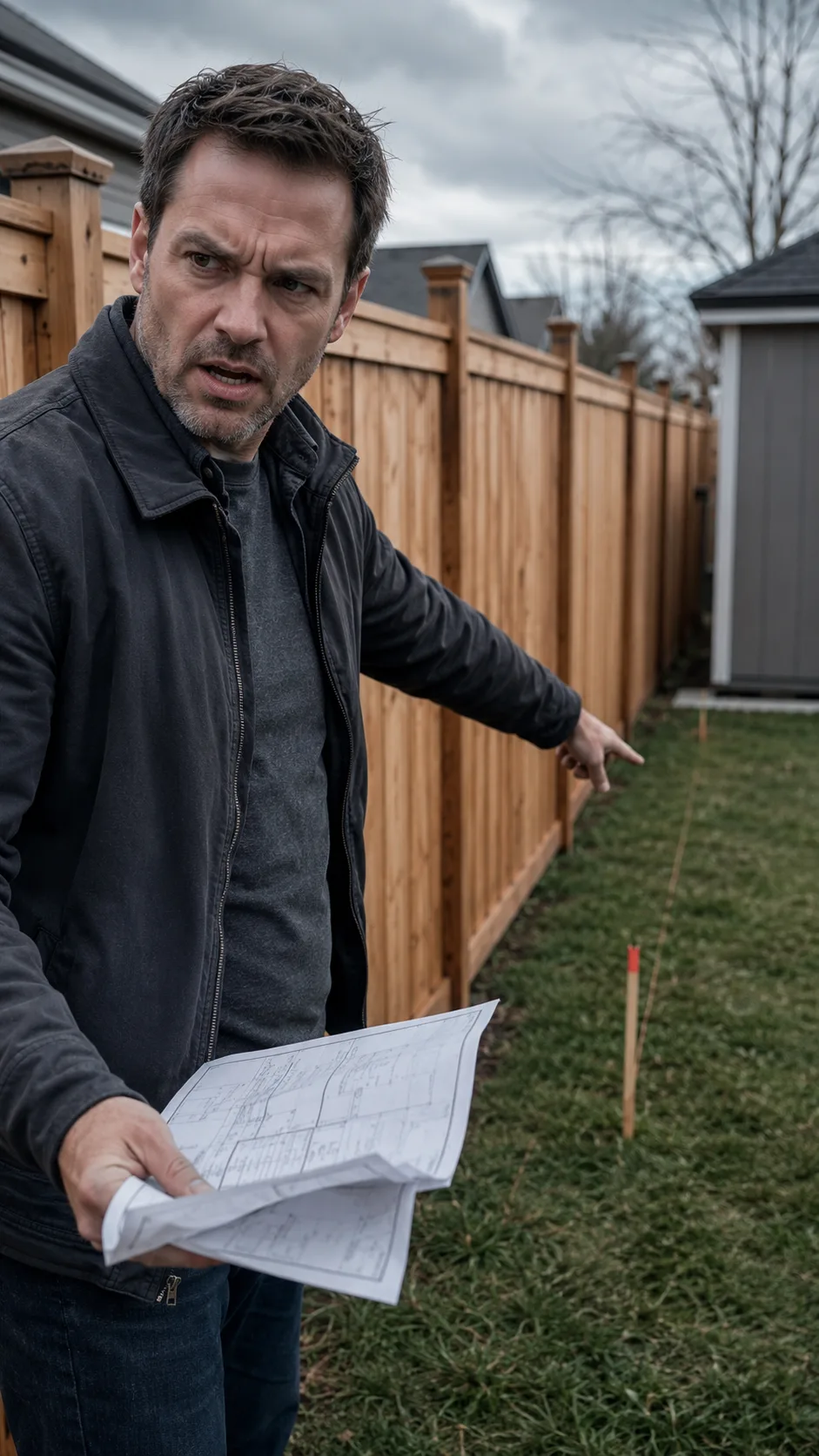
After the contractor called me, Ethan's attitude changed.
Chapter 3
After the contractor called me, Ethan's attitude changed.
Not immediately.
He didn't knock on my door that night and apologize.
He didn't send an email admitting what he'd done.
But the silence next door felt different.
The arrogance disappeared.
For weeks, Ethan had behaved as though the burden was entirely on me.
He had moved the fence.
I had to prove it.
I hired the surveyor.
He disagreed.
I produced photographs.
He claimed the fence had been there for years.
Every time evidence appeared, Ethan simply moved to a new argument.
But the contractor's call created a problem he couldn't dismiss by saying, “I disagree.”
A third party now knew what had happened.
More importantly, that third party had been told that I had approved something I had never even been consulted about.
A few evenings later, Ethan came over.
No smile this time.
No smug greeting.
He stood on my porch with his hands in his pockets.
“Can we talk?”
I stepped outside.
He glanced toward the backyard.
“What if I pay you for the strip?”
The offer almost surprised me.
Not because buying property is impossible.
Because only days earlier, Ethan had been insisting the strip effectively belonged to him already.
Now suddenly he wanted to purchase it.
“No.”
He frowned.
“You don't even know what I'm offering.”
“It doesn't matter.”
“Everything has a price.”
“Not that.”
He shifted his weight.
“It's three feet.”
“It's my property.”
“You're going to make me tear down a brand-new fence over three feet?”
I stared at him.
“You built it on property you don't own.”
He ran a hand over his face.
“You're being unreasonable.”
That word fascinated me.
Unreasonable.
I had been away for four days.
During those four days, Ethan replaced a boundary fence and moved it approximately three feet into my yard.
By doing that, he
gained several hundred square feet of additional space along the length of the property.
Then I discovered that part of his storage shed crossed the boundary as well.
When challenged, he told me to prove the land was mine.
When I proved it, he rejected the survey.
When old photographs contradicted his claim, he stopped discussing the old fence.
When the contractor revealed Ethan had falsely claimed both homeowners agreed, suddenly Ethan wanted to buy the property.
And somehow I was unreasonable.
I looked directly at him.
“If I built a garage three feet into your backyard, would you leave it there?”
He didn't answer.
“If I told you that you weren't really using that part of your yard anyway, would that make it okay?”
Still nothing.
“If I spent nine thousand dollars building something on your property, would the amount I spent suddenly give me ownership?”
His jaw tightened.
“You know that's different.”
“No. That's exactly what happened.”
For the first time since the dispute began, Ethan looked genuinely frustrated rather than dismissive.
“I was trying to improve the property.”
“Your property.”
“The fence improves both yards.”
“Then you should have built it on the boundary.”
He looked toward the backyard again.
I could almost see him doing the math.
Fence removal.
New posts.
Labor.
Materials.
Correcting the shed.
Whatever this decision had seemed worth when I was out of town was becoming more expensive by the day.
He lowered his voice.
“Can't we find some compromise?”
“We already have one.”
“What?”
“The surveyed property line.”
He laughed once, but there was no humor in it.
“You really won't move on this.”
“No.”
He stood there for another moment.
Then he walked back home.
I thought that conversation might lead to another round of resistance.
Instead, the formal process continued.
There were communications.
Documentation was reviewed.
The survey remained clear.
The photographs remained clear.
The contractor's account did not help Ethan.
And the shed encroachment meant the issue could not be solved simply by pretending the fence was decorative.
At one point, I stood in the backyard staring at the new cedar boards.
They really were beautiful.
That was almost the absurd part.
Had Ethan approached me before construction and said he wanted to replace the old fence, I probably would have supported the idea.
The previous fence was aging.
Some boards needed repair.
A new cedar fence would have improved both properties.
We could have reviewed the boundary together.
We might even have shared some decisions about height or style.
Instead, he'd waited until I was away.
He'd chosen a new line.
He'd told the contractor I had agreed.
Then he'd assumed the inconvenience of challenging him would be greater than the value of three feet of yard.
That assumption was the entire gamble.
He wasn't taking land because he desperately needed it.
His backyard was already large.
The strip didn't unlock access to anything.
It didn't solve a serious problem.
It simply gave him more.
Several hundred extra square feet that belonged to someone else.
As the dispute moved toward resolution, workers eventually appeared beside the fence.
I watched from my patio.
Measurements were taken again.
The official markers were visible.
For the first time since returning from my brother's house, the question was no longer whether Ethan accepted the boundary.
The only question left was how much of his brand-new work would have to be undone to respect it.
Then I saw the first cedar panel being loosened from the posts.
Ethan was standing on the other side.
Watching.
Click the blue “PART 4” below to read the final part: 👉 PART 4 👈
Chapter complete
You have reached the end of this chapter.
Continue reading
A few more worlds to get lost in after this chapter.




