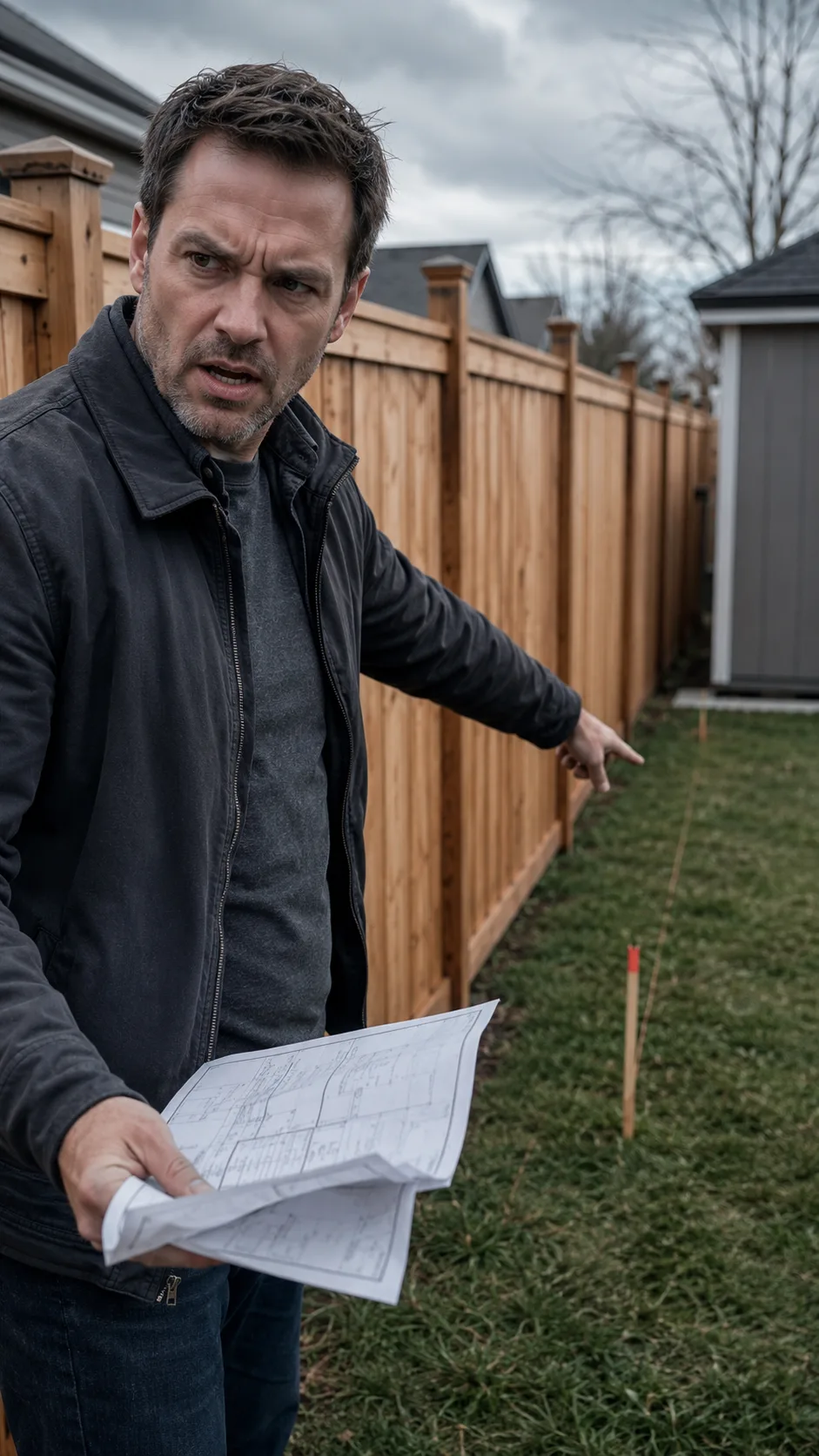
I printed the survey.
Chapter 2
I printed the survey.
If Ethan wanted to “disagree,” I wanted him to do it while looking at the actual document.
I walked next door that evening.
He answered wearing the same expression he'd had the first day—the expression of a man mildly inconvenienced by someone else's problem.
I held out the survey.
“This is the proof you asked for.”
Ethan took the pages but barely looked at them.
His eyes moved across the first page for maybe three seconds before he handed them back.
“Surveyors make mistakes.”
I almost laughed.
“Do you have a survey showing another boundary?”
“I don't need one.”
“You literally told me to prove it.”
He crossed his arms.
“And now I'm telling you I don't accept your proof.”
For several seconds, I didn't say anything.
There are moments when someone's confidence becomes so disconnected from reality that you need time to process it.
Ethan seemed to interpret my
silence as weakness.
He gestured toward the strip of land between the legal boundary and his new fence.
“You weren't using that strip anyway.”
There it was.
The real argument.
Not that the property belonged to him.
Not that the survey was inaccurate.
Not that the old fence had been installed incorrectly.
His argument was that I had not been using the three-foot strip in a way he considered important.
Therefore, apparently, he should have it.
I looked at him.
“So if I'm not standing in a room in my house, does that room become yours?”
“That's not the same thing.”
“Why?”
He sighed.
“It's grass.”
“It's my grass.”
He rubbed his jaw.
“You're making this into something bigger than it needs to be.”
I looked toward the new fence.
Nine thousand dollars of polished cedar standing on land he didn't own.
“No, Ethan. You made it bigger when you
moved the fence.”
“I didn't move anything illegally.”
“The survey says you did.”
“Your survey.”
“A licensed survey.”
He shook his head as though we were debating an opinion.
I asked him clearly to remove the encroachment.
He refused.
That was the last time I tried resolving the matter as an informal disagreement between neighbors.
The following morning, I began documenting everything.
I found old photographs of the backyard.
Most were ordinary family pictures.
Birthday parties.
Summer cookouts.
My daughter playing with the dog.
One photo showed my brother helping repair a loose fence board.
Another showed the old boundary clearly behind the patio.
I contacted the appropriate professionals and gathered the property documents from when I purchased the house.
I saved every email Ethan had sent me.
I photographed the new fence.
I photographed the old post locations.
I photographed the survey markers.
I photographed the shed.
Then the
dispute became formal.
A letter was sent to Ethan outlining the encroachments and requesting that the fence and shed be corrected.
His response arrived several days later.
According to Ethan, the fence line had been in its current location “for many years.”
I sat at my desk reading that sentence.
Then I looked out the window at the cedar boards that still looked so new you could smell the wood from several feet away.
For many years.
I opened the folder of photographs.
It didn't take long.
Eleven months earlier, my daughter had graduated.
We held a barbecue in the backyard.
There were dozens of photos.
In one of them, my daughter stood with her friends near the edge of the patio.
Behind them was the old fence.
The entire line was visible.
And it was approximately three feet farther toward Ethan's property than the fence standing there now.
I enlarged the photo.
There was no ambiguity.
The maple tree created an easy reference point.
So did the corner of Ethan's house.
The old fence location was obvious.
I submitted the photograph with the rest of the documentation.
Ethan's claim that the fence had occupied that location “for many years” suddenly became difficult to maintain.
I expected that to be the moment he finally backed down.
It wasn't.
He became quieter instead.
He stopped waving when we passed each other.
If I was working in the backyard, he stayed inside.
If I walked toward the fence, his blinds sometimes moved.
For a while, nothing happened.
Then one afternoon my phone rang.
The number wasn't saved.
I nearly ignored it.
“Hello?”
“Is this the homeowner next to Ethan?”
“Yes.”
The man introduced himself.
He was the contractor who had installed the fence.
I immediately became more interested.
He sounded uncomfortable.
“I understand there's a property-line issue.”
“There is.”
There was a pause.
Then he said something I had not expected.
“Ethan told us you both agreed to the new fence line.”
I went completely still.
“What?”
“He said the boundary placement had already been discussed between both homeowners.”
“I was out of town when you installed it.”
Another silence.
This one was longer.
The contractor clearly hadn't known that.
I asked him exactly what Ethan had told his crew.
According to the contractor, Ethan claimed the previous fence had been installed incorrectly and that both homeowners understood the new fence would follow the “real” boundary.
But that wasn't all.
One of the workers had apparently noticed the old post holes.
He had questioned why the replacement fence wasn't following them.
Ethan had insisted the previous fence location was wrong.
The contractor sounded increasingly unhappy as he explained it.
And I understood why.
Ethan hadn't simply made a unilateral decision.
He had apparently used my nonexistent agreement to reassure the people building the fence.
I thanked the contractor for calling.
When the conversation ended, I looked through the kitchen window toward Ethan's house.
Until then, Ethan had been arguing that everyone else was wrong.
The surveyor was wrong.
The old fence was wrong.
My photographs apparently weren't enough.
But now the man who had physically installed the fence was involved.
And Ethan had a much bigger problem than three feet of grass.
Click the blue “PART 3” below to read the next part: 👉 PART 3 👈
Chapter complete
You have reached the end of this chapter.
Continue reading
A few more worlds to get lost in after this chapter.




