comes.”
I picked up the USB drive and slipped it into my coat pocket.
“But first, I need to look my son in the eye and ask him why.”
We drove to Julian’s house in silence.
The beachfront property sat at the edge of Ravenwood Bay, all glass and steel and sharp angles, the kind of modern architecture Julian had always dreamed of building. I remembered standing on this porch the day they moved in, handing Ophelia a housewarming gift—a cutting from Arthur’s favorite rose bush. She had taken it with two fingers, like it might soil her dress, and set it on the entryway table where it had withered within a week.
The doorbell echoed through the empty rooms.
No answer.
Eamon tried the handle, and it swung open.
The house was stripped.
The furniture was gone.
The walls were bare.
The light fixtures removed.
The kitchen counters empty.
A single envelope sat on the marble island, addressed to me in Julian’s handwriting.
I opened it with shaking hands.
Mother,
By the time you read this, I’ll be gone. I know you found the recording. I know you know everything.
I’m not going to make excuses. I was a coward. I let Ophelia manipulate me, and I let you believe I was on your side when I was just trying to survive. The debt was too high—gambling, investments, bad decisions. She promised she would fix it. She promised we would start over. I believed her because I wanted to believe her.
I’m sorry for the porch. I’m sorry for the silence. I’m sorry for every moment I made you feel small.
I’m checking myself into a rehabilitation facility in Portland. I need to fix the parts of me that broke. I don’t know how long it will take. I don’t know if you’ll ever forgive me.
But I want you to know one thing: the recording Arthur left—the one of me talking to Ophelia—that was the moment I realized what I had become. Hearing my own voice, saying those things about you… I wanted to destroy the tape. I wanted to burn the house down. But I couldn’t. Because it was the truth.
I’m not asking you to wait for me. I’m not asking you to trust me. I’m just asking you to know that I’m trying to be better.
Your son, Julian
I read the letter twice.
Then I folded it carefully and placed it in my coat pocket, next to the USB drive.
“He’s gone,” I said, my voice flat. “Checked himself into rehab in Portland.”
Eamon let out a breath I didn’t realize he’d been holding.
“That’s… not the worst outcome, Cressida. He’s taking responsibility.”
“He’s running.”
I looked around the empty house, the bare walls, the silence.
“But maybe that’s what he needs to do. To find himself again.”
Mia stepped forward, her face pale.
“Mrs. Thornwood, what about the trust? The waterfront properties? The sale Ophelia was planning?”
I turned to face her, and for the first time in days, I felt something solid settle in my chest.
“The sale was never finalized. The codicil blocks any transfer of assets without my signature. And I’m not signing anything until I’ve reviewed every document, every deed, every account statement going back five years.”
Eamon nodded slowly.
“I’ll have my office start the audit immediately. We’ll need to trace every transaction Ophelia made, every account she accessed, every signature she forged.”
“And the debts?” I asked.
“Three hundred thousand in hidden credit card debt, two hundred thousand in personal loans from private lenders, and a hundred and fifty thousand in unauthorized transfers from the trust to accounts under Priscilla Vane’s name.”
Eamon pulled a folded document from his briefcase.
“I had the bank compile a preliminary report. The total is approximately six hundred and fifty thousand dollars.”
Six hundred and fifty thousand dollars.
Arthur had built Thornwood Holdings from nothing—a single rental property he’d bought with his savings, then another, then another. By the time he died, the trust was worth over twelve million dollars.
Ophelia had managed to bleed nearly seven percent of it in five years.
“Can we recover the money?” I asked.
“Some of it. The transfers to Priscilla Vane’s accounts are traceable and recoverable through the courts. The credit card debt is Ophelia’s personal liability, not the trust’s. The personal loans… those may be more complicated, depending on the lenders.”
“Then we’ll deal with it.”
I walked to the window, looking out at the gray Pacific. The waves crashed against the shore, relentless and indifferent.
“I want every asset frozen. I want Ophelia’s name removed from every account, every deed, every document. And I want the legal fees for the recovery to come out of her personal accounts—not the trust.”
Eamon made a note in his ledger.
“It will be done by the end of the week.”
“One more thing.”
I turned back to face them.
“I want a full investigation into Julian’s involvement. Not a criminal one—I’m not pressing charges. But I want to know every decision he made, every signature he forged, every time he chose her over me. I need to understand what I’m forgiving, if I ever choose to forgive him.”
Mia’s eyes widened.
“Mrs. Thornwood, that could take months.”
“Then take months.”
I picked up my shawl from the empty counter.
“I’ve waited five years to reclaim my life. I can wait a little longer for the truth.”
We left the empty house, the door swinging shut behind us.
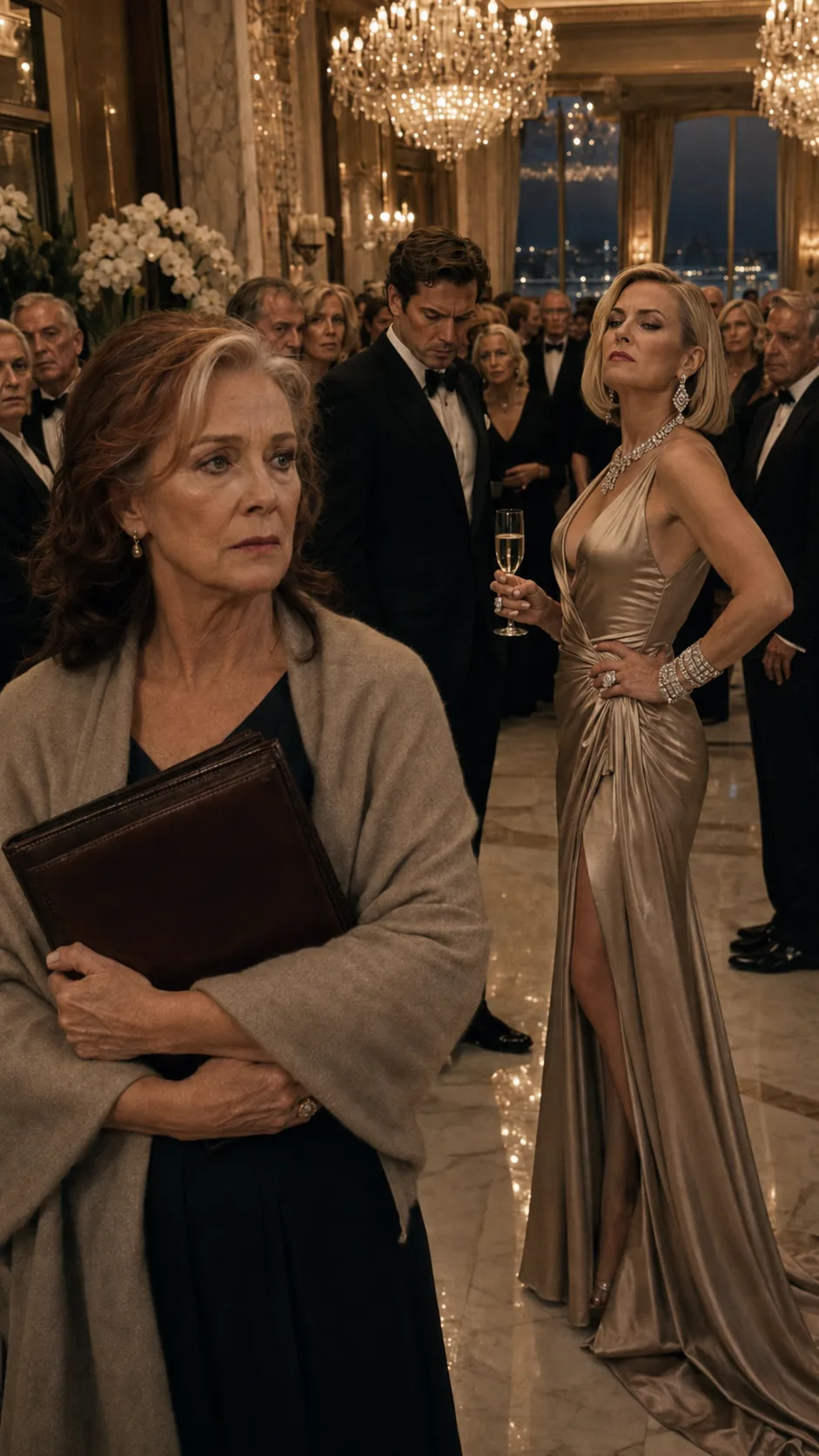
The fog had lifted slightly, revealing the distant outline of the Ravenwood Bay Yacht Club, where Ophelia’s empire had crumbled just days before. I thought of the chandeliers, the champagne, the silk gowns. I thought of the way she had looked at me on the porch, her eyes full of contempt.
She had thought I was nothing.
She had thought I was poor, powerless, a relic of a past that no longer mattered.
But I was the one standing in the cold December air, the leather folio tucked under my arm, the codicil signed by Arthur’s hand, the trust in my name.
She was in a holding cell at the county jail, awaiting trial for fraud.
And Julian was in Portland, trying to rebuild himself from the wreckage.
The power had shifted.
Not because I had taken it, but because it had always been mine.
Section 8: Emotional Resolution
Lydia’s bakery smelled like cinnamon and yeast and the kind of warmth that only comes from decades of friendship.
I sat at the small table by the window, a cup of tea growing cold in my hands, watching the morning light slant through the frosted glass. The bakery was quiet—the morning rush had passed, and Lydia had flipped the sign to CLOSED so we could talk without interruption.
She sat down across from me, her plump hands wrapped around a mug of coffee, her cheerful face etched with concern.
“You look like you haven’t slept in a week.”
“I haven’t.”
“Eat something.”
She pushed a plate of fresh croissants toward me.
“You can’t fix your life on an empty stomach.”
I picked at the flaky pastry, my appetite a distant memory.
“I talked to Julian’s therapist this morning. He’s been in the facility for three days now. He’s agreed to a six-month program.”
Lydia’s eyebrows rose.
“He called you?”
“He asked the therapist to call me. He said he’s not ready to speak to me directly yet. But he wanted me to know he’s serious about getting help.”
“And what do you think?”
I set the croissant down, watching the butter soak into the paper napkin.
“I think I’ve spent five years waiting for him to choose me. And now that he’s finally trying, I don’t know how to feel about it.”
Lydia reached across the table and took my hand. Her skin was warm, her grip firm.
“You don’t have to know how to feel, Cress. You can feel everything at once. That’s allowed.”
I blinked back the tears that had been threatening all morning.
“I’m angry at him. I’m heartbroken. I’m relieved he’s getting help. I’m terrified he’ll relapse. I’m proud of him for making the choice. And part of me—a small, petty part—wishes he had done this years ago, before Arthur died, before Ophelia, before any of this.”
“That’s not petty. That’s human.”
I looked out the window, at the gray sky, the bare trees, the distant glint of the harbor.
“I keep thinking about Arthur. He knew, Lydia. He knew about Ophelia’s debts. He knew about Julian’s weakness. And instead of confronting them, instead of trying to fix it, he just… planned for the worst. He left me the codicil, the recording, the investigation. He spent his final months preparing for his own death.”
“He was trying to protect you.”
“I know. But I wish he had trusted me enough to tell me while he was alive. I wish I had been part of the plan, not just the beneficiary of it.”
Lydia squeezed my hand.
“Arthur loved you more than anything in this world. But he was also a man who believed in fixing things quietly, without causing a scene. He thought he was sparing you the pain.”
“Instead, he left me to discover it alone.”
The silence stretched between us, filled with the warmth of the bakery and the weight of five years of secrets.
I thought of Arthur’s study, the leather folio hidden behind the loose floorboards, the wax seal I had broken alone in my kitchen.
I thought of the moment I had opened the codicil and seen his handwriting, his voice echoing in my memory.
My dearest Cressida, if you’re reading this, I failed to protect you while I was alive.
He hadn’t failed.
He had done everything he could, from beyond the grave, to give me the tools to save myself.
But the saving—the actual work of standing up, walking into that gala, facing Ophelia, facing Julian—that had been mine.
And I had done it.
“I’m going to sell the beachfront house,” I said, the words surprising even me. “Julian’s house. The one he shared with Ophelia. I’m going to put it on the market and use the proceeds to pay off the debts she accumulated. The rest will go back into the trust.”
Lydia’s eyes widened.
“Are you sure? That was Julian’s dream house.”
“It was Ophelia’s dream house. Julian just lived in it.”
I took a sip of my cold tea, the bitterness grounding me.
“I’m going to keep the family home—the one Arthur and I built together. I’m going to plant roses in the garden. I’m going to volunteer at the community center. I’m going to live the life I was living before Ophelia tried to erase me.”
“And Julian?”
I set the cup down.
“When he finishes his program, if he wants to rebuild our relationship, he’ll have to do it on my terms. He’ll have to earn my trust. He’ll have to prove that the man who wrote that letter is the man he wants to be, not just the man he was in that moment of guilt.”
Lydia nodded slowly.
“That’s fair.”
“It’s the only thing I have left to give him. A chance. Not a promise. A chance.”
We sat in silence for a long moment, the clock ticking on the wall, the smell of cinnamon wrapping around us like a blanket.
I thought of the woman who had stood on the porch five days ago, her shawl pulled tight against the wind, her son driving away without a backward glance.
That woman had felt small, invisible, irrelevant.
This woman—the one sitting in Lydia’s bakery, the codicil locked in Eamon’s safe, the trust restored, the future uncertain but hers—this woman was not small.
She was a Thornwood.
And Thornwoods did not break.
Section 9: Final Scene
The family home looked different in the December twilight.
The porch light cast a warm glow across the weathered boards, the rose bushes bare but alive, the windows reflecting the last gold of the setting sun. I stood at the threshold, my hand on the doorframe, and I let myself feel it.
This was my house.
My home.
Not Ophelia’s.
Not Julian’s.
Not even Arthur’s, not anymore.
It was mine, and I would fill it with whatever I chose.
I stepped inside.
The kettle was already whistling. I had left it on before driving to Lydia’s, and now the kitchen was warm, the windows fogged with steam. I poured myself a cup of tea and carried it to the living room, where Arthur’s photograph sat on the mantelpiece.
He was smiling in the photo, his blue eyes crinkling at the corners, his hand resting on the shoulder of a younger Julian. It had been taken ten years ago, at Julian’s graduation from architecture school. Arthur had been so proud that day, so full of hope.
I set my tea down and picked up the photograph, tracing the glass with my fingertip.
“I did it, Arthur,” I said softly. “I did what you asked. I stood up. I fought back. I won.”
The silence answered me.
But it was not an empty silence.
It was the silence of a house that had waited for its owner to return. The creak of the floorboards, the hum of the refrigerator, the distant sound of the harbor foghorn—they were not lonely sounds.
They were the sounds of a life resuming.
I set the photograph back on the mantelpiece.
Then I walked to Arthur’s study, where the leather folio had been hidden for five years. The floorboards were still loose. I knelt down, pulled them up, and looked at the empty space where the folio had rested.
It was gone now, locked in Eamon’s safe.
But the memory of it—the weight, the wax seal, Arthur’s handwriting—would stay with me forever.
I closed the floorboards and stood up.
The study was dark, the bookshelves lined with Arthur’s favorite novels, the desk bare except for a single envelope I had placed there that morning.
Inside the envelope was a letter to Julian. I had written it in the early hours of the morning, by the light of the kitchen lamp, my hand shaking over the paper.
Dear Julian,
I received your letter. I’m glad you’re getting help. I’m proud of you for making that choice.
I’m not ready to see you yet. But I want you to know that I’m not closing the door. I’m leaving it open, just a crack, for the man you’re trying to become.
Take the time you need. Heal. Grow. And when you’re ready, write to me again.
I’ll be here.
Your mother.
I left the envelope on the desk, next to Arthur’s photograph, the two pieces of my life side by side.
Then I walked back to the kitchen, poured another cup of tea, and stood at the window, watching the stars emerge over Ravenwood Bay.
The fog had lifted completely.
The sky was clear, the water dark and glittering, the lighthouse beam sweeping across the horizon.
I thought of Arthur, of the codicil, of the gala, of Ophelia’s handcuffs, of Julian’s letter.
I thought of the woman on the porch, the wind in her silver hair, the shawl wrapped tight around her shoulders.
She was still there.
But she was different now.
She was free.
I raised my tea to the window, to the stars, to the memory of a man who had loved her enough to plan for a world without him.
“To you, Arthur,” I whispered. “And to the life I’m going to live.”
The kettle clicked off.
The house settled into its nightly quiet.
And somewhere in Portland, my son was beginning his own journey back to himself.
The chapter was closed.
But the story—my story—was just beginning.
THE END.