my hands.
I read it twice, three times, letting the words sink into my bones like rain into dry earth.
Five years.
He had given me this weapon five years ago, and I had let it sit beneath a loose floorboard while Ophelia stripped my name from every deed, every check, every whispered conversation at the Ravenwood Bay Yacht Club.
“She’s at the Ravenwood Gala tonight,” I said, my voice barely a whisper. “The charity dinner. She’s going to announce she’s selling the waterfront properties to a developer from Portland. She told Julian it was a ‘strategic divestment.’ She told me I was too senile to understand.”
Eamon’s thin fingers trembled as he adjusted his spectacles. “She can’t sell. The sale isn’t legal without the codicil holder’s signature. And you’re the codicil holder, Cressida. You’ve always been the codicil holder.”
I looked at the parchment again.
Arthur’s handwriting. Arthur’s love. Arthur’s final move in a game he had known was coming long before I did.
“How much does she owe?” I asked.
Eamon pulled out a second document—a financial statement, printed on thick paper, stamped with the seal of Thornwood Holdings.
“Three hundred thousand dollars in hidden debt. Personal loans taken out in Julian’s name. Credit card charges for designer clothes, vacations, renovations on the beachfront home. She’s been siphoning the trust for years, Cressida. She was counting on the sale to cover the gap before anyone noticed.”
I set the documents down.
The kitchen was quiet, the fog pressing against the windows, the kettle cold on the stove. I thought of Ophelia’s smirk on the porch. Julian’s silence. The way she had touched Arthur’s study like it was already hers.
“Eamon,” I said, and my voice didn’t shake. “Drive me to that gala.”
He frowned. “Cressida, it’s black tie. You’ll be—they’ll—”
“I know what I’ll be.” I stood, wrapping my shawl tighter. “I’ll be the poor widow who just became their landlord. Get Detective Reed on the phone. And tell your daughter Mia to bring a notary. I’m going to ruin her perfect night.”
The look in his eyes said everything.
Arthur had been dead five years.
But his last move was about to checkmate the queen.
And Julian?
He had no idea his silence had just cost him everything.
The drive into town took twenty minutes, but it felt like hours. The fog thickened as we descended from the cliffs into Ravenwood Bay proper, the streetlights glowing like pale ghosts through the mist. I sat in the passenger seat of Eamon’s sedan, the leather folio pressed against my chest, watching the familiar landmarks slide past.
The bakery where Lydia Hart had made my morning croissants for thirty years.
The old church where Arthur and I had been married.
The flower shop with its faded sign, Cressida’s Blooms, closed now for two years.
“Do you remember the day Arthur came to my office?” Eamon asked, his voice soft over the hum of the engine. “He was already sick. He didn’t tell anyone, but I could see it in his face. He was thinner, paler, but his eyes were sharp as ever. He sat down, didn’t even say hello, and just started writing.”
I nodded. “He always knew things before the rest of us. He knew Ophelia was trouble the day Julian brought her home. He said she had ‘sharp edges and soft intentions.’ I thought he was being unfair.”
“He wasn’t.”
“I know that now.”
The sedan turned onto Harbor Boulevard, and the Ravenwood Bay Yacht Club appeared through the fog—a grand white building with tall windows, chandeliers glowing inside, the silhouette of silk gowns and tailored suits moving against the light. The valet station was busy, luxury cars lined up along the curb, the air thick with the scent of saltwater and expensive perfume.
Eamon parked at the end of the line.
I stepped out, my sensible shoes landing on the wet pavement, my cashmere shawl the only thing between me and the Pacific wind. The valet attendant looked at me—at my age, my shawl, my widow’s ring—and his brow furrowed.
“Ma’am, this is a private event. Black tie only.”
“I know,” I said, and I walked past him.
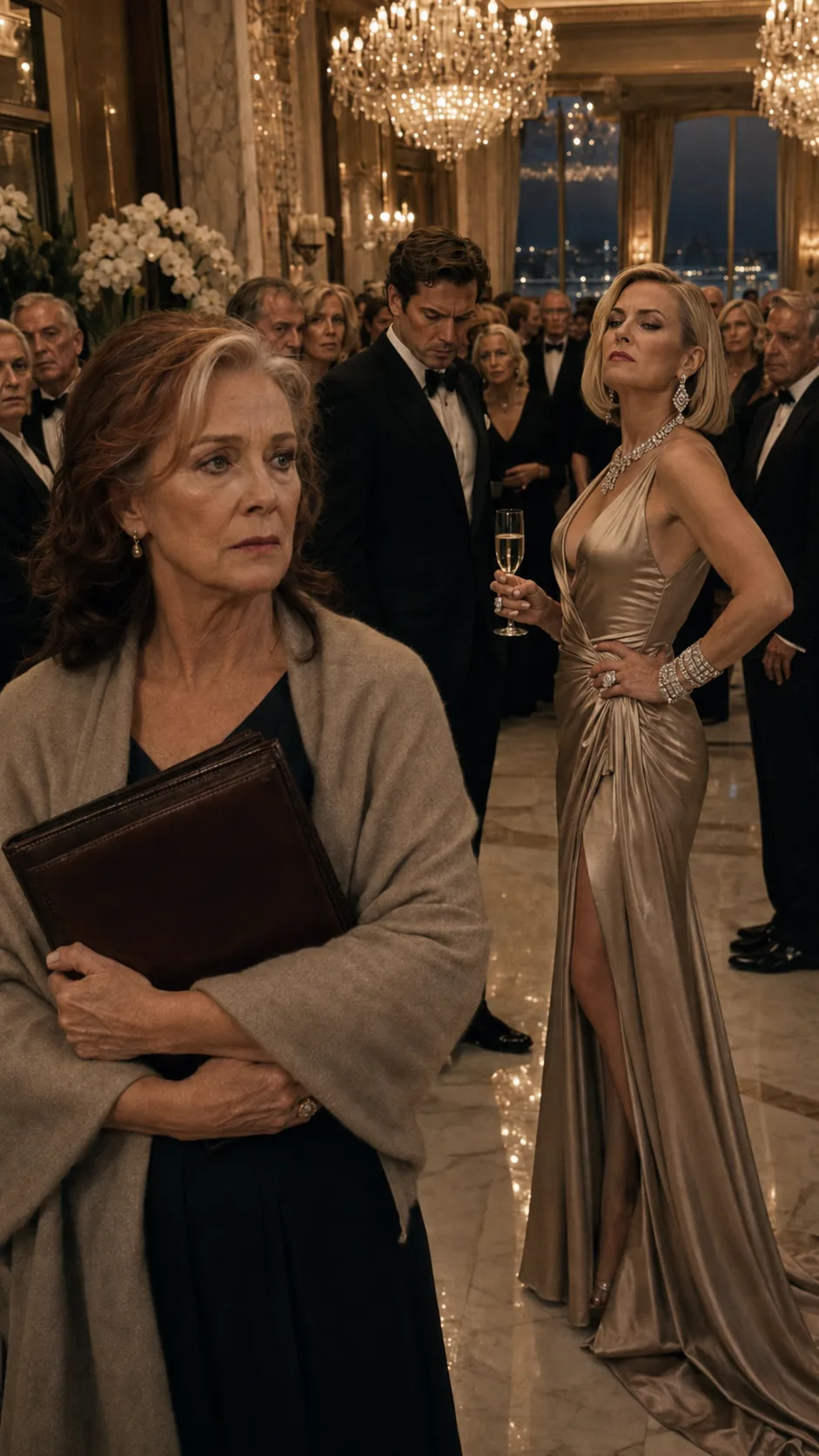
The lobby was all polished marble and the scent of orchids. Crystal chandeliers hung from the ceiling, casting warm light over clusters of donors in designer gowns and tailored tuxedos.
I saw them before they saw me.
Ophelia stood at the center of a group, her blonde bob catching the light, her green eyes scanning the room for someone more important to talk to. Julian was beside her, holding a champagne flute he hadn’t touched, his shoulders tight, his smile thin. He looked like a man drowning in slow motion.
Then Ophelia turned.
She saw me.
And for one perfect second, her mask cracked.
“What are you doing here?” she hissed, crossing the floor in three sharp strides. The guests around her went quiet, their conversations dying like candles in a draft. “I told you to stay home. This is a charity gala, Cressida. Not a soup kitchen.”
The silence spread.
Heads turned.
I felt their eyes on my shawl, my age, the silver streaks in my hair. Julian finally looked up, and I saw the flash of shame in his brown eyes before he looked away again.
“I’m here because Arthur wanted me to be,” I said, my voice steady. “The Thornwood family trust funds this gala, Ophelia. Every centerpiece. Every bottle. Every plate. I paid for this room. And I’m here to collect.”
She laughed, but it was thinner now, brittle, a sound like glass cracking.
“You’re senile. Julian, get your mother out of here before she embarrasses us.”
Julian stepped forward.
For a moment, I thought he would take my arm and lead me out, his face twisted with shame and apology.
But instead, he stopped.
He looked at Ophelia. Then at me. Then at the leather folio in my hands.
“What’s that, Mother?” he asked, his voice barely a whisper.
I opened it.
The codicil slid out, Arthur’s signature clear as a bell, the wax seal broken but the words unharmed.
“Your father’s last will and testament. Filed the day he died, five years ago this March. It gives me sole control of Thornwood Holdings. Every property. Every account. Every share.”
The silence was absolute.
I watched the color drain from Ophelia’s face, watched her green eyes go wide and wild.
“That’s a forgery. He would never—I was his daughter-in-law—I managed everything—”
“You managed to run up three hundred thousand in hidden debt,” Detective Callum Reed said, stepping out from behind a marble column.
He was in plain clothes, but his badge glinted on his belt, and his voice carried the weight of authority.
“You managed to forge Julian’s signature on a sale agreement for the waterfront properties. You managed to transfer trust funds into a private account under your mother Priscilla Vane’s name.”
Ophelia’s mother, Priscilla Vane, dropped her champagne glass.
It shattered on the marble floor, the sound sharp and final, the golden liquid spreading like a stain across the polished stone.
“I never—she told me it was a gift—she said it was a retirement fund—”
Simon Cross, Ophelia’s father, grabbed his wife’s arm and pulled her back, his face ashen, his mouth a thin line of shock and betrayal.
But I wasn’t finished.
Eamon stepped forward and pulled a tablet from his briefcase, the screen glowing in the chandelier light.
“Mr. Thornwood left one more thing,” he said. “A video will. Recorded in my office, five years ago, with specific instructions.”
Ophelia’s face went from white to gray.
“No. No, that’s illegal. You can’t—”
“It’s fully notarized,” Mia Finch said, stepping out from beside her father. She held up the notary stamp, her young face set with determination. “And admissible in court.”
Eamon pressed play.
Arthur’s face filled the screen—grayer than I remembered, thinner, the lines of his illness carved deep into his features. But his eyes were the same sharp blue, the same sharp intelligence that had built Thornwood Holdings from nothing. He was sitting in Eamon’s office, the leather folio on the desk in front of him, the afternoon light streaming through the window behind him.
“Cressida, my love. If you’re watching this, I’m gone. And I’m sorry I couldn’t say this to your face.”
He paused, and I heard the rasp of his breathing, the labored sound of a man who knew his time was short.
“I knew about Ophelia. I knew about the debts, the lies, the way she was positioning herself to take everything the moment I was in the ground. I hired a private investigator six months before I died. He placed a recording device in my study. I have her own words, Cressida. I have her telling her mother that she would ‘bury you in a pauper’s grave and sell the trust to the highest bidder.’”
The room erupted.
Ophelia screamed, a raw, tearing sound that bounced off the marble walls and shattered against the chandeliers.
“That’s not real! He edited it! He was a sick old man who hated me!”
But Arthur wasn’t finished.
On the screen, he leaned forward, his voice dropping to a whisper that somehow carried through the entire room.
“I left the recording with Eamon. Full transcript, date-stamped, voice-verified. Ophelia Vane-Cross, you are a fraud. And my wife is going to make sure everyone knows it.”
The video ended.
The screen went black.
Ophelia stood frozen, her designer dress suddenly looking like a costume, her green eyes darting left and right for an exit that didn’t exist. The guests around her had drawn back, forming a circle of judgment, their whispers rising like a tide.
Detective Reed stepped forward, handcuffs already out, the metal glinting in the chandelier light.
“Ophelia Vane-Cross, you are under arrest for fraud, forgery, and attempted coercion of an estate trustee. You have the right to remain silent. Anything you say can and will be used against you in a court of law.”
She didn’t fight.
She just stared at me, her mouth open, her perfect world crumbling around her like a house of cards in a hurricane.
“You planned this. You knew.”
I looked at Julian. He was crying, silent tears streaming down his face, his champagne flute shattered at his feet.
“Mother,” he whispered. “I’m so sorry. I didn’t know. I didn’t know.”
And then he said something that made the entire room go still again.
“But I knew enough to help Eamon gather the evidence.”
Ophelia’s head snapped toward him, her eyes widening with disbelief.
“What?”
Julian wiped his face with the back of his hand, his tailored suit rumpled, his composure shattered.
“Six months ago, Mother called me. She told me about the codicil. She asked me to help her prove what Ophelia was doing. I said no at first. I was scared. But then I found the bank statements. The forged signatures. The calls to the developer. I planted the recording device in Dad’s study. I gave Eamon the transcripts. I’ve been working with them the whole time.”
The bonus twist hit like a second wave.
Ophelia’s legs buckled, and Detective Reed caught her arm, steadying her as he clicked the handcuffs into place. Priscilla Vane was already being led out by security, her heels clicking against the marble like a death march, her sobs echoing through the lobby. Simon Cross stood alone, a man who had just lost his daughter and his reputation in the same breath.
But Julian—my Julian—was still standing.
He walked toward me, his hands shaking, his face wet with tears.
“I’m sorry I couldn’t say it to your face on the porch. I’m sorry I let her speak to you that way. But I had to make her believe I was still on her side. It was the only way to get the last piece of proof.”
I took his hand.
The signet ring—Arthur’s ring—pressed between our palms, warm and solid.
“Your father would be proud of you,” I said.
And for the first time in five years, Julian Thornwood looked me in the eye without shame.
The Ravenwood Bay Yacht Club glittered like a jewel against the black Oregon coast. Through the tall windows, I could see the chandeliers, the silk gowns, the clink of champagne flutes.
I sat in the back of Eamon’s sedan, the leather folio pressed against my chest, my cashmere shawl the only thing between me and the Pacific wind. Detective Callum Reed was already inside, waiting. Mia Finch had the notary stamp in her purse. And somewhere in that room, my son was standing beside a woman who had just told me I wasn’t elegant enough to exist.
Eamon parked at the valet station.
The attendant looked at my shawl, my sensible shoes, the silver streaks in my hair.
“Ma’am, this is a private event.”
“I know,” I said, stepping out onto the gravel. The salt wind hit my face, cold and sharp, carrying the distant cry of gulls. “I’m the guest of honor. She just doesn’t know it yet.”
The lobby was all polished marble and the scent of saltwater and expensive perfume—the same perfume Ophelia wore, the one that had clung to Arthur’s study like a ghost.
I saw them before they saw me.
Ophelia stood at the center of a cluster of donors, her blonde bob catching the light, her green eyes scanning the room for someone more important to talk to. Julian was beside her, holding a champagne flute he hadn’t touched, his shoulders tight, his smile thin. He looked like a man drowning in slow motion.
Then Ophelia turned.
She saw me.
And for one perfect second, her mask cracked.
“What are you doing here?” she hissed, crossing the floor in three sharp strides. Her stilettos clicked against the marble like gunshots. “I told you to stay home. This is a charity gala, Cressida. Not a soup kitchen.”
The guests around us went quiet.
I felt their eyes on my shawl, my age, my widow’s ring. Julian finally looked up, and I saw the flash of shame in his brown eyes before he looked away again.
“I’m here because Arthur wanted me to be,” I said, my voice steady, the folio warm against my ribs. “The Thornwood family trust funds this gala, Ophelia. Every centerpiece. Every bottle. Every plate. I paid for this room. And I’m here to collect.”
She laughed, but it was thinner now, brittle, like glass about to crack.
“You’re senile. Julian, get your mother out of here before she embarrasses us.”
Julian stepped forward, his brown eyes flickering between us. The champagne flute trembled in his hand.
For a moment, I thought he would take my arm and lead me out, the same way he’d led me out of every argument for the past five years.
But instead, he stopped.
He looked at Ophelia. Then at me. Then at the folio in my hands.
“What’s that, Mother?” he asked, his voice barely a whisper. A bead of sweat traced down his temple.
I opened it.
The leather creaked, the same sound it had made when Arthur first handed it to me, five years ago, in a study that smelled of old books and his pipe tobacco.
The codicil slid out, Arthur’s signature clear as a bell on the yellowed paper.
“Your father’s last will and testament. Filed the day he died, five years ago this March. It gives me sole control of Thornwood Holdings. Every property. Every account. Every share.”
The silence was absolute.
I watched the color drain from Ophelia’s face, watched her green eyes go wide and wild, the champagne flute in her hand tilting dangerously.
“That’s a forgery. He would never—I was his daughter-in-law—I managed everything—”
“You managed to run up three hundred thousand in hidden debt,” Detective Reed said, stepping out from behind a marble column.
His voice was calm, professional, but his eyes were cold. He held up a folder thick with paper.
“You managed to forge Julian’s signature on a sale agreement for the waterfront properties. You managed to transfer trust funds into a private account under your mother Priscilla Vane’s name.”
Ophelia’s mother, Priscilla Vane, dropped her champagne glass.
It shattered on the marble floor, the sound sharp and final, sending a spray of liquid across the hem of her gown.
“I never—she told me it was a gift—a retirement fund—I didn’t know—”
Simon Cross, Ophelia’s father, grabbed his wife’s arm and pulled her back, his face ashen, his jaw tight.
“Ophelia, what is he talking about?” he demanded, his voice cracking. “What have you done?”
But I wasn’t finished.
Eamon stepped forward, his thin fingers trembling as he pulled a tablet from his leather briefcase. The screen glowed to life.
“Mr. Thornwood left one more thing,” he said, adjusting his round spectacles. “A video will. Recorded in my office, five years ago, with specific instructions. He wanted it played only if—if things went wrong.”
Ophelia’s face went from white to gray. She took a step back, her stilettos scraping against the marble.
“No. No, that’s illegal. You can’t—he’s dead—you can’t spring something like this—it’s not admissible—”
“It’s fully notarized,” Mia Finch said, stepping forward with the notary stamp in her hand. She was young, thirty years old, with the same silver-rimmed glasses as her father.
“Signed by three witnesses. Date-stamped. Mr. Thornwood filed it with the county the same day. It’s as legal as the codicil.”
“And Judge Margot Blythe has already reviewed the contents,” Detective Reed added, his voice flat. “She issued a warrant for Ophelia’s arrest an hour ago. This is just—the icing on the cake.”
Eamon pressed play.
The tablet screen flickered, and then Arthur’s face filled the room—grayer than I remembered, thinner, his cheekbones sharp against his skin. But his eyes were the same sharp blue, the same eyes that had looked at me across a crowded church forty years ago and made me believe in love at first sight.
He was sitting in Eamon’s office, the leather folio on the desk in front of him, his hands folded over the cover.
“Cressida, my love. If you’re watching this, I’m gone. And I’m sorry I couldn’t say this to your face.”
He paused, and I heard the rasp of his breathing, the same sound that had haunted the last months of his life.
“I knew about Ophelia. I knew about the debts, the lies, the way she was positioning herself to take everything the moment I was in the ground. I hired a private investigator six months before I died. He placed a recording device in my study. I have her own words, Cressida. I have her telling her mother that she would ‘bury you in a pauper’s grave and sell the trust to the highest bidder.’”
The room erupted.
Ophelia screamed, a raw, tearing sound that bounced off the marble walls and shattered against the chandeliers. The guests drew back, forming a circle of judgment, their whispers rising like a tide.
“That’s not real! He edited it! He was a sick old man who hated me! He was jealous of my relationship with Julian—he never trusted me—this is all a setup!”
But Arthur wasn’t finished.
On the screen, he leaned forward, his voice dropping to a whisper that somehow carried through the entire room. The camera caught the glint of his wedding ring, the same ring I now wore on a chain around my neck.
“I left the recording with Eamon. Full transcript, date-stamped, voice-verified. Ophelia Vane-Cross, you are a fraud. And my wife is going to make sure everyone knows it.”
The video ended.
The screen went black.
Ophelia stood frozen, her designer dress suddenly looking like a costume, her green eyes darting left and right for an exit that didn’t exist.
The guests around her had drawn back, forming a circle of judgment, their whispers rising like a tide. I saw Lydia Hart, my best friend, standing near the bar, her hand over her mouth, her eyes wet with tears. She had been with me through every dark moment of the past five years, and now she was watching the light come back.
Detective Reed stepped forward, handcuffs already out, the metal glinting in the chandelier light.
“Ophelia Vane-Cross, you are under arrest for fraud, forgery, and attempted coercion of an estate trustee. You have the right to remain silent. Anything you say can and will be used against you in a court of law.”
She didn’t fight.
She just stared at me, her mouth open, her perfect world crumbling around her like a house of cards in a hurricane. The mascara she had applied so carefully was now streaking down her cheeks, black rivers against her pale skin.
“You planned this. You knew.”
I looked at Julian.
He was crying, silent tears streaming down his face, his champagne flute shattered at his feet. The shards glittered on the marble like broken stars.
“Mother,” he whispered. “I’m so sorry. I didn’t know. I didn’t know.”
And then he said something that made the entire room go still again.
“But I knew enough to help Eamon gather the evidence.”
Ophelia’s head snapped toward him, her eyes widening with disbelief.
“What?”
Julian wiped his face with the back of his hand, his tailored suit rumpled, his composure shattered.
“Six months ago, Mother called me. She told me about the codicil. She asked me to help her prove what Ophelia was doing. I said no at first. I was scared. But then I found the bank statements. The forged signatures. The calls to the developer in Portland.”
He looked at Ophelia, and his voice broke.
“I planted the recording device in Dad’s study. I gave Eamon the transcripts. I’ve been working with them the whole time.”
The bonus twist hit like a second wave.
Ophelia’s legs buckled, and Detective Reed caught her arm, steadying her as he clicked the handcuffs into place.
Priscilla Vane was already being led out by security, her heels clicking against the marble like a death march, her sobs echoing through the lobby.
Simon Cross stood alone, a man who had just lost his daughter and his reputation in the same breath, his designer suit suddenly looking like a costume too.
But Julian—my Julian—was still standing.
He walked toward me, his hands shaking, his face wet with tears. The room was silent except for the soft clink of ice in champagne flutes and the distant crash of waves against the harbor wall.
“I’m sorry I couldn’t say it to your face on the porch. I’m sorry I let her speak to you that way. But I had to make her believe I was still on her side. It was the only way to get the last piece of proof.”
I took his hand.
The signet ring—Arthur’s ring—pressed between our palms, warm and solid. The metal was still warm from my skin, still carrying the heat of the codicil I had held all night.
“Your father would be proud of you,” I said.
And for the first time in five years, Julian Thornwood looked me in the eye without shame.
Section 4: The Rebuild
The next morning, the fog had lifted, leaving Ravenwood Bay scrubbed clean and golden under a pale November sun. I sat in the kitchen of my house, the same kitchen where I had watched the taillights of Julian’s car disappear five nights ago. The kettle was whistling, the same kettle that had screamed through that first terrible night. Lydia Hart was at my table, her plump hands wrapped around a mug of tea, her cheerful face unusually serious.
“You did it, Cressida,” she said, her voice soft. “She’s in county lockup. The news is already on every station from Portland to Seattle.”
I shook my head, the steam from my tea curling against my face.
“It’s not over. Ophelia’s lawyers will fight. Priscilla Vane will try to claim she was coerced. Simon Cross will distance himself. And Julian—Julian has to deal with the wreckage of his marriage.”
Eamon Finch arrived at ten o’clock, his leather briefcase worn and heavy, Mia at his side.
They laid out the documents on my kitchen table—the codicil, the video will transcript, the bank statements Ophelia had hidden, the forged sale agreement for the waterfront properties.
The papers covered every inch of the wooden surface, a map of betrayal.
“The court hearing is set for December fifth,” Eamon said, adjusting his round spectacles. “Judge Margot Blythe is presiding. She’s fair, but she’s no-nonsense. We’ll need to present everything in a clear, chronological order.”
Mia nodded, her pen already moving across a legal pad.
“The video will is our strongest piece of evidence. Arthur’s voice is unmistakable. The date stamp is verified. The investigator’s affidavit is solid. But we also have the bank records—the three hundred thousand in hidden debt, the transfers to Priscilla Vane’s account, the forged signatures on the sale agreement.”
I listened, my fingers tracing the edge of Arthur’s codicil. The paper was yellowed, the ink faded, but his handwriting was still clear:
My dearest Cressida, if you’re reading this, I failed to protect you while I was alive. Forgive me.
“There’s more,” Eamon said, his voice dropping.
He reached into his briefcase and pulled out a small digital recorder.
“This is the recording from the device Julian planted in Arthur’s study. It’s date-stamped six months after Arthur died. Ophelia is talking to her mother.”
He pressed play.
Ophelia’s voice filled the kitchen, sharp and impatient:
“Priscilla, I told you, we just have to wait. The old man is dead. Cressida is a fool. Julian does whatever I say. The trust will be mine within a year. I’ll sell the waterfront properties, pay off the debts, and we’ll be set for life. Cressida will be in a nursing home before she knows what hit her.”
Priscilla’s voice, fainter, nervous:
“But what if the codicil is real? What if Arthur actually left her control?”
Ophelia laughed, the same brittle laugh I had heard on the porch.
“Arthur was a sentimental old fool. He loved her. But he was sick. He probably forgot to file it. And even if he did, I’ll bury it. I’ll bury her. She’s nothing but a poor widow in an old house. No one will believe her over me.”
The recording ended.
I sat in silence, the weight of her words pressing against my chest. Lydia reached across the table and squeezed my hand.
“She planned this from the beginning,” I said, my voice hollow. “Even before Arthur died. She was already plotting.”
Mia nodded, her face pale.
“The investigator’s report shows she started accumulating debt two years before Mr. Thornwood passed. She was betting on him dying before the creditors closed in. She thought she could use the trust to pay everything off and start fresh.”
Eamon closed his briefcase with a soft click.
“We have enough evidence to put her away for a decade, Cressida. Maybe more. But the hearing is only the first step. There will be depositions. Discovery. The trial could take months.”
I looked out the window.
The bay was calm, the water silver under the winter sun. Somewhere out there, the Thornwood family trust owned three properties—the waterfront lots Ophelia had tried to sell, the family home where I now sat, and a small cottage on the cliffs that Arthur had bought for our fortieth anniversary but never lived to see.
“I want to keep the trust,” I said, my voice firm. “For Julian. For whatever family he builds after this. Arthur didn’t build this empire so Ophelia could tear it down. He built it for our son, for our grandchildren. I’m going to protect that.”
Lydia smiled, her eyes glistening.
“That’s the Cressida I know.”
Over the next week, I threw myself into the preparation.
I met with Eamon and Mia every morning at nine, going over documents, timelines, strategies. I met with Detective Reed twice, reviewing the evidence chain and the arrest report. I called Judge Margot Blythe’s chambers myself, requesting a pre-hearing conference to ensure all evidence would be admissible.
And I called Julian.
He answered on the first ring, his voice hoarse and tired.
“Mother.”
“Julian.” I paused, the phone pressed against my ear. “How are you?”
“I’m staying at a hotel,” he said. “I can’t go back to the house. Everything in it—it’s all tied to her. I’m selling it. I’m starting over.”
“You don’t have to start over,” I said. “The trust is yours. It always was. I’m just—I’m holding it until you’re ready.”
He was silent for a long moment.
“I don’t deserve it. I let her treat you like that. I stood there on the porch and said nothing.”
“You said nothing because you were working against her,” I said. “You were gathering evidence. You were playing a role. That took more courage than fighting her in the moment.”
“But the porch—that moment—I saw the look on your face. I saw you break. And I didn’t stop her.”
I closed my eyes, the memory sharp and painful. The gravel crunching. The foghorn groaning. Ophelia’s perfume in the cold air.
“You didn’t break me, Julian. You gave me a reason to fight. You gave me a reason to open the folio.”
He exhaled, a shaky breath.
“I love you, Mother.”
“I love you too, my son.”
Section 5: The Return
December fifth arrived cold and clear, the sky a hard, pale blue over the Ravenwood Bay courthouse. The building was old, built of gray stone, with ivy climbing the walls and a clock tower that had chimed the hours for over a century.
I arrived with Eamon and Mia at eight-thirty, my cashmere shawl wrapped tight against the wind, Arthur’s signet ring warm on my finger.
The courtroom was already packed.
The local news had caught wind of the story—Daughter-in-law arrested at charity gala, video will reveals hidden debts—and every seat was filled.
I saw reporters in the back row, their phones raised, their eyes hungry. I saw Lydia Hart in the third row, her hand over her mouth, her eyes wet. I saw Priscilla Vane and Simon Cross sitting on the opposite side, their faces drawn and hollow.
And I saw Ophelia.
She sat at the defendant’s table, her blonde bob now flat and dull, her green eyes rimmed with red. She was wearing a prison-issued blazer, gray and shapeless, a far cry from the designer dresses she had once filled my closets with. Her lawyer, a thin man with a sharp suit and sharper eyes, whispered in her ear, but she wasn’t listening.
She was staring at me.
Judge Margot Blythe entered, and the room rose.
She was a tall woman, fifty-five years old, with iron-gray hair and a voice that could cut glass. She took her seat, adjusted her robes, and looked over the room with cold, impartial eyes.
“We are here today for the preliminary hearing in the case of the State versus Ophelia Vane-Cross,” she said, her voice carrying through the silent courtroom. “Charges include fraud, forgery, and attempted coercion of an estate trustee. The prosecution will present evidence. The defense will respond. Let’s proceed.”
The prosecution called Detective Callum Reed first.
He took the stand, his uniform crisp, his voice steady. He laid out the timeline—the hidden debts, the forged signatures, the transfer to Priscilla Vane’s account, the attempted sale of the waterfront properties. He presented the bank statements, the sale agreement, the investigator’s affidavit.
Then he presented the recording.
Judge Blythe listened, her face unreadable, as Ophelia’s voice filled the courtroom:
“Cressida is a fool. Julian does whatever I say. The trust will be mine within a year.”
When the recording ended, the room was silent.
Ophelia’s lawyer stood, his face tight.
“Your Honor, the defense objects to the admissibility of this recording. It was obtained without a warrant. It violates my client’s right to privacy.”
Judge Blythe looked at him over her glasses.
“The recording was made in the private study of Arthur Thornwood, in a home owned by the Thornwood family trust. The device was planted by Julian Thornwood, a beneficiary of that trust, who had legal access to the property. The recording was turned over to law enforcement as part of an ongoing fraud investigation. Objection overruled.”
The lawyer sat down, his face red. Ophelia’s hands were shaking, her knuckles white against the table.
Then it was my turn.
Eamon called me to the stand, and I walked through the silent courtroom, my footsteps echoing against the wood floors. I took the oath, my hand on the Bible, Arthur’s ring catching the light.
“Mrs. Thornwood,” Eamon said, his voice gentle. “Can you describe the events of November twentieth, the night of the charity gala?”
I told them everything.
The porch.
Ophelia’s words.
Julian’s silence.
The gravel crunching under the car wheels.
The foghorn groaning from the harbor.
The headlights of Eamon’s sedan cutting through the fog.
The codicil on the kitchen table, Arthur’s handwriting swimming before my eyes.
I told them about the gala.
The lobby.
Ophelia’s scream.
The video will.
The arrest.
When I finished, Judge Blythe looked at me, her eyes softening for just a moment.
“Thank you, Mrs. Thornwood. You may step down.”
As I walked back to my seat, I passed Ophelia’s table.
She looked up at me, her green eyes wild, her voice a harsh whisper.
“You think you’ve won? This isn’t over. I have connections. I have money. I’ll appeal. I’ll drag this out for years. You’ll be dead before I see a day in prison.”
I stopped.
I looked at her, this woman who had tried to erase me, who had stood on my porch and called me poor, who had stolen from my husband’s trust and planned to bury me in a pauper’s grave.
“You’re right,” I said, my voice calm. “You do have connections. You do have money. But you don’t have the truth. And the truth always wins, Ophelia. Always.”
Judge Blythe banged her gavel.
“Order in the court. The defendant will refrain from speaking to the witness.”
I took my seat.
Julian was beside me, his hand reaching for mine. I took it, and we watched as the prosecution presented the final piece of evidence—the video will, played in full, Arthur’s voice filling the courtroom one last time.
When the video ended, Judge Blythe looked at Ophelia’s lawyer.
“Does the defense have any evidence to present?”
The lawyer stood, his face pale.
“Your Honor, the defense requests a continuance. We need time to review the evidence, to prepare a response—”
“Denied,” Judge Blythe said, her voice flat. “The evidence has been in the possession of the defense for three weeks. The court will proceed. Ophelia Vane-Cross, how do you plead to the charges of fraud, forgery, and attempted coercion of an estate trustee?”
Ophelia stood, her hands shaking, her voice barely a whisper.
“Not guilty.”
Judge Blythe looked at her, her eyes cold.
“Based on the evidence presented, the court finds probable cause to proceed to trial. The defendant is remanded to custody without bail, pending trial. Trial date is set for February fifteenth.”
The gavel banged.
The room erupted.
Reporters rushed for the doors, their phones already dialing. Priscilla Vane collapsed into her husband’s arms, her sobs echoing through the room.
And Ophelia was led away in handcuffs, her green eyes fixed on me until the door closed behind her.
Section 6: The Twist Reveal
But the trial was not the end.
Three weeks later, on a gray December morning, I received a call from Eamon.
“Cressida, you need to come to my office. There’s something I need to show you. Something Arthur left that even I didn’t know about.”
I drove through the coastal fog, my hands tight on the steering wheel, my heart pounding. Eamon’s office was in a small building near the harbor, the windows fogged with salt spray. Mia was there, her face pale, a manila envelope on the desk.
“What is it?” I asked, sitting down.
Eamon pushed the envelope toward me.
“This was in Arthur’s safe deposit box at the bank. The box was only to be opened after Ophelia’s arrest. I didn’t know it existed until the bank called me yesterday.”
I opened the envelope.
Inside was a single sheet of paper, typed, with Arthur’s signature at the bottom.
And a USB drive.
“Read it,” Eamon said.
I read the letter. It was brief, written in Arthur’s careful, precise language:
“Cressida, my love.
If you’re reading this, then my plan worked. Ophelia has been exposed, and you are free.
But there is one more piece of the puzzle I never told anyone—not even Eamon.
The recording device Julian planted in my study was not the only one. I had a second device installed in the study six months before I died. It was hidden behind the bookshelf, in a hollowed-out book. The recording from that device contains something I never had the heart to listen to myself. But you need to hear it.
It’s proof of something I discovered in my final months—something that changes everything.
I’m sorry I couldn’t tell you in person. But I knew you would be strong enough to handle the truth.
All my love, Arthur.”
I looked at the USB drive, my hands trembling.
“What’s on this?”
Mia plugged it into her laptop.
The screen flickered, and then a voice filled the room—not Ophelia’s, not Priscilla’s.
It was Julian’s.
“—I told you, I can’t keep doing this. The debt is too high. She’s going to find out.”
Ophelia’s voice, sharp and impatient:
“She won’t find out. You’re her son. She trusts you. Just keep playing the loyal fool, and I’ll handle the rest.”
Julian:
“But the codicil—if Mother finds out about it—”
Ophelia:
“She won’t. I’ve already looked. Eamon has it locked in his safe. But I have a copy. I had it photographed when I visited his office last year. If she tries to use it, I’ll destroy it. And if she tries to fight, I’ll destroy her.”
The recording went silent.
I stared at the screen, my mind reeling.
Julian had known about the codicil before I ever told him.
He had been working with Ophelia from the beginning—not against her.
“No,” I whispered. “No, that can’t be right.”
Eamon’s face was ashen.
“Cressida, I didn’t know. I swear to you, I didn’t know.”
I looked at Mia.
She was crying, silent tears streaming down her face.
“I’m so sorry, Mrs. Thornwood. I’m so sorry.”
The room spun.
I gripped the edge of the desk, my knuckles white.
Julian—my Julian—had been lying to me.
The porch.
The silence.
The gala.
The confession.
It had all been an act.
He had been playing both sides.
And I had believed him.
To be continued… Click “PART 3” to read the final part: 👉 PART 3 👈