PART 3 — THE BOUNDARY THAT SAVED OUR FAMILY
He sounded surprised.
Chapter 3
PART 3 — THE BOUNDARY THAT SAVED OUR FAMILY
He sounded surprised.
That in itself told me how much he still expected the old version of me. “Conditions?”
“No money talk. No legal talk. No comments about what I should do with my home or my assets. If you want a relationship with me, it will be because you value me as a person, not because you see me as a funding source. The first time anyone crosses that line, I leave.”
The silence that followed stretched so long I wondered whether he had hung up.
Then he said, “Okay. We can do that.”
I did not know if they could. But I knew I could leave if they could not.
Sunday arrived gray and drizzly.
I changed clothes three times before settling on a simple blue dress and the pearl earrings my husband had loved. I wanted to look like myself, only steadier. Not hard. Not meek. Just a woman who
still loved her granddaughter and had finally remembered that love did not require surrender.
Emma was waiting in the front window when I pulled into the driveway.
The second she saw my car, her whole face lit up. She burst through the front door before either parent could stop her and ran across the walkway with both arms out. When she hit me, she did it with the full-bodied joy only little children possess, and I held her so tightly I had to blink back tears.
“I missed you so much,” she said. Then, in a smaller voice, “I thought maybe you didn’t love me anymore.”
That nearly undid me.
“Oh, sweetheart,” I whispered into her hair. “I will always love you. Nothing in the world will change that.”
David stood in the doorway watching us. Sarah behind him, careful-faced, unreadable.
Inside, the house looked exactly as it always had.
Expensive furniture. Polished surfaces. Tasteful décor chosen to impress other adults more than comfort a child. But the mood had changed. Everything felt staged now, as if I were walking through a model home where the real conversation had been hidden in the walls.
Emma dragged me by the hand to see her new dollhouse. It was enormous, beautifully made, and far too elaborate for a three-year-old. “Daddy bought it for me,” she said proudly. Then she looked up and added, “But it’s not as fun as our tea parties.”
“Can we have one after dinner?”
Before I could answer, Sarah said, “Grandma can’t stay long tonight, honey. Maybe next time.”
The message landed cleanly. This visit was permitted, not welcomed.
Dinner was polite in the brittle way strained families often are. Questions about my volunteer work. My tomatoes. My health. The weather. Emma was the only genuinely natural person
at the table, chattering about preschool and stickers and a girl named Katie who never shared the red crayons.
I watched David when he thought I was not looking. The sharpness was still there, but so was something else. Fatigue, maybe. Embarrassment. The dawning understanding that power plays are easy to start and much harder to live inside afterward.
At dessert he cleared his throat. “Mom, I want you to know we appreciate everything you’ve done for us over the years. Helping with the down payment on this house. Covering some of Emma’s daycare. All of it.”
I braced myself. Here it comes, I thought.
But instead he stopped there.
So I said what needed to be said. “I love you. I love Emma. I want a relationship with this family. But I will not be manipulated, and I will not hand over control of my life to keep the peace. If you can accept that, we can build something honest. If you cannot, then we have a problem.”
Sarah shifted in her chair. “Of course we can accept that.”
Her voice was smooth, but not convincing.
“Good,” I said. “Then we start with honesty. No more scheming. No more surprise attorneys. No more using Emma as pressure. If you need help with something, ask me directly. If I say no, you accept it gracefully. That is what healthy families do.”
David nodded slowly, as if the words were difficult but not impossible.
When it was time for me to leave, Emma clung to my legs and begged for one more hour, one more story, one tea party. It hurt to disappoint her, but I had promised myself I would keep my own boundaries even when tenderness tempted me to soften them.
“Next Sunday,” I told her, kneeling down. “If Mommy and Daddy say it’s okay, we will have the best tea party ever.”
I looked up at them when I said it. They both nodded.
The next several weeks settled into a careful pattern.
Sunday visits with Emma. Always supervised. Always polite. David and Sarah kept a measured distance, like people who had not decided whether I was family or a complication. We talked about preschool crafts and grocery prices and spring weather. Safe topics. Surface topics. It was not warm, but it was not war either, and that mattered.
Still, children notice what adults try to hide.
“Grandma,” Emma asked me one afternoon while we colored at the kitchen table, “why don’t you live with us like Katie’s grandma?”
How do you explain financial coercion to a child who still believes stickers are a form of diplomacy?
“Sometimes grandmas need their own houses,” I said. “But that doesn’t mean we love each other any less.”
She accepted that because children are generous before adults teach them to negotiate affection.
Three months into this uneasy peace, David called again with news that shifted everything.
“Mom,” he said, “Sarah’s pregnant.”
I felt a real burst of happiness. Another grandchild. Another small person entering the world without having asked for any of the mess already waiting in it. “That’s wonderful,” I said. “How is she feeling?”
“Not great. It’s high-risk. The doctor wants her on bed rest.”
He paused then, and I heard the real reason for the call gather itself.
“We may need help with Emma.”
There it was.
Not money this time. Labor. Care. Time. The kind of thing people request when they suddenly remember that the person they nearly pushed out of the family is still the most reliable one in it.
“What kind of help?” I asked.
“If Sarah has to stay off her feet, someone will need to watch Emma during the day. Daycare is expensive, and with medical bills…” He let the sentence trail off.
I could hear the pressure in his life even through the phone. Fear, debt, responsibility, pride. Real things. Hard things. Not excuses, exactly. But not permission either.
“If I agree,” I said, “there will be very clear boundaries. I am there for Emma. I am not there to reopen financial discussions, and I am not there to be taken for granted.”
“Of course,” he said too quickly. “We just need someone she trusts.”
The arrangement began the following week.
Sarah’s condition worsened, and soon she was on full bed rest for the rest of the pregnancy. I was at their house five days a week, arriving early with my tote bag, extra cardigan, and enough patience to get us all through the day. It was not how I had pictured this season of my life. But love rarely asks whether its timing is convenient.
Mrs. Patterson raised one eyebrow when I told her. “That’s a lot to give after what they did.”
“I’m not doing it for them,” I said. “I’m doing it for Emma.”
And that was true. It remained true even on the hard days.
Caring for Emma full-time was exhausting and wonderful. She was funny and curious and dramatic in the very best way. We spent mornings reading library books and afternoons walking the neighborhood, looking for robins, tulips, squirrels, and signs of spring. I taught her how to rinse berries, tear lettuce, fold washcloths, and tell the difference between marigolds and petunias. She told me long, serious stories about her stuffed rabbit’s social problems.
For the first time in months, I felt wanted for something that had nothing to do with my bank account.
Sarah was harder.
Some days she was grateful. Other days she was tense, uncomfortable, and irritated by everything. From upstairs she would call down reminders about organic vegetables, screen time, nap schedules, and whether Emma had changed into the right play clothes. I bit my tongue more than once. High-risk pregnancy and fear can make a woman sharp around the edges, and I kept reminding myself that not every unpleasant moment deserved to become a battle.
David tried to help in the evenings, but he was overwhelmed. His job was demanding. The medical bills were beginning to pile up. The house, for all its good furniture and decorative calm, felt full of unspoken worry.
Without meaning to, I became the stabilizing force in it.
One evening, while Emma played with her dolls on the living room rug, David sat down at the kitchen table where I was cutting strawberries for her dessert. He looked older than he had six months earlier.
“Mom,” he said quietly, “I owe you an apology.”
I set the knife down and waited.
“What we did at the restaurant was wrong. The lawyers. The papers. All of it. We were scared about money and the baby, and we convinced ourselves we were being practical. We weren’t. We were selfish.”
I looked at him for a long moment. There was real remorse in his face this time. Not complete wisdom. Not transformation. But the first honest crack in the wall.
“Yes,” I said. “It was wrong. It hurt me more than you can imagine.”
He nodded, eyes lowered. “I know. Watching you with Emma these past weeks… I realize what we almost destroyed. I was so focused on giving her things that I forgot she needs people. She needs you more than she needs a perfect wedding or a bigger account or any of the nonsense we made so important.”
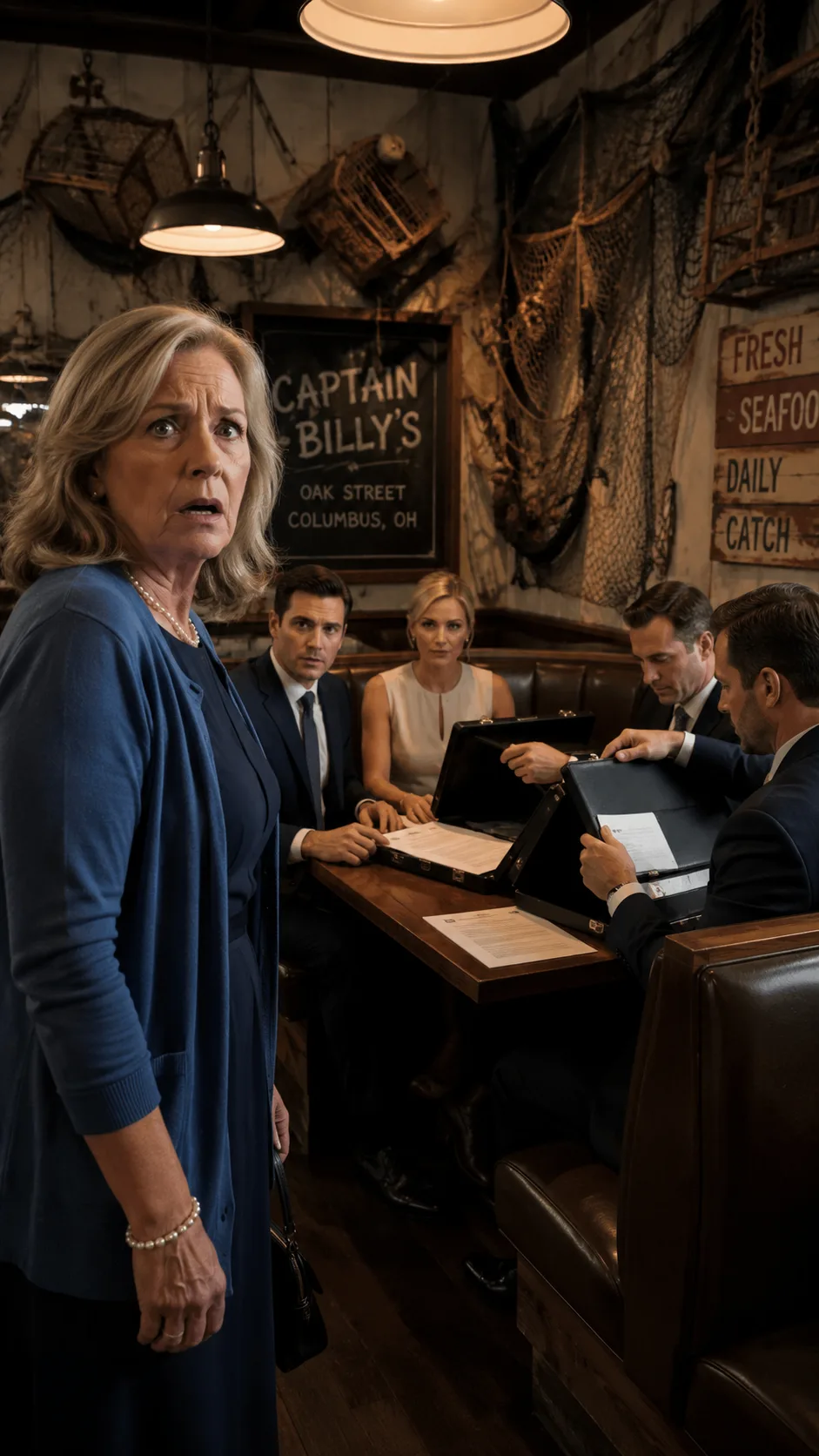
It was not a grand speech. It did not erase the dinner at Captain Billy’s. But it was real. Sometimes real is enough to begin.
Sarah went into labor early on a snowy Tuesday in March.
David called from the hospital with worry packed tight in his voice. “The baby’s coming. Can you stay with Emma?”
Of course I could.
Emma and I spent the day baking cookies and making a crayon card for her new sibling. She talked nonstop about all the things she was going to teach the baby. How to color inside the lines. How to pet dogs gently. How to whisper during bedtime stories. By three-forty-seven that afternoon, James David Thompson arrived small but healthy, weighing five pounds, twelve ounces and carrying a full dark head of hair that made every nurse in the room smile.
When David called with the news, I cried in my kitchen with one hand over my mouth.
No matter what had happened, this child was still mine to love in the grandmother way that asks for nothing back.
The hospital visit two days later felt complicated and tender all at once. Sarah looked worn out but softer than I had ever seen her, cradling James like he was made of spun sugar. Emma stood on her tiptoes to count his fingers. David watched all of us together with a face full of thoughts he was not yet ready to say out loud.
At one point, while he took Emma to peek into the nursery window, Sarah looked down at the baby and said, very quietly, “Thank you. For helping. For staying. For Emma. For all of it.”
It was not a perfect apology, but I knew what it cost her to offer even that much.
“I did it for the children,” I said. “And I’d do it again for them. That’s what grandmothers do.”
Sarah blinked hard and nodded. “I got so worried about making sure they had everything that I forgot what they actually needed.”
“A stable family,” I said.
She met my eyes. “Yes.”
The months that followed were not magically simple, but they were better. Better in the way healed bones are better than open breaks. Stiff sometimes. Tender in bad weather. Still changed forever. But capable of holding weight again.
Real conversations started to replace polite performances. David and Sarah asked for advice instead of making demands. When James would not stop crying at night, they called me for help instead of pretending they had everything under control. When Emma started asking why families sometimes got upset with each other, we worked together to answer in ways that told the truth without handing a child adult bitterness she did not deserve.
By the time Emma turned four, the party was in my backyard under the apple tree where David used to swing when his legs were still short and his future still looked uncomplicated. There were homemade cupcakes, paper plates, dollar-store decorations, a sprinkler in the grass, and half a dozen neighborhood children running in bright circles. Emma wore a simple dress I had sewn for her myself, and she declared, with chocolate frosting on her cheek, that it was the best birthday ever.
I watched David and Sarah exchange a look over her head. Not a guilty look this time. A humbled one. As if they were finally beginning to understand that joy has very little to do with price tags once love is actually in the room.
Later, while we folded chairs and gathered napkins, David said, “I used to think success meant being able to buy whatever we wanted. Watching Emma today, I realized I had it backward. Success is having people who love you for who you are, not what you can provide.”
It was hard-earned wisdom. The only kind that tends to last.
The trust Jennifer established remained untouched except for what it was designed to do: protect the future. Emma’s education. Later, James’s as well, once the structure was expanded properly. David and Sarah never asked about accessing it again. They never hinted. They never circled back toward entitlement dressed as concern. Whether that change came from maturity, fear, or genuine growth hardly mattered by then. The change was real, and I respected real change when I saw it.
One Sunday afternoon I sat in my garden watching Emma chase butterflies while James slept in his stroller under the shade of the maple tree. The air smelled like warm grass and tomato vines. Somewhere down the block a lawn mower hummed. David came outside with two cups of coffee and handed me one before dropping into the chair beside mine.
Emma ran over holding a dandelion in one fist.
“Grandma, look. A wish flower.”
I took it with the solemnity her discovery deserved. “What are you going to wish for?”
She thought very hard, then said, “For our family to always be happy. And for baby James to sleep all night so Mommy stops being tired.”
I laughed, and for the first time in a very long time, the sound came out easy.
We blew the seeds into the breeze together. As they floated off, I made my own private wish. Not for money. Not for safety. Not even for certainty. Just for the wisdom to keep my boundaries without closing my heart. To keep choosing honesty over false peace. To keep remembering that kindness and self-erasure were never the same thing, no matter how many women my age had been raised to confuse them.
That evening, after David’s family went home and the garden settled into crickets and dusk, I called Mrs. Patterson and told her how the day had gone.
“You should be proud of yourself,” she said. “Not many people stand up to their own children and come out of it with their dignity intact.”
I sat on the porch swing and looked out at my yard, at the toys Emma had left behind in the grass, at the flowerbed James would one day stumble through with sticky hands and no balance. “It didn’t feel like courage,” I said. “It felt like necessity.”
“Most real courage does,” she replied.
She was right.
A year earlier I had been a woman frightened of conflict, willing to trade security for access, willing to call it love when people treated me like an account they could draw from. That woman was not gone exactly. She still lived somewhere inside me. But she no longer ran my life.
I started wearing brighter colors. I signed up for an art class at the community center. I joined a book club. I even had coffee a few times with a widowed man from the library who laughed in the right places and never once asked what my house was worth. Life opened again in small, almost embarrassing ways. It turned out there were still rooms in me I had not lived in yet.
Six months later, I stood in the same garden while Emma helped me plant tulip bulbs and James toddled through the grass in soft shoes, collapsing every three steps with delighted outrage. David and Sarah were planning a simple anniversary dinner at home that year, no show, no performance, just food and family and gratitude. The lesson had stayed with them. Or maybe the scar had. Either way, it held.
“Tell me the story again, Grandma,” Emma said, pressing dirt around a bulb with intense concentration. “The one about the brave lady who didn’t let the mean people take her treasure.”
For her, I had softened the truth into a fairy tale. A queen. A garden. Greedy dragons who learned that gold was not the same thing as love. But even inside the child’s version, the lesson remained.
“Once upon a time,” I began, “there was a queen who lived in a beautiful garden and loved her family very much. But one day she learned that loving people does not mean handing them the keys to your kingdom.”
Emma listened with wide, serious eyes. James squealed at a butterfly. David came over and sat on the grass beside us.
“Mom,” he said after a while, “Sarah and I were talking. We want you to know we’re grateful for what you taught us this past year. About family. About priorities. About what actually matters.”
I looked at him, then at the children, then at the house beyond them all.
“You learned because you chose to,” I said gently. “I just stopped making it easy not to.”
That was the truth of it. I had not rescued them with sweetness. I had not fixed them with sacrifice. I had drawn a line and refused to move it. Sometimes that is the most loving thing a person can do, especially when children are watching and learning what relationships are supposed to look like.
As the sun dropped lower over the yard, turning the sky pink and gold above the fence line, I felt something I had once mistaken for weakness and now recognized correctly as peace. Not the shallow peace that comes from avoiding conflict. The stronger kind. The earned kind. The kind that grows only after truth has been spoken aloud and survived.
“Grandma,” Emma said, tugging at my sleeve, “when I grow up, I want to be brave like the queen.”
I pulled her close, breathing in the smell of sunshine, dirt, shampoo, and childhood. “You already are brave,” I told her. “Every time you try something new. Every time you tell the truth. Every time you stand up for what’s right. And every time you love people without letting them be unkind to you.”
That night, during her weekly sleepover at my house, I tucked her into the guest room bed under the butterfly quilt I had made by hand. Just before she drifted off, she asked one last question.
“Will you always protect us, Grandma? Even when we’re big?”
I brushed the hair back from her forehead and thought about all the ways protection changes shape as children grow. Sometimes it looks like cookies and stories and soft blankets. Sometimes it looks like saying no. Sometimes it looks like letting people be disappointed when the alternative is teaching them that love comes without respect.
“I will always love you,” I said. “And I will always try to do what is best for you, even when it’s hard. That’s what real love does.”
She smiled and fell asleep without another question.
I stood there a moment longer in the quiet glow of the bedside lamp, listening to the steady little rhythm of her breathing. Then I went out to the hallway and looked around my home, my life, my ordinary beautiful kingdom that nobody would ever again mistake for something available to seize.
What I almost lost at Captain Billy’s was never just money.
It was my right to remain fully myself.
What I protected was not only an inheritance for Emma and James. It was an example. A standard. A line in the soil of our family that said love could be generous without becoming surrender, and forgiveness could be real without requiring amnesia.
In the end, that was the most valuable thing I could leave my grandchildren.
Not just security. Not just a trust. Not just a house full of memories.
But the story of a woman who loved deeply, stood firmly, and refused to disappear.
THE END.
Chapter complete
You have reached the end of this chapter.
Continue reading
A few more worlds to get lost in after this chapter.




