PART 2 — THREE LAWYERS AT OUR FAMILY BOOTH
There are moments when the body knows before the mind does.
Chapter 2
PART 2 — THREE LAWYERS AT OUR FAMILY BOOTH
There are moments when the body knows before the mind does.
My hands began to shake before he finished the sentence.
He opened his briefcase and drew out a thick folder. “We’ve prepared some documents that we believe will benefit everyone.”
“What kind of documents?” I asked.
David would not meet my eyes. Sarah kept turning her wedding ring around and around with her thumb.
Robert slid the paperwork closer. “Simply put, we’re recommending that you grant power of attorney to your son and daughter-in-law. You live alone now, and financial management can become complicated as people get older.”
My age. He said it with that polished legal gentleness people use when they are trying to take something from you and call it help.
I was fifty-eight years old, not confused, not fragile, not incapable. I balanced my accounts every month. I paid every bill on time. I still climbed a step stool to change light bulbs and carried my own
mulch bags through the garden center at Lowe’s if I had to.
“I don’t understand,” I said, looking straight at David. “Why would I need someone else to manage my money?”
A younger attorney, thin and restless, stepped in as if reading from a prepared script. “Well, Mrs. Thompson, there have been concerns. Some questionable decisions lately. Refusing to assist with important family needs. Remaining alone in a home that may no longer be suitable. Sometimes it’s wise to let loved ones make better choices on your behalf.”
Better choices.
Like spending forty-eight thousand dollars on one wedding. Like treating my husband’s pension as a family vending machine. Like deciding the widow who earned none of their contempt suddenly had too much independence.
The third lawyer, who had not spoken yet, slid the signature page toward me with two fingers. “If you sign tonight, we can get everything in place
immediately. Your son and daughter-in-law only want what’s best for you.”
I looked down at the papers. Power of attorney. Financial management authority. Legal control. A neat stack of calm language designed to strip away a life one signature at a time. My house. My savings. My freedom. The emergency cushion my husband and I had built across thirty-five years of ordinary sacrifice. All of it reduced to lines on a page.
“And if I don’t sign?” I asked.
That was when David finally lifted his head.
I wish I could say I still saw the boy I raised. I did not. I saw a man who had spent two months nursing resentment into strategy. His face was blank in the way only determined people become when they have decided that someone else’s pain is an acceptable cost.
“Mom,” he said, flat and cold, “you need to think about Emma.
She needs stability. Security. If you’re not willing to help your family, maybe you don’t deserve to be part of this family.”
The sentence hit me so hard that for a second the room blurred.
Sarah leaned in with the same bright, cruel composure she wore whenever she wanted something to sound reasonable. “Emma needs grandparents who care about her future. Who want to support her parents and help build a good life for her.”
My voice came out smaller than I wanted. “Are you saying I can’t see Emma anymore?”
David gave the tiniest shrug, like we were discussing weather or traffic or whether the restaurant’s hush puppies were any good tonight. “That depends on you. Sign the papers, and we can all be a happy family again. Refuse, and we’ll have to think carefully about negative influences around our daughter.”
Negative influences.
That was what my love had become in his mouth.
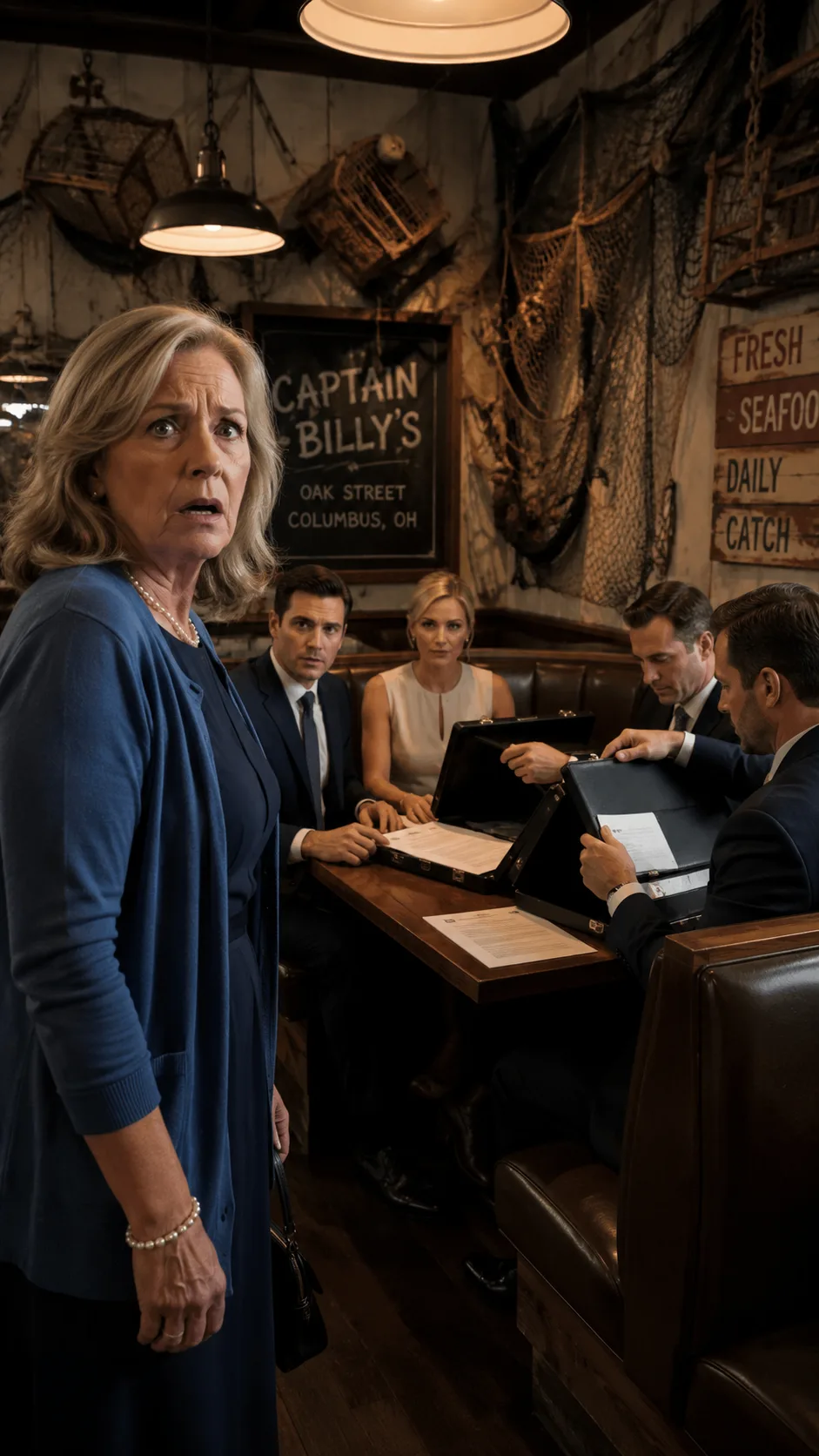
Around us, other families were eating dinner under the old fishing nets and laughing over baskets of fries and cracked crab legs. A little boy in the next section was begging for more ketchup. A couple near the window clinked glasses and smiled at each other. The whole room went on being ordinary while my son tried to turn my granddaughter into leverage.
I looked back down at the paperwork, but I was no longer seeing the pages. I was seeing my future disappear into their appetite. My house sold because it was “an investment.” My life reduced to a controlled allowance. My access to Emma granted or withheld according to compliance. A nice apartment, they would say. Somewhere more suitable. Somewhere easier to supervise. Somewhere my choices would no longer belong to me.
And then, beneath the panic, something steadier rose up.
Mrs. Patterson.
My neighbor two doors down. A widow with silver hair, a sharper mind than most judges, and a daughter in Arizona who had once tried something not so different. The week before, over lemonade on her porch, she had said, “Martha, if your family ever corners you with papers, you call my lawyer before you sign so much as a birthday card. Promise me.”
I had thought she was being dramatic.
I had thought my David would never become this kind of man.
But there I was, trapped in a seafood restaurant with three attorneys and my son threatening my relationship with Emma unless I surrendered control of everything I owned.
So I reached into my purse.
David leaned forward, probably thinking I was reaching for a pen. Instead, I took out my phone.
“Mom,” he said, sharper now. “What are you doing?”
“Making a phone call,” I said.
I scrolled calmly, though my pulse was pounding so hard I could hear it in my ears. When Jennifer answered, I kept my voice clear. “Hello, Jennifer. It’s Martha Thompson, Mrs. Patterson’s neighbor. Yes. I need you to come to Captain Billy’s on Oak Street right now. Bring the documents we discussed.”
I ended the call and laid the phone face down on the table.
The silence afterward was almost theatrical.
Robert Hayes cleared his throat. “Mrs. Thompson, perhaps we should discuss this more privately. Family matters can be emotional.”
I looked at him. “Can they? How thoughtful of you to notice.”
David’s face was darkening by the second. “Mom, you’re making this more complicated than it needs to be. Just sign the papers and we can go home.”
“Whose home?” I asked. “Mine, which you want to control? Or yours, where Emma apparently isn’t allowed to leave unless I cooperate?”
Sarah made a sound of irritation and reached for her purse. “This is ridiculous. David, we don’t need to sit here and listen to this.”
He stopped her with a hand on her arm. “No. We finish this tonight.”
Then he turned back to me with a look so unfamiliar it made my chest ache. “Don’t you want Emma to have nice things? Good schools? A real future?”
“I want Emma to have grandparents who love her without conditions,” I said. “I want her to learn that family doesn’t blackmail each other. I want her to understand that love is not something you buy.”
The attorneys were whispering among themselves now. The version of me they had expected had not shown up. They had anticipated an older woman who would be embarrassed, intimidated, eager to avoid a scene. Instead they were sitting across from someone who had spent half her life stretching paychecks, burying a husband, keeping a home, and surviving the slow humiliations that come when people mistake kindness for weakness.
David changed tactics.
“How much money do you even have in your savings, Mom?”
The question was so invasive, so nakedly hungry, that heat climbed into my face. “That is none of your business.”
The younger attorney actually smiled. “If you sign, it becomes his business. Full financial transparency. Complete asset oversight. Everything is in the paperwork.”
He said it like a benefit.
I looked at David for a long second. “And my house? The one where you grew up. The one where Emma likes to play in the garden.”
He shrugged again. That same careless little motion that cut deeper than anger ever could. “A house is an asset. Sarah and I could manage it more wisely. Maybe move you into something smaller. Something more appropriate.”
More appropriate for someone my age.
More convenient for people who wanted keys, control, and explanations.
That was when I heard the restaurant door open behind me, followed by the quick, clean sound of heels against the wood floor. A woman’s voice spoke to the hostess with calm authority, and a moment later Jennifer Walsh appeared beside our booth with a leather briefcase in one hand and the expression of someone who had seen this exact kind of family performance before.
She was sixty-two, maybe, compact and sharp as a blade. Silver hair cut in a sleek bob. Blue eyes that missed nothing.
“I’m sorry I’m late,” she said, not sounding sorry at all. Then she looked around the table and smiled. “Jennifer Walsh. Mrs. Thompson’s attorney.”
Everything shifted.
The three men who had seemed so comfortable a minute earlier suddenly looked annoyed, then cautious, then distinctly less certain. Jennifer pulled out a chair, set down her briefcase, and snapped it open with practiced ease.
“Now then,” she said lightly, “I understand there are some documents you’d like Mrs. Thompson to sign. Before anyone proceeds, I think you should see what she has already put in place.”
She spread her papers across the table.
Official seals. Trust language. Legal transfer documents. The kind of paperwork that makes greedy people go quiet because real protection looks very different from intimidation when it arrives in writing.
David’s face drained of color.
“Revocable trust,” Jennifer said, as casually as if she were discussing the weather. “Established last week after Martha was advised that family pressure regarding her assets might escalate. All major holdings, including the house, savings, and investment accounts, have been transferred into the Emma Thompson Educational Trust.”
David grabbed the papers. “What does that mean?”
Jennifer folded her hands. “It means your daughter will be very well provided for. Tuition, medical expenses, educational opportunities, future security. Everything a loving grandmother would want for her grandchild.”
She paused, and her tone sharpened just slightly. “It also means neither you nor your wife has direct access to those funds. The trust is administered by an independent institution. I oversee legal compliance. Martha receives a structured monthly amount for living expenses, and the rest is protected for Emma’s future.”
Sarah stared at her as if she had spoken another language. Then she made a choked sound. “You can’t do that. We’re family.”
“Yes,” Jennifer said. “And family members who genuinely care about one another do not threaten to withhold children unless money changes hands.”
David was reading frantically now, his hands shaking. “This is impossible. We had an agreement.”
I looked at him. “What agreement? The one where you pressure me into giving up my life savings? Or the one where I’m allowed to see my granddaughter only if I pay for your lifestyle?”
His mouth opened, then closed. No answer came.
Robert Hayes tried to recover the room. “Mrs. Thompson, Mrs. Walsh, I think there has been some misunderstanding. These documents were prepared in good faith to assist with family planning.”
Jennifer laughed softly. It was the nicest ugly sound I had ever heard.
“Good faith,” she repeated. “Is that what you call arranging a fake peace dinner at a restaurant, bringing three attorneys, and pressuring a competent woman into transferring control of her assets under threat of losing contact with her granddaughter?”
Then she opened a second folder.
“Because I also brought something else.”
She slid photographs across the table.
David and Sarah entering one of the attorneys’ offices two weeks earlier. David carrying a folder of financial notes. Sarah with printouts about property values and comparable home sales. Another photo showed them leaving after nearly two hours. Another showed the younger lawyer walking them to the parking lot.
The color drained from every face across from me.
“How did you get those?” David whispered.
Jennifer did not blink. “Mrs. Patterson had concerns. She hired a private investigator after hearing enough details to believe Martha might be targeted. Imagine our lack of surprise when we found evidence that tonight’s little family gathering had been in motion well before the invitation was made.”
Then she turned to the attorneys.
“Gentlemen, I assume you’re prepared to explain to the state bar why you participated in an attempt to pressure an older woman into surrendering financial control under coercive circumstances. Because from where I’m sitting, that explanation may need to be exceptionally good.”
The youngest attorney started shuffling his papers at once. The third stared down at the table. Robert Hayes looked like a man who had just realized the bill for this dinner might arrive in ways he had not budgeted for.
David stood so quickly his chair nearly tipped over.
“This isn’t over,” he said. “You’re my mother. That money should be mine.”
The words hung there in the restaurant air, ugly and naked and impossible to take back.
Twenty-nine years of raising him. Twenty-nine years of lunches packed, fevers cooled, cleats bought, overtime shifts worked, college bills paid, breakups survived, worries swallowed. And underneath all of it, this.
Mine.
I stood up too.
“You’re right,” I said. “I am your mother. I’m the woman who walked the floor with you when you had colic. I’m the woman who saved for two years to buy you the bicycle you wanted for Christmas. I’m the woman who worked extra shifts so you could finish college without drowning in debt. And this is how you repay me? By bringing lawyers to dinner and trying to take everything your father and I built?”
My voice never rose, which somehow made the whole thing quieter and more devastating.
Sarah pulled at his sleeve. “Come on. Let’s go.”
But David stood there a moment longer, staring at me with something that might have been shame if greed had not already gotten there first.
“Emma needs things,” he said. “Good schools. Nice clothes. Opportunities.”
“Emma needs love,” I said. “She needs honesty. She needs people who value her more than leverage and money. If you keep using her as a weapon, what exactly are you teaching her?”
For one flicker of a second, I thought I saw the boy he used to be. The child who cried when he accidentally stepped on a butterfly in our backyard. The teenager who once gave half his allowance to a classmate whose mother had lost her job.
Then Sarah tugged his arm again, and whatever softness remained vanished.
“Fine,” he said coldly. “If this is how you want to do things, don’t expect to see Emma anytime soon. And don’t expect us at Christmas.”
It was meant to wound me.
It did. Just not in the way he intended.
By the time they left with the attorneys trailing behind them, I was not angry anymore. I was sad in the deep, exhausted way only mothers can be when love survives but trust does not.
Jennifer stayed. We sat in the suddenly quiet booth while waitresses pretended not to watch us and the couple by the window asked for dessert as if no family had just blown apart under the lobster traps.
“Are you all right?” she asked.
I thought about it before answering. My son had just tried to corner me into giving up my life. My granddaughter had been used as a bargaining chip. My family had cracked open right in front of me. And yet I still had my home. My choices. My name on my own accounts. My dignity.
“I think I will be,” I said. “It hurts. More than I knew it could. But I’m not going to let them erase me.”
Jennifer nodded. “Good. The trust is solid. Emma’s future is protected, and so is yours.”
Outside, the Ohio night felt cooler than it had when I arrived. The drive home was silent. No radio. No talk. Just the road, the passing streetlights, and the ache of understanding that some kinds of betrayal do not arrive from enemies. They arrive wearing your child’s face.
When I pulled into my driveway, my house looked different.
Emptier, yes. But also clearer. It was still mine. The white porch swing. The wind chime by the hydrangeas. The kitchen window over the sink where I had stood through years of family life and years of being taken for granted. I unlocked the door and went inside as if entering a place I finally intended to defend.
I made myself chamomile tea with honey and sat in my favorite chair by the front window. The same chair where I had nursed David as a baby, read him bedtime stories, waited up for him when he was learning to drive, prayed over him when he went off to college, and called him after his father died because grief had left both of us standing in different corners of the same darkness.
A little after nine, the phone rang.
For one dangerous second I hoped it was David calling to say he had lost his mind and wanted it back. It was not. It was Mrs. Patterson.
“Martha,” she said, “how did it go?”
I told her everything. The lawyers. The threat about Emma. Jennifer arriving like weather sent to save a roof. Mrs. Patterson listened without interrupting, except for the occasional gasp of outrage that made me feel oddly less alone.
When I finished, she exhaled hard. “Honey, I’m sorry it came to this. But I am proud of you. Choosing dignity over family pressure takes more courage than most people ever admit.”
I did not feel courageous. I felt like someone who had seen the edge of the water and decided not to step in just because everyone else called it love.
“What happens now?” I asked.
“Now,” she said, “you find out who you are when you’re not being managed by guilt.”
That night I lay awake thinking about Emma. Her butterfly rain boots. The way she said my name with her whole body. The warm smell of her hair after bath time. I wondered what David and Sarah would tell her. I wondered whether she would grow up hearing that Grandma was selfish. That Grandma cared more about money than family. The uncertainty hurt, but not enough to make me undo what I had done.
Three weeks passed before David called again.
In those weeks I built a routine. Coffee on the porch in the morning. Walks through the neighborhood after lunch. Volunteer hours at the library helping with children’s reading programs. I started sleeping a little better. I laughed a little more easily. It turned out there was a kind of peace in being useful for something other than your wallet.
I was reading to a group of five-year-olds when my phone buzzed in my purse. Later, out by the library steps in the afternoon sun, I answered.
“Mom,” David said, and this time his voice was uncertain in a way I had almost forgotten. “Can we talk?”
“We are talking.”
He hesitated. “Emma keeps asking about you. She wants to know when Grandma is coming over again. She says she misses your Sunday tea parties.”
The words went through me like warmth after a fever.
“What do you tell her?” I asked.
There was a long pause. “I tell her you’re busy.”
I closed my eyes. “And does she believe that?”
“No. She asked yesterday if you were sick.”
For a moment I could not speak. Emma was too young to understand power and pride and adult cruelty. All she knew was absence.
“I miss her too,” I said finally. “More than you can imagine.”
“Then come over,” David said quickly. “Sunday. Sarah’s making pot roast.”
Pot roast. As if normalcy could be plated and served and called repair.
I leaned against the brick wall outside the library and chose my words carefully. “If I come, there will be conditions.”
To be continued… Click “PART 3” to read the final part: 👉 PART 3 👈
Chapter complete
You have reached the end of this chapter.
Continue reading
A few more worlds to get lost in after this chapter.




