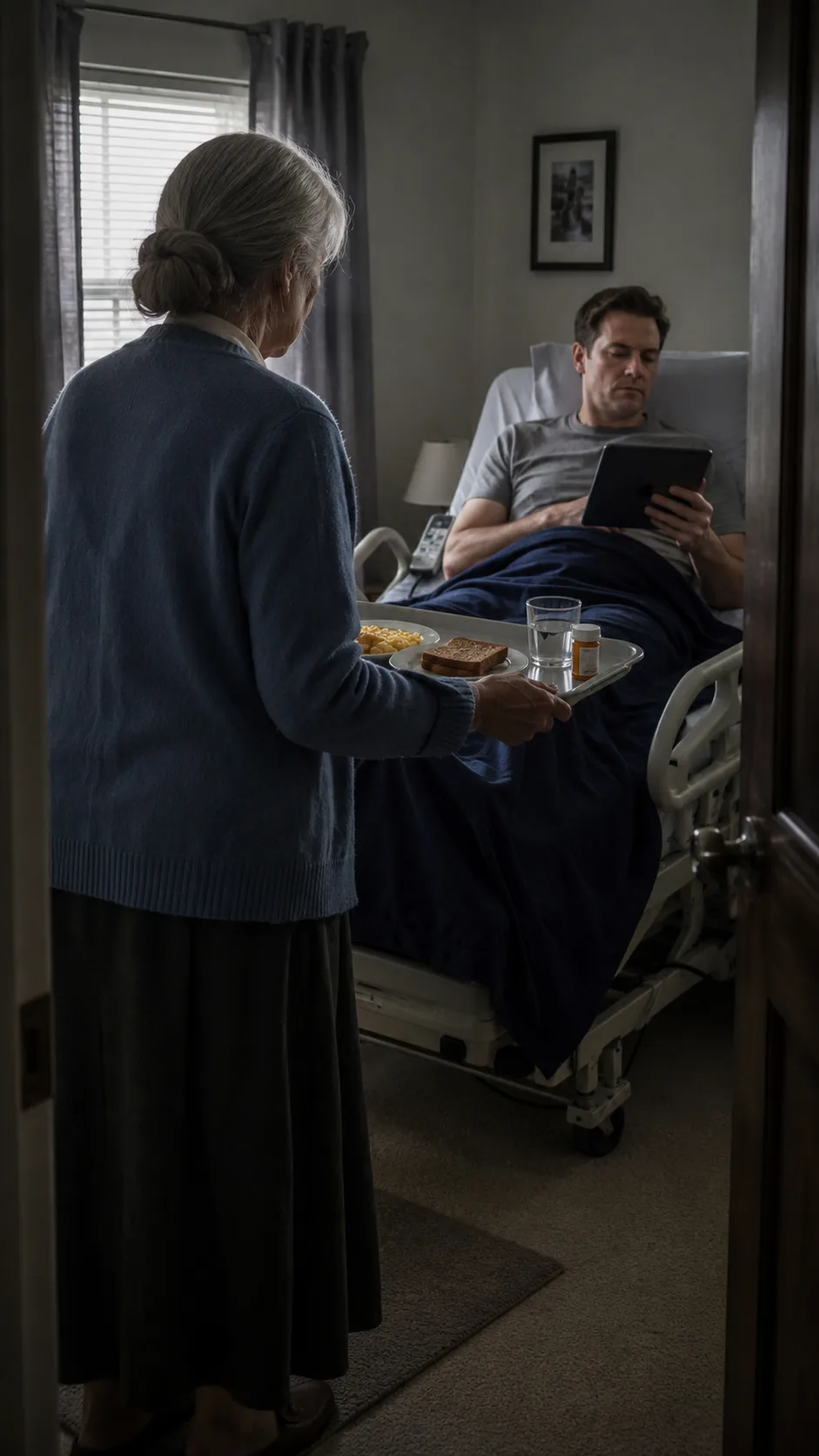
PART 3 — THE DAY HIS LIFELONG MAID WALKED AWAY
I told him I had filed for removal as his guardian and that the court would be transferring oversight to George effective the following week.
Chapter 3
PART 3 — THE DAY HIS LIFELONG MAID WALKED AWAY
I told him I had filed for removal as his guardian and that the court would be transferring oversight to George effective the following week.
I told him the groceries would stop arriving, the bills would be handed off, and the keys would stay on the table.
“How could you do this?” he asked.
His voice was thin and weak.
“You did it first,” I said. “You did it when you stopped seeing me. You did it when you handed off my sacrifices to someone who vanished when things got hard. You did it when you let someone else take not just money, but years.”
He tried to say he did not know. He said Savannah had promised she was only managing things until he recovered. He said she never told him about the marriage.
“You’re an adult, Bryce,” I said. “A sick one, yes. But still an adult. You chose silence. You chose ease. You chose a dream because it was easier than respecting the person standing in front of you every day. Now
I’m choosing clarity.”
I stood, collected the breakfast tray, and turned to go.
“Irene,” he said softly.
Almost like a whisper.
I paused.
But I did not turn back.
Instead, I walked into the kitchen and started wiping down the counters. I made myself coffee. I sat by the window and watched the street.
I breathed.
He did not call again.
Later that day, I packed a single suitcase. A few changes of clothes. My documents. A small photograph of my husband and me taken back when Bryce was just a toddler with two big shoes and a laugh that could shake a room.
I left everything else: the furniture, the china, the walls I had painted twice in ten years, the dented silverware, the hand towels embroidered with our old last name.
I walked out quietly.
No drama. No slammed doors.
Just the firm click of a lock behind
me.
For the first time in a decade, I did not feel like someone leaving her life.
I felt like someone returning to it.
The apartment was small, one bedroom, no yard, no porch swing, and no wide-open windows like the house I had left behind.
But it was mine.
The day I moved in, the manager handed me the keys and a single sheet of rules printed in large font. No smoking. No pets. Quiet hours after ten.
I nodded, signed the lease, and closed the door behind me.
The walls were pale yellow. The carpet was rough beneath my shoes. The light in the kitchen flickered once before settling.
I unpacked slowly, one box at a time.
I placed the photo of my husband on the dresser. I folded the same towel I had used during my first year of marriage. I brewed a cup of tea and
drank it standing up, staring out the window at the parking lot.
No one waved.
No one noticed.
And still, I felt more seen than I had in years.
There were no calls, no requests, no trays to prepare, no medications to crush, no silence to tiptoe around.
Only the ticking of the microwave clock and the low hum of my own breath.
That night, I slept without waking.
The following morning, I walked to the small grocery store two blocks away. I carried one reusable bag. I bought a loaf of sourdough, one apple, and a jar of peanut butter, the kind with the oil on top that needs stirring.
No dietary supplements. No protein blends. No medical labels.
I paid in cash.
At home, I toasted the bread and sat at the kitchen counter. The chair was stiff. The view was dull.
But the stillness tasted like freedom.
I chewed slowly.
My hands did not tremble.
In the afternoon, I opened a blank notebook and started to write. I did not know what I was writing yet. I started with one sentence.
Ten years is a long time to disappear.
Then I added another.
But one day is enough to begin again.
I did not know if I would keep writing or if the notebook would end up in a drawer, forgotten. But for now, it felt right to let the words come without a plan.
In the evenings, I walked around the apartment complex and saw other women sitting on their patios, reading or talking softly on the phone. I did not speak to them.
Not yet.
I was not ready for conversations. I needed the silence more than company.
One day, I passed a woman my age sitting in a folding chair, knitting. She looked up and nodded.
I nodded back.
That was enough.
Days passed quietly.
One morning, I received a letter in the mail. There was no return address. Inside was a simple note.
I hope you’re okay. I’m sorry.
The handwriting was familiar.
I folded the letter and set it in the drawer under the sink. I did not need to answer it.
Not yet.
Maybe never.
The apology did not erase what had happened, but it did not sting the way I thought it would.
That night, I lay in bed and listened to the old pipes rattle. I thought about the line I had drawn the moment I chose to step out of the role that had defined me for so long.
Not because I was angry. Not because I wanted to teach anyone a lesson.
Because I remembered who I was before I became invisible.
Because I had stopped asking someone else to see me and started seeing myself.
I started the podcast without telling anyone.
No promotion. No cover art. No music intro.
Just my voice recorded in the quiet of my new apartment, sitting at the kitchen counter with a secondhand microphone and a cup of tea gone cold.
I called it Under the Hushed Lamp.
The name came from the corner light above my table, the one with a soft yellow glow that stayed on through the evening. It was not much, but it made the space feel less like a transition and more like a place where things could begin again.
The first episode was ten minutes long.
I did not plan it. I did not write a script.
I just hit record and started talking.
I said I had spent ten years caring for someone who no longer saw me. I did not name him. I did not need to. I spoke about the weight of disappearing slowly, about how a person can give up everything for someone and still be mistaken for furniture.
I described the routine, the silence, the feeling of waking up and forgetting your own name.
Then I listed the numbers, not as revenge, only as facts.
Three hundred sixty-four mornings a year when I woke before dawn.
Two thousand six hundred seventy loads of laundry.
More than ten thousand pills counted and administered.
Six birthdays spent alone at the kitchen table.
One hundred twenty-one thousand eight hundred dollars withdrawn from my pension to pay for ramps, beds, vans, and food.
And not once did anyone ask me how I was doing.
I ended the episode with a single sentence.
“The price of care is not always measured in dollars, but the receipt shows up eventually.”
Then I clicked save.
I did not expect anything to come of it. I was not chasing attention. I just needed a place to lay the truth down somewhere outside my body.
I uploaded it and shut the laptop.
Two days later, a comment appeared.
Then another.
Quiet, anonymous messages arrived from women across the country.
One said she had cared for her husband for fifteen years until he passed, and no one even remembered to send her flowers. Another said her daughter had moved back in after a divorce and never once paid rent or said thank you. Another said she had not had a room of her own in seven years.
They did not ask for advice.
They just needed to say it out loud.
And somehow, they had chosen my voice to listen to while they did.
So I made a second episode.
This one was about how guilt can be passed down like heirloom furniture, how women are taught that staying is a virtue even when it erases them. I talked about the sound of silence in a house full of expectation, about the way your name disappears from mail, from calendars, from conversations, until you are just Mom or Grandma or, worse, the help.
Each week, I added more little memories, stories, and observations.
One morning, I received an email from a woman in Nebraska. She said my voice kept her company during her night shift as a cleaner at a hospital. She said she had played the episode about boundaries three times in a row and finally asked her sister to help with their mother.
She ended the message with one line.
You helped me remember that my life matters, too.
I read it twice.
Then I opened my notebook and started outlining the next episode.
The topic would be simple.
Care is not love unless it flows both ways.
And some things we do out of love must be allowed to end. Not because we failed, but because we remembered we were human.
It was George who called to let me know.
His voice was steady, but I could hear something beneath it. Maybe frustration. Maybe pity. Maybe neither.
He said Savannah had cleared out her things a week earlier, leaving the house without a note and leaving Bryce sitting there in the living room surrounded by silence and bills. She had withdrawn the last of the funds from the account.
George said it was not much, just enough to cover one last hotel stay. The transaction was flagged, but it went through before the freeze became official. By the time anyone could act, she was already gone.
Bryce did not call me.
He did not have to.
I already knew what it would look like: the empty chair, the discarded packaging, the laptop left open with unanswered emails, the sudden absence of a voice that used to fill the room.
George told me Bryce had asked if I would come back.
George told him no.
He said I was building something.
He said I had moved on.
Bryce did not argue.
The next day, I received a letter from the bank confirming the closure of the joint account. Attached was a list of all transactions over the last eighteen months.
Savannah’s name appeared again and again.
Ride-share payments. Spa appointments. Gift card purchases. Airline tickets. Small withdrawals at odd hours.
Bryce had approved all of them.
He had not been deceived in the traditional sense.
He had been willing.
He trusted her.
Or maybe he only wanted to believe that someone other than me cared enough to stay.
But she did not.
I placed the letter in the back of a drawer and returned to my writing desk. I opened the notes for my next podcast episode and added a line at the top of the page.
There is no shame in being fooled, but there is danger in staying blind by choice.
That evening, I walked to the community garden and sat on the bench under the fig tree. A breeze rolled through, soft and cool. I watched an older woman plant a small bed of tomatoes with quiet focus. Her back was straight. Her hands were steady.
I did not cry.
I did not feel victory either.
What I felt was something quieter, the full weight of what I had left and what Bryce now had to carry alone.
He had chosen to believe in something that never truly stood beside him.
Now, in the echo of her exit, he would have to reckon with what remained.
Not money.
Not comfort.
Silence.
And that silence was not the kind I had once endured.
Mine had been full of motion, full of giving, full of waiting.
His was empty.
For the first time in years, I did not feel responsible for what he did with it.
I went home and made dinner. Lentil soup. Toasted bread. I played an old jazz record on the kitchen speaker while I ate. Then I turned the volume down low and let it play into the night.
The phone did not ring.
No one knocked at the door.
And the quiet this time did not feel lonely.
It felt earned.
Two weeks after the last withdrawal cleared, I received another envelope without a return address. Inside was a short note. No greeting, just my name written in block letters and five sentences.
I messed up.
I know that.
She left and took everything.
I don’t expect anything from you.
I just wanted you to know I’m sorry.
I hope you’re okay.
It was not signed, but I recognized the handwriting.
I folded the paper and placed it in the drawer next to the first letter. I did not cry. I did not feel relief. Only a faint pressure in my chest that came and went like a passing breeze.
That afternoon, I walked to the library downtown. They had a quiet room with big windows and padded chairs. I brought my notebook and sat in the corner near the biography section.
For two hours, I wrote not about him, not about her, but about me.
I wrote about the first job I had at nineteen, working in a school cafeteria. I wrote about the way my mother folded towels and how I used to mimic her hands. I wrote about the time I skipped a church fundraiser to sit in a diner with my husband, watching rain roll down the glass.
These were not stories for a podcast.
They were pieces of me I had let go of somewhere along the way.
I wrote them because I needed to see them again. I needed proof that I had existed before I was needed by someone else.
On the walk home, I passed a church marquee that read, Sometimes peace looks like letting go.
I stopped, read it twice, then kept walking.
Back at the apartment, I made a pot of tea and played a voicemail from a woman named Carla. She was starting a support group for family caregivers who had stepped away. She said she had found my podcast through a friend and wanted to invite me to speak.
I did not respond right away.
I was not sure if I had anything to offer beyond my own quiet truth. But something about the timing made me pause.
The idea of standing in front of a room, not as a caregiver, not as someone recovering, but as a full person with a story that had edges and weight, felt strange and possible.
That evening, I wrote down five words.
I am still becoming myself.
I did not know what came next, but I knew what would not return.
The silence that once haunted me now served as a kind of border, a line between what had been and what would be allowed again.
And I was learning to hold that line with steadier hands.
The day I stood in front of that small room with folding chairs and coffee poured from a cardboard box into foam cups, I did not feel nervous.
I felt rooted.
The women gathered slowly. Some carried clipboards. Some had tired eyes. All of them had stories that weighed the same, even if they wore different names.
I did not read from notes.
I told them about the quiet unraveling, about how easy it is to become useful instead of whole. I told them how I lost my name in the routines, how it took ten years and one sharp truth to find it again.
I did not cry.
I did not raise my voice.
I spoke plainly, like I was sitting at my own kitchen table.
When I finished, no one clapped.
They just sat with it.
And I let the silence stretch, because silence no longer made me feel forgotten.
It made me feel heard.
Afterward, a woman about my age came up and pressed a folded slip of paper into my hand.
It said, You gave words to something I didn’t know I was allowed to feel.
That night, I walked home under a sky without clouds. No weight. No fog. No ghost tugging at the edges.
I opened my notebook one last time that evening and wrote one sentence.
This is not the end. This is me returning to myself.
And for the first time in years, I closed the book without needing to explain what came next.
THE END.
Chapter complete
You have reached the end of this chapter.
Continue reading
A few more worlds to get lost in after this chapter.




