PART 2 — THE PAPERS HIDDEN IN MY OWN HOME
It was the drawer where I kept the paperwork: insurance forms, medical files, property records, benefit notices, therapy notes, bank letters, all the paper proof of a life built around someone else’s needs.
Chapter 2
PART 2 — THE PAPERS HIDDEN IN MY OWN HOME
It was the drawer where I kept the paperwork: insurance forms, medical files, property records, benefit notices, therapy notes, bank letters, all the paper proof of a life built around someone else’s needs.
I did not know what I was looking for yet, but I knew this much. Something had shifted, and I was done pretending it had not.
The drawer had not been properly opened in years. I pulled out the folders slowly, careful not to bend the corners. The manila folders in the back held older documents: the original house deed, the life insurance policy from when my husband was alive, bank statements, and notes from social workers and therapists who used to visit after Bryce’s accident.
The more recent folders sat near the top: medical authorizations, state care benefits, and power of attorney documents.
I flipped through each paper, not sure what I was hoping to find, but something inside me told me to keep looking.
Near the bottom of one folder was a notarized document I did not remember signing.
I sat at the kitchen table, turned on the
overhead light, and read it twice. Then I read it a third time, more slowly.
It was a property transfer agreement.
The house was no longer under my name. It now listed Bryce as the sole owner, effective six months earlier.
I stared at the line with my signature.
It looked like mine. The tilt was just right. The loop on the L looked the way I always wrote it.
But I had never signed that form.
I would have remembered.
My hands started to sweat.
Behind that paper, I found a letter from our financial adviser, a follow-up to a conversation confirming Bryce’s request to redirect the monthly government disability deposits into a separate account.
Not our joint account.
A new one under someone else’s name.
Savannah Delaney.
I felt my throat tighten.
I flipped back through the documents, searching for context. There was a printout from a virtual
consultation with a lawyer, with notes in Bryce’s handwriting. The date circled in red ink was the same week Savannah had reappeared in his life.
My stomach turned.
I thought of the groceries I had skipped so he could have his protein powder. The bills I had delayed to pay for widened doorways, the hospital bed, and the ramp. I had taken out a small loan against my pension to afford the electric lift we installed in the bathroom.
All of it was in this house.
And now the house was not mine.
Not even in part.
I set the documents down and stood. My knees cracked. My back ached. But the pain felt distant, like it belonged to someone else.
I went to Bryce’s room.
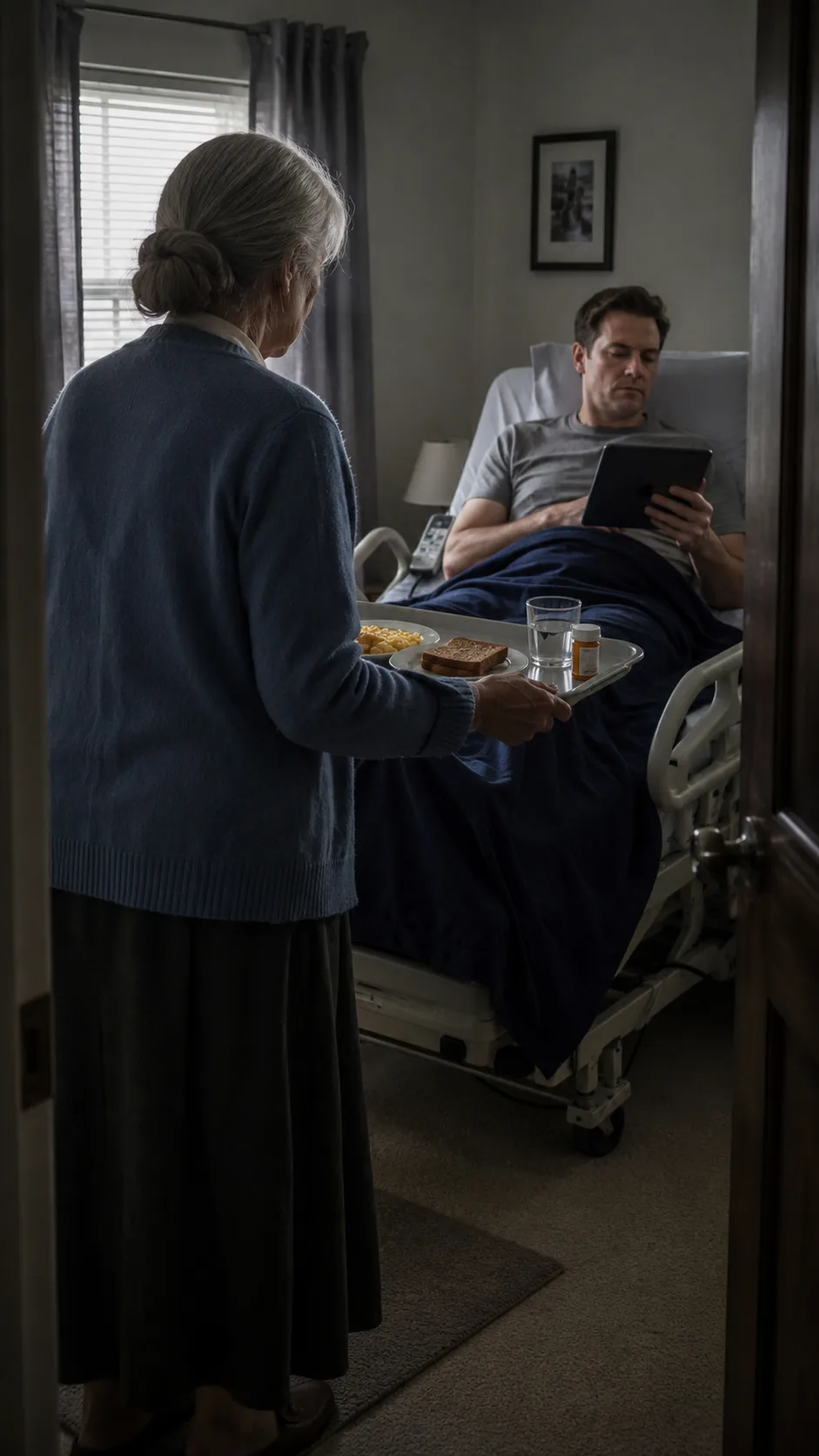
He was watching something on his tablet, headphones on his head, propped against the pillow. I stood in the doorway until he noticed me.
He looked up. His expression did not change.
No guilt. No concern. Just impatience, as if I had interrupted something important.
“Dinner will be late,” I said.
He nodded and turned back to his screen.
I did not mention the papers.
Not yet.
I needed time. I needed space to think.
Back in the kitchen, I poured myself a glass of water, sat at the table, and stared out the window. The front lawn needed mowing. The trash bins were still out from Monday. Small things I always handled without asking and without thanks.
But now I was seeing them for what they were.
Signs.
I went back to the file drawer and found the binder with old voice memos from Bryce’s rehab sessions. I remembered recording them to help him with speech therapy. But now I scanned the dates, found the ones from the month of the transfer, and played one.
It was Bryce speaking slowly, reading back a list of items the therapist had written out.
“Food prep. Bathroom help. Transfer from bed to chair. Light cleaning. Bill payments.”
Then a pause.
Then his voice, quiet but clear.
“Mother does all that. She always will.”
The words hit me differently now.
Not with gratitude.
With assumption.
That night, I sat on my bed with the folder in my lap and felt something settle deep in my chest. Not anger. Not yet. Awareness. The kind you cannot unsee once it shows up.
In the moment I found those signatures, I knew something fundamental between us had broken. Quietly. Cleanly.
And I was not going to let it be put back the way it was.
The next morning, I got up at five, the same as always. I moved through the kitchen on autopilot. Kettle on. Supplements mixed. Tray wiped. The routine helped me stay numb, helped me stay safe, but the papers I had found the night before kept flashing in my mind like hazard lights.
After I gave Bryce his breakfast and set his medication by the bedside, I told him I had errands and would be back in the afternoon.
He did not ask where I was going.
He just nodded, eyes on his tablet.
I packed a tote bag with the folder of documents and left the house without looking back.
The drive to Wichita was quiet. Two hours of flat roads, cornfields, and gray skies. I did not turn on the radio. My hands stayed tight on the wheel.
I had not driven that far in years, not since before the accident.
But muscle memory took over. My body remembered what freedom felt like, even if only a little.
I parked in front of George’s house around ten-thirty. He lived on the edge of town in a one-story brick place with chipped paint and an old flagpole in the yard. I had not seen him in over a year.
We never had much of a relationship after my husband passed. George was blunt. He did not like small talk. He did not pretend to be kinder than he was.
But I needed someone who would not sugarcoat the truth.
He opened the door in a flannel shirt and boots, looked me up and down, then stepped aside.
We sat at the kitchen table, the same one from twenty years before, still covered in cigarette burns and coffee rings. I handed him the folder.
He read everything slowly, his mouth set in a straight line. He did not say a word.
Then he leaned back and exhaled through his nose.
I waited.
Finally, he said, quiet and firm, “What Bryce did may be legally binding, Irene. But it is morally rotten. I can help, but only if you are serious. No changing your mind later. No feeling guilty halfway through.”
“I’m done,” I said.
He nodded once.
George was not the emotional type, but I saw something shift in his eyes. Maybe respect. Maybe regret.
He picked up his flip phone and made a call to an attorney he knew. He asked about guardianship transfer procedures and made notes on a yellow legal pad. Then he asked if I had thought about what came next.
“Not fully,” I said. “But I know I can’t stay where I am. Not after what I saw. Not after realizing my son chose someone else to guard his future. Someone who didn’t even show up in his worst days.”
George did not say much else. He gave me an envelope with his personal notary copy and said I could use his name for the first filing.
I thanked him, tucked the envelope into my bag, and drove back before the sun dipped.
At home, Bryce did not ask anything. I heated dinner and served it. He did not notice the folder was missing from the cabinet. He did not ask about the papers no longer in the drawer.
I washed the dishes, dried my hands, and stood by the window again.
This time, I did not feel invisible.
I felt steady, like something inside me had finally clicked into place.
It was not revenge I wanted.
It was clarity.
A line had been drawn, and I had decided once and for all to stand on the side that remembered who I was before I became just hands, just routine, just someone to keep the wheels turning.
I went to bed early that night. Lights off by nine. I slept straight through until morning for the first time in years.
Three days later, I sat across from a woman named Angela in a quiet office above a strip mall outside El Dorado. She was a financial consultant I had worked with briefly after my husband passed. I was not sure she would remember me.
But she did.
She even offered me tea. Chamomile.
I accepted.
I handed her the same folder I had given George. Angela went through the papers carefully, flipping pages with short, sharp fingers. Her expression did not change much, but I noticed the way her eyes narrowed at the third document.
She read the account transfer authorization twice, then pulled out a yellow legal pad.
She asked a few quiet questions.
I answered honestly.
“No, I didn’t sign anything in person.”
“No, I wasn’t consulted before the assets moved.”
“Yes, I handled most of Bryce’s care expenses for years out of pocket from my pension, sometimes on credit.”
She nodded and circled a number at the bottom of a printed ledger.
That number stayed in my head for hours afterward.
Thirty-four thousand five hundred dollars.
That was the total withdrawn from the joint health expense account Bryce and I had shared. A line of small transactions, each labeled as therapy consultation, private care, mental wellness retreat, ride-share health rides, and hotel accommodations.
Every one of them cleared by Bryce.
Every one of them connected to Savannah.
Angela said the bank statements aligned with a pattern she had seen before, when a third party gains influence over a dependent person and begins manipulating access to financial tools.
She called it soft fraud.
Hard to prove. Even harder to undo.
Then she looked at me gently and said something I did not expect.
“You’re not crazy, Irene. And you’re not overreacting.”
That felt like oxygen.
After I left, I drove to the pharmacy to pick up Bryce’s prescriptions. The clerk handed me the bag like always, but something about the weight of it felt different now, like a burden I was about to set down.
At home, I opened the refrigerator and saw the grocery shelf I had been restocking every week. Protein drinks. Yogurt. Apple slices he always asked for but never finished.
I stared at them, then slowly started pulling things out and setting them aside.
I made a list of what I would no longer buy.
That day, while Bryce watched television in the living room, I sat in the den and made copies of every paper. I scanned them onto a flash drive and sent a summary to George. Then I opened a drawer and pulled out my pension balance sheet.
One hundred twenty-one thousand eight hundred dollars.
That was how much I had withdrawn since his accident.
Modifications to the house. Medical supplies. The wheelchair-accessible van.
Most of it had gone into things no longer visible.
Invisible sacrifices.
And all this time, Bryce had let Savannah reach into that same pool without blinking.
I sat still for a long time after adding the numbers.
It was not about the money. Not really.
It was the decision.
He made it without me. He chose someone else. Trusted someone else. Let someone else use what I had built, and he did not even think I would notice.
I folded the papers back into the folder, placed them in a zip bag, and put it under the cushion of the chair in the den.
I was not ready to leave yet.
But I was ready to protect myself.
Something had shifted again. Not louder, just deeper. It was starting to show in every quiet choice I made.
George showed up on a Thursday afternoon with a flash drive and a paper bag full of pears from the tree behind his house.
He did not knock. He just walked in the way people do when they have known a house long enough to know where the creaky step is.
He handed me the bag and sat down without a word.
I waited while he pulled his reading glasses from his coat pocket and opened the small manila envelope he had brought. Inside were three printed photos, a short report, and a transcript.
He slid the first photo across the table.
Savannah stood beside a man I did not recognize, cutting a birthday cake. Her hand rested on his shoulder. A wedding ring was visible. The date stamp was from almost two years earlier, in Missouri.
The second photo showed them again, holding hands at a courthouse, filing paperwork. A marriage license sat in the corner of the frame, issued three years earlier.
George did not say much.
He let the photos speak.
His face was hard.
Then he passed me the transcript. A short recording had been collected through public social media and an anonymous tip. It captured a casual conversation, Savannah bragging about how she kept Bryce thinking she might come back.
Her words were exact.
“It’s like printing money. He signs anything I tell him. Poor guy still thinks I’m waiting for him.”
I did not blink.
I did not speak.
George looked at me, waiting to see if I would break.
But there was nothing left to break.
I set the photos aside, folded the report neatly, and placed it in the folder with the others. Then I stood, poured George a cup of coffee, and asked him to stay for dinner.
We ate quietly.
Bryce stayed in his room that night and said he was tired. He did not know George was there. I did not tell him.
There would be time for that later.
After George left, I washed the dishes slowly, my hands steady, my chest calm.
It was strange. For so long, I thought the worst thing that could happen had already happened: the accident, the loss, the responsibility.
But I had been wrong.
This was worse.
Knowing that the one person I gave everything for had let someone else exploit my care, my sacrifice, and my trust. For what? For an illusion. For a woman who had already moved on. For someone who had never planned to stay.
I sat on the porch just after midnight with a blanket over my knees and the folder resting on my lap.
It was not sadness I felt.
It was quiet.
A stillness that came not from giving up, but from finally knowing the full shape of the truth.
All the doubts, all the second-guessing, all the cracks in my confidence stopped. Because now I had proof, not just of Savannah’s lies, but of Bryce’s silence.
He had known, maybe not everything, but enough. Enough to feel the shift. Enough to question it.
And he did not.
He let it happen.
The kind of betrayal that does not come with screaming or fists can still settle in the bones.
That night, I finally understood the difference between staying out of love and staying out of habit.
And I knew I would not stay out of either anymore.
I waited until Saturday to say anything.
Not out of fear. Not out of uncertainty. Out of order.
I needed time to decide what to say and how to say it. I wanted the moment to be exact and final, not messy.
I woke early and made his breakfast the same way I always did. Scrambled eggs. Wheat toast. Half a banana. No supplements. No protein powder. Just food, plain and simple.
I set the tray on the table beside his recliner and told him I needed to talk.
He kept his eyes on the television, flicking through channels like none of them interested him.
I waited.
Eventually, he muted the volume and looked up.
I did not hold the folder, the photos, or the transcript.
I did not need to.
“I know everything,” I said.
His face did not move.
I told him about the account, about Savannah’s withdrawals, about the marriage license, about the fake therapy receipts. I told him I had spoken to George, to Angela, and to an investigator. I told him I had seen the video and heard the words.
His face stayed flat for a second too long.
Then came the first crack.
A twitch in his lip. A shift in his shoulder. His fingers clutched the edge of the blanket like a child trying to hold on to something already gone.
He opened his mouth.
I held up my hand.
“I’m not looking for an apology,” I said. “I’m not looking for a story.”
Then I told him I was leaving.
To be continued… Click “PART 3” to read the final part: 👉 PART 3 👈
Chapter complete
You have reached the end of this chapter.
Continue reading
A few more worlds to get lost in after this chapter.




