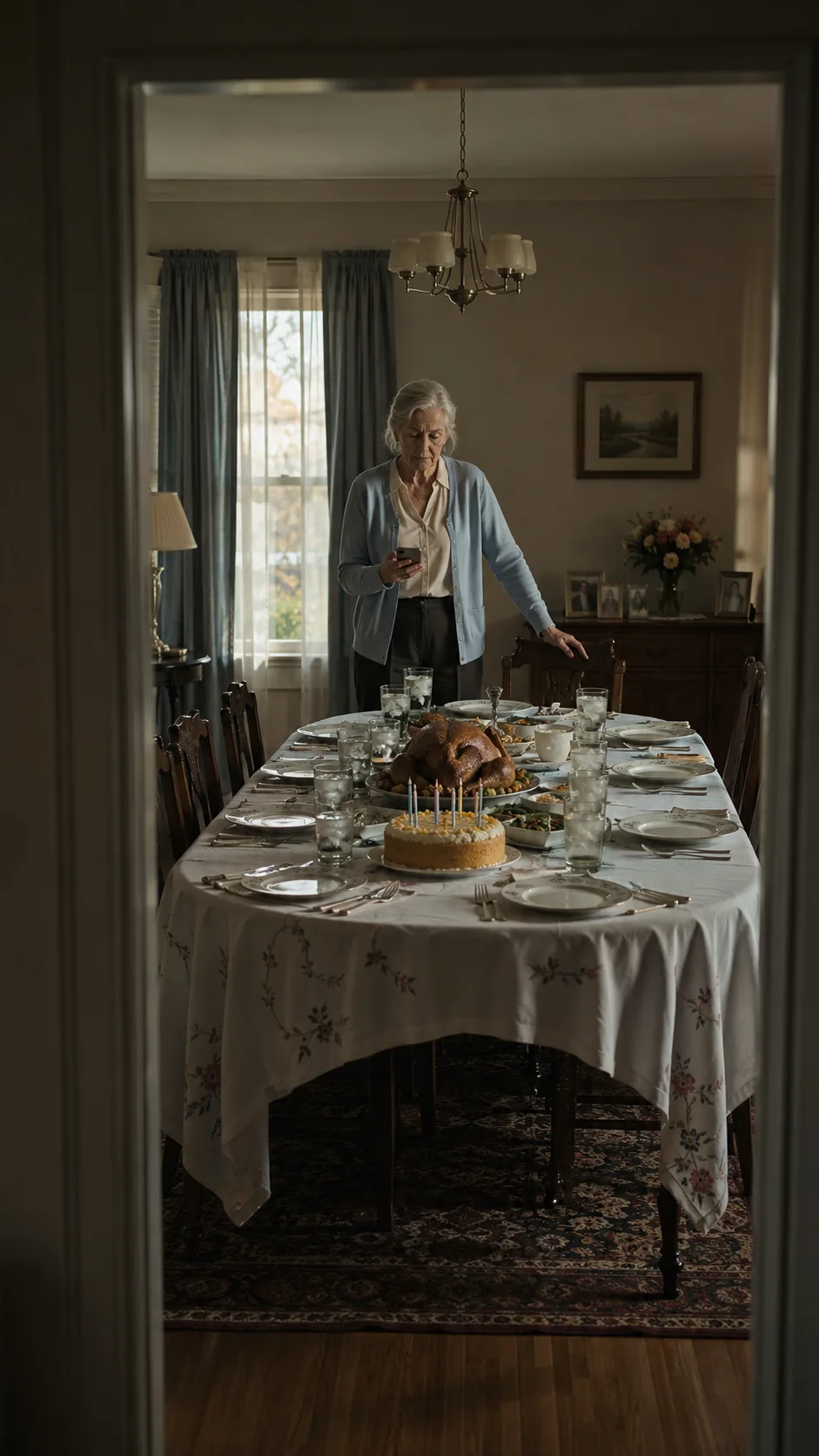
No one reached for the envelopes at first.
Chapter 3
No one reached for the envelopes at first.
They only stared.
That was the strange thing about people who feel entitled to take from you. They are often deeply offended when you start keeping records.
Daniel was the first to speak.
“Mom,” he said, his voice low, warning me in my own dining room. “This is unnecessary.”
I looked at the place card in front of him.
“Twenty thousand dollars,” I said. “Down payment assistance. You said the school district would change your children’s lives.”
Lisa folded her arms. “It was a gift.”
“Yes,” I said. “It was.”
That startled her.
I turned to Marcus.
“Fifteen thousand dollars. Flights, hotels, rental cars, meals. Sandra’s mother was ill. I didn’t ask for receipts.”
Sandra stared at her lap.
Then Patrice.
“Twelve thousand for the transmission that somehow became tuition. Eight thousand for the roof. Four thousand for the emergency you never named.”
Patrice began crying silently.
Jeff looked at
her, confused. That told me something. Perhaps he had not known all of it.
Daniel placed both palms on the table.
“What is the point of this?”
“The point,” I said, “is that I never wanted repayment.”
His anger faltered.
“I wanted to know whether I mattered when I had nothing left to give.”
The room changed then.
Not softened. Not healed.
Changed.
Because the grandchildren were listening.
Daniel’s oldest daughter, Emily, looked from her father to me with the startled expression of a child old enough to understand that adults lie, but not old enough to know where to put the disappointment.
Marcus’s younger boy whispered, “Dad?”
Marcus closed his eyes.
I hated that the children had to hear it. I truly did. But I had learned something in the long quiet year after Thomas died: families that hide rot to preserve appearances usually end up teaching the children
to call rot love.
Patrice wiped her cheeks.
“Mom, I’m sorry,” she said.
Daniel snapped, “Don’t.”
She flinched.
That made me look at him more closely.
My oldest son, the boy who once cried when a stray dog limped through our yard, had become a man who could tell his grieving mother she was bitter for remembering what he owed her.
“What did Dad’s letter say?” Patrice asked.
I unfolded the cream pages with hands that were steadier than I expected.
Thomas’s handwriting moved across the paper in dark blue ink, slightly uneven from the weakness cancer had already begun stealing from him.
I did not read all of it. Some words belonged only to me.
But I read the part he had meant for them.
“Marion has spent her life confusing sacrifice with obligation. I did too. We gave because we loved you. But love is not permission to
drain the person who gave you life. If any of you ever pressure your mother to sell her home, surrender her money, or trade her independence for your comfort, then you have mistaken inheritance for ownership.”
No one moved.
I continued.
“I want my wife protected from guilt disguised as concern. I want her to live in the house we built until she no longer wants it. Not until you want it. Until she does.”
My voice broke on the last sentence.
I folded the letter.
Daniel’s face was red now. “This is emotional manipulation.”
“No,” I said. “This is documentation.”
Lisa gave a sharp laugh. “Documentation of what? A dying man being sentimental?”
The silence after that was not quiet.
It was dangerous.
Even Daniel turned to her.
“Lisa,” he said.
But she had already said it.
She had reduced Thomas, my Thomas, to a weak man with a pen.
I looked at her, and for the first time, I stopped trying to be gracious.
“You are standing in the room where my husband held our first grandchild,” I said. “You are eating from plates I bought with money I earned teaching children how to read. You are looking at the house he repaired with his own hands while cancer was already inside him. You will not speak of him like that again.”
Lisa looked away first.
It was a small victory.
But I accepted it.
Then I placed Abigail Reed’s business card in the center of the table.
“I changed my estate plan yesterday.”
Daniel’s head came up.
Marcus whispered, “Mom…”
“The house remains mine. Completely. No management agreement. No co-signers. No family oversight.”
Daniel stepped back from the table as if I had struck him.
“My savings remain mine,” I continued. “My accounts now have two safeguards. One through the bank. One through Abigail.”
“What does that mean?” Marcus asked.
“It means none of you can access them. Not through concern. Not through emergency. Not through paperwork I’m pressured to sign while surrounded by people telling me I’m too old to think clearly.”
Patrice covered her face.
“And after I die,” I said, “the house will be sold. Half of the proceeds will fund a scholarship at Riverside Elementary in Thomas’s name. Children who need help with books, lunches, field trips, shoes, winter coats.”
My throat tightened.
“I spent thirty-one years teaching children whose parents were doing their best with very little. I know what help looks like when it is received with gratitude.”
Daniel stared at me.
“And the other half?” he asked.
There it was.
Still counting.
I looked at my grandchildren.
“The other half goes into education trusts for the grandchildren. Managed by the bank. Not by their parents.”
Emily’s eyes filled.
Marcus’s wife Sandra finally spoke.
“So we get nothing?”
I looked at her.
“You received help when you asked for it.”
Daniel laughed once, bitterly. “This is revenge.”
“No,” I said. “Revenge would be asking for the money back.”
He had no answer.
Marcus sank into a chair.
“Mom, I was wrong,” he said.
Sandra shot him a look, but he ignored her.
“I knew the birthday mattered,” he continued. “I knew. I told myself the tournament was important because it was easier than telling my son he’d miss one game for his grandmother.”
His voice cracked.
“I’m sorry.”
I believed that he was sorry in that moment.
I also knew sorry spoken after consequences is not the same as love arriving on time.
Patrice walked around the table and stopped beside me, trembling.
“I didn’t call back,” she said. “I told myself I would, and then I felt guilty, and then the guilt got so big I avoided you.”
I looked at my daughter and saw, for the first time in months, the sensitive child she had once been.
“I missed you,” I said.
She started crying harder.
Daniel remained standing.
Rigid. Angry. Cornered.
“You’re going to tear this family apart over one birthday?” he asked.
I almost laughed.
One birthday.
It is never one birthday.
It is the unanswered call. The postponed visit. The check cashed quickly and the thank-you forgotten. The way grief makes a room echo and the people who should enter it send excuses instead.
“It wasn’t one birthday,” I said. “It was the first day I stopped lying to myself.”
Daniel grabbed his envelope.
“I don’t need this.”
“You’re right,” I said. “You don’t.”
He crushed it in his hand.
His daughter Emily stood up suddenly.
“I want mine,” she said.
Daniel turned. “Emily.”
She did not look at him. She looked at me.
“I want to know what happened.”
So I gave her the envelope with her name on it.
Inside was not a bill.
None of the grandchildren’s envelopes held bills.
They held photographs.
Emily as a baby in Thomas’s arms. Marcus’s boys covered in flour one Christmas Eve. Patrice’s daughter Lily asleep against my shoulder during a thunderstorm.
On the back of each photo, I had written the date.
Proof that they had belonged here before the adults turned love into leverage.
Lily began to cry.
One by one, the grandchildren opened their envelopes. The room softened around them, but not around their parents.
That was all right.
Some truths are not meant to soften everyone.
Daniel left first.
Lisa followed him.
Marcus stayed long enough to hug me. I let him, but I did not melt into it. Forgiveness, I had decided, would not be another thing taken from me before it was earned.
Patrice stayed after the others left.
She helped me clear the table.
For twenty minutes, we washed glasses in silence.
Then she said, “Can I come next Saturday?”
I dried a plate.
“For dinner?” I asked.
She nodded.
I looked at her carefully.
“No money talk,” I said.
“No money talk.”
“No house talk.”
“No house talk.”
“And if you cancel,” I said, “you call me like a grown woman speaking to her mother. Not with excuses. Not with emojis.”
A small, ashamed smile trembled on her mouth.
“I will.”
The next Saturday, she came.
Only Patrice. No performance. No folder. No careful family strategy.
She brought flowers from the grocery store and apologized before she crossed the threshold.
It did not fix everything.
But it was a beginning, and at seventy years old, I had learned that beginnings are more honest than forced endings.
Daniel did not call for six months.
Marcus called every Sunday for a while, then every other Sunday, then found a rhythm that belonged to sincerity instead of panic.
Patrice came often enough that the house began to sound like conversation again.
And the next April, on my seventy-first birthday, I set five places at the table.
One for me.
One for Patrice.
One for Lily.
One for my neighbor Mrs. Alvarez, who had brought soup after Thomas died.
And one for Abigail Reed, who arrived with a bottle of sparkling cider and said, “To women who keep their own keys.”
There was no roast that year.
I made soup, bread, and my mother’s lemon cake.
This time, I used eight candles because Lily insisted that seven had been “too sad.”
Before I lit them, my phone buzzed.
A message from Daniel.
Happy birthday, Mom.
No balloon emoji.
No request.
No mention of the house.
Just three words.
I looked at it for a long time.
Then I placed the phone face down beside my plate.
Not out of anger.
Out of choice.
For years, I had believed love meant always answering.
Now I understood something better.
Love means showing up before the table is empty.
And if people only come when they want what you have, you are allowed to stop setting a place for them.
THE END
Chapter complete
You have reached the end of this chapter.
Continue reading
A few more worlds to get lost in after this chapter.




