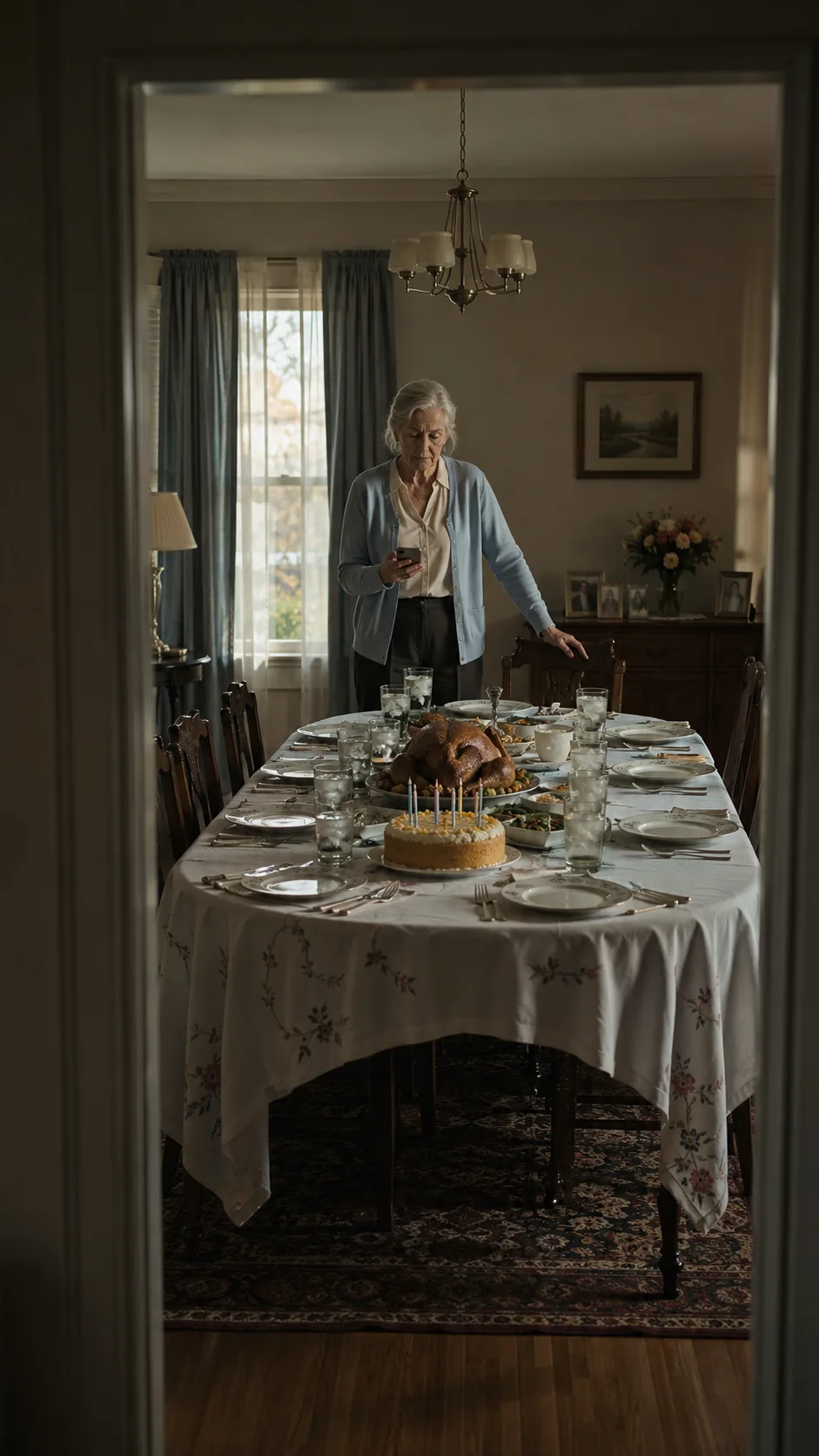
I stood there with the phone still pressed against my ear long after Daniel hung up.
Chapter 2
I stood there with the phone still pressed against my ear long after Daniel hung up.
The call had ended, but those last words kept breathing in the room.
Good. Now ask her about the house next week.
Not, “Is she okay?”
Not, “Maybe we should go see her.”
Not even, “Poor Mom.”
The house.
That was what had survived their forgetfulness.
My birthday had slipped from their minds, but my house remained sharp and clear.
I lowered the phone and stared at the table. The eleven glasses had begun to sweat onto the embroidered tablecloth. My mother’s tablecloth. The one she had given me when Thomas and I married forty-three years earlier.
Thomas had said once that heirlooms were not valuable because they were expensive. They were valuable because they had witnessed things.
That tablecloth had witnessed baby showers, Christmas dinners, school reports, arguments, reconciliations, my daughter’s engagement dinner, my sons bringing home the women they later married.
Now it witnessed me realizing that grief
had not made my children distant.
Convenience had.
I did not cry then.
That surprised me.
I had cried over smaller things after Thomas died. A coffee mug left in the wrong cabinet. His winter coat hanging behind the laundry room door. The day I found three tomato seedlings dried to paper in the garage because I had forgotten to water them.
But that afternoon, with a birthday cake no one had tasted and a roast no one had come home to eat, I felt something colder than sadness.
I felt awake.
I blew out the seven candles alone. Smoke curled over the cake, thin and gray, and for one second I imagined Thomas sitting across from me with that quiet look he used when one of the children had done something wrong and he was waiting for them to confess.
“They’re our kids, Marion,” he used to say.
Yes,
I thought.
And I am their mother.
Not their savings account.
The next week, they did exactly what Daniel’s wife had whispered they would do.
It began with Patrice.
“Mom,” she said, “we’re worried about you.”
I was standing at the kitchen sink washing the same serving platter I had used on my birthday. The house still smelled faintly of lemon and rosemary, though the leftovers had gone into containers no one picked up.
“Worried how?” I asked.
“Well…” She sighed. “You’re alone in that house. It’s too big. Too much responsibility. Dad wouldn’t want you rattling around there by yourself.”
It is strange how often people use the dead to win arguments.
Thomas had loved that house. He had planted the hydrangeas by the porch. He had measured the grandchildren’s height on the inside of the pantry door. He had fixed the back step three times because he said
old wood deserved patience.
But I said nothing.
Patrice continued, “Daniel and Marcus feel the same way.”
Of course they did.
“They thought maybe we should all talk,” she said. “As a family.”
“As a family,” I repeated.
There was a pause on the line.
“Mom, don’t make it sound like that.”
“Like what?”
“Like we’re doing something wrong.”
I looked toward the dining room, where I had not yet removed the eleventh chair.
“When would you like to talk?” I asked.
That Saturday, they came.
All of them.
Not for my birthday, of course. That had been impossible. There had been school stress, tournaments, prior commitments, coastal air, forgotten dates.
But for my house, they found time.
Daniel arrived first with his wife, Lisa, and their two children. He hugged me quickly, one arm, the way men hug women they feel guilty around. Lisa kissed the air near my cheek and looked past me into the foyer as if she were already measuring the square footage.
Marcus came next with Sandra and their boys. Sandra brought store-bought muffins in a plastic container and said, “We thought you might not have much food around.”
I had fed that woman for sixteen Thanksgivings.
Patrice arrived last with her husband, Jeff, and their daughter, Lily. Patrice’s eyes were red, but not from crying. She looked exhausted, irritated, cornered by her own conscience.
For a moment, with all eleven of them standing in my entryway, I remembered the table exactly as I had set it seven days earlier.
Eleven places.
Eleven absences.
Now here they were.
Not hungry for roast.
Hungry for decisions.
We sat in the living room because Lisa said the dining room felt “too formal,” which was her way of saying she did not want to look at the table she had failed to fill.
Daniel cleared his throat.
“Mom, we want to talk about the future.”
I folded my hands in my lap.
“My future?” I asked.
“Our family’s future,” he corrected.
Marcus leaned forward. “Property taxes are going up. Repairs are expensive. You shouldn’t have to deal with all that.”
Sandra nodded. “And honestly, Marion, at your age, these decisions get harder the longer you wait.”
At your age.
Three words.
So clean. So polite. So cruel.
Patrice stared at the carpet.
Daniel opened a folder.
I noticed that immediately.
A blue folder. Crisp. Professional. Prepared.
He had not remembered my birthday, but he had remembered to print documents.
“We talked to someone,” he said. “Just informally.”
“A realtor?” I asked.
Lisa smiled. “And a financial planner.”
I looked at the folder. “How thoughtful.”
Daniel missed the edge in my voice. Or chose to.
“The house is worth more than you realize, Mom. If you sold now, you could move into a really nice senior community. Safe. Social. Less maintenance.”
“And the money?” I asked.
Daniel blinked.
Marcus answered too quickly. “It could be protected.”
“Protected from whom?”
No one spoke.
Then Sandra laughed lightly, the way people do when they want an insult to sound harmless.
“From poor planning, Marion.”
Patrice finally looked up. “Mom, please. Don’t turn this into a fight.”
“I haven’t turned anything into anything,” I said. “I’m listening.”
Daniel slid a paper across the coffee table.
“It’s just a proposal. Nothing final.”
At the top, in neat black letters, it said:
Family Asset Management Agreement.
My house. My savings. My life, rearranged into language that made theft look responsible.
Daniel would be primary manager.
Marcus would be co-manager.
Patrice would have “limited advisory input,” which explained the tightness around her mouth.
And I would receive a monthly allowance from my own money.
An allowance.
At seventy years old.
From children who could not remember to eat the birthday dinner I cooked for them.
I looked at Daniel.
“Did you bring this last Saturday?”
His face changed.
“What?”
“Was this why you were supposed to come?”
Lisa shifted beside him.
Marcus said, “Mom, that’s not fair.”
“No,” I said quietly. “It isn’t.”
Daniel’s jaw tightened. “We’re trying to help you.”
“Were you helping me when you took twenty thousand dollars?”
The room went still.
His children looked up.
Lisa’s smile disappeared.
I turned to Marcus. “Were you helping me when you asked for fifteen thousand to fly Sandra’s family across the country?”
Sandra’s cheeks flushed. “That was a medical situation.”
“And Patrice,” I said, softer now, “were you helping me when you mentioned your roof, your car, and tuition until I filled the silence with checks?”
Patrice’s eyes filled.
“Mom,” she whispered.
Daniel stood. “This is exactly why we’re worried. You’re becoming suspicious. Bitter.”
There it was.
The punishment for noticing.
Marcus added, “Dad wouldn’t like this.”
For the first time all afternoon, I smiled.
Not warmly.
Not kindly.
Just enough for them to stop talking.
“No,” I said. “Your father would have hated this.”
Then I reached under the side table and pulled out a cream envelope.
Daniel frowned. “What is that?”
“A letter,” I said. “From Thomas.”
Patrice put her hand over her mouth.
“He wrote it six weeks before he died,” I continued. “And yesterday morning, I took it to Abigail Reed.”
Daniel’s face hardened. He knew that name. Thomas and I had used Abigail for our wills thirty years earlier.
Lisa sat up straighter. “You met with a lawyer?”
I looked at all three of my children.
“Yes,” I said. “Because last Saturday, I finally understood what your father started seeing before he died.”
Marcus shook his head. “Mom, don’t do this.”
But I was already standing.
I walked to the dining room and switched on the light.
The table had been set again.
Eleven places.
But this time, there was no roast.
No cake.
No candles.
Only eleven envelopes resting on eleven empty plates.
Each envelope had a name written across the front.
Daniel.
Marcus.
Patrice.
Lisa.
Sandra.
Jeff.
And the grandchildren.
My children followed me in silence.
Daniel stared at the envelopes.
“What is this?”
I stood at the head of the table, where I had stood alone on my birthday.
“Before we discuss my house,” I said, “we’re going to discuss what each of you took from it.”
TO BE CONTINUED, PART 3 NOW
Chapter complete
You have reached the end of this chapter.
Continue reading
A few more worlds to get lost in after this chapter.




