PART 3 — I REFUSED TO DISAPPEAR
Daniel looked shocked.
Chapter 3
PART 3 — I REFUSED TO DISAPPEAR
Daniel looked shocked.
Vanessa did not.
“That is an extreme accusation,” she said coolly.
“It is a precise question.”
Daniel looked between us. “Vanessa—”
She hesitated.
And in that hesitation, everything spoke.
“We’re trying to protect the future,” she finally said.
“Whose?” I asked softly.
Neither of them answered.
The candles flickered. Outside, a car passed slowly on the street. Ordinary sounds. Ordinary night.
Inside, the air changed permanently.
I stood and began clearing plates.
“You are guests,” I said quietly. “Not guardians.”
Vanessa rose too.
“This isn’t over.”
“I know,” I replied.
And for the first time, I saw something else in her expression.
Not confidence.
Calculation.
The next morning Vanessa canceled the cognitive evaluation.
Not because she wanted to.
Because she had to.
I know this because I heard her standing in the hallway near the staircase, voice low and sharp.
“We’re postponing,” she said into her phone. “Yes, I understand.
No, she’s being difficult.”
Difficult.
That word rolls so easily off certain tongues when control slips.
I stayed in my bedroom and let her finish. I did not give her the satisfaction of knowing I had heard. Instead I focused on the next step.
Helen had called late the night before.
“We move quickly,” she said. “If they’re building a case, we counterbuild one. Come to my office tomorrow morning. Bring identification and your original deed.”
So that afternoon I retrieved the metal lockbox from the back of my closet.
Vanessa had never noticed it.
Inside were the deed, insurance papers, my will, and the notarized mortgage release.
I put everything neatly into my handbag.
At dinner no one mentioned appointments. No one mentioned cognition. We ate in careful quiet.
Afterward Daniel lingered while Vanessa went upstairs.
“Mom,” he began, his voice softer than usual. “This is getting tense.”
“It
was tense when you scheduled doctors behind my back.”
He looked worn down.
“You don’t understand the pressure we’re under.”
“Then explain it.”
He hesitated. “Rent went up. The renovation is taking longer. We’re stretched.”
“So you thought securing this house would relieve that?”
He didn’t answer directly. He didn’t need to.
“You could have asked for help,” I said quietly.
His shoulders tightened. “It’s not that simple.”
“It never is.”
The next morning I left before either of them woke.
Helen’s office smelled faintly of old paper and lemon polish. She reviewed every document carefully. No rushing. No assumptions.
“You’re legally secure,” she said at last. “But we’re strengthening it.”
We updated my medical directive, with clear language stating that no cognitive evaluations were to take place without my written consent unless ordered by a court. We revised my will, adding clauses that prevented any property transfer under duress
or through vague caregiving claims. We established a trust structure requiring an independent third party for major asset decisions.
“And one more thing,” Helen said. “I recommend drafting a formal occupancy agreement.”
“For my own son?”
“For anyone living under your roof.”
By the time I left her office, I carried a folder thicker than the one Vanessa had assembled.
Documentation works both ways.
When I returned home, Vanessa was waiting at the kitchen island.
“You were out early.”
“Yes.”
“With your lawyer?”
I paused just long enough.
“Yes.”
Daniel came downstairs in the middle of that silence.
“What does that mean?”
“It means,” I said, setting my folder on the counter, “that any further attempts to interfere with my finances, medical status, or property will be addressed formally.”
Vanessa crossed her arms.
“You’re threatening us.”
“I’m protecting myself.”
Daniel ran a hand through his hair, the same nervous habit he had when he was twelve.
“Mom, we don’t want this to get ugly.”
“It already was.”
I slid one document across the counter.
A formal occupancy agreement. Terms clearly outlined. Duration. Responsibilities. Boundaries.
Vanessa scanned the first page, and her expression hardened.
“You expect us to sign this?”
“Yes.”
“And if we don’t?”
“Then we discuss alternative living arrangements.”
The room fell silent for the first time since they arrived.
The power shifted visibly then. Not through shouting. Not through drama.
Through paper.
Vanessa set the agreement down carefully.
“This is extreme.”
“No,” I said. “This is structure.”
She stared at me for a long moment. Daniel looked from her to me and back again, and I saw the realization land.
They had underestimated me.
Now the ground beneath them was no longer steady.
Vanessa did not sign that day. She read the agreement twice, lips thinning further with each paragraph. Daniel read it more slowly, as though testing ice beneath his feet.
“This makes us tenants,” Vanessa said finally.
“You are,” I said evenly. “Guests with structure.”
“We’re family.”
“Family doesn’t require secret evaluations.”
“Mom—”
“The agreement outlines shared expenses,” I continued. “Utilities. Groceries. Duration of stay. Privacy boundaries. No alteration of property without written consent. It protects all of us.”
“It protects you,” Vanessa snapped.
“Yes.”
Silence.
She laid the document down as if it were contaminated.
“We need time.”
“You have forty-eight hours.”
Her eyes flashed.
“You can’t impose deadlines.”
“I can. It’s my house.”
The words felt steady in my mouth now. Not defensive. Not angry. Simply factual.
That evening, something changed again.
Not the tone.
The tactics.
I noticed first when the internet flickered, then vanished entirely. I reset the router. Nothing. Daniel appeared in the hallway.
“We updated the Wi-Fi account,” he said casually. “Bundled it with our phones. More efficient.”
“And the password?”
Vanessa answered from the living room.
“We’ll manage the devices.”
“Manage?”
“I work from home occasionally,” I said. “I need access.”
“You don’t work,” Vanessa said lightly.
I held her gaze.
“Correction. I manage my affairs.”
Daniel shifted. “We’ll give you the password.”
“When?”
“Soon.”
That night I checked my landline.
Dead.
I picked up my mobile and called it.
Disconnected.
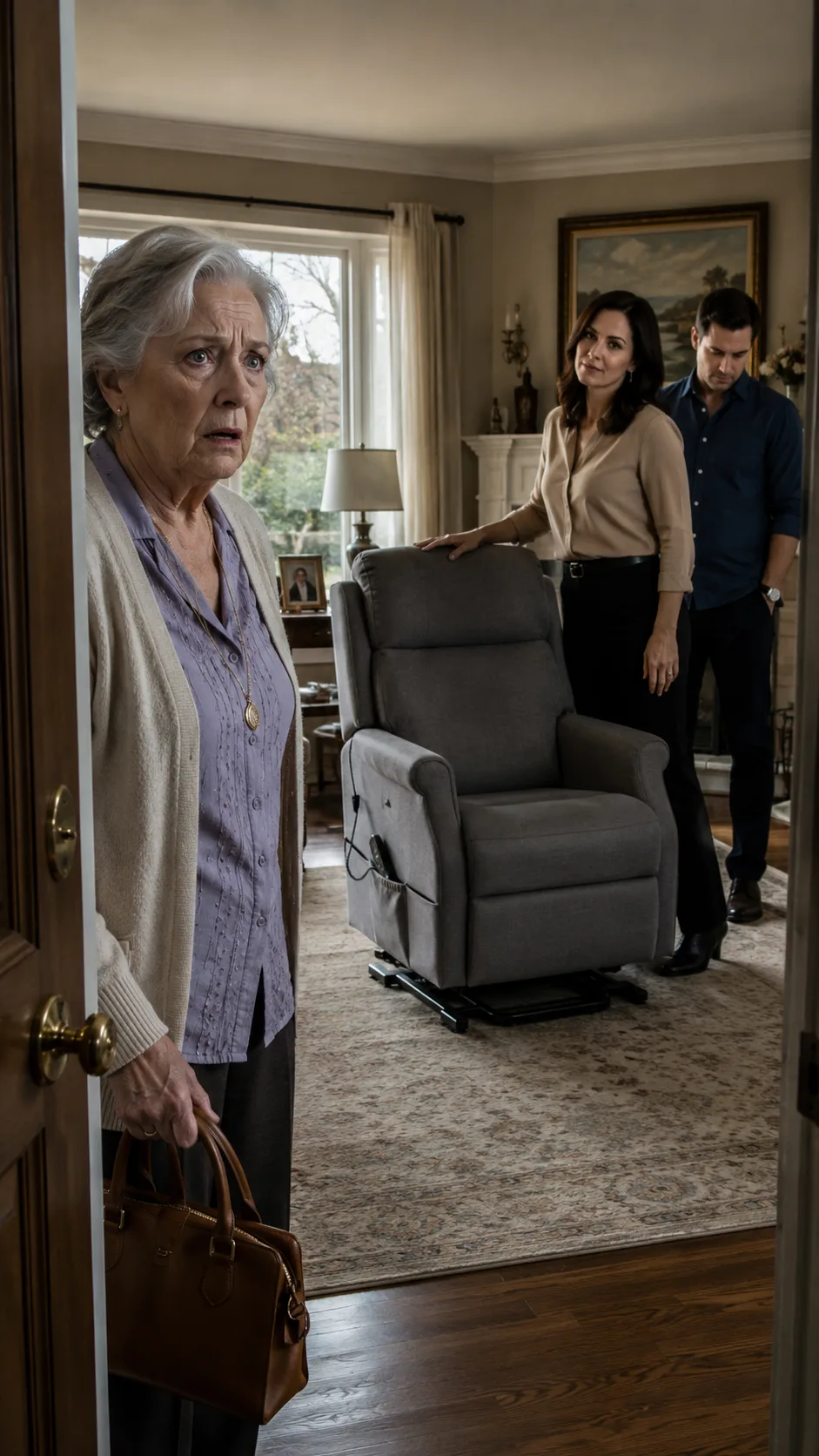
I stood in the hallway listening to the hum of the refrigerator and the faint whir of the gray mechanical recliner as Vanessa adjusted it in the living room.
They were tightening control.
Digitally first. Subtle. Deliberate.
The next morning I did not confront them.
I drove to the service provider’s office.
Yes, drove.
My hands were steady on the steering wheel. My reflexes were intact.
The representative reviewed the account and frowned slightly.
“It was transferred yesterday,” she said. “To a Daniel Hale.”
My son.
Without my authorization.
“It appears he listed himself as primary resident.”
Primary resident.
“I am the homeowner,” I said quietly. “Restore the account immediately. Add a security flag. No changes without in-person verification.”
She complied.
When I returned home, the router lights were blinking again.
Vanessa stood in the kitchen when I entered.
“You went out.”
“Yes.”
“You could have told us.”
“I didn’t realize I needed clearance.”
Her jaw clenched.
Daniel came downstairs minutes later, phone in hand, staring at the screen.
“They reversed the transfer,” he said slowly.
“Yes.”
“You went to the provider.”
“Yes.”
He looked at me, and for the first time there was no irritation in his face, no dismissal.
Only recognition.
“You’re not going to let this go,” he said quietly.
“No.”
Vanessa stepped closer and lowered her voice.
“This is going to get very uncomfortable.”
“It already is.”
She leaned in slightly.
“You think paper protects you, but families are complicated.”
“And law is precise,” I said.
The tension in the room was no longer hidden. It pulsed like heat above asphalt.
That afternoon an envelope arrived by courier.
Not regular mail. Courier.
It was addressed to me.
Inside was a printed notice from a financial advisory firm requesting confirmation of asset review discussions.
I had never contacted them.
Someone had.
I walked into the living room where Vanessa sat scrolling through her phone.
“Did you contact Whitmore Financial?” I asked.
She did not look up immediately.
“We were exploring options.”
“Using my name?”
She finally met my eyes.
“We’re trying to prevent chaos.”
“No,” I said quietly. “You’re trying to create leverage.”
Daniel stepped into the doorway.
“Enough,” he said, tension cracking in his voice.
“Yes,” I agreed. “Enough.”
I placed the courier letter on the coffee table.
“Sign the occupancy agreement. Or begin packing.”
Vanessa stood slowly.
“You wouldn’t evict your own son.”
“Try me.”
The word hung in the room.
Not loud. Not hysterical.
Certain.
And for the first time since they arrived, I saw something shift in her posture.
Not superiority.
Uncertainty.
They did not sign.
Forty-eight hours passed in brittle silence. No shouting. No slamming doors. Only careful movement and measured glances. Vanessa stayed on her phone more often, stepping outside to take calls. Daniel lingered in rooms he once passed through quickly, as though trying to remember what life had felt like before this became a standoff.
On the second evening I noticed something missing.
The metal lockbox.
It had been in my closet that morning.
By dinner, it was gone.
I did not confront them immediately. I walked downstairs calmly and poured myself a glass of water.
My pulse was steady.
Not panic.
Analysis.
Vanessa stood near the sink.
“Have you been in my room?” I asked.
She didn’t blink.
“No.”
Daniel avoided looking at me.
“The lockbox in my closet is missing.”
Daniel’s head snapped up. “What lockbox?”
“The one containing my original deed.”
Silence.
Vanessa’s voice turned cool.
“Why would we touch your things?”
“Because you already have.”
Daniel shifted his weight.
“Mom, maybe you misplaced it.”
“I did not.”
The room felt smaller again, but this time the air was sharper.
“I’m asking once,” I said. “Return it.”
Vanessa folded her arms.
“We don’t have it.”
There are moments when you can feel the exact point of fracture.
That was one of them.
I nodded slowly.
“Very well.”
I walked to the hallway table, picked up my phone, and dialed Helen. I did not lower my voice.
“Helen,” I said clearly, “the original deed has been removed from my locked bedroom without my consent.”
Vanessa stiffened.
“Yes,” I continued. “I would like to file documentation immediately, and I may need to involve law enforcement if it is not returned within twenty-four hours.”
Daniel’s face drained of color.
“Mom—”
I raised one hand without looking at him.
“Yes,” I said into the phone. “I understand. Thank you.”
I ended the call.
Vanessa stepped forward.
“You’re threatening police over a misunderstanding.”
“Removing legal documents from a homeowner’s locked room is not a misunderstanding.”
Daniel dragged both hands through his hair.
“This is insane.”
“No,” I said quietly. “This is theft.”
The word landed heavier than any accusation before it.
Vanessa’s composure cracked.
“You’re overreacting. We were just reviewing things.”
“So you do have it.”
She froze.
Daniel turned toward her slowly.
“Vanessa.”
She exhaled sharply.
“We needed to understand the full picture.”
“You could have asked.”
“You would have said no.”
“Yes.”
Silence again.
Daniel looked between us like a man standing between two closing walls.
“Give it back,” he said quietly.
Vanessa hesitated.
That hesitation told me everything.
She went upstairs without another word. Daniel remained where he was.
“I didn’t know she took it,” he said.
“You didn’t stop her either.”
His shoulders slumped.
A minute later Vanessa returned with the metal lockbox in both hands. She set it on the table harder than necessary.
“You’re destroying this family,” she said coldly.
“No,” I answered. “I’m protecting myself.”
Vanessa stared at me with something close to fury.
“You think paper and threats will save you.”
“I think boundaries will.”
Daniel looked exhausted.
“We just needed stability,” he muttered.
“You needed control,” I corrected.
The mask had slipped completely by then.
Now the next move would decide everything.
Vanessa did not apologize for taking the lockbox. She didn’t need to. Her silence was louder than any excuse.
The following morning I did something she would not anticipate.
I invited witnesses.
Not loudly. Not dramatically.
At eleven o’clock Ruth arrived with her structured handbag and her sharp practical eyes. At eleven-fifteen Helen Carver walked through my front door in a navy blazer carrying a slim leather briefcase.
The night before, I had told Daniel and Vanessa that we would be clarifying household matters. Vanessa assumed it was posturing.
It was not.
We gathered in the living room. Not in the den. Not in the kitchen.
In the center of the house they had been trying to redesign around me.
The gray mechanical recliner sat where my blue chair once had. I did not sit in it.
I remained standing.
Daniel looked uneasy. Vanessa looked irritated but composed.
Helen opened her briefcase.
“Mrs. Hale has requested a formal review of her current living situation,” she said evenly, “specifically regarding unauthorized financial inquiries, medical scheduling without consent, removal of legal documents, and attempted asset consultation under her name.”
Vanessa crossed her arms.
“This is absurd.”
Helen did not look at her.
“I’m speaking to facts.”
Ruth sat quietly beside me, observing.
I stepped forward slightly.
“I welcomed you into this home,” I said to Daniel and Vanessa. “That welcome did not include legal maneuvering or attempts to redefine my competence.”
Daniel swallowed.
Vanessa’s expression hardened.
“We were trying to protect you.”
Helen slid several documents across the coffee table.
“Effective immediately,” she said, “any further interference with Mrs. Hale’s property, accounts, or medical autonomy will constitute documented harassment and potential financial exploitation under state law.”
The word exploitation changed the air.
Daniel looked at me sharply.
“Mom, you’re making us criminals.”
“I’m describing behavior,” I said.
Vanessa leaned forward.
“You can’t evict family over misunderstandings.”
“I can terminate occupancy,” Helen corrected smoothly, “particularly when no lease exists and the homeowner feels threatened.”
“Threatened?” Daniel’s composure cracked. “We never threatened her.”
“You removed her deed from a locked room,” Helen said.
Silence.
Ruth finally spoke.
“Margaret is sharper than most people I know. If anyone suggests otherwise publicly, I will testify.”
Vanessa’s eyes flicked toward her.
Calculating.
I placed one final document on the table.
A formal notice of conditional occupancy termination.
Thirty days. Signed. Not yet filed.
“You have a choice,” I said calmly. “Sign the occupancy agreement today and abide by it, or begin preparing to leave within thirty days.”
Daniel looked at Vanessa.
Vanessa looked down at the papers for the first time since this began. For the first time, she was not calculating advantage.
She was calculating loss.
“You’d throw us out,” she said quietly.
“I will not be erased in my own home.”
The room fell still.
Daniel lowered himself into the gray recliner without thinking. It lifted slightly beneath him, humming mechanically.
The irony was not lost on me.
“We need to talk privately,” Vanessa said to him.
“You can,” I replied. “But the timeline stands.”
They stepped into the kitchen.
Ruth squeezed my hand once.
Helen leaned toward me.
“You did the right thing.”
I nodded. But what I felt rising inside me was not relief.
It was resolve.
Because thirty days is a long time for people who believe they are entitled.
And standing there in the middle of my house, I knew this still was not over.
The house felt different after that meeting.
Not louder.
Thinner.
As if the walls themselves were listening.
Daniel avoided eye contact for most of the day. Vanessa did not. She moved through the rooms with deliberate calm, wiping already-clean counters, adjusting cushions that no longer belonged to her imagined version of the house.
By evening I received the first sign of their counterattack.
A phone call.
Not from them.
From my sister-in-law Elaine.
“Margaret,” she began carefully, “Vanessa mentioned you’ve been overwhelmed lately.”
Overwhelmed.
“I’m quite clear,” I said.
“She said you might be pushing Daniel out over confusion.”
There it was.
The narrative had started to spread.
I kept my voice steady.
“Elaine, were you told they removed my legal documents from a locked room?”
A pause.
“No.”
“Were you told they attempted to open credit in my name?”
Another pause.
“No.”
“I thought not.”
By the time we hung up, I understood something critical. If they could not control me directly, they would control perception.
That night I prepared.
I drafted a short letter—not emotional, not defensive—simply outlining the facts.
Unauthorized bank inquiry. Attempted medical scheduling without consent. Removal of deed. Legal response taken. Boundaries established.
I printed copies.
The next morning I invited two more neighbors over for coffee.
Not gossip.
Witness.
We sat in the living room. I served proper coffee in porcelain cups, not the oversized mugs Vanessa preferred. I laid out the timeline clearly, with documents.
No dramatics.
Just clarity.
People listen differently when paper is present.
By afternoon, something shifted. Vanessa returned from outside looking tighter than usual.
“Did you speak to the neighbors?” she asked sharply.
“Yes.”
“You’re turning people against us.”
“I’m correcting misinformation.”
Daniel stepped into the hallway.
“You didn’t have to escalate publicly.”
“I didn’t. I clarified privately.”
Vanessa’s composure cracked again.
“You’re humiliating us.”
“No,” I said evenly. “Your actions are.”
Then came the final move I had not anticipated.
A knock at the door.
Two representatives from Adult Protective Services stood on the porch. Polite. Neutral.
“We received a concern regarding your well-being,” one of them said.
Daniel stood frozen behind them. Vanessa’s face was unreadable.
I did not react.
“Please,” I said calmly, stepping aside. “Come in.”
They asked questions—orientation, date, current events, medication, finances, living conditions.
I answered every one clearly.
I provided documentation.
I handed them Helen’s card.
I described the unauthorized bank inquiry. The removed deed. The scheduled cognitive evaluation without my consent.
The representatives exchanged a look.
Then they spoke with Daniel and Vanessa separately.
The air in the hallway felt thick enough to touch.
After thirty minutes, they stood to leave.
“Mrs. Hale appears fully competent and aware of her affairs,” one of them said professionally. “We see no indication of vulnerability at this time.”
Daniel looked down.
Vanessa’s jaw tightened visibly as the door closed behind them.
Silence flooded the house.
I turned toward them slowly.
“You called them,” I said.
Vanessa did not deny it.
“We were concerned.”
“No,” I corrected. “You were strategic.”
Daniel looked shaken now. Not angry. Not defensive. Shaken.
“You made it official,” I said quietly. “You escalated it beyond family.”
“We had to ensure protection,” Vanessa said.
“For whom?”
No one answered.
The power had shifted again.
They had tried the strongest card available to them.
And it had failed.
For the first time since this began, I saw fear in Vanessa’s eyes.
Not fear of me.
Fear of consequences.
After Adult Protective Services left, the house felt exposed.
Not fragile.
Revealed.
Daniel stood in the hallway a long time, staring at nothing. Vanessa went straight to the kitchen and began wiping the counter again, though it was already spotless.
“You went too far,” Daniel said finally.
“I did not call them.”
He flinched.
Vanessa spoke without turning around.
“We needed documentation.”
“You have it now.”
Silence spread through the house like ink in water.
That evening Daniel knocked on my bedroom door again.
Not aggressively. Not defensively.
“Can we talk?”
I let him in.
He sat on the edge of my desk chair, shoulders heavy.
“I didn’t think it would go like this,” he said quietly.
“How did you think it would go?”
He hesitated.
“I thought we’d transition things gradually. You’d move somewhere smaller eventually. We’d refinance here. It would help all of us.”
There it was.
The original plan, finally spoken plainly.
“And my consent?”
He did not answer.
“You decided the ending,” I said softly, “without telling me.”
He looked up, and for one brief second I saw the boy he used to be—the child who cried when he scraped his knee, who asked before borrowing the car, who once believed asking permission mattered.
“It got complicated,” he said.
“It got greedy.”
He did not argue.
The next morning Vanessa signed the occupancy agreement.
Not gracefully.
Not willingly.
But clearly.
Daniel signed as well.
I watched them initial every clause: duration, shared expenses, no alterations to property, no financial actions under my name, no medical decisions without written consent.
The thirty-day termination notice still existed.
But now there were boundaries in ink.
For a week the house stabilized. No missing documents. No altered accounts. No whispered hallway calls. But tension remained. Vanessa moved carefully, though not humbly. She watched me differently now—less like an obstacle, more like a barrier she had misjudged.
Then came the final fracture.
On the eighth day after the APS visit, Helen called.
“They contacted another advisory firm,” she said calmly. “They attempted to inquire about property transfer structures. Not in your name this time. Hypothetical questions about elder homeowner transitions.”
I closed my eyes briefly.
“They’re still exploring angles.”
“Yes,” she said. “Which means the intent hasn’t changed.”
That evening I called Daniel and Vanessa into the living room.
No witnesses this time.
Just us.
“I’ve been informed you’re still investigating transfer options,” I said evenly.
Daniel looked stunned.
Vanessa did not.
“We’re planning for the future,” she said coolly.
“The future does not include manipulation.”
Daniel’s voice cracked slightly.
“Mom, we can’t keep living like this.”
“You won’t.”
Silence.
I walked to the hallway table, picked up the notice of conditional occupancy termination, and placed it on the coffee table between us.
“I’m filing it tomorrow.”
Daniel stared at me.
“You’re serious?”
“Yes.”
Vanessa’s voice turned sharp again.
“You’d rather live alone than have family?”
“I’d rather live in peace than under strategy.”
The mechanical recliner hummed softly as Daniel shifted in it.
“It’s thirty days,” I said calmly. “Use them.”
Daniel’s shoulders dropped.
Vanessa looked at me for a long moment, something cold settling behind her eyes.
“You’ll regret this.”
“No,” I said. “I won’t. Because regret requires doubt. And for the first time since you arrived, I have none.”
They moved out on the twenty-seventh day.
Not thirty.
Twenty-seven.
Boxes began appearing quietly in the hallway three days after I filed the termination notice through Helen. No speeches. No last-minute negotiations. Vanessa stopped pretending entirely. Daniel stopped trying to bridge the silence.
On the final morning I woke before them.
The house was almost empty again. Their chrome coffee machine was gone. The beige runner had disappeared from my table. Even the gray mechanical recliner had been disassembled and removed.
They left the walls intact.
I walked into the garage.
And there, leaning against the far wall and loosely wrapped in a sheet, was my blue armchair.
Not donated.
Hidden.
I stood very still.
They had planned to remove it quietly. To erase it without confrontation. But in the rush of leaving, they forgot.
Or perhaps Daniel hesitated.
I do not know.
I dragged it back inside myself, slowly and carefully. It felt heavier than before, not physically, but symbolically.
I positioned it exactly where it had always belonged, by the bay window where the afternoon light gathers like warm honey. Dust clung to the fabric. One leg was scratched. I cleaned it with a damp cloth and sat down.
No permission required.
No schedule taped to the refrigerator.
No whispers in the hallway.
Silence.
Real silence.
Daniel knocked before they left. I opened the door.
He looked smaller somehow. Not physically. Internally.
“We’ll find somewhere else,” he said.
“I hope you do.”
He hesitated.
“It wasn’t supposed to become this.”
“It did.”
Vanessa stood near the car with her arms crossed, waiting.
Daniel swallowed.
“You could have helped us.”
“I would have,” I said softly, “if you had asked.”
He nodded once.
No apology. No dramatic reconciliation.
Just consequence.
They drove away without looking back.
The house exhaled.
That afternoon I made tea. Darjeeling, exactly at six. I set the kettle on my stove—my stove—waited for the low whistle, then carried my cup into the living room and sat in my chair.
The familiar creak beneath me felt like recognition.
Peace is not the absence of conflict.
It is the presence of boundaries.
I am seventy-seven years old, and I do not ask for much.
Just peace.
And now, at last, I have it again.
THE END.
Chapter complete
You have reached the end of this chapter.
Continue reading
A few more worlds to get lost in after this chapter.




