PART 2 — THE PLAN TO ERASE ME
I did not argue.
Chapter 2
PART 2 — THE PLAN TO ERASE ME
I did not argue.
I went to the pantry instead and noticed my Earl Grey tin was gone. In its place were neatly stacked bags of quinoa, chia seeds, and something called activated buckwheat. My tin sat on the top shelf behind a basket labeled Legacy Items.
Legacy. As if I were already gone.
Daniel came in ten minutes later, hair still damp from the shower, one earbud in. He kissed Vanessa on the cheek and gave me a distracted nod.
“Morning, Mom.”
“Where’s my tea?” I asked.
He pulled out the earbud. “Vanessa reorganized. It’s more efficient this way.”
“For whom?”
He sighed. “Can we not start the day like this?”
Like this. As though I had lit the match.
By afternoon they had moved more things.
My porcelain figurines—three small swans I had owned since my wedding day—were packed into a box.
“Too fragile,” Vanessa explained. “We don’t want accidents.”
Accidents.
I
walked into the living room and saw my bookshelf half-empty. My cookbooks, with my handwritten notes tucked between pages of cocoa cake and lemon pie recipes, were stacked on the floor. In their place stood glossy design books and a ceramic sculpture that looked like a twisted bone.
“Vanessa felt the room needed elevation,” Daniel said when he noticed me looking. “It’s about value perception.”
Value perception.
In a house I paid off in 2003.
That evening they hosted friends. I was informed at noon by text message.
Just a small gathering, Vanessa wrote. Probably best if you keep to the den so it’s not overwhelming.
Overwhelming for whom?
At seven, laughter filled the house. I sat in the den at first and listened. Someone in the living room asked, “So how long has this place been yours?”
Vanessa answered in that breezy voice of hers.
“Oh, we’re figuring that
out. It’s a transitional phase.”
Transitional.
I stood.
I walked into the living room wearing my cream cardigan and the small gold locket I have worn since I was thirty-one. Conversations faltered for half a second. Vanessa’s smile tightened.
“This is my mother,” Daniel said quickly. “She’s staying with us.”
Staying with us.
I looked at the guests—three couples, polite faces, curious eyes.
“Actually,” I said gently, “they’re staying with me.”
Silence. A glass clinked softly on the coffee table.
Vanessa laughed.
“Oh, Margaret has such a sense of humor.”
I didn’t sit. There was nowhere for me to sit. My blue chair was still in exile. The narrow angular thing faced away from the room, decorative but unwelcoming.
So I remained standing until Daniel touched my elbow.
“Mom,” he whispered, “you’re making it awkward.”
Awkward is when someone forgets a name at dinner.
This was something else.
I went
back to the den on my own. I did not slam a door. I did not raise my voice. But as I passed through the hallway, I noticed something new on the small console table near the front entrance.
A thick manila folder with my name printed on a white label.
Margaret Hale.
I didn’t open it. Not yet.
But I felt it.
The shift had deepened. This was no longer about furniture or tea schedules. They were organizing more than a house, and I was done pretending not to see it.
I waited until the house went quiet. The laughter faded around eleven. Doors closed. Water ran upstairs in the bathroom.
I sat in the den with my hands folded over my handbag, listening the way I used to listen when Daniel had a fever as a child, counting breaths through walls.
At midnight I stepped into the hallway.
The folder was still there.
The paper felt heavier than it should have.
I carried it back to the den and closed the door softly behind me. No trembling. No rushing. Just steady hands and the low hum of the old lamp in the corner.
Inside were copies of property tax statements, my mortgage payoff confirmation from 2003, bank summaries, and a printed estimate of my home’s current market value highlighted in yellow. A sticky note was attached to one page.
Sign when ready. Will handle the rest.
There was no signature line yet. Just preparation.
Preparation for what?
Then I turned the page and saw the answer.
A brochure from a senior assisted living facility.
Smiling gray-haired couples holding hands beneath bright artificial sunshine. The words Independent Living Transition Program were circled in pen.
Transition.
So that was the direction of the current.
The next morning I did something I had not done in years.
I locked my bedroom door.
At breakfast, in my designated seven o’clock time slot, I placed the folder neatly on the table between us.
Vanessa froze first. Daniel followed.
“What’s this?” I asked calmly.
Daniel swallowed. “Mom, we were just organizing paperwork.”
“In case anything ever…” He stopped.
“In case anything ever what?” I asked.
Vanessa leaned forward, both palms flat against the table as though she were presenting quarterly projections.
“Margaret, you’ve said yourself you get tired sometimes. We thought it might be responsible to explore options before things become stressful.”
“For whom?” I asked again.
“For everyone,” she said smoothly.
There it was again.
Everyone.
Daniel avoided my eyes. “It’s just planning, Mom. Estate stuff. Protection.”
“Protection feels different from replacement.”
I opened the brochure slowly and slid it toward him.
“Did I ask for this?”
“No,” he said.
“No. I did not.”
Silence.
Vanessa exhaled through her nose. “This is exactly why we need structure. Emotional reactions don’t help.”
Emotional.
I have buried a husband. I have survived two surgeries. I have balanced three jobs at once. If this was emotional, then earthquakes are gentle breezes.
I folded the papers back into the folder.
“You went through my files.”
“We were helping,” Daniel said weakly.
“My filing cabinet was locked.”
Another silence.
Vanessa’s jaw tightened. “Margaret, when families live together, there has to be transparency.”
“Transparency without permission is intrusion.”
That afternoon I checked something else.
My spare keys were gone from the porcelain bowl near the hallway mirror where they had sat for fifteen years. In their place, on the side door leading into the garage, was a new keypad no one had mentioned.
“Security upgrade,” Daniel said when I asked.
“What’s the code?”
Vanessa answered before he could.
“We’ll manage access. It’s simpler that way.”
Manage access.
To my own home.
That evening I went into the den and pulled my blue armchair closer to the small desk in the corner. I opened my old leather-bound address book—the one Vanessa had called clutter—and ran my finger down the pages.
Names I had not needed in years.
Until now.
I may have been seventy-seven, but I was not confused, and I was not transitioning anywhere without a fight.
The next morning I put on lipstick. Not because I was going anywhere glamorous. It was simply a ritual from another era, a reminder to myself that presentation is power. Coral Rose—the shade I had worn the day Daniel graduated college.
If they were preparing paperwork behind my back, then I would prepare too.
At nine sharp I walked to the local bank branch three blocks away. I did not tell them I was leaving. I did not leave a note. I simply took my handbag, the sturdy brown leather one with the brass clasp, and stepped into the cool morning air.
The young man at the desk smiled politely when I gave him my name. His expression changed almost imperceptibly as he typed.
“Mrs. Hale, there was an inquiry submitted regarding a home equity line of credit.”
“I did not submit one.”
“Yes, ma’am. It appears someone requested preliminary information online. It wasn’t finalized. We attempted to call for confirmation, but didn’t reach you.”
“My number hasn’t changed in twenty-two years,” I said.
He nodded slowly.
“The contact number listed was different.”
Different.
I felt something cold settle into my spine—not panic. Clarity.
“Please place a note on my account,” I said. “No inquiries, no changes, no applications without me physically present. And add a verbal password.”
He blinked once. “Of course.”
“I would also like a printed copy of any recent access attempts.”
He hesitated only a moment before nodding again.
When I walked home, the house looked the same. Pale siding. Trim hedges. The ceramic birdbath Daniel made in middle school still crooked beside the roses.
But it no longer felt neutral.
It felt like a stage set.
Inside, Vanessa was in the kitchen blending something aggressively green.
“You were out,” she said, checking her watch.
“Yes.”
“You didn’t mention that.”
“I didn’t realize I needed clearance.”
Her lips pressed thin.
“We worry.”
“No,” I said quietly. “You plan.”
Daniel came downstairs halfway through the exchange, sensing tension the way he used to when his father and I argued about money.
“What’s going on?”
“I visited the bank,” I said evenly.
Vanessa froze for half a second.
“Why?” she asked lightly.
“To ensure no one is opening lines of credit against my house.”
Silence.
Daniel’s face drained.
“Mom, we were just exploring options.”
“It wasn’t yours to explore. Exploring requires consent.”
Vanessa set the blender down harder than necessary.
“You’re twisting this. We’re trying to secure the future.”
“My future?”
“For all of us,” she said again.
There it was. The phrase that meant them.
I placed the printed bank report on the counter. The unfamiliar phone number glared up from the page.
“I’ve placed a lock on my accounts,” I said. “Any further attempts will require me in person.”
Daniel ran a hand through his hair. “You didn’t have to escalate this.”
“Escalate?”
I almost laughed.
“You installed a keypad without telling me. You moved my documents. You contacted my bank. If anyone escalated, it wasn’t me.”
Vanessa crossed her arms.
“You’re being paranoid.”
That word. Old people and paranoia. They fit together so neatly in other people’s minds.
“Perhaps,” I said softly. “But paranoid people don’t leave paper trails.”
Her eyes sharpened at that.
The rest of the day was quiet in a way that wasn’t peaceful. Doors closed more gently. Voices lowered. But I felt the shift. They understood something had changed.
That evening, when I walked into the living room, the angular chair was still there, but my blue armchair had been moved again.
Not to the den.
To the garage.
I saw it through the little window in the door—my chair sitting between paint cans and a folded aluminum ladder.
Exiled further.
I stood there for a long moment and realized this was no longer about money.
This was about erasure.
And I do not disappear quietly.
I did not confront them about the garage. Not immediately. Instead I opened the side door, stepped into the cool cement-scented air, and ran my hand over the worn fabric of my chair. Dust had already begun settling along the arms. A smear of white paint marked one leg.
Careless.
As if it were only another object waiting to be discarded.
I didn’t drag it back inside. Not yet.
I went upstairs instead, slowly, deliberately, and when I reached my bedroom I locked the door again and sat at my small writing desk, the one Vanessa had called quaint.
I opened my address book to the letter C.
Carver, Helen — estate and probate attorney.
Helen and I had shared lemon scones at a church fundraiser fifteen years earlier. Her husband died the same year mine did. We had not spoken recently, but I remembered two things about her. She listened carefully, and she did not scare easily.
I dialed.
Her voice was older now, rougher around the edges, but steady.
“Helen, it’s Margaret Hale.”
A pause. Then warmth.
“Margaret. I wondered when you might call.”
I did not waste words. I explained the brochure. The bank inquiry. The folder. The keypad. The quiet language of transition.
I did not cry. I did not dramatize. I laid facts on the table like playing cards.
When I finished, she was silent for a few seconds.
“Do you still hold full title to the house?” she asked.
“Yes.”
“Any joint ownership, transfers, powers of attorney?”
“No.”
“Good,” she said. “Then they’re testing boundaries, not acting legally yet.”
“Yet.”
“I want to protect myself.”
“You will,” she said. “But protection requires preparation. I’ll need copies of everything. And Margaret?”
“Yes?”
“Stop being polite.”
That made me smile for the first time in days.
After I hung up, I did something Vanessa would not expect.
I took photographs.
The garage. My chair. The new keypad. The rearranged filing cabinet. The folder. I even photographed the house rules list still taped to my refrigerator.
Evidence.
That afternoon Daniel knocked on my bedroom door.
“We need to talk,” he said.
I unlocked it.
He stepped inside and closed the door behind him. He looked tired. Thinner somehow.
“Vanessa feels like you’re undermining us,” he began.
“Undermining what?”
“Our attempt to stabilize things.”
“Daniel,” I said gently, “this house has been stable for decades.”
He paced once across the carpet. “You don’t see the bigger picture. Property taxes are rising. Maintenance costs. It makes sense to restructure assets now instead of later.”
“Restructure whose assets?”
He hesitated. “There are ways to simplify ownership. For protection. For tax efficiency.”
“By moving me out?”
He flinched. “That’s not what I said.”
“You printed a brochure.”
“That was just research.”
“And the bank inquiry?”
He looked away. “It wasn’t finalized.”
“No,” I said. “Because I stopped it.”
His jaw tightened.
“You’re making this adversarial.”
“No. You did that when you stopped asking.”
For a moment I saw something flicker in his expression. Not anger. Not arrogance.
Fear.
Of what, I wasn’t yet sure.
Vanessa’s voice floated up from downstairs.
“Daniel.”
He stepped toward the door, then paused.
“We’re trying to think long-term.”
“So am I,” I said.
When he left, I sat back down at my desk and opened a small wooden box I had not touched in years. Inside were old documents: my will, updated after my husband died; a notarized statement from 2010; a list of beneficiaries.
Everything was intact.
But not specific enough.
Helen would help with that.
That evening I made dinner. Proper dinner. Roast chicken with rosemary and thyme. Buttered carrots with a pinch of nutmeg. A small glass of sherry for myself. I plated everything beautifully and even used the china Vanessa had once called impractical.
When they came to the table, Vanessa looked almost startled.
“What’s the occasion?” she asked.
“No occasion,” I said calmly. “Just reclaiming my kitchen.”
She sat stiffly. Daniel said very little.
Halfway through dinner, I spoke again.
“I will not be transitioning anywhere,” I said, cutting my chicken carefully. “And no financial decisions will be made about this house without my explicit, written, notarized consent.”
Vanessa set her fork down.
“Margaret, you’re escalating this unnecessarily.”
“No,” I replied, meeting her eyes for the first time without softness. “I’m clarifying.”
The room felt smaller after that.
Later that night, passing through the hallway, I noticed the folder was gone from the console table.
Good.
Let them hide it.
I already had what I needed.
The next two days were quiet in a way that felt rehearsed. Vanessa stopped mentioning structure. Daniel avoided financial vocabulary altogether. The house rules sheet disappeared from the refrigerator.
If an outsider had walked through the front door, they might have thought everything had settled.
But politeness after exposure is not peace.
It is recalculation.
On Thursday morning I found something new on the kitchen counter: a small weekly pill organizer already filled Monday through Sunday.
“For you,” Vanessa said lightly when she saw me looking. “Just to make things easier.”
I stared at the translucent lids.
“I manage my own medication.”
“It’s just vitamins,” she said. “And your blood pressure tablets. Daniel mentioned you forgot once last month.”
I had not forgotten. I had delayed it by an hour.
“I’ll handle my own health,” I said, pushing the organizer back toward her.
She did not argue. She only picked it up and placed it beside the coffee machine.
A visible marker.
That afternoon I noticed another change.
My mail was no longer on the hallway table.
It sat in a neat stack beside Vanessa’s laptop.
“I sorted it,” she said before I could ask. “Junk goes straight to recycling.”
“Open envelopes aren’t junk.”
She gave me a small patient smile. “I was helping.”
Helping had become the most dangerous word in my house.
That evening I made a quiet decision. I would no longer react in real time.
Instead, I would observe.
After dinner—salmon, slightly overcooked because Vanessa insisted on well-done “for safety”—I excused myself early and went to my bedroom. I pulled out a small spiral notebook I used to track household expenses. On the first blank page I wrote the date.
Then I began listing.
Keypad installed without notice.Bank inquiry using unknown number.Legal paperwork assembled without consent.Medication organizer prefilled.Mail intercepted.
Facts, not feelings.
At ten-thirty I heard low voices in the hallway. My door was slightly ajar. I remained still.
“We have to move faster,” Vanessa whispered.
Daniel answered more quietly. “She went to the bank. We can’t rush it now. She’s suspicious.”
“She’s my mother.”
“She’s an obstacle.”
Obstacle.
I did not move. I did not change my breathing. I simply let the word settle.
Obstacle. Not family. Not resident. Not homeowner.
Obstacle.
Their footsteps faded downstairs. I waited five full minutes before standing.
Then I walked to the hallway console table.
The folder was back, thicker this time.
Inside were new documents. A draft letter addressed to a physician regarding a cognitive evaluation. Notes about “observed forgetfulness.” Bullet points. Clinical language.
They were building a narrative.
And narratives, once documented, travel.
I photographed every page.
Then I did something else.
I called Ruth, my neighbor of thirty-two years, the woman who knows how I take my tea and when my lawn was last reseeded. If anyone could speak to my supposed decline, it would be Ruth—and she would laugh at the suggestion.
“Ruth,” I said when she answered, “I may need you to remember a few things for me.”
She didn’t ask many questions.
“Come by tomorrow,” she said. “I’ll make biscotti.”
The house felt different after that call.
Not smaller.
Sharper.
Back in my bedroom, I opened the wooden box again and added something new: a USB flash drive I had once used for family photos.
That night it held copies of every image I had taken.
Backup.
Because if they were constructing a case, I would not stand unarmed.
They believed I was seventy-seven and tired.
They were correct about one thing.
I was tired.
But I was not weak, and I was certainly not an obstacle.
I did not sleep much that night. Not because I was afraid. Because I was thinking.
By morning the house had settled into its now-familiar performance of civility. Vanessa hummed while slicing avocado. Daniel read news headlines aloud like nothing was cracking beneath us. I watched them the way one watches weather move in—subtle pressure changes, invisible currents.
At noon I told them I would be visiting Ruth.
Vanessa offered to drive me.
“I still know how to cross a street,” I said evenly.
Ruth’s kitchen smelled like cinnamon and old wood. The biscotti were slightly overbaked, just the way she preferred them. I laid everything out for her calmly, chronologically: the folder, the letter draft, the bank inquiry, the word obstacle.
Ruth did not interrupt.
When I finished, she removed her glasses and stared at me hard.
“You’re sharper than I am,” she said. “And I balance three bridge groups.”
“I may need a written statement.”
“You’ll have it.”
By three o’clock I was back home.
The garage door was open.
My blue armchair was no longer there.
For one split second my heart kicked hard against my ribs. Not panic. Recognition.
I stepped inside.
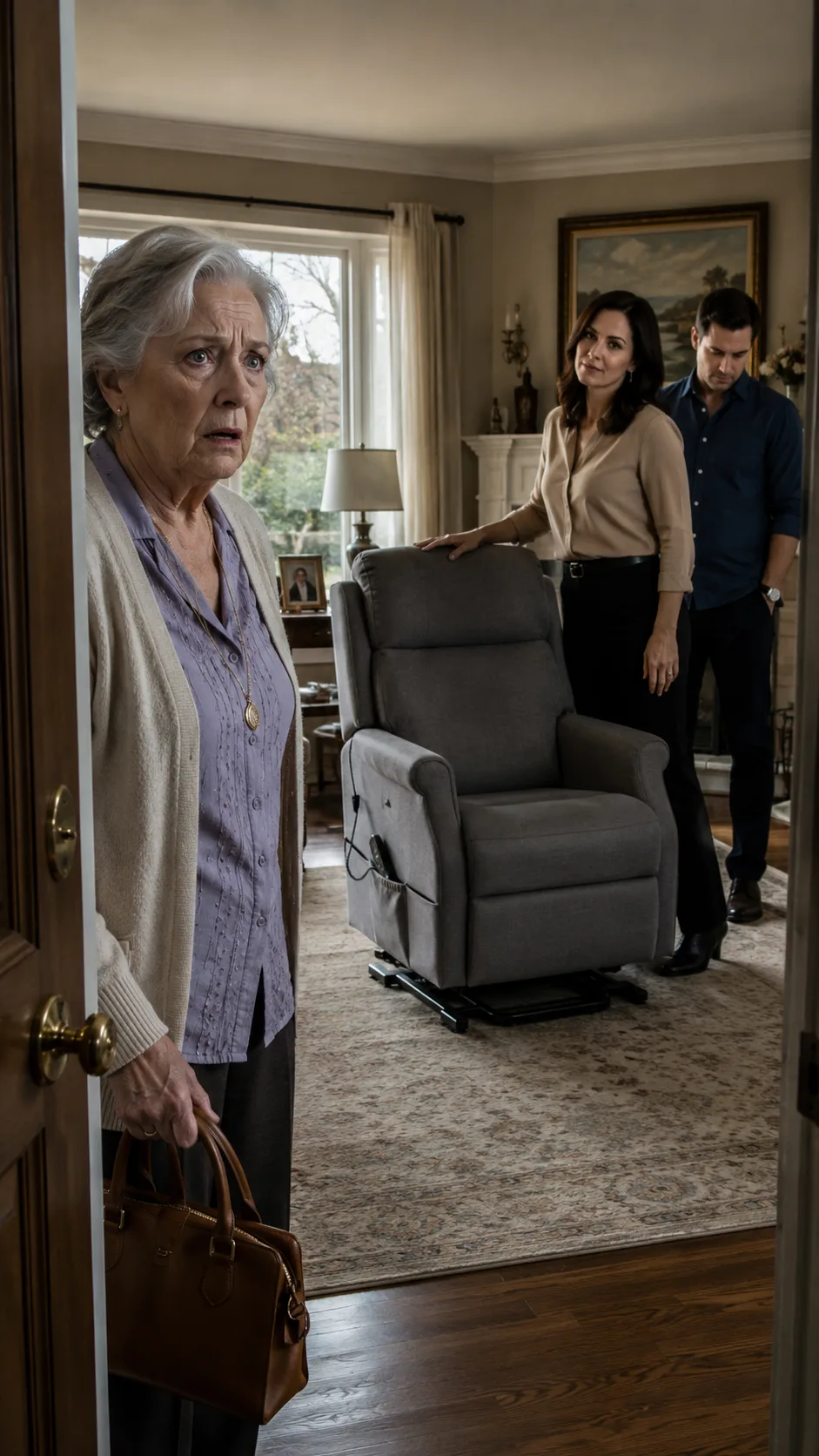
The living room had been rearranged again. The angular accent chair was gone. In its place stood a larger plush recliner in dark gray—mechanical, modern, the kind designed for someone who needed assistance standing up.
Vanessa stood beside it.
“We thought this would be better for you,” she said gently. “It has lift support.”
Daniel hovered nearby, not quite looking at me.
“And my chair?”
Vanessa smiled thinly.
“It was worn. We donated it.”
Donated.
Without asking.
Without telling me.
My husband died in that chair.
I sat in it the night I received the hospital call. It held thirty-four years of quiet evenings, winter naps, and ordinary marriage.
“You donated it,” I repeated.
“It was time,” she said. “We have to move forward.”
Move forward.
Something in me hardened then. Not loudly. Not explosively. Just firmly.
I walked to the new recliner and pressed the button. It hummed, lifting slowly, tilting forward like it was presenting me to the room.
A throne of managed decline.
“I don’t need help standing,” I said.
Vanessa’s voice lost some of its softness.
“Margaret, this resistance isn’t healthy.”
“Healthy?”
Daniel finally spoke. “Mom, we scheduled an appointment next week. Just a consultation. A cognitive screening to ease everyone’s mind.”
“You scheduled,” I repeated.
“For your benefit,” Vanessa said quickly.
And there it was.
The line crossed without permission.
I looked at my son.
“Did you tell them I agreed?”
He hesitated.
Silence is an answer.
“They just need to assess,” Vanessa said. “If everything is fine, wonderful. If not, we can plan appropriately.”
Plan.
I walked past them to the hallway console. The folder was there again, slightly open. I reached into my handbag and placed one sheet on top of it: a printed notice from my bank confirming that all financial activity on my accounts required my in-person authorization.
Signed. Stamped.
Then I added another.
Helen Carver’s business card.
Vanessa’s expression changed. Daniel’s face went pale.
“I’ve also scheduled an appointment,” I said calmly. “To update my legal protections, including medical directives and property restrictions.”
“You didn’t tell us,” Vanessa said sharply.
“I didn’t realize I needed clearance.”
The words hung in the air between us.
For the first time since they moved in, Vanessa dropped the polite tone entirely.
“This doesn’t have to be a fight,” she said coldly.
“No,” I agreed. “It doesn’t.”
I walked to the front door and opened it.
“You will cancel that appointment,” I said. “And no further discussions of my cognitive state will happen without me present.”
Daniel looked torn, but Vanessa stepped forward instead.
“You’re overreacting.”
“No,” I said quietly. “I’m responding.”
Outside, the late afternoon sun lit the porch in gold. For the first time in weeks, I felt steady.
They thought replacing a chair would soften me. They thought paperwork would corner me.
They forgot one important thing.
I built this house.
And I was not finished standing in it.
The house did not explode after that conversation.
It narrowed.
Vanessa stopped pretending to be gentle. Daniel stopped pretending not to notice. We moved around one another like diplomats from hostile countries sharing a thin and temporary border.
On Sunday I suggested dinner.
“A proper one,” I said. “Candles, wine, no phones.”
Vanessa studied me for a moment.
“What’s the occasion?”
“I feel like cooking.”
Control can look like aggression. But sometimes it also looks like hospitality.
I went to the market alone. I chose ingredients carefully—fresh thyme, shallots, a small wheel of pecorino, and a cut of lamb I hadn’t cooked in years. I even bought saffron, the real kind, in a tiny glass vial that smelled faintly metallic and warm.
When I returned, Vanessa was in the living room on the phone. I caught only fragments as I passed.
“Evaluation next Thursday… yes, she’s resistant… documentation…”
She saw me and lowered her voice.
That evening I set the table with my china again. Linen napkins. Two slender beeswax candles. A small bowl of olives in the center.
Daniel looked uncertain. Vanessa looked strategic.
We ate slowly. I poured a modest amount of red wine into each glass. I did not overfill mine.
Halfway through the meal, I leaned back.
“I’ve been thinking,” I said calmly.
Vanessa straightened.
“It would be helpful if we clarified expectations.”
“In what sense?” she asked.
“In the sense that this is my property, and while I welcomed you here, that welcome did not include my removal.”
Daniel shifted. “Mom—”
“I’m not finished.”
Silence.
“I want transparency as well,” I said. “If there are concerns about my cognition, voice them directly now with specifics.”
Vanessa met my eyes.
“You’ve been forgetful.”
“Example.”
“You misplaced your reading glasses last week.”
“They were in the garden.”
“You repeated a story at dinner.”
“I’ve repeated stories for forty years.”
Daniel rubbed his temples. “This is uncomfortable.”
“Yes,” I said. “It is.”
Vanessa exhaled slowly.
“Margaret, you don’t adapt well to change.”
“Change?”
I set down my fork.
“My husband died. That was change. I survived.”
No one spoke for several seconds.
“You scheduled a cognitive evaluation without my consent,” I said. “That appointment will be canceled.”
“You can’t stop us from caring,” Vanessa said.
“Care does not override autonomy.”
She opened her mouth to answer, but I reached into my cardigan pocket and placed something on the table.
A small digital recorder.
Not turned on. Just present.
Daniel stared at it. “What is that?”
“Insurance.”
Vanessa’s composure cracked for the first time.
“Are you recording us?”
“Not yet.”
Silence, heavier this time.
“I prefer clarity,” I said. “So I’ll ask plainly. Are you attempting to establish grounds to declare me incompetent?”
To be continued… Click “PART 3” to read the final part: 👉 PART 3 👈
Chapter complete
You have reached the end of this chapter.
Continue reading
A few more worlds to get lost in after this chapter.




