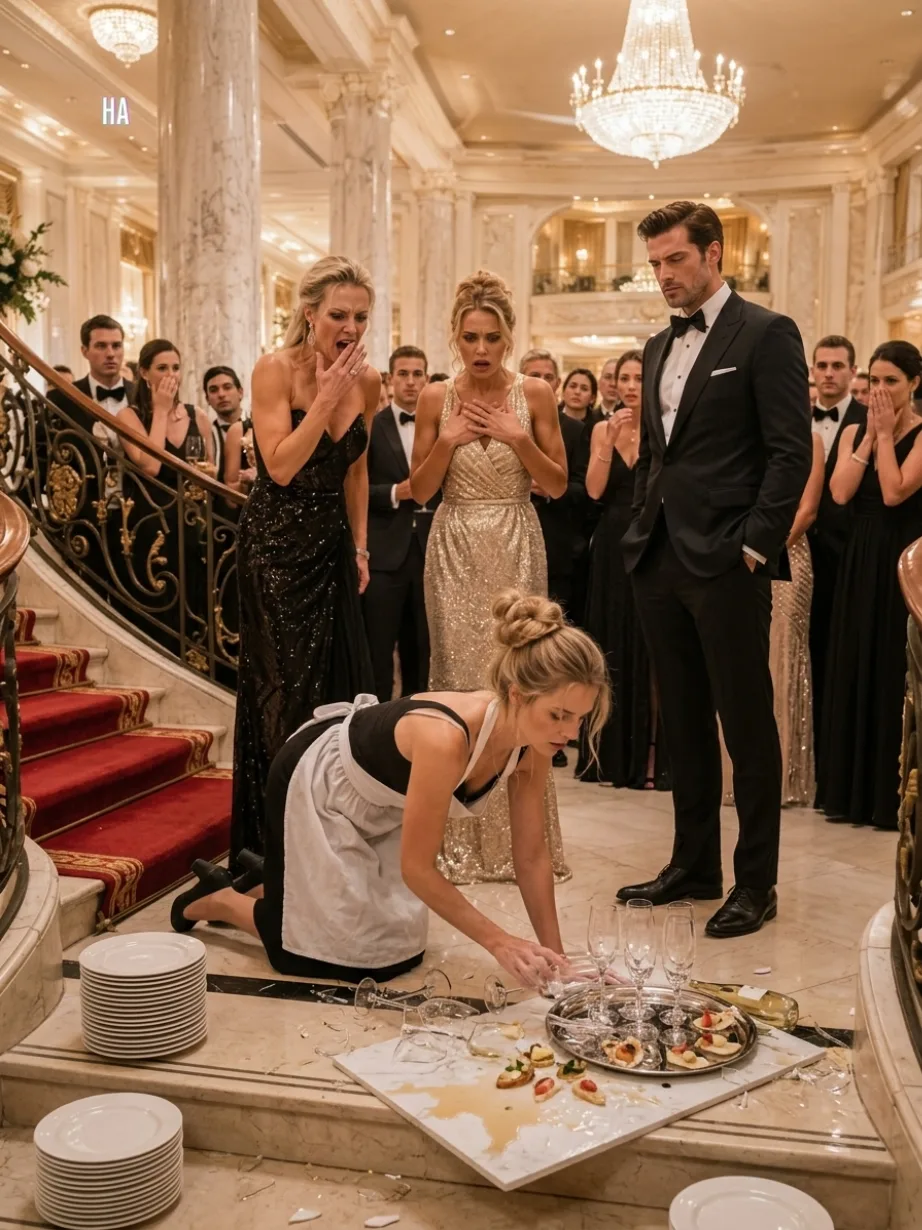
They forced her to wash dishes at the gala without knowing her millionaire husband owned every inch of the hotel
“Yes,” Rachel said.
Chapter 1
“Yes,” Rachel said.
“I do.”
The kitchen doors swung open.
Noise changed instantly.
The clatter and steam of the kitchen dissolved into music, laughter, and the soft golden hum of wealth. Rachel stepped into the grand ballroom with the heavy tray balanced against her palms.
No one noticed her at first.
That was always the first cruelty of rooms like this. Not insults. Not laughter. Invisibility.
She passed tables draped in ivory linen. Women in diamonds lifted glasses without looking at her. Men in tailored suits continued discussing mergers, elections, and private schools. Someone’s hand brushed hers while taking a flute of champagne, and the woman did not even apologize.
Rachel moved through them like a ghost.
At the head table sat Amelia Evans.
Damian’s mother looked elegant in midnight blue, silver hair swept back, pearls resting at her throat. She had the kind of face that never had to ask for attention.
It received it automatically.
Rachel had once tried desperately to earn warmth from that face.
For three years after marrying Damian, she had arrived at family dinners with flowers, handwritten notes, careful dresses, polite smiles. Amelia had never shouted. She had never called Rachel poor, unworthy, or embarrassing.
She had simply looked through her.
That had hurt more.
Rachel placed a glass before one of Amelia’s friends.
“Careful,” the woman snapped without glancing up. “That crystal costs more than your weekly paycheck.”
A few women laughed.
Rachel’s fingers tightened on the tray.
Amelia looked up.
Their eyes met.
Recognition flashed in Amelia’s face, quick as lightning and just as dangerous. Then it disappeared behind a wall of practiced composure.
Rachel placed the final glass on the table and turned away.
She was almost at the kitchen doors when Lauren’s voice filled the ballroom through the microphone.
“Good evening, everyone. Welcome
to the annual Rebirth Foundation Gala.”
Applause rolled through the room.
Rachel stopped.
Lauren stood on the stage beneath a white floral arch, smiling like an angel who had never sinned.
“Tonight, we celebrate generosity,” Lauren said. “We celebrate dignity. We celebrate the moral beauty of knowing how to serve a purpose larger than ourselves.”
Rachel stared at the door handle.
“Of course,” Lauren continued, “none of this would be possible without the invisible hands behind the scenes. The cooks, the servers, the dishwashers. Those who, despite unfortunate circumstances, find grace in accepting the place life has given them.”
A few polite laughs rippled through the room.
Rachel felt Khloe appear beside her.
“Don’t listen,” Khloe whispered. “Please. She wants you to break.”
Lauren’s gaze cut across the ballroom and found Rachel.
“There is beauty,” Lauren said, “in scrubbing what others leave behind.”
Rachel stood perfectly still.
Then the grand
front doors opened.
The applause died strangely, not all at once, but in waves. First the people near the entrance turned. Then the ones behind them. Then the head table. Even the quartet faltered.
A man walked into the ballroom in a black tailored suit, tall, broad-shouldered, and calm in a way that made powerful people nervous.
Damian Evans did not hurry.
He never had to.
Every waiter straightened. Every donor seemed to remember some urgent reason to smile. The mayor’s wife leaned toward her husband and whispered. Two board members stood before they realized they were standing.
Lauren stopped speaking mid-sentence.
Fiona appeared in the kitchen doorway behind Rachel and went pale.
Damian’s gaze moved across the ballroom once.
Then he saw Rachel.
He saw the wet sleeves.
The stained apron.
The empty silver tray clutched to her chest.
The humiliation still hanging in the air.
For three long seconds, nobody breathed.
Rachel looked at her husband and silently pleaded with him not to explode.
Not yet.
Damian understood.
Their marriage had survived too much for him not to understand one look.
He adjusted one cuff, his expression turning cold enough to chill the whole room, and walked to the head table.
“Mother,” he said.
Amelia looked up slowly. “Damian. You’re late.”
“No,” he said. “I arrived exactly when I needed to.”
Part 2
Rachel returned to the kitchen before the room could watch her face fall apart.
She set the silver tray down on a metal counter, removed the champagne glasses one by one, and told herself to breathe.
Behind her, the kitchen had erupted into whispers.
“That was Damian Evans.”
“He owns the hotel, right?”
“I thought he wasn’t attending.”
“Why was he looking at her like that?”
Khloe came to Rachel’s side, her voice barely audible. “Who are you?”
Rachel looked at the girl, at the exhausted worry in her eyes, at the little burn mark on her wrist, at the name tag pinned crookedly over her heart.
“Someone who should have come here sooner,” Rachel said.
Before Khloe could ask more, Fiona stormed into the far corner with her phone pressed to her ear.
“Yes, he’s here,” she hissed. “No, he was not on the final guest list. I would have prepared if someone had told me.”
She paused.
Her eyes widened.
“What do you mean he bought out the remaining ownership shares last week? The entire hotel? Since when?”
Rachel rinsed another plate and pretended not to hear.
Fiona hung up slowly. For the first time all night, fear broke through her authority. It did not last long. Cruel people often reached for cruelty when fear embarrassed them.
“Solis,” Fiona called.
Rachel turned.
“Basement storage,” Fiona said. “We need more linen napkins. Now.”
Khloe stiffened. “I can go.”
“You can finish your desserts,” Fiona snapped.
Rachel wiped her hands. “It’s fine.”
Khloe grabbed her arm gently. “No, it isn’t. The basement cameras have been out for weeks. She sends people down there when she wants to scare them.”
Rachel looked at Fiona.
Fiona smiled.
Rachel reached into her apron pocket and touched the small recorder she had carried since the first night.
Then she nodded. “I’ll go.”
The basement of the Sovereign was nothing like the ballroom. It was all concrete corridors, humming pipes, old storage cages, and fluorescent lights that flickered like tired eyes. Rachel walked past stacked banquet chairs and boxes of branded candles, then entered the linen room.
For the first time all evening, she allowed her shoulders to sag.
Her reflection stared back from the small square window in the storage door. Damp hair at her temples. Red hands. A face too tired to pretend this had not reopened old scars.
She thought of her grandmother, Clara Solis, who had cleaned hotel rooms for thirty-eight years and still ironed her uniform every night like it was a judge’s robe.
“Never be ashamed of honest work,” Clara used to say. “Be ashamed only if your heart gets dirty.”
Rachel swallowed hard.
The door opened behind her.
She turned quickly.
Damian stood there.
All the fury he had hidden from the ballroom was alive in his face now.
“You should not be down here,” Rachel whispered.
“My wife is in a basement carrying napkins while strangers applaud charity upstairs,” he said. “Where else would I be?”
Her composure cracked.
“Damian.”
He crossed the room and took her hands, lifting them carefully, seeing the redness from the hot water.
His jaw tightened. “I should have stopped this.”
“No.” She shook her head. “You would have stopped the symptoms. I needed the disease.”
“You found it?”
“I found Fiona stealing vendor kickbacks. Threatening staff. Keeping people desperate. I found three employees who were told they’d be blacklisted if they complained. Khloe’s mother is sick, and Fiona has been using that to control her schedule and wages.”
Damian closed his eyes briefly.
Rachel continued, voice shaking now. “And Lauren knew exactly who I was. She arranged the public humiliation because she wanted to watch me stand where I started.”
Damian touched her cheek. “You did not start low.”
Rachel gave a sad laugh. “Tell that to half the women upstairs.”
“I would rather show them.”
She looked up at him. “Not yet.”
His eyes sharpened.
“Rachel, she made you carry glasses to my mother’s table.”
“I know.”
“She let them laugh at you.”
“I know.”
“She sat there.”
Rachel pulled her hands gently from his. “Your mother is part of this too, Damian. But not the same way Lauren is. Amelia’s sin is cowardice. Lauren’s is cruelty. Fiona’s is corruption. If you punish them all the same way, nobody learns anything.”
He stared at her, torn between love and rage.
“You still want to save people after what they did to you.”
“No,” Rachel said. “I want to save the people they were hurting before I arrived.”
That silenced him.
A sound came from the corridor.
Both of them turned.
Someone had been outside the door.
Damian stepped forward and opened it.
No one was there, but the faint echo of retreating heels told them enough.
Lauren.
Damian’s expression hardened.
“She heard?”
“Good,” Rachel said.
Upstairs, the gala dinner was reaching its most photographed hour. Champagne was being poured. Cameras flashed. Lauren moved through the ballroom with a smile so bright it looked painful. Fiona stood near the service entrance, frantically texting someone. Amelia sat at the head table, food untouched.
Damian returned alone and took his seat beside his mother.
“Where did you go?” Amelia asked.
“To the basement.”
Her fingers tightened around her fork. “That is hardly a place for the owner during a gala.”
“It was where my wife was sent.”
The table went silent.
A woman across from them blinked. “Your wife?”
Damian looked straight at Amelia. “You recognized her.”
Amelia did not answer.
Lauren appeared suddenly beside them, carrying her tablet like a shield.
“Damian,” she said with a laugh too quick to be natural, “I’m so glad you came. We were just about to begin the charity auction. The final piece is truly moving.”
Arthur Parker approached before Damian could respond.
Arthur was seventy-one, white-haired, broad-faced, and warm-eyed. He had been Damian’s father’s closest friend and the only board member who still remembered the hotel before it became a symbol of luxury. To Arthur, the Sovereign had never been marble and chandeliers. It had been the dream of a poor man who believed hospitality meant dignity.
“Damian Evans,” Arthur said, embracing him. “You didn’t tell me you were coming.”
“I made the decision late.”
Arthur smiled. “And Rachel? Please tell me you brought that wonderful woman. Your father would have adored her spirit.”
The effect was immediate.
Lauren’s smile stiffened.
Amelia looked down.
Two women at the table exchanged confused glances.
Damian leaned back. “Rachel is here.”
Arthur brightened. “Where?”
“Closer than anyone realizes.”
Lauren laughed nervously. “How mysterious. Damian always did enjoy drama.”
Damian turned to her. “Tell me, Lauren. How long have you known my wife?”
Her face twitched.
“Your wife?”
“Rachel.”
“Of course,” Lauren said carefully. “We crossed paths years ago.”
“Crossed paths,” Damian repeated.
Lauren swallowed. “She used to work here. Everyone knows that.”
“And that made you comfortable mocking dishwashers from a stage?”
Color rose in her cheeks.
“I was honoring the staff.”
“You were humiliating one woman.”
Lauren glanced around. People were listening now. Not openly, but with the eager stillness of the wealthy sensing scandal.
“Damian,” Amelia murmured. “Not here.”
He looked at his mother. “Why not here? This is where it happened.”
Arthur’s warm face had gone grim. “What happened?”
Damian stood. “Something my father would have been ashamed to witness.”
Lauren moved quickly. “The auction is beginning. We can discuss any concerns later.”
But Damian had already turned away.
The stage lights brightened. Lauren climbed the steps with a dazzling smile, though sweat gleamed at her temple.
“Ladies and gentlemen,” she announced, “our final auction item tonight is a remarkable painting titled Hands That Hold the World.”
Two attendants unveiled the painting.
It showed a woman kneeling by a cold river, washing clothes with bare hands while snow fell around her. Her face was tired, but strong. Her palms were red. Her back was bent. Behind her, a city glowed with warm windows, as if everyone inside owed their comfort to her labor and had forgotten her name.
Rachel had paused at the kitchen doors again.
She saw the painting and felt something twist inside her.
Lauren’s voice rang out. “This beautiful piece reminds us that humble labor has dignity. It reminds us to honor the hands that serve us.”
Damian’s fingers curled around his bidding card.
Lauren smiled toward the kitchen entrance.
“The opening bid is twenty thousand dollars.”
A man offered thirty.
A woman said fifty.
Numbers rose quickly, tossed around like confetti.
Damian stood.
“I bid two hundred thousand dollars.”
The ballroom went still.
Lauren blinked. “Mr. Evans, how generous.”
“I’m not finished.”
He walked toward the stage, every step quiet and dangerous.
“I bid five hundred thousand,” he said, “on behalf of the woman in this building who understands that painting better than anyone in this room.”
Whispers spread.
Damian reached the stage and took the microphone from Lauren’s hand.
She resisted for half a second.
Then let go.
“My father built this hotel,” Damian said, his voice calm enough to terrify those who knew him. “Not as a monument to wealth. Not as a playground for people who confuse money with worth. He built it because he believed every person who walked through these doors deserved respect.”
The room had gone utterly silent.
“Tonight,” he continued, “I watched a woman be forced to wash dishes as punishment. I watched her sent into this ballroom carrying glasses so certain people could enjoy her humiliation. I heard a speech praising dignity from the same mouth that tried to strip it from her.”
Lauren’s face turned white.
Fiona disappeared through the kitchen doors.
Rachel followed.
In the kitchen, Fiona was unraveling.
“You,” Fiona hissed, pointing at Rachel. “Who sent you? Corporate? Legal? The board?”
Rachel looked at the shaking finger inches from her face.
“Does it matter?”
“It matters when an unverified temp walks into my kitchen and starts asking questions.”
“I asked why employees were crying.”
“They’re weak.”
“I asked why wine vendors were paying personal checks into an account under your sister’s name.”
Fiona’s mouth opened.
Rachel stepped closer. “I asked why Khloe Rivers worked seventy hours last week but was paid for forty-two.”
Khloe, standing near the dessert station, covered her mouth.
Fiona lowered her voice. “You have no proof.”
Rachel reached into her apron and pulled out her phone.
“No,” she said. “You have proof. Your own security system recorded you threatening workers, discussing vendor kickbacks, and admitting you adjusted timesheets. You installed audio in this kitchen to spy on your staff. You forgot it could hear you too.”
Fiona stared at the phone.
Then her own phone buzzed.
She looked down.
Whatever message she read made the blood leave her face.
Rachel knew what it said before Fiona whispered it.
“Rachel Solis Evans.”
The kitchen stopped moving.
Fiona lifted her eyes slowly. “You’re his wife.”
Rachel said nothing.
“You’re the co-owner.”
The swinging doors opened.
Damian entered first. Arthur Parker followed. Behind them came Lauren, looking like a woman being marched to judgment by the weight of her own choices.
Damian looked at Fiona.
“I believe you have met my wife.”
Part 3
No one in the kitchen moved.
The cooks stood frozen over half-plated desserts. Servers held trays against their chests. Khloe cried silently, one hand pressed over her mouth. Fiona Greer, who had ruled that room with threats for nearly four years, seemed to shrink inside her navy blazer.
“I didn’t know,” Fiona whispered.
Rachel stepped forward. “You didn’t know I was rich.”
Fiona flinched.
“You didn’t know I was married to Damian. You didn’t know I owned part of the hotel. But you knew Khloe was scared. You knew Marco in prep had three kids and couldn’t afford to lose his job. You knew the dishwashers didn’t speak enough English to defend themselves when you shorted their hours.”
Fiona’s lips trembled. “I was under pressure.”
“So were they.”
Damian’s voice cut through the room. “Fiona Greer, you are terminated effective immediately. Security will escort you out. Our legal team will review every recording, every payroll file, every vendor contract, and every payment made under your authority.”
Fiona looked at Arthur. “Please. I can explain.”
Arthur’s face was sad, not soft. “I spent forty years watching Damian’s father build a place where staff were treated like family. You turned it into a cage.”
Fiona looked back at Rachel, desperate now. “I’m sorry.”
Rachel studied her.
Part of her wanted the apology to mean something. Another part knew it had arrived only after power changed sides.
“I hope someday you become sorry for what you did,” Rachel said. “Not for getting caught.”
Fiona broke.
A sob escaped her, sharp and ugly. Security appeared at the door. No one applauded when she was led out. No one cheered. The silence was heavier than revenge.
Lauren stood near the ovens, shaking.
Damian turned to her.
“And you.”
Lauren lifted her chin, but her eyes were wet. “You don’t understand.”
“I understand enough.”
“No, you don’t.” Her voice cracked. “She got everything.”
Rachel stared at her.
Lauren laughed bitterly, tears slipping down her perfect makeup. “You walked into this hotel with nothing. You cleaned rooms. You wore cheap shoes. You had no family name, no connections, no polish. And somehow he looked at you like you were the only woman in Chicago.”
Damian’s expression darkened. “Careful.”
Lauren ignored him. Years of poison poured out of her now, too long contained to be elegant.
“I worked to become someone,” she said. “I learned how to speak, how to dress, how to enter rooms, how to make donors love me. I watched women like Amelia decide who belonged and who didn’t. I did everything right.”
Rachel’s voice was quiet. “No. You did everything they rewarded.”
Lauren recoiled.
Rachel removed her wet apron and laid it on the counter between them.
“You think I stole your life because Damian loved me,” Rachel said. “But love is not a promotion, Lauren. It is not a table you reserve. It is not a man you earn by humiliating the woman he chose.”
Lauren covered her face.
“I hated you,” she whispered. “I hated that you never seemed ashamed.”
Rachel thought of all the nights she had cried quietly in the bathroom after society dinners. All the times she had changed outfits three times before visiting Amelia. All the cruel little jokes wrapped in polite smiles.
“I was ashamed,” Rachel said. “For a long time. I just refused to let that shame make me cruel.”
Lauren looked up.
For the first time all night, she did not look glamorous. She looked young, frightened, and exhausted.
“What happens to me now?” she asked.
Damian answered. “You will resign from the foundation board tonight. Publicly. Arthur will appoint an interim chair by morning. Any role you have connected to this hotel ends now.”
Lauren swallowed. “And my reputation?”
Rachel looked toward the ballroom, where hundreds of guests still waited behind closed doors, hungry for explanation.
“That depends,” Rachel said, “on whether your next words are honest.”
Lauren gave a broken laugh. “You’d let me speak?”
“I won’t protect your lie,” Rachel said. “But I won’t write your confession for you either.”
Before Lauren could answer, another figure appeared in the kitchen doorway.
Amelia Evans.
The room seemed to change around her. Even in tears, she carried the ghost of authority. But tonight her pearls could not save her, and her posture could not hide the truth.
“Rachel,” she said.
Damian stepped toward his mother. “Not now.”
Rachel touched his arm.
“It’s all right.”
Amelia walked forward slowly, stopping in front of the woman she had spent years refusing to embrace.
“I saw you at the table,” Amelia said. “I knew it was you.”
Rachel waited.
“I should have stood up.” Amelia’s voice broke. “I should have said your name. I should have told them who you were before my silence gave them permission to continue.”
Damian’s face tightened with pain.
Amelia looked at him, then back at Rachel. “When my husband was alive, he loved people like you most.”
Rachel’s eyes burned.
Amelia corrected herself immediately. “No. That came out wrong. He loved people with courage. People who worked without losing kindness. People who understood that dignity does not come from being served.”
She took a trembling breath.
“After he died, I was terrified. The families, the donors, the old circles, they all watched me. I thought if I let the wrong person close, they would decide the Evans name had become ordinary.” A tear fell down her cheek. “Then Damian brought you home, and you reminded me of everything my husband respected and everything I had betrayed.”
Rachel’s anger did not vanish.
But it softened into something more complicated.
“I loved Damian,” Rachel said. “I did not marry his name.”
“I know that now.”
“You knew it then.”
Amelia closed her eyes.
“Yes,” she whispered. “I knew it then.”
Rachel folded the apron once, then again, giving her hands something to do.
“I forgive you,” she said.
Amelia sobbed.
“But forgiveness does not mean we pretend nothing happened,” Rachel continued. “You want to honor your husband’s memory? Stop hiding behind his name. Help rebuild what you allowed to rot.”
Amelia nodded fiercely. “Tell me what to do.”
Rachel looked at Khloe.
The young woman stood against the dessert counter, tears streaking her face, her whole body trembling from the impossible sight of powerful people finally being held accountable.
Rachel held out her hand. “Come with me.”
Khloe shook her head, panicked. “Me? No, Mrs. Evans, I can’t go out there.”
“Yes, you can.”
“I’m nobody.”
Rachel’s expression changed.
The room felt that change.
Rachel walked to Khloe and took both her hands, careful of the burn on her wrist.
“Do not ever say that inside a building that survives because of people like you.”
Khloe began crying harder.
Damian removed his suit jacket and placed it gently around Rachel’s shoulders.
She looked down at the stained uniform, the wet cuffs, the sensible black shoes she had worn for three nights of undercover work.
“I should change,” she said.
Damian shook his head. “No. They should see exactly who they tried not to see.”
Together, they walked out.
The kitchen staff followed at a distance, uncertain at first, then braver. Cooks. Servers. Dishwashers. A pastry assistant with flour on his cheek. A busboy still holding a stack of napkins. Arthur walked with them. Amelia followed. Lauren came last, pale and shaking, carrying the full weight of her public mask in both hands.
When the ballroom doors opened, every conversation died.
Rachel entered first.
Not in diamonds.
Not in silk.
Not as the invisible woman with the tray.
She walked in wearing a water-stained uniform, red hands visible, Damian Evans’s jacket resting on her shoulders like a banner.
Gasps moved through the room.
Damian led her to the stage, but Rachel climbed the steps on her own.
He handed her the microphone.
For a moment, she simply looked at them.
The donors who had laughed.
The women who had looked away.
The men who were already calculating how much they had heard and how little they could admit.
Lauren stood beside the stage, trembling.
Rachel raised the microphone.
“My name is Rachel Solis Evans,” she said. “Many of you know my husband, Damian. Some of you know my mother-in-law, Amelia. Almost none of you knew me tonight when I carried your glasses.”
The silence deepened.
“That is not an accident,” Rachel continued. “It is easy to overlook people when their job is to make your life comfortable. It is easy to praise dignity from a stage while ignoring the hands washing your dishes behind a door.”
A woman at the head table looked down.
Rachel’s voice remained steady.
“For the last three days, I worked in this hotel under my maiden name because my husband and I received complaints from staff. Tonight confirmed what those complaints could not fully describe.”
She turned slightly toward the kitchen doors.
“Employees were threatened. Wages were manipulated. Vendors were corrupted. People were made afraid in a hotel my father-in-law built to make people feel safe.”
Whispers broke out, but Rachel did not let them grow.
“The manager responsible has been terminated. Legal action will follow. But one person’s corruption is not the only issue. Cruelty survives when decent people treat silence as good manners.”
Amelia flinched, but did not look away.
Rachel turned to Lauren.
Lauren’s hands shook as she took the microphone Rachel offered.
For a moment, it seemed she might run.
Then she faced the crowd she had spent years trying to impress.
“My name is Lauren Davis,” she said. “Tonight, I used this gala to humiliate Rachel Evans because I resented her. I disguised cruelty as charity. I spoke about dignity while trying to strip another woman of hers.”
A shocked murmur rose.
Lauren’s voice broke. “I am resigning from the Rebirth Foundation, effective immediately. I do not ask for sympathy. I only ask that the foundation become what it claimed to be before I used it as a stage for my bitterness.”
She handed the microphone back and walked down the steps.
No one clapped.
That was good.
Some moments did not deserve applause.
Arthur Parker rose from his seat.
“I accept Ms. Davis’s resignation,” he said, his deep voice carrying through the room. “By morning, the foundation board will appoint interim leadership and begin a full review of its partnerships with the Sovereign Hotel. But tonight, I would like the room to return its attention to Mrs. Evans.”
Rachel gave him a grateful glance.
Then she looked at Khloe.
“This young woman is Khloe Rivers,” Rachel said. “Earlier tonight, she was the only person who risked her job to show me kindness.”
Khloe shook her head, crying.
Rachel smiled gently. “Khloe, step up here.”
The room watched as Khloe slowly climbed the stage.
“She has been supporting her mother through a medical crisis while working under a manager who used that vulnerability against her,” Rachel said. “That ends tonight.”
Khloe covered her mouth.
“The Sovereign Hotel will pay every dollar of outstanding medical debt for Khloe’s mother. She will also enter our new Supporting Hands Management Program with full salary, mentorship, and tuition assistance.”
A sound moved through the staff near the kitchen doors first.
Not applause.
A sob.
Then the room rose.
Arthur stood first. Then Amelia. Then Damian. Then, slowly, the guests followed. The applause became thunderous, not the polite kind given to speeches, but the stunned kind people offer when shame and hope collide in the same room.
Khloe threw her arms around Rachel.
Rachel held her tightly.
For the first time that night, her hands stopped trembling.
Months later, people still talked about the gala.
Some remembered the scandal. Some remembered Lauren’s confession. Some remembered the shock of seeing Damian Evans’s wife in a stained service uniform on the most expensive stage in Chicago.
But inside the Sovereign Hotel, people remembered what changed after.
Payroll became transparent.
Every department received anonymous reporting protection.
The basement cameras were repaired and monitored by a third-party safety office.
The kitchen got new equipment, proper breaks, and a manager promoted from within.
Khloe Rivers became assistant operations manager by spring. She was nervous at first, then extraordinary. Her mother recovered enough to visit the hotel in May, crying when the staff brought out a cake with her name on it.
Amelia Evans started coming every Tuesday morning.
At first, the employees stiffened when she walked in. She did not blame them. She wore simple clothes, tied on an apron, and asked where she could be useful. Sometimes she sorted donated coats for the foundation. Sometimes she wrote thank-you notes to staff families. Sometimes she simply sat with Rachel in the quiet hour between breakfast and lunch, learning how to apologize without expecting comfort in return.
Lauren Davis left Chicago for a while.
Six months later, Rachel received a letter.
It was not dramatic. It did not beg. It did not excuse.
It said only that Lauren had begun volunteering at a women’s employment center in Milwaukee and that, for the first time in her life, she was learning to be useful without being admired.
Rachel read it twice.
Then she placed it in a drawer and whispered, “Good.”
Not because everything was healed.
Because something had begun.
One evening, nearly a year after the gala, Rachel stood in the restored ballroom before another charity dinner. The chandeliers glowed above her. The tables were set. The flowers were simple this time, chosen by staff vote. In the kitchen, laughter rose through the swinging doors.
Damian came up behind her and wrapped his arms around her waist.
“Are you thinking about that night?” he asked.
Rachel leaned back against him. “A little.”
“I still hate that I let you do it.”
“You didn’t let me. You trusted me.”
“That sounds nicer.”
“It’s also true.”
He kissed her temple.
Across the room, Khloe directed a team of servers with calm confidence. Amelia helped an elderly guest find her table. Arthur argued cheerfully with the auctioneer about whether he was allowed to bid on everything.
Rachel looked down at her hands.
They were no longer red from dishwater. But she remembered the sting.
She hoped she always would.
Because pain, when it did not turn into bitterness, could become a compass.
The ballroom doors opened, and the first guests entered.
This time, every server was greeted by name.
This time, the kitchen staff would eat the same dinner as the donors after service.
This time, no one would be invisible unless they wished to be left in peace.
Damian took Rachel’s hand.
“Ready, Mrs. Evans?”
Rachel smiled.
“Yes,” she said. “But after the speeches, I’m checking on the dish station.”
He laughed softly. “Of course you are.”
She squeezed his hand and looked once more at the shining room her family owned, not because ownership made her better than anyone else, but because it gave her the power to make sure nobody beneath those chandeliers was treated as less than human again.
That was the truth the gala had revealed.
Not that a dishwasher could secretly be a millionaire’s wife.
But that the hands washing dishes had always deserved respect, even before anyone discovered the ring in her pocket.
THE END
Chapter complete
You have reached the end of this chapter.
Continue reading
A few more worlds to get lost in after this chapter.




