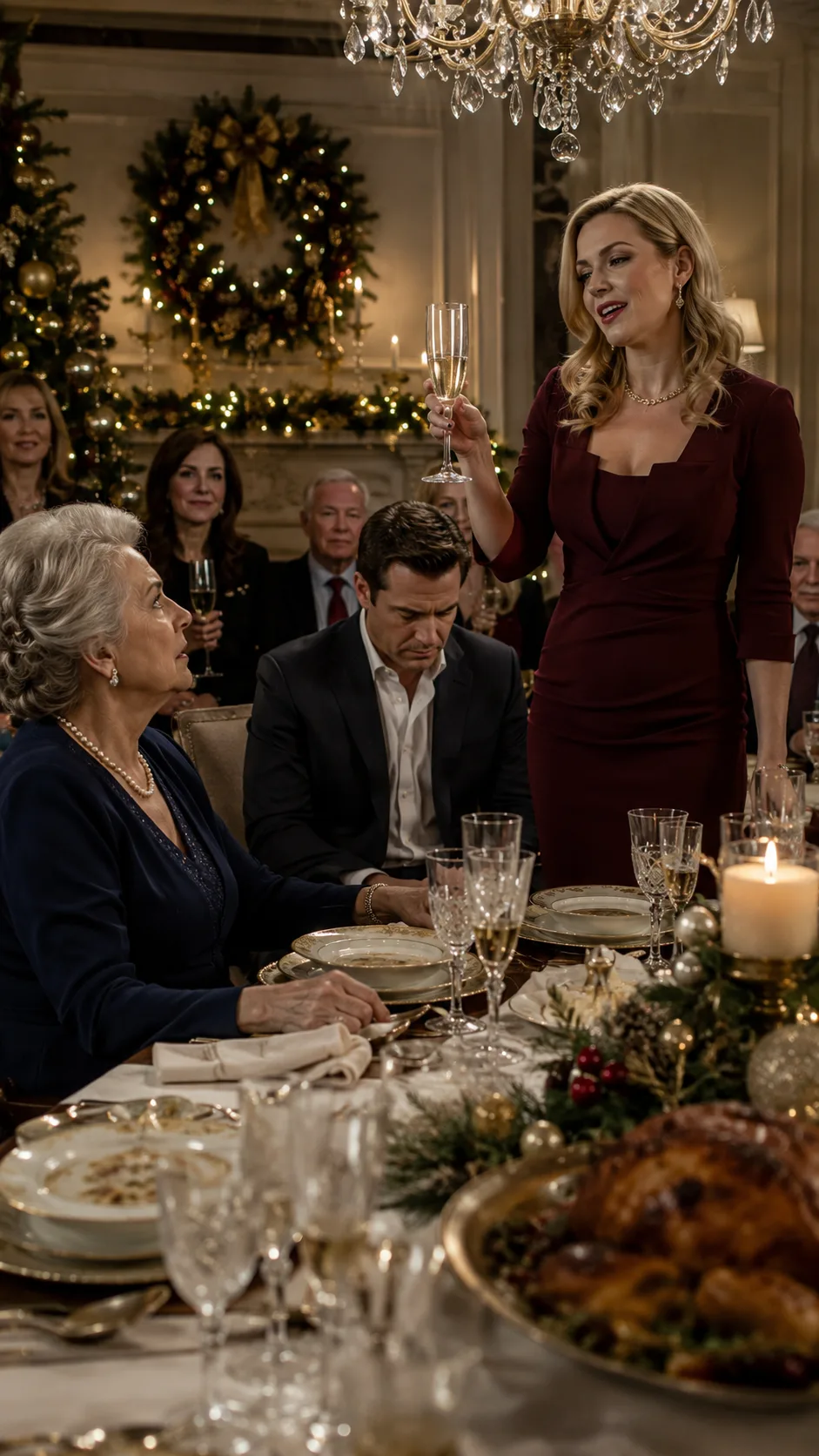
PART 3 — THE NIGHT CONSEQUENCES FINALLY CAME TO DINNER
She slapped him.
Chapter 3
PART 3 — THE NIGHT CONSEQUENCES FINALLY CAME TO DINNER
She slapped him.
The sound cracked across the room.
Beverly gasped. Carla stood. Harold whispered, “Good Lord.”
Ethan touched his cheek, stunned. He looked younger than I had seen him in years.
Madison pointed at me. “She did this. She turned you against me. This was always what she wanted.”
I did not move.
“No,” I said. “I wanted my son to come to dinner at my house without asking your permission.”
That landed harder than I meant it to.
Ethan shut his eyes.
The younger officer took Madison gently but firmly by the arm. Madison jerked back, then seemed to remember the audience. She straightened her sweater, lifted her chin, and walked out of her own dining room as if she were leaving a board meeting instead of being escorted past a Christmas wreath.
At the front door, she turned once.
“You’ll regret this,” she said to Ethan.
He did not answer.
The door closed behind her.
For several seconds, nobody spoke.
Then the house made ordinary sounds again. The furnace clicked on. A log collapsed in the fireplace. Somewhere in the kitchen, the timer on the oven beeped three times, absurdly cheerful.
Harold reached for his wine.
“Don’t,” Beverly said.
He froze.
She was looking at him in a way I had never seen before. Not angry yet. Worse. Clear.
Carla came around the table slowly. She stopped a few feet from me, arms crossed against her chest like she was cold.
“I shouldn’t have clapped,” she said.
“No,” I said. “You shouldn’t have.”
Her eyes filled.
I did not comfort her. That surprised both of us.
Mr. Calloway gathered the documents. “Margaret, we’ll need your formal statement tomorrow. The bank has already preserved the call records and access logs.”
Ethan looked up sharply. “There are call records?”
“Yes,” Mr. Calloway
said. “There are always records.”
Madison had forgotten that, too.
People like her trust performance more than paper. They believe if they can command a room, the records will somehow rearrange themselves out of embarrassment.
They do not.
The officers left with Madison. Mr. Calloway stayed long enough to make sure I was steady, then placed one hand gently on my shoulder.
“You handled that well,” he said.
I looked at the ruined tablecloth, the cooling food, the family members who had discovered too late that applause can become evidence.
“No,” I said. “I handled it late.”
After he left, Ethan and I stood in the hallway beside the mirror.
There were things he wanted from me. Forgiveness, maybe. Direction. A version of motherhood that would wrap this night in a clean blanket and tell him he had been manipulated, not responsible.
But he was responsible.
Love does not erase
signatures.
“Mom,” he said, his voice breaking. “I’m sorry.”
I nodded once.
He flinched at the smallness of it.
“I believe you,” I said. “And that matters. But it doesn’t fix what you signed.”
His eyes reddened. “What happens now?”
“Now the trust distributions stop while the review is completed. Your access is suspended. So is Harold’s. So is any account Madison touched.”
He looked like I had slapped him, too.
“For how long?”
“Until I’m certain my husband’s work and my life savings are not being treated like a family vending machine.”
Behind us, Harold started to protest. Beverly cut him off with one word.
“Enough.”
I turned.
She had removed her napkin from her lap and set it beside the wine stain.
“I want to know what you did,” she told Harold.
His face collapsed into panic. “Bev, not here.”
“Yes,” she said. “Here.”
That was how the room truly shifted. Not with police. Not with documents. With one woman refusing to keep protecting a man because the old arrangement had become inconvenient to witness.
Carla picked up plates with shaking hands. I told her to leave them.
Nobody ate dessert.
By midnight, I was back in my Connecticut house.
Snow had started again. Small, quiet flakes moved through the porch light. Inside, the rooms smelled faintly of cedar and lemon polish. My own Christmas tree stood in the front window, smaller than Ethan’s, decorated with ornaments collected over a lifetime instead of purchased in matching sets.
There was a felt reindeer Ethan made in second grade hanging near the top.
One antler was crooked. One eye had been glued too low.
I touched it with one finger and finally cried.
Not loudly. Not dramatically. I cried the way older women often cry, standing up, one hand on a table, careful not to fall apart so completely that no one can put dinner away afterward.
The next morning, Ethan came alone.
I saw his car from the kitchen window. He sat in the driveway for almost eight minutes before getting out. No Madison. No phone in his hand. No practiced speech visible on his face.
When I opened the door, he looked exhausted.
“Can I come in?”
I stepped aside.
He stopped in the foyer, looking at the old family photographs on the wall. His father holding him at the beach. Me with flour on my cheek during a birthday party. Ethan at twelve in a suit too big for him, trying not to cry at a school concert because the song reminded him of his dad.
“I forgot this house,” he said.
“No,” I replied. “You avoided it.”
He nodded.
We sat at the kitchen table. I made coffee because habit is stronger than anger, but I did not make him breakfast. That distinction mattered to me.
He told me Madison had been released pending further review. She had gone to her sister’s in Rye. She had called him thirty-four times. He had not answered.
“I don’t know how I let it get this bad,” he said.
I did.
But I let him find the words.
“She made me feel like needing you was pathetic,” he said eventually. “Like every family dinner, every check, every property, everything connected to you proved I wasn’t a man.”
“And you believed her.”
He stared into his coffee.
“I wanted to.”
That was the first honest thing he had said.
So I gave him one honest thing back.
“I built the trust because your father died young and I wanted you safe. Not rich. Safe. There’s a difference.”
He wiped his face with both hands.
“I know.”
“No,” I said. “You’re learning.”
The investigation took months.
Madison’s Northline account led to more than the invoices. There were transfers, emails, voice messages, draft letters to banks, and a document template she had planned to use to challenge my competency if I refused the Cape Cod transfer. Ethan cooperated. Harold tried to minimize his part until Beverly hired her own attorney and stopped speaking for him in public.
Carla wrote me a letter. A real one, on paper. She did not ask for money. She did not explain away her clapping. She wrote that she had spent years laughing at Madison’s little comments because it was easier to be on the winning side of a cruel room than risk becoming its next target.
I kept the letter.
I did not answer for three weeks.
When I did, I wrote only four lines.
I accept your apology.
I hope you become braver than you were.
Do not confuse shame with growth.
Growth changes what you do next.
Madison eventually pleaded to reduced charges tied to unauthorized access and fraudulent financial activity. The civil recovery hurt her more than anything else. Money had been her language, and losing it in public translated perfectly.
Ethan and I did not become instantly close again.
That would make a prettier story, but not a true one.
He moved into a smaller rental after the house in Westchester was sold. He got a job that had nothing to do with family property. For the first time in his adult life, he paid bills with money he earned and called me without mentioning distributions, repairs, taxes, or Madison.
Sometimes I answered.
Sometimes I let it ring and called back later.
Trust, unlike money, cannot be released on a schedule.
The following Christmas, I hosted dinner at my house.
Not everyone was invited.
Harold was not. Madison, obviously, was not. Beverly came alone and brought a sweet potato casserole that was too sweet but made with effort. Carla came early and helped set the table without being asked. Ethan arrived last, carrying a small box wrapped badly in blue paper.
He looked nervous in the doorway.
I knew then that a part of me still wanted to make it easy for him. To smile too quickly. To wave him in as if none of it had happened. Mothers are dangerous that way. We can mistake relief for repair.
So I waited.
He held out the box.
“It’s not much,” he said.
Inside was a candle holder.
Silver. Old. Slightly tarnished. One of the pair Madison had claimed as hers. Ethan had found it packed in a storage box after the sale of the Westchester house.
“I thought it should come home,” he said.
I ran my thumb over the rim.
The other one had disappeared. Maybe sold. Maybe hidden. Maybe thrown away by Madison in one of her rages. It did not matter as much as I thought it would.
A missing half is still proof something survived.
I placed the candle holder in the center of the table, not at the head. Then I lit a taper and watched the flame steady itself.
During dinner, Ethan did not sit beside me. He did not perform regret. He did not make speeches.
But when Beverly asked whether I wanted him to carve the turkey, he looked at me first.
Not Madison. Not the room.
Me.
“Mom?” he asked quietly.
It was such a small thing.
Permission.
Respect.
A son remembering that love is not control.
I handed him the carving knife.
“Yes,” I said. “You can help.”
And for the first time in a long time, the room stayed quiet for the right reason.
THE END.
Chapter complete
You have reached the end of this chapter.
Continue reading
A few more worlds to get lost in after this chapter.




