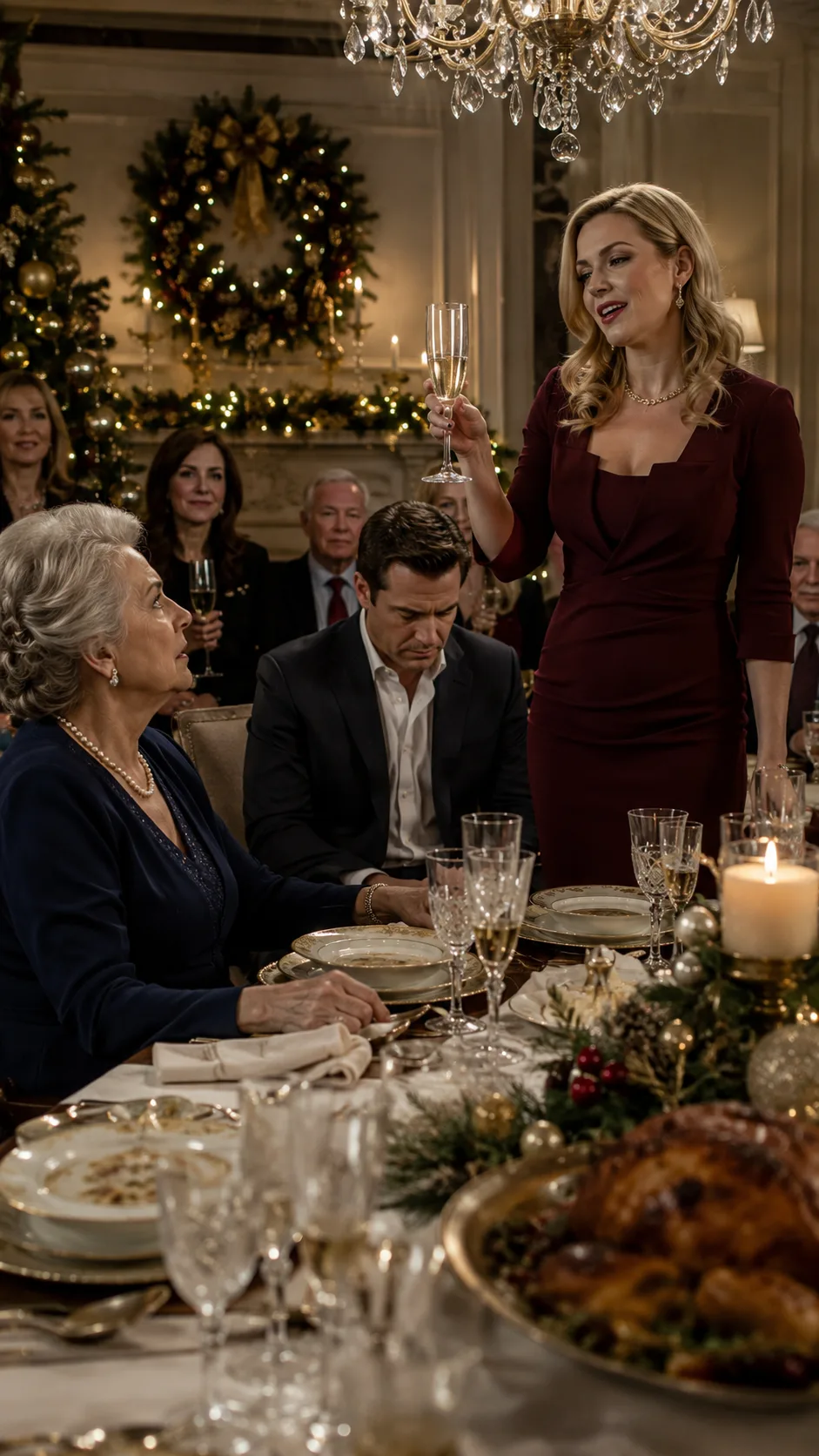
PART 2 — THE DOCUMENTS MADISON NEVER EXPECTED TO SEE
I walked around the table slowly.
Chapter 2
PART 2 — THE DOCUMENTS MADISON NEVER EXPECTED TO SEE
I walked around the table slowly.
My knee ached in the cold, and the old hardwood creaked under my shoes. I could feel every pair of eyes following me. Not one of them offered help. Not one of them apologized.
When I reached the hallway, I saw my reflection in the narrow mirror beside the coat closet. Seventy-one years old. Silver hair pinned too neatly. Navy dress. Pearl earrings my husband had given me on our last anniversary before the heart attack took him before breakfast.
For a moment, I saw myself at forty-two, standing in a funeral home while relatives told me I would have to sell the house, sell the car, scale down, be reasonable.
I had been reasonable my whole life.
That was how I knew when to stop.
I opened the front door.
Mr. Calloway stood on the porch in a dark overcoat, snow dusting his shoulders. Beside him were two uniformed
officers, one older man with tired eyes and one younger woman whose gaze moved past me into the glowing house.
“Merry Christmas, Margaret,” Mr. Calloway said gently.
“I’m sorry to interrupt yours.”
He looked over my shoulder. “You didn’t.”
When I brought them into the dining room, the silence changed texture. Before, it had been shocked. Now it became calculation.
Harold sat up straighter. Beverly set her wineglass down. Carla pulled her phone off the table and slid it into her lap, though the screen lit blue against her dress.
Madison’s face hardened into something polished and cold.
“Are we really doing this?” she asked.
Mr. Calloway did not answer her. He placed his leather folder on the sideboard, opened it, and removed several documents.
The younger officer spoke first. “Mrs. Pierce?”
Madison stiffened. “It’s Madison Pierce.”
“I need you to remain in the room while we ask a few
questions.”
Madison gave a sharp little laugh. “About what? A family disagreement?”
“About a report involving attempted financial fraud, identity misuse, and unauthorized access to protected accounts.”
The words landed one by one.
Harold muttered, “Jesus.”
Madison spun toward him. “Stay out of it.”
That was her mistake.
Until then, the family had been afraid of me being wrong. Now they were afraid Madison might be guilty, and people who fear guilt nearby start rearranging themselves quickly.
Beverly leaned away from Madison. Carla stopped pretending not to record. Ethan remained standing, face empty, his hand still half-raised as if he had forgotten what he meant to do with it.
Mr. Calloway slid a document across the table toward him.
“Ethan,” he said, “this is a copy of the trustee authority page from the Hawthorne Family Trust. You signed acknowledgment of beneficiary status nine years ago.”
Ethan stared at it.
Madison
said, “He doesn’t need to read that.”
“Yes,” I said. “He does.”
Her eyes cut to me.
There it was, finally. Not the social smile. Not the daughter-in-law warmth she performed when neighbors were around. The real Madison. Furious because the script had slipped out of her hands.
Ethan picked up the page.
I watched his eyes move.
He had always been a fast reader. As a child, he could finish the last page of a book and sit silently for several minutes afterward, not ready to leave the world he had entered. Now he stood at his own Christmas table reading proof that the world Madison had built for him was made of smoke.
“This says Mom controls distributions,” he said.
Mr. Calloway nodded. “Correct.”
“And I’m not trustee.”
“No.”
Madison exhaled loudly. “This is legal nonsense. We’ve paid the bills for years. We manage the properties. We host the family. We—”
“You host,” I said, “with money you requested from the trust.”
Her nostrils flared.
“And because I loved my son,” I continued, “I approved more than I should have.”
That sentence cost me more than I expected. Not because Madison heard it. Because Ethan did.
He looked at me then, really looked, and I saw the first crack in him. Shame does not arrive all at once. It shows up in the small things first: a blink held too long, a jaw working without sound, a man suddenly unable to meet his mother’s eyes.
“Mom,” he said. “I didn’t know about the lien.”
Madison turned on him. “Don’t you dare.”
His face tightened.
“What lien?” Beverly asked.
Mr. Calloway looked to me. I nodded.
He removed another page.
“An application was submitted to attach a private debt obligation to Mrs. Hawthorne’s Connecticut residence,” he said. “It included Ethan’s signature and a supporting statement claiming Margaret was mentally unfit to manage her financial affairs.”
The room went very still.
Not dramatic still. Worse.
Personal still.
The kind of still that comes when everyone understands a line has been crossed and nobody wants to be the first person to admit they saw it.
I heard my own breathing. I heard the soft pop of the fireplace. I heard Madison’s bracelet slide down her wrist as she clenched her fist.
Ethan whispered, “What?”
“You signed it,” Mr. Calloway said.
“No.” Ethan shook his head. “No, I signed a property tax form.”
Madison snapped, “That’s what it was.”
Mr. Calloway removed a color copy from the folder. “This is the document.”
He handed it to Ethan.
My son took it like it might burn him.
His eyes found the signature. His own name, written in black ink, sitting beneath a paragraph that called me confused, vulnerable, and incapable of responsible judgment.
I remembered the day he signed it. He had come by my house in Connecticut with Madison waiting in the car. He stayed twelve minutes. He kissed my cheek, refused coffee, and said they were drowning in paperwork. I remembered how he had kept glancing toward the driveway.
I remembered thinking, at least he came.
That was the humiliating part. Not the paper. Not the lie.
That I had been grateful for twelve minutes.
Ethan looked at Madison. “You told me it was tax paperwork.”
Madison’s voice dropped. “Because you never read anything. Don’t make this my fault.”
There it was.
The first witness shift happened then.
Not from Harold. He was too practiced at protecting himself.
It came from Carla.
“She did say that,” Carla said quietly.
Madison turned. “Excuse me?”
Carla’s face flushed, but she did not look away. “At Thanksgiving. In the kitchen. You told Ethan, ‘Just sign it, your mother gets overwhelmed by documents anyway.’”
Beverly whispered, “Carla.”
“No.” Carla’s hands trembled, but she lifted her chin. “I heard it.”
Madison stared at her like she had discovered a servant stealing silver.
“You clapped,” Madison said.
Carla flinched.
Then she looked at me. “I’m sorry, Aunt Margaret.”
It was not enough.
But it was something.
Harold cleared his throat. “Well, now, nobody wants to see family business turn into—”
“Harold,” I said.
He stopped.
For most of my life, Harold had spoken over me. At our father’s wake. At my wedding. After my husband died. He liked me best when I was useful, quiet, and writing checks no one mentioned in front of company.
I turned to him. “You received two of those withdrawals.”
His face drained.
Beverly’s head snapped toward him. “What?”
Madison went perfectly still.
Mr. Calloway consulted a page. “One payment labeled emergency bridge loan, twenty-eight thousand dollars. Another labeled consulting advance, seventeen thousand.”
Beverly’s glass tipped. Red wine spread across the white tablecloth like blood in water.
“I thought Ethan approved it,” Harold sputtered.
“You thought,” I said, “or Madison told you?”
He looked at Madison.
That was answer enough.
Madison lifted both hands. “This is insane. You all came to me. Every one of you. Harold needed help. Beverly wanted the remodel finished before summer. Carla asked about a loan for her boutique. Ethan wanted to stop begging his mother for money like a child.”
The word begging struck him.
He stepped back.
“I never said that,” he said.
Madison laughed once, cruel and exhausted. “You said it every day without saying it.”
The older officer shifted his weight. “Mrs. Pierce, did you submit invoices under the name Northline Strategy Group?”
Madison’s mouth closed.
The room understood the silence before she answered.
“I don’t know what that is.”
Mr. Calloway placed two invoices on the table.
I had seen them before. Clean formatting. Corporate logo. Vague services. Advisory support. Asset transition planning. Family governance consultation.
A person who steals with a smile always gives the theft a professional name.
“These invoices directed payment to an account registered to an LLC formed by you six months ago,” Mr. Calloway said.
Madison looked at Ethan. “Say something.”
For the first time all night, he did not obey immediately.
Her eyes widened slightly.
That was the midpoint. Not the officers. Not the documents. Not even the exposed invoices.
It was the moment Madison reached for the control she had always had and found empty air.
Ethan looked at me. “Why didn’t you tell me?”
The question hurt because it was cowardly.
I answered anyway.
“I tried.”
His face folded.
“I called you after Madison asked for the Cape Cod house. You said I was being suspicious. I asked you to come to lunch alone. You brought her. I asked you whether you understood the trust. You told me Madison understood numbers better than both of us.”
Madison said, “Because I do.”
“No,” Mr. Calloway said. “You understand access. Not ownership.”
The younger officer stepped slightly closer to Madison. “Mrs. Pierce, we’re going to ask you to come with us to answer questions at the station.”
Madison’s composure finally cracked.
On anyone else, it might have looked like fear. On Madison, it looked like insult.
“On Christmas?” she said.
I almost laughed.
Not because it was funny, but because that was what mattered to her. Not the attempted theft. Not the lie about my mental state. Not the way she had arranged a family audience to watch an old woman be stripped of dignity.
The inconvenience of consequences arriving on a holiday.
Ethan moved toward her. “Madison—”
To be continued… Click “PART 3” to read the final part: 👉 PART 3 👈
Chapter complete
You have reached the end of this chapter.
Continue reading
A few more worlds to get lost in after this chapter.




