PART 3 — I TOOK BACK MY KEYS—AND MY LIFE
On Monday morning, I met the realtor.
Chapter 3
PART 3 — I TOOK BACK MY KEYS—AND MY LIFE
On Monday morning, I met the realtor.
Her name was Melissa. She was brisk, kind, and wonderfully practical. She walked through the house with me, took notes, photographed the view from the deck, and assured me that the structure was solid, the location was desirable, and the right tenants would pay well.
“This place has character,” she said.
I looked at the cherrywood table, now cleared and polished again.
“Yes,” I said. “It does.”
I hired a professional cleaning crew, scheduled minor repairs, and added a separate lock to the wine storage area. Melissa recommended a rental management company that handled tenant screening, maintenance calls, and payments. I signed the preliminary paperwork that same afternoon.
By the time I drove back to Charlotte, I felt tired but steady.
Jason was waiting in my hallway when I arrived.
He looked worse than before.
Unshaven. Pale. Eyes shadowed.
“Mom,” he said. “What did you do?”
I unlocked my door.
“I protected my property.”
He followed me inside.
“Brenda and the others had to check into a motel.”
“That was their choice.”
“Sarah has been upset for hours. She says you humiliated them.”
I hung my coat in the hall closet.
“I did not humiliate anyone. I stopped hosting people who were never invited.”
He sat at the kitchen table.
“We don’t have money for a motel and the down payment. Closing costs are due. If we don’t pay soon, we lose the house.”
I sat across from him.
“I’m sorry to hear that.”
He looked stunned.
“That’s all?”
“What would you like me to say?”
“I thought you cared.”
There it was.
The sentence designed to turn a mother’s spine into water.
I looked at my son, my only child, the boy whose fevers I had slept beside, whose college application essays I had proofread, whose first broken heart
I had soothed with grilled cheese sandwiches and silence.
“I care very much,” I said. “That is why this has to change.”
His eyes filled.
“Mom.”
“No, Jason. Listen.”
He closed his mouth.
I went to my desk and brought back a folder.
Inside was a simple agreement. Not a formal contract drafted by an attorney, though I intended to have one review any final version. It was a statement of terms. Plain language. Clear expectations.
I placed it on the table between us.
“I am willing to help with housing,” I said. “But under new conditions.”
He stared at the paper.
“The cabin will be managed by a rental agency from now on. Neither you nor Sarah will have a key. No one stays there without a written rental agreement through the agency.”
He swallowed.
“The savings account for the grandchildren remains protected, but I will be the sole
trustee. There will be no withdrawals for emergencies created by Sarah’s relatives.”
His eyes moved down the page.
“If I help with a home, the money goes directly where it is supposed to go. Closing costs, lender, school, repairs. Not cash in anyone’s hand.”
He looked up.
“And Sarah?”
“Sarah owes me a written apology.”
He leaned back like I had asked for the moon.
“Mom.”
“No.”
“She won’t do that.”
“Then the account stays closed.”
He rubbed his forehead.
“She thinks you’re trying to dominate her.”
“Sarah has mistaken access for respect. I am correcting that.”
He looked at the paper again.
For a moment, he seemed angry. Then tired. Then smaller.
“I don’t know how to fix this,” he said.
“You begin by telling the truth.”
“To Sarah?”
“To yourself.”
He did not answer.
For the next two weeks, there was near silence.
Not true silence, of course. Sarah found ways to make noise without speaking directly.
She sent pictures of the grandchildren.
Little Emma holding a drawing. Ben in a soccer jersey. The baby asleep in a car seat with one sock missing.
Each message arrived with a sentence sharp enough to look innocent.
“They miss their Nana.”
“Emma asked why you don’t visit anymore.”
“Ben says family should forgive.”
It hurt.
Of course it hurt.
Anyone who says boundaries do not hurt has never drawn one around grandchildren.
I missed them terribly. I missed the smell of their hair after bath time, the way Ben told stories with his whole body, the way Emma pressed stickers onto my wrist and declared them jewelry.
But I had learned something in that cabin.
People who use love as a lever will keep pulling until something breaks.
I refused to let the broken thing be me.
So I replied simply.
“I miss them too. As soon as the cabin matter is settled, I would love to see them.”
No argument.
No defense.
No opening.
Then came the day their option on the new house expired.
Jason called in the evening.
His voice shook.
“Mom.”
I closed my book and listened.
“Sarah won’t apologize,” he said. “She says you’re acting like a tyrant. The sellers backed out. We lost the house.”
The sadness hit me harder than I expected.
Not for Sarah. Not even for the house itself.
For Jason.
For the version of him who had wanted something stable and had not understood that stability cannot be built on money borrowed from someone you allow others to disrespect.
“I’m sorry,” I said.
“Are you?”
“Yes. But I am not responsible for Sarah’s pride.”
He breathed unsteadily.
“She blames me.”
“For what?”
“For not making you fix it.”
I let that sit between us.
Then I said, “Jason, pride does not pay the mortgage. Neither does avoidance.”
He did not argue.
Shortly after that, the tone shifted inside Sarah’s household.
Brenda and Larry ran out of money for the motel.
The relatives scattered back to their own lives, suddenly unavailable. Brenda and Larry ended up in Jason and Sarah’s two-bedroom apartment, which had already felt crowded with two adults and three children.
Now it became unbearable.
Jason told me later that Brenda criticized Sarah’s cooking, Larry watched television too loudly, the kids had nowhere quiet to sleep, and every conversation turned into a complaint about me.
Sarah’s perfect image began to crack under the weight of her own invitation.
Brenda called me once.
I answered because I did not recognize the number.
“Diane,” she said, sweet as syrup. “I think this has gotten out of hand.”
“Yes,” I replied. “It did.”
“We should talk like adults.”
“We had that opportunity in my kitchen.”
She sighed dramatically.
“I may have said some things.”
“You said enough.”
“I was joking.”
“You were not.”
Her voice sharpened.
“You know, people are saying you threw a family into the street.”
“I changed locks on my own property after giving them a deadline.”
“You are a cold woman.”
“No,” I said. “I am a clear one.”
Then I ended the call and blocked the number.
That small action felt better than it should have.
Not because I enjoyed shutting people out, but because I finally understood that access to me was not a public utility.
A few evenings later, Jason came to my townhouse alone.
He had a suitcase.
The sight of it nearly broke my heart.
Not because I was surprised, but because part of me had been expecting it.
He stood on my porch with his shoulders slumped.
“I can’t do it, Mom,” he said.
I stepped aside.
He came in.
The suitcase wheels bumped softly over the threshold.
“The apartment is full of her relatives,” he said. “Everyone is fighting about money. Sarah says it’s my fault. Brenda says I ruined everything by not handling you. The kids are upset. I can’t think.”
“You can stay in the guest room,” I said.
His face filled with relief.
“But one condition.”
He tensed.
“We do not negotiate about money in this house,” I said. “We do not use my home as a war room against Sarah. We do not invite chaos through the door. This is my sanctuary.”
He nodded.
“I understand.”
For three days, Jason stayed with me.
He slept more than I had seen him sleep in years. He ate breakfast at my small kitchen table. He drank coffee on the patio while the morning light moved across my garden. He watched me go about my life, and I think he saw something he had forgotten existed.
Peace.
Not wealth. Not perfection. Not loneliness.
Peace.
He saw bills paid on time. Meals planned. Friends calling without drama. A neighbor dropping off tomatoes from her garden. A book club reminder on my calendar. A life that did not require someone raising her voice to prove she mattered.
On the second night, he helped me make pasta.
He chopped onions while I stirred sauce.
“I didn’t realize how tired I was,” he said.
“I know.”
“Sarah says I’m weak.”
I turned down the stove.
“Are you?”
He looked at me.
“I don’t know anymore.”
“That means you are ready to find out.”
He gave a sad little laugh.
“You sound like Dad.”
That one hurt in a tender place.
His father had been gone eight years. He had been a steady man. Not perfect, but steady. He believed a person’s word should have weight and a person’s home should have a door that could close.
“He would have changed the locks faster than I did,” I said.
Jason smiled for the first time in days.
On the fourth morning, Sarah came over.
She knocked.
That alone told me the world had shifted.
When I opened the door, she stood on the porch looking worn down. Her hair was loose, her makeup minimal, her expression drained of its usual polish. She was still a beautiful woman, but the sharpness had dulled. Exhaustion makes everyone more honest.
“Is Jason here?” she asked.
“He is asleep.”
She started to step forward.
I remained in the doorway.
She stopped.
“What do you want, Sarah?”
Her eyes flicked past me, then back.
“My parents moved out.”
I said nothing.
“They drove up to stay with my brother in Virginia.”
Still I said nothing.
“It was a nightmare,” she added.
I waited.
Silence had become my best tool. I wished I had discovered it earlier. Not the silence of surrender, but the silence that requires the other person to carry her own words.
Sarah swallowed.
“I’m sorry,” she said.
It sounded forced.
It sounded painful.
It sounded like something pulled from her with pliers.
But it was there.
“I’m sorry about the cabin,” she continued. “And how my mother acted. I shouldn’t have let it happen.”
I looked at her for a long moment.
“That is a start.”
Her jaw tightened at the word “start,” but she did not argue.
“An apology without a change in behavior,” I said, “is just noise.”
She looked down.
“I know.”
I stepped aside.
She entered quietly.
The three of us sat at my kitchen table after Jason woke. It was strange seeing them there together, my son and his wife, no children, no distractions, no holiday meal to soften the edges.
Just the table.
The truth.
And me with the keys.
I laid out the terms again.
The cabin would remain under rental management. No family keys. No informal stays. No last-minute favors disguised as emergencies.
The savings for the grandchildren would remain, but I would be the sole trustee.
If I helped with housing, I would do it in a way that protected the money and the family from impulsive decisions. No cash transfers. Payments directly to lenders, schools, or vendors. If they found another house and needed help, my name would be attached in a way that protected my investment for the first five years.
Sarah started to protest.
“This makes us look like children,” she said.
Jason looked at her.
For once, he did not rush to soften her discomfort.
“We acted like children,” he said.
Sarah stared at him.
He held her gaze.
“We blew it.”
Those three words changed the room.
Not loudly.
Not dramatically.
But I saw it happen.
Sarah had expected him to bend toward her as he always had. To translate her anger into my guilt. To ask me, privately, to let things go for the sake of peace.
Instead, he sat beside her and told the truth.
She looked down at her hands.
I almost felt sorry for her.
Almost.
The months that followed were not magical.
Real change rarely is.
Sarah did not become warm overnight. Brenda did not send flowers. Jason did not transform into a perfectly confident man after one conversation at my kitchen table.
But the pattern changed.
That was enough.
The mountain cabin was leased to a lovely couple from Atlanta. Melissa’s agency handled everything. The tenants paid on time, sent polite maintenance requests, and once emailed me a photo of the yard after a snowfall because they thought I would like to see how beautiful it looked.
I did.
The rental income went straight into my account.
For the first time in years, I felt my retirement becoming something more than a careful hope. I could breathe around the numbers. I could repair things before they became emergencies. I could say yes to lunch with friends without calculating the week’s groceries in my head.
The cabin was not a symbol of what my family might inherit.
It was part of the life I was still living.
Jason moved back home after a week, but something in him had shifted. He began making decisions again. Small ones at first. He enrolled in a certification course Sarah had once dismissed as a waste of time. When he told me, I offered to help pay for it.
He hesitated.
“Are you sure?”
“Yes,” I said. “Send me the school’s payment link.”
He smiled faintly.
“Directly to the school?”
“Directly to the school.”
He understood.
That was how help worked now.
It built something or it did not leave my account.
I organized a family dinner at a local bistro a few months later. Nothing flashy. Just a proper sit-down meal with cloth napkins, warm bread, and a server who knew when to refill water without interrupting.
Jason came. Sarah came. The children came.
Brenda and Larry were not invited.
Sarah did not ask why.
That was progress.
During dinner, Emma showed me a drawing of a purple horse. Ben told me about soccer practice. The baby threw a piece of bread on the floor and laughed like he had invented comedy.
Jason looked lighter.
Sarah looked careful.
Careful was acceptable.
Not every relationship needs to become soft. Some simply need to become respectful.
At one point, Sarah reached for the check when it arrived.
I placed my hand gently over it.
“I invited everyone,” I said. “This one is mine.”
She nodded.
“Thank you, Diane.”
No edge.
No performance.
Just the words.
Another afternoon, Sarah came to my townhouse by herself.
She brought flowers.
Not expensive flowers. Grocery-store tulips in a paper sleeve. But they were my favorite color, and she had remembered that somehow.
“I wanted to say thank you,” she said.
I took the flowers.
“For what?”
“For taking Jason in when things were bad at our place.”
I looked at her.
“I love my son.”
“I know.”
“But I also love myself,” I said. “That is the difference between now and then.”
She absorbed that.
There was a time she would have rolled her eyes. That day, she did not.
Instead, she asked, “How did you do it?”
“Do what?”
“Stay so calm when all of us were pushing you.”
I trimmed the tulip stems at the sink.
“I was not calm at first.”
“You looked calm.”
“That is different.”
She leaned against the counter.
“I thought you were being cold.”
“I was being clear.”
Sarah watched me place the flowers in a vase.
“When you know what belongs to you,” I said, “and you know what you are worth, you do not need to burn the room down to defend yourself. A little light is enough.”
She was quiet.
Then she said, “My mother still talks about that night.”
“I’m sure she does.”
“She says you embarrassed her.”
“Your mother embarrassed herself. I simply changed the locks.”
Sarah almost smiled.
Not fully.
But almost.
That was when I knew we had reached a new level.
Not friendship exactly.
Not mother and daughter.
Something more practical and perhaps more durable.
Recognition of territory.
She knew where I stood. I knew where she stood. And both of us knew the old game was over.
Today, I am sixty-nine years old.
I am sitting on my patio as I write this, looking out at the garden behind my townhouse. The hydrangeas are coming in full. My phone is beside me, but it no longer feels like a device that can ruin my day. If it rings, I decide whether to answer. If a message comes in, I decide whether it deserves my energy.
That may sound small to some people.
It is not small.
It is freedom.
The cabin in the Blue Ridge Mountains is in good hands. The tenants treat it with care. They keep the porch swept. They asked permission before hanging anything on the walls. They oil the butcher-block counter because they noticed it needed it. They understand something my own extended family forgot.
A home belongs to the person who carries its responsibility.
Not the person who imagines inheriting it.
Jason and Sarah eventually found another house. It was not the first one. It was smaller, but better suited to what they could actually afford. I helped, but under the terms we discussed. The deed and financing were structured carefully. My support was tied to responsibility, not entitlement.
Some people would call that harsh.
Those people are welcome to fund chaos with their own retirement.
I am done doing it with mine.
The grandchildren come over often. We bake cookies. We plant herbs in little pots. We watch old movies on rainy afternoons. They know my house is a place of love, but also a place where shoes go by the door, sticky hands get washed, and no one opens drawers that are not theirs.
Boundaries are not the opposite of love.
They are the structure that lets love stay healthy.
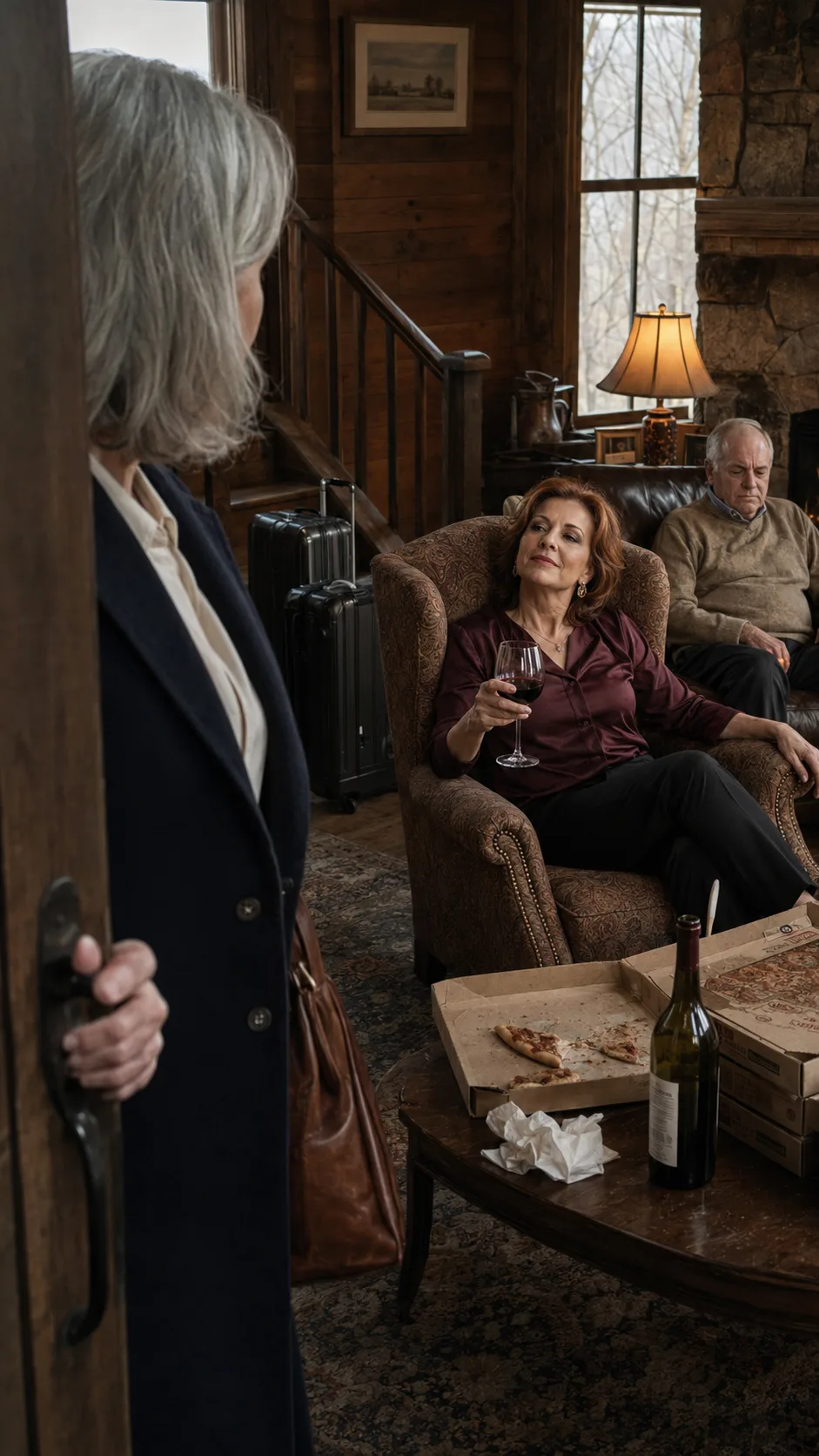
I have not heard directly from Brenda since the Sunday night at the cabin. I hear, through the family grapevine, that she still tells people I threw her out into the cold. She leaves out the wine, the pizza boxes, the luggage, the weeks she intended to take, and the sentence about getting a head start on the inheritance.
People like Brenda always edit the story until they can survive their own role in it.
That is no longer my concern.
The echo does not reach me here.
Sometimes, when the tenants are away and the agency calendar is clear, I drive up to the mountains for a day. I sit on the porch with coffee in the morning or a glass of wine at sunset. The air smells like pine and damp earth. The old cherry furniture sits where it belongs. The cast-iron skillet is dry, seasoned, and safe.
The house is quiet again.
But the quiet is different now.
Before, it was the quiet of a woman trying not to cause trouble.
Now it is the quiet of a woman who knows she can handle it when trouble arrives.
I think often about the moment Brenda laughed and told me Sarah said the house would be hers someday.
For a long time, that sentence hurt.
Now I almost appreciate it.
Not because it was kind. It was not.
Because it woke me.
It showed me the future they had planned if I did nothing. More assumptions. More access. More decisions made around me, over me, and eventually without me. It showed me how easily love can be converted into expectation when no one is required to say thank you.
I realized something that day.
You may have to risk the approval of people you love to save the truth of who you are.
You may have to let your only child be disappointed in you.
You may have to let your daughter-in-law call you selfish.
You may have to let relatives tell a version of the story where you are the villain because the honest version does not flatter them.
Let them.
A person who needs you powerless will always describe your boundaries as cruelty.
That does not make it true.
Jason respects me more now than he did when I was paying, yielding, and smoothing everything over. He may not say it in those exact words, but I see it. He calls before coming by. He asks instead of assumes. He has begun to stand straighter in his own life.
That is the unexpected gift.
By taking back my keys, I gave my son a picture of what a backbone looks like.
I am Diane.
I am sixty-nine years old.
I own my home, my cabin, my accounts, my time, my silence, and my yes.
And I am never giving away my keys again.
*** THE END.***
Chapter complete
You have reached the end of this chapter.
Continue reading
A few more worlds to get lost in after this chapter.




