PART 2 — THE NIGHT I CHANGED THE LOCKS
I was sixty-eight years old at the time.
Chapter 2
PART 2 — THE NIGHT I CHANGED THE LOCKS
I was sixty-eight years old at the time.
Old enough to have buried a husband, raised a son, paid mortgages, repaired roofs, survived medical bills, balanced checkbooks, cared for aging relatives, and learned that a woman can be called sweet right up until the moment she becomes inconvenient.
I had spent most of my adult life keeping peace.
Not because I was weak. That is what people always misunderstand about quiet women. We are not quiet because we have nothing to say. Sometimes we are quiet because we are measuring the cost of every word.
For years, I had measured.
I had measured Sarah’s comments.
“This table is a little dated, Diane.”
“Do you really need such a big place at your age?”
“Jason and I would make better use of that cabin someday.”
I had measured Jason’s discomfort when she said these things. I had measured the way he laughed softly and changed the subject because conflict
exhausted him.
I had measured every holiday when Brenda arrived with opinions and left with leftovers. Every time Sarah rearranged a kitchen drawer in my house without asking. Every time someone assumed that because I loved them, my boundaries were optional.
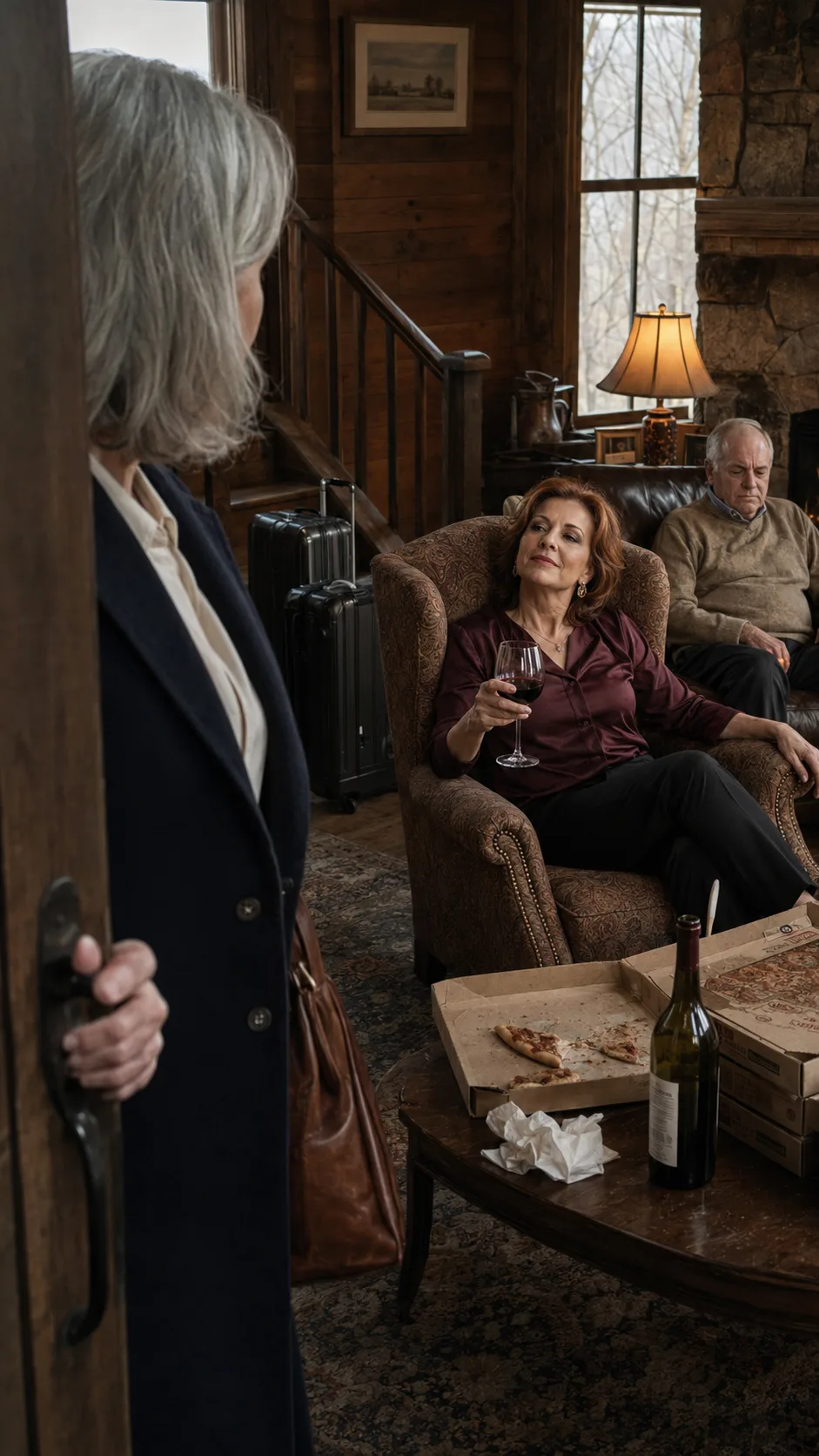
But standing in that cabin, watching Brenda drink my wine and speak of my property as if I were already gone, something inside me stopped measuring.
It became clear.
Not emotional.
Not dramatic.
Clear.
“I’m going to check the kitchen,” I said.
Brenda looked amused.
“Suit yourself.”
I walked past the living room and into the kitchen.
It was worse than I expected.
The sink was full of dishes. Not rinsed dishes. Crusted dishes. Plates with sauce drying on them. Forks thrown into the basin at odd angles. Crumbs across the counter. A cabinet door hanging open. A grocery bag on the floor. My husband’s cast-iron skillet sitting in
soapy water.
That skillet had been with us since our first apartment.
He used to make cornbread in it on Sunday afternoons, humming old country songs while Jason sat at the table pretending to do homework. It had survived moves, storms, and grief. It had not been treated carelessly in all the years I owned it.
Until Brenda’s family arrived.
I stared at it for a long moment.
Brenda followed me into the kitchen, swirling wine in the glass like she was touring a resort.
“Don’t get your feathers ruffled,” she said. “We’ll clean up before we leave.”
“When were you planning to leave?” I asked.
She leaned against my counter.
“A few weeks. Maybe the month. Larry needed a break, and Sarah said this would be fine.”
“The month,” I repeated.
Brenda tilted her head.
“You make it sound like we broke in.”
“Did you ask me?”
Her expression
tightened.
“Jason is your son.”
“That is not what I asked.”
She looked irritated now.
“Diane, really. Sarah said you’re not even using the place. And like I said, it’ll be hers someday. You can’t expect everyone to tiptoe around your feelings forever.”
My feelings.
That was another phrase people use when they do not want to discuss your rights.
I did not answer.
Instead, I took out my phone.
Brenda watched me photograph the dishes. The skillet. The counters. The wineglass in her hand. The living room. The pizza boxes. The luggage.
“What are you doing?” she asked.
“Documenting the condition of my property.”
Her smile disappeared.
Larry appeared in the kitchen doorway.
“Now, hold on,” he said. “There’s no need to make this official.”
I looked at him.
“If you wanted unofficial, you should have asked permission before moving in.”
No one spoke.
For a brief second, I saw it: their surprise. They had expected flustered Diane. Polite Diane. The Diane who would say, “Well, this is uncomfortable,” and then drive back to Charlotte to cry quietly and call Jason later.
They did not know this Diane.
To be fair, I was meeting her myself.
Brenda recovered first.
“You’re overreacting,” she said. “Sarah will be very upset when she hears how you’re treating her family.”
That sentence might have worked on me the year before.
It might have worked when I was still trying to earn Sarah’s approval. When I still believed that if I were patient enough, generous enough, quiet enough, she might finally see me as more than an account balance and a future estate.
But not that day.
I slipped my phone back into my purse.
Then I walked to the front door.
Brenda followed me into the hallway.
“So you’re just leaving?” she asked.
“Yes.”
“You’re not even going to talk this through?”
I turned around.
“There is nothing to talk through with people who are drinking my wine in my home without my permission.”
One of the cousins muttered something under her breath.
Brenda lifted her chin.
“Could you at least take the trash out when you go?”
The room went silent.
Even Larry looked uncomfortable.
That was the moment I knew they truly believed they had won. Not because they were powerful, but because I had trained them to expect my cooperation even while they insulted me.
I looked at Brenda for a long second.
Then I smiled.
Not because anything was funny.
Because I finally understood the kind of lesson this situation required.
“No,” I said.
I opened the door and stepped out into the cold mountain air.
Behind me, Brenda called my name again, sharper this time. I kept walking.
By the time I reached my car, Jason was already calling.
I watched his name light up on the screen.
I let it ring.
He called again as I backed down the gravel driveway.
I let it ring.
He called a third time when I reached the highway toward Charlotte.
I let it ring.
My son was not a bad man. I need that understood. Jason had a good heart. He loved his children. He worked hard. He still kissed my cheek every time he saw me. But he had learned to survive his marriage by avoiding discomfort, and avoidance has a cost.
Often, that cost had been me.
Sarah pushed.
Jason yielded.
I paid.
That had become the arrangement, though none of us had ever signed it.
On the drive home, the mountains faded in my rearview mirror, and the late-afternoon sky turned the color of old brass. I should have been shaking. I should have been crying. Instead, my mind became orderly.
Bank accounts.
Utility accounts.
Cleaning service.
Rental agency.
Keys.
Legal documents.
Every authorization I had ever signed.
Every favor I had dressed up as love.
Every line between family and ownership that had been blurred because I did not want to be seen as difficult.
By the time I reached my townhouse in Charlotte, I had stopped feeling wounded.
I felt awake.
My townhouse was quiet when I entered. Clean. Calm. Mine.
I set my purse on the hall table, locked the door, and made a cup of tea.
Then I sat at my desk and opened my laptop.
The first account I checked was the joint savings account I had set up for Jason and the grandchildren. It held sixty thousand dollars. My money. Money I had placed there for a future down payment on a house for Jason’s family.
Jason had signatory access, but the principal was mine.
Legally, emotionally, practically, mine.
I stared at the balance for a moment.
Sixty thousand dollars.
For years, I had pictured that money becoming stability for my son and grandchildren. A yard. A better school district. A safer neighborhood. A kitchen where the kids could do homework while dinner simmered.
But generosity without respect becomes a leak in the roof. At first, you think it is small. Then one day you realize the whole ceiling has been softening above you.
I transferred every cent back into my private account.
Not angrily.
Carefully.
Then I printed the confirmation page.
Next, I messaged the cleaning service I had used for the cabin for years. I canceled the upcoming sessions.
If Brenda and her group wanted to treat my house like a free vacation property, they could learn where the mop was.
Then I logged into the utility portal.
Electricity.
Water.
Gas.
I canceled the autopay attached to my personal account and scheduled closure of service after the minimum required notice. The cabin would not be immediately uncomfortable, but the free ride had an end date.
I forwarded the realtor my photos and asked to proceed with rental management as soon as the house was empty.
Then I sat back.
The room was silent except for the hum of my refrigerator.
My tea had gone cold.
I did not care.
The hardest part was not the money. It was not the cabin. It was not even Brenda’s laughter.
The hardest part was admitting that my son had allowed someone else to treat me as if I had already become an inheritance.
The next morning, Sarah arrived at my door without calling first.
That was typical.
Sarah did not visit so much as enter.
She knocked once and pushed the door open before I reached the hallway.
Her face was flushed. Her hair was pulled back so tightly it made her expression seem sharper than usual. She carried her phone in one hand like a weapon.
“Diane, what was that yesterday?” she demanded.
I was watering my African violets by the window.
I kept watering.
“Good morning, Sarah.”
“Don’t good morning me. My mother is devastated.”
I looked at the violets.
“They are delicate plants,” I said. “Too much water and the roots suffer.”
Sarah stared at me.
“What?”
I set the watering can down.
“Your parents are unwelcome in my cabin.”
She let out a short laugh, as if I had embarrassed myself.
“They’re family.”
“They are trespassers I happen to know.”
Her mouth opened.
Then closed.
Then opened again.
“Jason and I agreed they could stay there.”
“No,” I said. “You and Jason agreed to give away something you do not own.”
Her eyes hardened.
“You’re being selfish.”
There it was again. The old word. Selfish. The word used on women when they stop making themselves available for unpaid access.
I walked to the kitchen table and sat down.
Sarah remained standing, arms crossed.
“That house is going to be ours anyway,” she said. “Why are you making such a big drama out of this?”
I looked at her directly.
“Later is not now.”
Her jaw tightened.
“And whether it will ever be yours is a decision I make every day.”
For the first time since she entered, Sarah had no immediate response.
I could see her recalculating.
The old Diane would have softened the sentence. Added a little laugh. Said, “I don’t mean it like that.” Offered coffee. Offered comfort. Offered money.
I did none of those things.
Sarah’s voice dropped.
“Jason saw the savings account.”
“I assumed he would.”
“It’s empty.”
“Yes.”
“We were supposed to sign the contract for the new house next week.”
“I know.”
“What did you do?”
“I moved my money.”
Her eyes flashed.
“That money was for us.”
“That money was intended as a gift,” I said. “A gift with an unspoken condition.”
Sarah scoffed.
“What condition?”
“Respect.”
She looked away, then back at me.
“You can’t punish your grandchildren because you’re upset with me.”
I folded my hands on the table.
“I am not punishing anyone. I am refusing to fund a household that uses my property without permission and then lectures me for noticing.”
Sarah leaned forward.
“My parents needed a place to stay.”
“Then you should have hosted them.”
“Our apartment is too small.”
“Then you should have paid for a hotel.”
“We don’t have that kind of money right now.”
“But you believed you had the authority to give them my house.”
She went quiet.
Not ashamed. Not yet.
Angry.
Her anger had always been theatrical. Raised voice. Quick accusations. A wounded tone designed to make other people apologize for responding to her choices. Jason folded under it. Brenda amplified it. Larry avoided it.
I simply watched it.
That unsettled her more than anything I said.
“You’re going to regret this,” she said.
“No,” I replied. “I regret letting it get this far.”
She stood there another moment, waiting for me to blink.
I did not.
Finally, she grabbed her purse.
“Jason is going to be furious.”
“Jason is welcome to come speak with me.”
She left hard, the door closing behind her with a force that rattled the glass.
A few hours later, Jason arrived.
He looked exhausted.
My son had always carried stress in his shoulders. Even as a boy, when he had a spelling test or a game he worried about, he would hunch slightly, as if trying to make himself smaller than the problem.
That afternoon, he looked twelve years old and forty-five at the same time.
“Mom,” he said, standing in my hallway.
“Come in.”
He sat at the kitchen table in the same chair where he used to do homework while I made dinner after work. For a moment, the sight softened me.
Then I remembered the pizza boxes on my mother’s coffee table.
“Does it have to be like this?” he asked.
“Yes.”
He rubbed his face.
“Sarah is losing it. Her parents won’t leave the cabin. Brenda says you embarrassed them.”
“I walked out of my own house after finding them using it without permission.”
“They thought it was okay.”
“Because you let them think that.”
He looked down.
There it was.
Not a denial.
Just silence.
“Jason,” I said, “did you give Sarah the spare key?”
He swallowed.
“She knew where it was.”
“That is not what I asked.”
He closed his eyes briefly.
“Yes.”
“And did you tell her she could offer the cabin to her parents?”
“Sarah said it would be fine. She said you weren’t using it.”
I nodded slowly.
“Did you ask me?”
“No.”
“Did you tell them the cabin was being prepared for rental?”
“I didn’t know the realtor was coming so soon.”
“You knew I was renting it.”
He said nothing.
The kitchen clock ticked between us.
I pushed a plate of cookies toward him. He did not take one.
“I love you,” I said. “That has never been the question.”
His eyes watered, and that nearly undid me.
But love was not a reason to surrender common sense. Love was not a deed transfer. Love was not a blanket permission slip for every person attached to my son’s marriage.
“I’ve hired a realtor,” I continued. “The first walkthrough for long-term tenants is next week. Sarah’s parents and their relatives need to be out by Sunday night.”
Jason looked up sharply.
“Sunday? Mom, they can’t do that.”
“They can.”
“They already unpacked.”
“They can pack.”
“Brenda says they planned on staying at least three weeks.”
“She planned incorrectly.”
He stared at me.
“You sound so cold.”
I leaned back.
“No. I sound like a woman who is finished paying for warmth she never receives.”
He flinched.
I did not apologize.
Then I told him about the utilities.
His face changed immediately.
“You can’t do that.”
“I can. The bills are in my name.”
“But they’re there now.”
“They should not be.”
“What if they have nowhere to go?”
“Then the adults who invited them can help them find a place.”
He stood up and paced to the window.
“This is going to make things worse.”
“No, Jason. It is going to make things honest.”
He turned back toward me.
“Sarah says you’re trying to control us.”
“I am controlling myself. That is what she dislikes.”
He looked at the floor.
I could see the conflict working through him. Son against husband. Habit against truth. Comfort against consequence.
“I don’t want to be in the middle,” he said.
“You placed me underneath the middle,” I replied. “I am simply stepping out.”
That ended the conversation.
He left quietly.
That night, I slept better than I had in years.
Not because the situation was resolved. It was far from resolved. But for the first time, I was not lying awake wondering how to make everyone else comfortable at my own expense.
Peace based on being a doormat is not peace.
It is just quiet resentment with a tablecloth over it.
On Sunday evening, I drove back to the mountains.
This time, I was not alone.
Mr. Miller, a locksmith from a small town twenty minutes away, met me at the gravel driveway. He was a polite man in his fifties with a gray beard, a work van, and the calm patience of someone who had seen every kind of property dispute humans can invent.
The cabin lights were blazing when we arrived.
Music drifted through the windows.
So they had not left.
Of course they had not left.
They thought I was bluffing because bluffing had been the family language for too long. People threatened change, then backed down before the discomfort arrived. I had been guilty of that myself.
Not anymore.
I got out of the car.
The mountain air was crisp. The porch light threw a golden circle across the steps. Inside, someone laughed.
I walked up and knocked.
Brenda opened the door wearing a robe over leggings, a glass of wine in her hand.
When she saw me, her expression hardened.
“Diane,” she said. “Back again.”
“Yes.”
Her eyes moved to Mr. Miller.
“Who is that?”
“This is Mr. Miller. He is here to change the deadbolts on the front and back doors.”
Her mouth fell open.
“You cannot be serious.”
“I am.”
Larry appeared behind her, his face red, his shirt untucked.
“What’s going on?”
“You have thirty minutes to pack,” I said.
Brenda laughed once.
It was not a real laugh.
“We told you we’re staying through the month.”
“No,” I said. “You told yourselves that.”
Larry stepped forward.
“You can’t throw people out on a Sunday night.”
I looked at my watch.
“It is eight o’clock. You have thirty minutes.”
Brenda’s voice rose.
“This is family.”
“This is my property.”
“You’re being cruel.”
“I am being precise.”
Mr. Miller stood quietly behind me with his toolbox. He did not speak. He did not need to. His presence did what words could not. It made the boundary visible.
Brenda grabbed her phone.
“I’m calling Sarah.”
“Please do.”
She put the call on speaker, perhaps believing Sarah’s voice would restore the old order.
Sarah answered on the second ring.
“Mom? What’s happening?”
Brenda spoke loudly.
“Your mother-in-law is here with some man trying to change the locks.”
Sarah’s voice sharpened instantly.
“Diane, have you lost your mind?”
I took the phone gently from Brenda’s hand and held it near my mouth.
“Sarah, your parents have thirty minutes to gather their belongings. Anything left behind will be handled by the rental agency.”
“You can’t do this,” Sarah said.
“I can.”
“My mother is crying.”
Brenda was not crying.
She was glaring.
“That is unfortunate,” I said.
Jason’s voice appeared faintly in the background.
“Mom, please—”
I ended the call and handed the phone back to Brenda.
The silence that followed was different from the silence the first day.
The first day, they had been comfortable in it.
This time, it exposed them.
Mr. Miller began removing the front lock. The metallic sound of the drill filled the hallway.
That sound did more than any speech could have done.
It announced that the house was returning to its owner.
The next thirty minutes were chaos.
Brenda stormed from room to room, stuffing clothes into plastic bags because she had not brought proper luggage for everything she had spread through the house. Larry searched for his shoes and blamed everyone within reach. One cousin tried to gather toiletries from the bathroom. Another wrapped leftover pizza in foil as if she still had the right to carry away dinner. The third asked me whether I was “really going to make them drive at night.”
I said, “Yes.”
No speech.
No explanation.
Just yes.
Brenda kept muttering about humiliation.
I stood in the hallway with my hands in my coat pockets.
At some point, Larry said, “You used to be nicer.”
I looked at him.
“I used to be easier.”
He had no answer.
When the back door lock was changed, Mr. Miller handed me the new keys.
The five of them stood in the driveway under the porch light with bags at their feet and outrage on their faces. The mountain night had turned cold. Their breath showed faintly in the air.
Brenda looked at me like she wanted one final line, something sharp enough to leave a mark.
“This will damage your relationship with your son,” she said.
“No,” I replied. “The damage began when my son learned he could give away my home and expect me to thank him for being included afterward.”
Her face tightened.
I stepped inside, closed the door, and locked it with the new key.
Then I turned off the porch light.
Through the window, I watched them stand in the darkness for several stunned seconds before they finally loaded their cars.
When the taillights disappeared down the driveway, the cabin became quiet again.
Real quiet.
I stood in the living room and breathed.
The house was a mess.
The coffee table needed careful cleaning. The kitchen needed more than an ordinary wipe-down. The trash smelled terrible. Someone had spilled wine on a throw pillow. The guest bathroom looked like a discount motel after a holiday weekend.
But the house was mine again.
That mattered more than the mess.
To be continued… Click “PART 3” to read the final part: 👉 PART 3 👈
Chapter complete
You have reached the end of this chapter.
Continue reading
A few more worlds to get lost in after this chapter.




