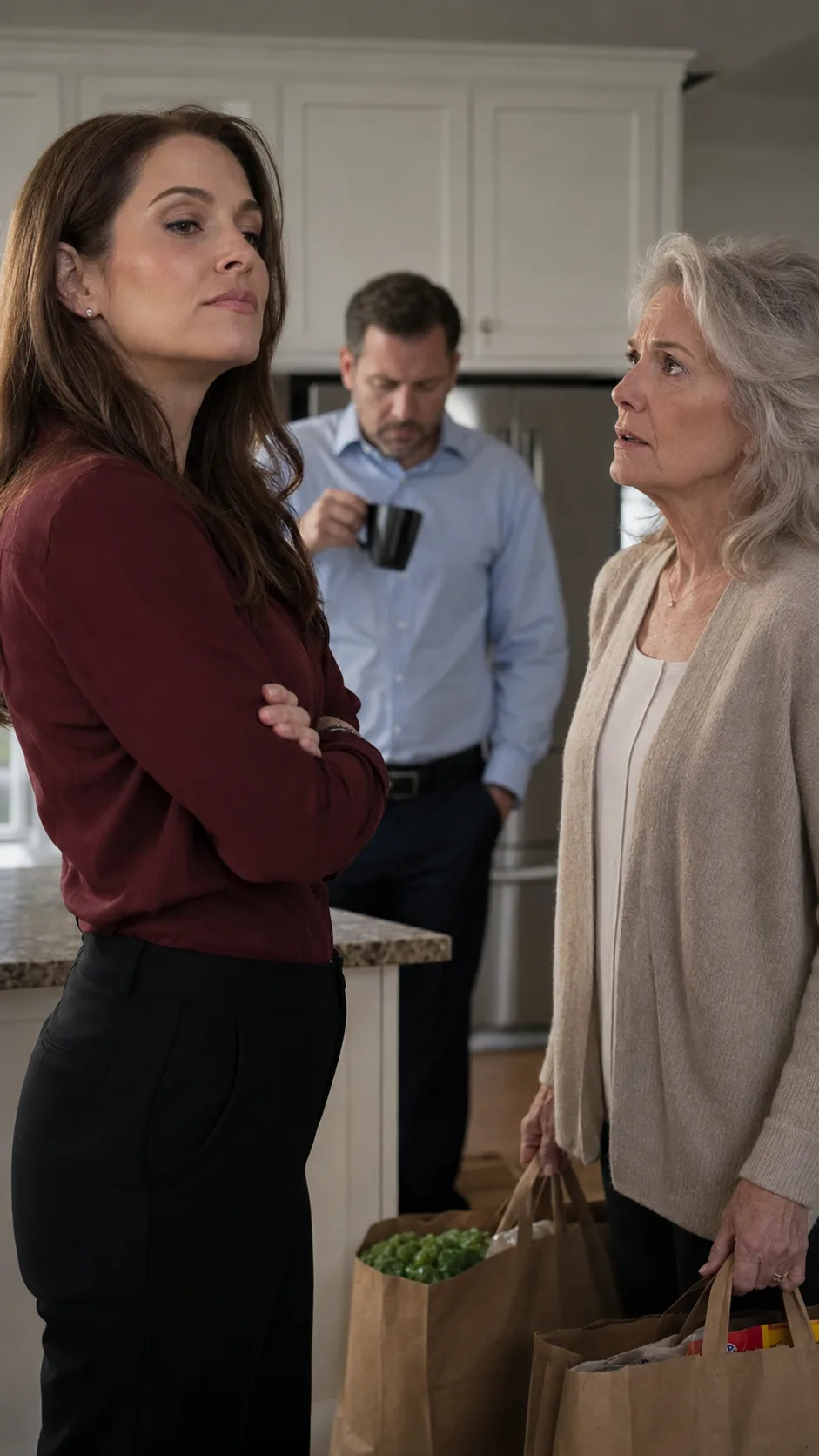
PART 3 — The Ledger That Exposed the Truth
“Yes,” I said.
Chapter 3
PART 3 — The Ledger That Exposed the Truth
“Yes,” I said.
“I bought it because I realized I was waiting for my son to defend me in a house where he had learned to benefit from my silence.”
His face crumpled.
This time, he did cry.
He bowed his head over the ledger and cried like a boy who had broken something he could not fix with glue.
I wanted to put my hand on his shoulder.
I did not.
Not yet.
When Brian left that day, he took photocopies of three pages and none of the original receipts.
“I’ll talk to Jenna,” he said.
I believed he would.
I did not believe he understood what that would cost.
Jenna called two hours later.
I let it go to voicemail.
Her voice was bright and hard.
“Ruth, I don’t appreciate you filling Brian’s head with numbers. You lived in our home for almost two years. Groceries and a few bills do
not equal rent. We were trying to be kind, and now you’re acting like a victim. Call me back so we can discuss this like adults.”
I saved the voicemail.
Not because I needed it.
Because old habits have their uses.
The next day, a letter arrived by email.
Not from an attorney.
From Jenna.
Subject line:
Household Reconciliation.
I almost admired the audacity.
She had made a spreadsheet.
Room value.
Utilities.
Kitchen usage.
Laundry usage.
Storage.
Pet companionship.
Pet companionship.
She had assigned a dollar value to Murphy sleeping at my feet after I paid for his ear medicine.
At the bottom, she claimed that after subtracting my “voluntary contributions,” I owed Brian and Jenna $18,900 for lodging.
I stared at the screen for a full minute.
Then I printed it.
I placed it in the ledger.
Behind it, I placed the grocery receipt from the morning she told
me I lived free.
Then I called the elder law attorney who had reviewed my condo closing documents.
Her name was Patricia Lowell, and she had silver hair, navy glasses, and the careful patience of someone who had spent her career watching families discover money inside their morals.
She read Jenna’s email in silence.
Then she said, “Do you want to pursue reimbursement?”
“No.”
“Are you sure?”
“Yes.”
“Then what do you want?”
I looked toward the patio door, where the maple leaves moved in the afternoon wind.
“I want them to stop treating my kindness like a contract they wrote without me.”
“That I can help with.”
Patricia sent a letter two days later.
It was calm.
It was formal.
It was devastating.
It stated that I denied owing rent, lodging, storage, or any other retroactive household charge. It listed my documented contributions. It attached a summary ledger, not
the full receipts, just enough to make the shape of the truth clear.
It also said any further attempt to pressure me for funds from the sale of my former home would be treated seriously, particularly given my age, widowhood, and the documented pattern of household support I had provided.
Patricia did not use the phrase financial exploitation until the second page.
She did not need to use it twice.
Jenna stopped calling.
Brian came back the following Sunday.
This time, he brought Murphy.
The old beagle waddled through my condo like a little king, sniffed the rug, and promptly fell asleep under my kitchen table.
Brian stood by the counter holding his baseball cap.
“She’s furious,” he said.
“I assumed.”
“She says you’re threatening us.”
“I’m protecting myself.”
“She says that letter made her look abusive.”
I poured coffee into two mugs.
“Did it?”
He did not answer.
That was answer enough.
We sat at the table.
Brian looked thinner than he had a week before.
“I went through our bank account,” he said.
I waited.
“I should have done it sooner.”
“Yes.”
He nodded.
No excuse.
That gave me a small, painful hope.
“She’s been using credit cards,” he said. “More than I knew. The mortgage has been late twice. She told me it was a bank timing issue.”
I thought of the water notice.
The electric bill printed in red.
The way Jenna had folded her arms and said free.
“Are you safe?” I asked.
He looked startled.
I was still his mother.
That had not changed.
“I’m not in danger.”
“That’s not what I asked.”
His eyes dropped.
“I don’t know.”
The truth sat between us.
It was not neat.
It rarely is.
Brian twisted his cap in his hands.
“She wants me to ask you for help.”
“No.”
He nodded quickly.
“I know. I told her no.”
That was the second crack.
No.
A small word.
A late word.
But late is not the same as worthless.
“What did she do?” I asked.
He gave a tired laugh.
“Called me ungrateful. Said I was choosing you over my wife.”
“And are you?”
He looked at me.
“I’m choosing the truth over pretending.”
For the first time in a long while, I reached across the table and put my hand over his.
His fingers tightened around mine.
He was not forgiven.
Not fully.
Not yet.
But he was my son, and he had taken one step out of the fog.
I could honor the step without pretending the road was finished.
The next month was ugly.
Not loud enough for neighbors.
Not dramatic enough for television.
Just ordinary ugly.
The kind that comes with bank statements, minimum payments, late fees, and the discovery that resentment has been living in the guest room longer than any mother-in-law ever did.
Brian found out Jenna had told three friends that I “refused to help with expenses” while living with them.
He found out she had thrown away two insurance notices before telling me about them.
He found out she had been using the grocery money he gave her for online shopping and letting me fill the refrigerator because she knew I would not let my son go without dinner.
When he confronted her, she denied it.
Then she cried.
Then she said he was attacking her.
Then she said I had poisoned him.
Then she said, “Your mother had all that money just sitting there.”
That sentence changed him.
He told me later there are things you hear once and cannot unhear.
Your mother had all that money just sitting there.
As if Henry’s pension, our sold house, and forty years of careful saving were not my security.
As if widowhood were a bank account waiting for a younger woman’s hand.
As if I had become a pile of money inconveniently shaped like a person.
Brian moved into the basement for three nights.
Then into a budget motel for two.
Then back home because Murphy was sick and because marriage, even damaged, has hooks.
I did not tell him what to do.
That was one of the hardest disciplines of my life.
A mother wants to warn.
To fix.
To show up with soup and a broom and a check.
But I had learned the cost of stepping in too quickly.
So I answered when he called.
I listened.
I said, “Have you called a counselor?”
I said, “Have you spoken with a financial advisor?”
I said, “Do not use my savings as your solution.”
The last one became easier each time.
Jenna did not stay quiet forever.
People who believe themselves entitled often mistake silence for a pause in negotiations.
Six weeks after Patricia’s letter, Jenna showed up at my condo.
She did not call first.
I was repotting a basil plant on the patio when the doorbell rang.
Through the peephole, I saw her standing there in a cream sweater, hair curled, lips pressed together.
I opened the door but kept the chain on.
Her eyes flicked to it.
“Really?”
“Yes.”
Her face tightened.
“I’m not dangerous, Ruth.”
“No. You’re persistent.”
She inhaled through her nose.
“We need to settle this.”
“It is settled.”
“No, it isn’t. You made Brian think I used you.”
“I did not make Brian read bank statements.”
Her eyes flashed.
“You always do that.”
“What?”
“Act calm while you judge everyone.”
I looked at her through the narrow opening.
For almost two years, that tone had made me shrink. In her kitchen, in her hallway, beside her coffee maker.
At my own door, it sounded smaller.
“Jenna, why are you here?”
She held up a folder.
“We’re going to lose the house if we don’t catch up.”
There it was.
Not apology.
Not accountability.
A bill wearing a sweater.
“I’m sorry to hear that.”
Her mouth fell open.
“That’s it?”
“What did you expect?”
“You lived with us.”
“I contributed while I lived there.”
“Not enough.”
I almost smiled.
She had learned nothing.
Or maybe she had learned exactly how little worked on me now, and panic was making her repeat the old language harder.
“I will not give you money.”
Her eyes went wet instantly.
I no longer trusted those tears.
“Brian is your son.”
“Yes.”
“And you’d let him lose his home?”
“I already sold mine.”
She flinched.
“You chose that.”
“I chose it because he invited me into his home and then let you call me free while I was paying to keep the lights on.”
Her tears disappeared.
There she was.
The polished anger beneath the softness.
“You’re enjoying this.”
“No.”
“You want me punished.”
“No. I want you responsible.”
She leaned closer to the door.
“You think that little condo makes you independent? You’re old, Ruth. Someday you’ll need us.”
There it was.
The threat under the family language.
For the first time, I saw not only who she was, but what she had counted on.
She believed age would become her leverage.
She believed fear would send me back.
I unhooked the chain.
Her face shifted with satisfaction.
Then I stepped onto the porch, pulled the door closed behind me, and locked it.
Jenna blinked.
“What are you doing?”
“Making sure you understand this conversation is not happening inside my home.”
Her jaw clenched.
I folded my hands.
“I may need help someday. Most people do if they live long enough. But needing help will not mean surrendering my dignity to you.”
Her face went pale.
“You’re cruel.”
“No,” I said. “I’m no longer available.”
She stared at me.
The words hit harder than I expected.
Maybe because useful people are not supposed to resign.
Her folder lowered.
For one second, something like fear crossed her face.
Then she turned and walked away.
Not dramatically.
No slammed door.
No final curse.
Just a woman leaving a porch she could not enter.
I called Patricia afterward and documented the visit.
Then I made myself lunch.
Tomato soup.
Toast.
A peach sliced into a blue bowl.
It felt absurdly peaceful.
The following winter, Brian and Jenna sold the house.
Click the blue “PART 4” below to read the final part:
Chapter complete
You have reached the end of this chapter.
Continue reading
A few more worlds to get lost in after this chapter.




