PART 2 — The Day I Said No
That was what she called cooking dinner after she texted at five saying she was too tired to cook.
Chapter 2
PART 2 — The Day I Said No
That was what she called cooking dinner after she texted at five saying she was too tired to cook.
Taking over was paying the bill before the water shut off.
Taking over was remembering Brian’s prescription refill because he forgot until he was down to one pill.
Taking over was walking Murphy in sleet because neither of them wanted to leave the house.
I kept my mouth closed because I had never been a woman who liked scenes.
Henry used to say I could win an argument with one eyebrow and a grocery receipt.
He was right about the receipt part.
I kept them.
All of them.
Not because I was plotting.
Because I had spent forty years balancing a household on one factory paycheck, one part-time library job, and whatever dignity we could save by not owing people who enjoyed being owed.
I kept the utility confirmations.
The grocery receipts.
The vet bill for Murphy’s ear infection.
The printed insurance payments.
The check stubs.
The pharmacy receipts.
The
lawn service invoice.
I kept them in a brown ledger with blue ink, the same kind I used when Henry and I were first married and every dollar had a place to stand.
Jenna thought I kept coupons because I was old.
I kept records because I was awake.
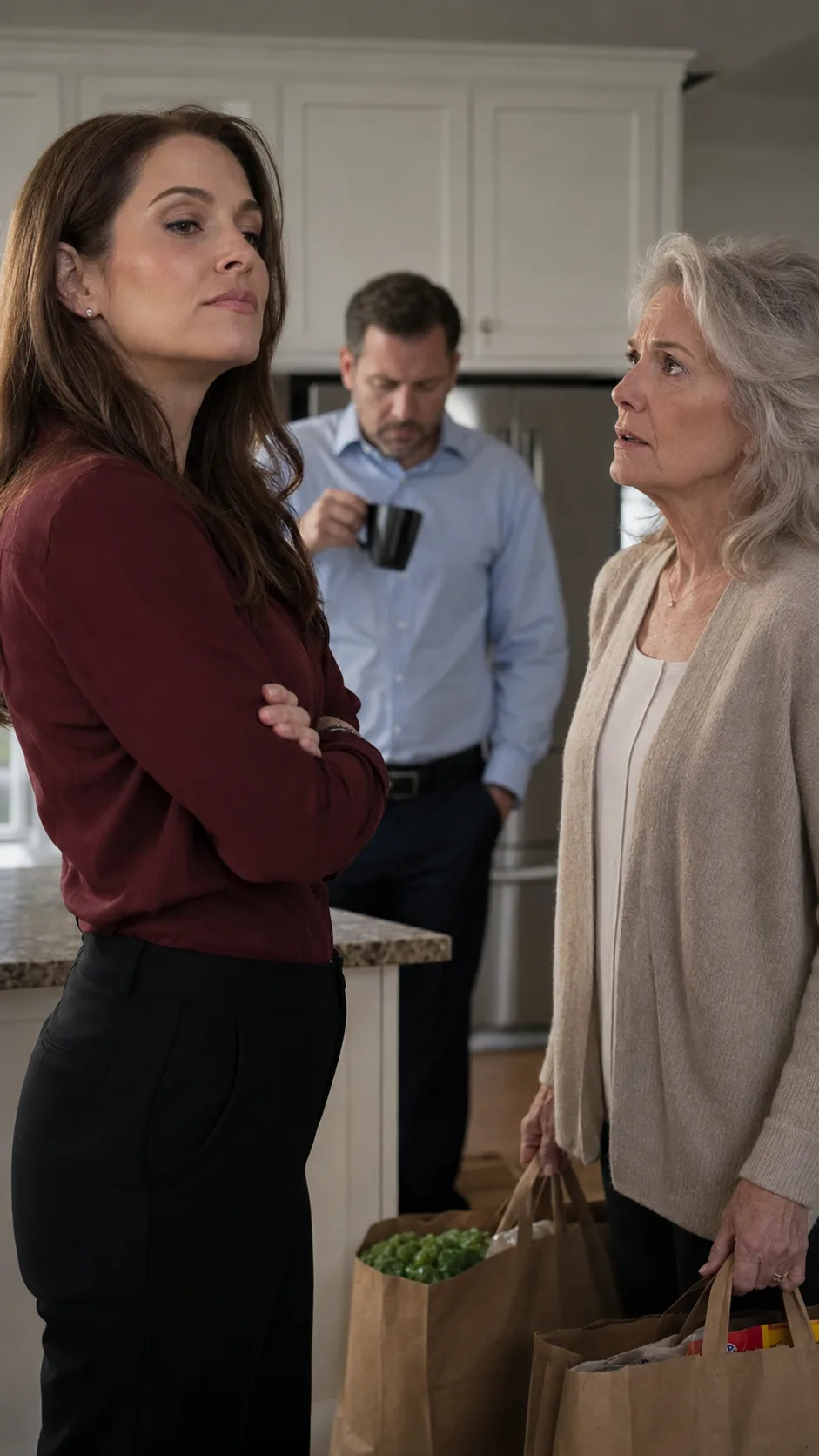
One Saturday morning, I came home from the grocery store carrying two paper bags and a gallon of milk. My hands ached. The Arizona oranges Jenna liked had gone up again, but I bought them anyway because she had mentioned wanting them.
She was in the kitchen when I walked in.
Brian stood by the coffee maker, staring into his mug like answers floated there.
Jenna did not offer to take a bag.
She folded her arms.
“Ruth,” she said, “we need to talk.”
There is a way people say that sentence when they have already decided you are the problem.
I set the groceries on the counter.
“What is it?”
Jenna looked at Brian.
He did not look at me.
Then she said it.
“You live here free. That has to change.”
The milk carton was still cold against my wrist.
“Free?”
“Yes,” she said. “Free. We gave you a place to stay. We have a mortgage. We have bills. We know you have money from selling your house.”
I looked at my son.
“Brian?”
He rubbed the back of his neck.
“Mom, nobody is attacking you.”
Jenna gave a small laugh.
“No, we’re being fair. Either contribute properly from your savings or start packing.”
Properly.
That word sat between us like a receipt no one wanted to read.
I thought about the grocery bags.
The July electric bill.
The water notice.
The dog food.
The dinners.
The insurance confirmations printed and tucked into the brown folder in my dresser.
I thought about Henry, who had worked thirty-nine years at the same plant and put money away one careful dollar at a time so I would never have to beg anyone for a roof.
Then I said one word.
“No.”
Jenna blinked.
Brian looked up.
I picked up the milk and placed it in the refrigerator.
Jenna’s mouth tightened.
“Then you should start packing.”
So I did.
Not loudly.
Not dramatically.
I went to the spare bedroom, opened the closet, and took out the two suitcases I had never fully unpacked.
Jenna followed me down the hall, her slippers whispering against the floor.
“You’re really going to make this into a scene?”
I folded my cardigan.
“No.”
“You can’t just leave because we asked for responsibility.”
I placed Henry’s photo in my tote bag.
“I’m leaving because you clarified the arrangement.”
Brian stood in the doorway, pale and silent.
“Mom,” he said, “where would you even go?”
That was when I took the small white envelope from my purse.
Inside was a closing packet for a one-bedroom condo near the library.
Nothing grand.
Nothing fancy.
Just a sunny kitchen, a little patio, and a front door that opened only for people I invited.
“I closed yesterday,” I said.
Jenna stared at the envelope.
Brian’s lips parted.
“You bought a place?”
“Yes.”
“With cash?”
“With my money.”
The sentence changed the room.
Not because it was cruel.
Because it was clean.
For two months, I had been searching quietly.
The realtor was a woman named Denise who had sold my ranch house and called me every Friday afterward, not to chase a commission but to ask whether I was really all right.
The first time she showed me the condo, the afternoon sun fell across the kitchen tile in a warm square. The cabinets were older but solid. The patio faced a maple tree. The bedroom had enough room for Henry’s cedar chest.
I stood in the doorway and felt something I had not felt since moving into Brian’s house.
Privacy.
Not loneliness.
Privacy.
The kind that lets you exhale.
I made an offer that same day.
I did not tell Brian.
That was not revenge.
That was protection.
By Sunday afternoon, movers carried my boxes out.
Jenna watched from the hallway with her arms folded, but she did not call me free again.
Brian tried to help with one box, then put it down when he saw it was heavier than he expected.
“You should have told me,” he said.
I looked at him.
“I waited for you to ask how I was living here. You never did.”
He opened his mouth.
No words came.
At the front door, I removed their spare-room key from my key ring and placed it on the entry table.
Then I picked up the brass key to my new condo.
Brian whispered, “Mom, I didn’t think you’d actually go.”
I looked at him.
“That was the problem.”
Three weeks passed.
My new kitchen smelled like lemon soap and quiet.
I drank coffee by the patio door.
I bought flowers for myself.
I hung Henry’s picture in the hallway and placed his cedar chest at the foot of my bed.
I found the library, the little grocery store with good peaches, and a walking path where older women in bright sneakers passed me every morning and nodded as if we had agreed to survive something.
I slept through the night for the first time in two years.
Not because I missed Henry less.
I never did.
But because no one sighed outside my bedroom door.
No one used my age as a reason to treat me like furniture.
No one called a room mine only when they wanted me to clean it.
My condo was small, but every inch of it belonged to peace.
Then the calls started.
First Brian.
Then Jenna.
Then Brian again.
I let them ring until the fourth message.
His voice sounded smaller than I remembered.
“Mom, please call me. Some bills didn’t clear, and Jenna says we need to figure out what you were paying.”
What I was paying.
Not what I had given.
Not what they had forgotten.
What I was paying.
I did not call back right away.
I made tea first.
Henry used to say no serious conversation should begin before the kettle had finished its work.
The next afternoon, Brian came to my condo alone, carrying a manila envelope full of overdue notices.
He stood on my porch and looked past me at the clean hallway, the soft rug, the little bowl of keys on the table.
For a second, I saw him understand something that hurt him.
I had not been rescued by his house.
I had been recovering from it.
“Mom,” he said quietly, “this is nice.”
“Yes,” I said. “It is.”
He held up the envelope.
“I didn’t realize how much you were covering.”
I stepped aside.
He came in carefully, like a man entering a church after breaking a window.
From the kitchen drawer, I took out the utility ledger.
Brown cover.
Blue ink.
Every date.
Every bill.
Every grocery run.
Every quiet payment they had mistaken for free.
I placed it on the table between us and opened to the first page.
Brian sat down before he read the first total.
The overdue notices had come asking for money.
The ledger had been waiting to ask for the truth.
For a while, the only sound was the clock above my stove.
Brian turned page after page.
March water bill.
April groceries.
May pharmacy.
June car insurance.
July electric.
August lawn care.
September vet.
October mortgage shortage.
He paused on that one.
“Mortgage shortage?”
“You and Jenna had a late notice. She said the bank made a mistake. I paid the amount due before fees posted.”
His face went gray.
“She didn’t tell me that.”
“I assumed you knew.”
He shook his head slowly.
“No. I didn’t.”
That was the first crack.
Not in him.
In the story he had been living inside.
He turned another page.
I had written notes in the margin.
Jenna asked for cash for plumber. Paid plumber directly.
Brian said insurance would lapse. Paid State Auto confirmation #4491.
Jenna requested grocery pickup. Total $186.72.
Murphy vet. Ear medication.
Brian’s prescription. Jenna said card declined.
Under each line was a receipt number, a payment confirmation, or a copy folded into the back pocket.
Brian leaned back.
“How much?”
I did not answer.
He looked at me.
“Mom.”
I turned to the last page, where I had added the total two nights after I moved into the condo.
Not every penny.
Only the household expenses that should never have been mine alone.
$31,482.67.
Brian stared at the number.
His eyes filled, but he did not cry.
Men like my son often think tears are something that happen to other people until a number tells them who they have become.
“I didn’t know,” he whispered.
“No,” I said. “You didn’t want to know.”
That hurt him.
I saw it.
A mother’s first reflex is to soften the blow.
But love that hides truth becomes another kind of debt.
So I let the words stand.
He rubbed both hands over his face.
“Jenna said you liked helping.”
“I did.”
He looked up.
I closed the ledger.
“I liked helping when I thought it was seen as love. I stopped liking it when it became an expectation, then an accusation.”
He swallowed.
“She said you were making us feel guilty on purpose.”
“I kept receipts in a drawer. If that made you feel guilty, Brian, the paper was not the problem.”
He flinched.
The front of his shirt was wrinkled. There was gray in his beard I had not noticed before. He looked forty-three and eleven at the same time.
“Jenna wants you to come over tonight,” he said.
“No.”
“She says we need to talk as a family.”
“This is talking as a family.”
“She thinks you owe us an explanation.”
I laughed once.
Not loudly.
Not kindly.
It surprised us both.
“I lived in her spare room. I bought her oat milk. I paid her shutoff notices. I kept her house running while she called me a burden. What she wants is not an explanation. It is control.”
Brian looked down.
“She’s angry.”
“I know.”
“She says you embarrassed her.”
“No,” I said. “I left quietly. If she is embarrassed, it is because her audience disappeared and the bills stayed.”
He sat there for a long time.
Then he asked the question that mattered.
“Is this why you bought the condo?”
I looked around my little kitchen.
At the blue dish towel folded beside the sink.
At the sunlight on the floor.
At Henry’s photo in the hall.
Click the blue “PART 3” below to read the next part: 👉 PART 3 👈
Chapter complete
You have reached the end of this chapter.
Continue reading
A few more worlds to get lost in after this chapter.