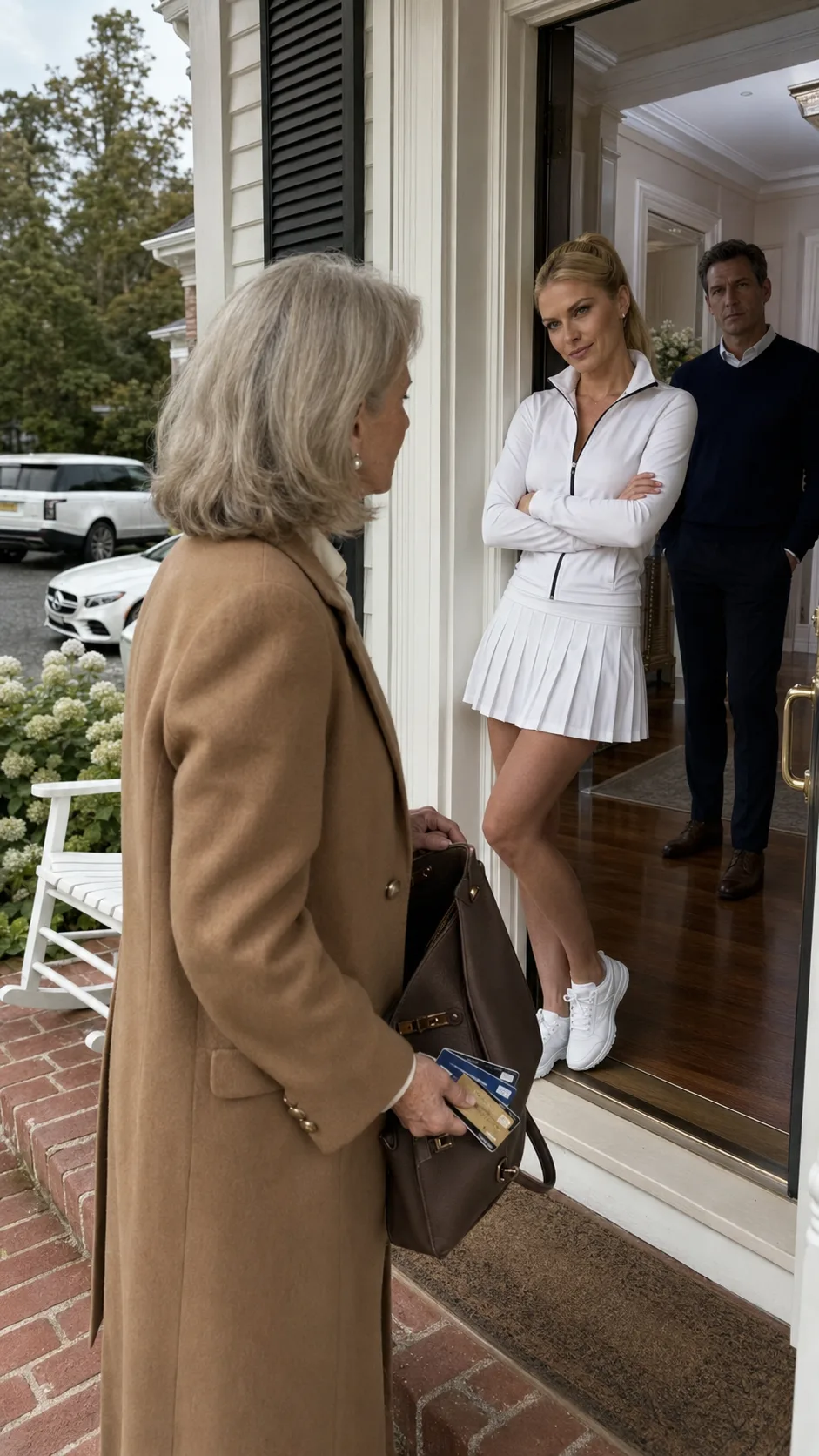
of him at twenty-three, crying in my kitchen the day his father was diagnosed because he still believed adults could be saved by wanting it hard enough.
Then I thought of the shell account in Karen’s maiden name.
“Make him understand,” I said.
The meeting was scheduled for the following Tuesday.
In the week between Whole Foods and that conference room, I changed the way I moved through the world. Not dramatically. Not visibly to most people. But in every meaningful sense. I changed all account passwords myself in person. I moved a series of personal valuables—jewelry, original deeds, Warren’s letters, my grandmother’s emerald earrings, the backup drive containing certain company records—into a private vault. I notified the school that any change to my grandchildren’s visitor permissions had to be verified in person by me and no one else. I had security cameras upgraded at my home and my office. I met with the COO and corporate controller independently and, without giving them the whole family scandal, made it clear that no transaction, no sale discussion, and no governance change was valid absent my direct written instruction. I also spent one sleepless night in Warren’s old study reading through years of decisions I had made in the name of being supportive, generous, flexible, loving, and calm.
That was the harder work.
Not the legal preparation. The moral inventory.
When had I started confusing help with surrender? When had I trained my son to believe the route to security was always through my resources? When had the company become, in his mind, less a legacy to steward than a reservoir to drain? There is no clean answer to those questions, because corruption in families usually grows the way mold grows—in neglected places, in damp corners, under surfaces that look fine from the room’s center.
Looking back, the signs had been there for years. The first “temporary” loan to cover private school tuition because Karen insisted public school would “limit the children socially.” The country club initiation fee that somehow ended up on my credit card because “it was easier for the family office to handle.” Desmond’s insistence on upgrading their first house long before the mortgage made sense. His increasing impatience whenever I asked routine questions about dealership margins or expansion debt. Karen’s phrase—our future—always delivered in a tone that implied I was selfish for remembering I also had one.
After Warren died, I believe they interpreted my grief as a form of softness that could be managed. I was slower to fight. More eager to avoid scenes. Too grateful whenever Desmond showed concern. A widow’s loneliness can make ordinary family attention feel like love at a markup. I see that now with painful clarity.
By the morning of the meeting, the whole city seemed to hum with sharp spring light. Miriam’s conference room sat high above downtown, glass on two sides, a long walnut table at the center. I arrived early. Frederick was already there with a banker’s file box and a stack of evidence binders. Miriam came in last, dropped a leather folio at her seat, and said, “Remember two things. First, he wants you emotional. Second, he thinks your maternal instinct is still his strongest asset.”
“I know,” I said.
“No,” she said calmly. “Know it in your body.”
Desmond arrived with an attorney who looked as if he had mistaken expensive cuff links for competence. Karen came with him despite being told the meeting concerned governance and financial authority. Of course she did. She had not spent years choreographing this without intending to watch the final movement.
When they entered, Desmond looked prepared to manage me. That was the phrase that came to mind. He had the smile people use on frightened animals or difficult clients. Karen carried a leather folder and a certainty that I recognized instantly: the certainty of someone who has won too many small manipulations and therefore misjudges what happens when the opponent finally stops cooperating.
“Mom,” Desmond began, before he was fully seated, “I’m glad you agreed to handle this privately—”
“Sit down,” Miriam said.
Something in her voice cut cleanly enough that even Karen obeyed before she realized she had. Desmond’s attorney opened his mouth to object, but Miriam slid a binder across the table.
“That,” she said, “is a forensic analysis prepared by First National Bank documenting unauthorized access attempts totaling approximately twenty-three million dollars across protected accounts belonging to Nora Morrison.”
The attorney actually blinked.
Frederick pushed forward another stack. “These are the destination accounts identified in the attempts. Two shell entities connected to an acquisition vehicle, one personal investment account, and one account in Ms. Karen Whitmore’s maiden name.”
Karen inhaled sharply. Her face did not fall apart—it tightened. She had the discipline of vain people; they practice composure like religion. But the edges changed.
Desmond tried to regroup. “There’s a misunderstanding. I had power of attorney—”
Miriam slid the signed revocation across the table. “Not anymore. And even before this morning, the authority granted did not permit self-dealing, fraudulent transfer attempts, or unilateral freezes of personal accounts absent incapacity. Three independent physicians have already provided written statements confirming Mrs. Morrison is cognitively intact and fully competent.”
Karen leaned forward. “She repeats stories. She forgets things.”
Miriam did not even look at her. “Ms. Whitmore, unless you are licensed to diagnose cognitive impairment, I suggest you conserve your commentary for your own counsel.”
Desmond’s attorney finally found his footing. “My client has concerns regarding his mother’s susceptibility to financial exploitation and—”
Frederick cut in with banker politeness sharpened into steel. “Your client attempted to move twenty-three million dollars into structures beneficial to himself. That is not protection. It is evidence.”
The silence that followed was one of the most satisfying sounds I have ever heard.
Miriam laid out the legal posture with clinical efficiency. The sale of Morrison Auto Group could not proceed because I retained controlling ownership and had not authorized any negotiation. All communications with Prestige Auto Consortium had been formally revoked. Any continued representation by Desmond that he had authority to negotiate on behalf of the company would expose him and any counterparties to substantial liability. His employment, if it could still be called that, was suspended pending review. Corporate devices and records were to be returned. Access credentials had been terminated.
Then she turned to the attempted theft.
“Mrs. Morrison could pursue criminal referrals,” she said. “Bank fraud. Wire fraud. Financial exploitation. Conspiracy, depending on the evidence linking third parties. She could also bring civil actions seeking recovery, punitive damages, injunctive relief, and attorney’s fees. Given the amount involved, the exposure is not hypothetical.”
Desmond went white.
“You’re threatening me with prison?” he asked, looking at me now instead of Miriam, because suddenly he remembered I existed as something other than a source of funds.
I held his gaze. “You threatened me with taking my grandchildren.”
Karen made a disgusted sound. “Oh, for God’s sake, that was said in the heat of—”
“In the heat of stealing?” I asked.
She shut up.
What followed was not dramatic in the way people imagine family reckonings to be. No one threw anything. No one screamed. That is one of the most important truths I can tell: the destruction of a relationship is often administrative. It happens in initials, signatures, revoked permissions, typed acknowledgments, legal language stripping fantasy from theft.
Desmond signed the resignation papers with a hand that shook visibly. He signed acknowledgment that he held no independent ownership interest in any portion of Morrison Auto Group. He signed a repayment agreement for the one hundred forty thousand dollars moved before the transfers were blocked. He signed documents disclaiming any authority over my personal finances, trust structures, or estate planning. He signed a non-contest provision related to future inheritance disputes. Karen signed her own acknowledgment regarding accounts, communications, and confidential company information, her mouth set in a thin white line.
At one point, Desmond looked at me and said, in a voice that wavered between outrage and disbelief, “You’re choosing strangers over your own son.”
That sentence told me more than anything else could have. He saw the company, the bank, the attorneys, the decades of work Warren and I had poured into those assets, the employees who depended on us, the legal structures designed to preserve what we built—and he reduced all of it to strangers because in his mind blood remained an all-purpose solvent for accountability.
“I’m choosing truth,” I said. “You should try it.”
Karen cried eventually, but not from remorse. She cried because she was losing access. I know the difference. There are tears that rise from shame and tears that rise from thwarted entitlement. Hers were the second kind. Miriam watched her with no visible emotion at all, which was perhaps the cruelest possible mercy.
When it was over, Desmond lingered a moment after his attorney had packed up.
“Mom,” he said.
I waited.
His face shifted then, and for one wild second I saw the boy again. Not the man. The boy. The child who used to run into the showroom after school and beg to sit in the driver’s seat of the newest model. The teenager who once slept on a cot in Warren’s hospital room because he refused to go home. The young father crying the first time Emma wrapped her hand around his thumb.
Then the moment passed.
“You didn’t have to humiliate me,” he said.
Humiliate.
My cards had been declined in a grocery store. My son had offered me forty dollars at his front door. He had called me cognitively impaired while trying to steal twenty-three million dollars and erase my authority over my own life. And in the final accounting, the humiliation that mattered to him was sitting in a conference room while documents proved what he had done.
That was the moment I understood apology was unlikely ever to come. Shame requires perspective. He still thought the central tragedy was his discomfort.
I did not answer him. I let him leave with that silence.
The aftermath unfolded over months, not days.
Marcus Chen stepped in first. Marcus had started with Warren as a service manager at our second dealership and, over twenty years, became the kind of executive large businesses spend fortunes trying to manufacture. He was methodical, loyal without being blind, and unromantic enough about money to make sound decisions. When I called him into my office and told him there had been “an internal governance issue” requiring immediate restructuring, he did not pry. He simply nodded and asked, “What do you need protected first?”
That question nearly made me cry.
We rebuilt the leadership structure. We tightened authorization controls. We brought in outside auditors—not because I thought the company was unsound, but because I needed sunlight in every corridor where Desmond had once moved unexamined. What the auditors found was infuriating and, in a cold practical way, useful. Unauthorized bonuses. Personal expenses misclassified through corporate entities. A pattern of leveraging business lines of credit for lifestyle costs that might have remained invisible for years if I had not been forced to look.
You want to know what really sickened me? Not the total. Though that was large enough. It was the pettiness. Restaurant tabs. Resort deposits. A “consulting retreat” that turned out to be a villa in Cabo. Designer furniture billed through a staging company attached to one of the acquisition shell entities. People always imagine greed operating at grand scale, but it often leaks through banal appetite. The man who tries to steal millions will also absolutely expense a patio heater if he thinks no one is watching.
I documented everything. Not for revenge. For insurance.
If Desmond ever tried to return to the company, contest authority, challenge my estate, or manipulate the children through false narratives that escalated into legal interference, I wanted enough evidence to bury every lie beneath paper.
Karen, unsurprisingly, attempted social damage. I learned through three different channels that she was telling people I had become unstable after Warren’s death. That I was “isolating.” That I had turned on Desmond out of grief and paranoia. That “the old Nora” would never have done something so drastic. The old Nora. As if my primary failure was evolving beyond usefulness to her.
Miriam sent one letter.
It was six pages long and so precise that one of Karen’s friends later described it to Diane—who told me over lunch—as “the most terrifying piece of paper I’ve ever heard described.” The defamation stopped.
My grandchildren were the tenderest part of all of it.
For three months I did not see them. Karen and Desmond controlled access during the legal cleanup and tried, I later learned, to present the separation as something temporary caused by “Grandma having episodes.” Emma, who was twelve then and already too observant for easy manipulation, began asking why a woman having “episodes” kept attending board meetings, charity dinners, and school fundraisers in heels and silk blouses while her allegedly concerned parents kept avoiding direct answers. Tyler, younger and more literal, asked why Grandma’s “episodes” involved no doctors, no hospital, and no one seeming actually worried except when he mentioned missing me. Children are often our first fact-checkers.
It was Emma who broke the stalemate. One Sunday afternoon she called my landline from a friend’s phone because, as she later told me with a small fierce lift of her chin, “Mom checks my cell.” When I heard her voice saying “Grandma?” I had to sit down.
I did not cry into the phone. Children deserve steadiness. But my throat closed so hard it hurt.
“Hi, sweetheart.”
“Are you sick?”
“No.”
“Are you mad at us?”
“Never.”
There was silence, then the sound of her trying not to cry. “Mom says you need space.”
“Your mom is wrong.”
Another silence. Then, in that clipped, bracing way some children speak when they’ve been forced to grow two years in two weeks, she asked, “Did Dad do something bad?”
I could not tell her everything. But I would not lie.
“Your dad made some serious mistakes,” I said. “Adult mistakes. And I’m handling them.”
“Are you still my grandma?”
The question nearly broke me. Not because she doubted it, but because someone had made her feel she needed to ask.
“Yes,” I said. “Always.”
After that, the line between us began to reopen. Gradually. Carefully. Through supervised dinners at first, because Miriam and I both agreed I needed documented cooperation before any new conflict over access could be manufactured. Then Sunday afternoons. Then every other weekend. Karen resisted until the day Emma told her, in my presence and without drama, “If you keep lying about Grandma, I’m going to start recording you.” That child is Warren reincarnated in a better moisturizer.
The first dinner I had them back at my house, I cooked roast chicken, mashed potatoes, green beans with almonds, and Warren’s favorite lemon cake with raspberries. Tyler ran straight to the den and checked that the old chessboard was still in its drawer. Emma stood in the kitchen doorway for a long moment, just looking around.
“It still smells the same,” she said.
I had not realized until then how much of home is scent memory. Rosemary, lemon polish, old books, and the faint cedar note from Warren’s study. The house held them too. That was a comfort I had not known I needed.
We made cookies that night. Tyler spilled flour on the floor. Emma corrected him twice and then did it herself. I let them argue over chocolate chips and watched the kitchen slowly fill with normalcy again. Children do not repair betrayal. But they can remind you what remains worth protecting when everything adult has gone sour.
I told them only what they needed to know.
“Your dad tried to take control of things that weren’t his to take,” I said while Emma rolled dough too thin and Tyler stole pieces when he thought I wasn’t looking. “When I said no, he got angry. That is not your fault.”
Tyler frowned. “Like when I took Ethan’s video game and Mom said I had to give it back?”
“In a way,” I said. “Except much bigger and much worse.”
Emma looked straight at me. “Did he steal from you?”
There it was. No child vocabulary. No escape.
“Yes,” I said. “He tried to.”
She nodded once, absorbing it not as gossip but as a reorganization of reality. Then she asked the question that told me she had already begun to separate herself morally from her parents.
“Are we going to lose the company?”
No child her age should have had to ask that. Yet there we were.
“No,” I said. “Your grandfather and I built it. I’m protecting it.”
She exhaled.
Years passed, as they do, without asking anyone whether enough had been settled to deserve them.
Morrison Auto Group did not merely survive; it grew. Freed from Desmond’s appetite and Karen’s influence, the business found its spine again. We opened a thirteenth location two years later. Then a fourteenth under a different brand strategy Marcus had advocated for years but Desmond dismissed because it lacked flash. Rental income from the properties Warren insisted we buy in less glamorous corridors proved, as usual, more stable than anyone’s sexier ideas. I sat in my office many mornings with coffee and quarterly reports and felt Warren’s presence not in ghostly ways, but in the architecture of our decisions. Every smart protection he had once seemed almost paranoid about turned out to be one more expression of love.
Desmond and Karen’s marriage deteriorated exactly the way marriages built on shared extraction often do: once the source narrows, resentment becomes visible. They fought over money, access, image, and blame. He wanted sympathy. She wanted replacement strategy. They divorced three years after the conference room. Karen went after what remained of his liquidity with a ruthlessness that would have impressed me if I hadn’t been so disgusted by the symmetry. He moved to another state eventually, took a position in a mid-level sales operation far from our industry, and disappeared into a life that sounded, by all accounts, adequate. Which is to say, the kind of life many decent people would be grateful for and men like Desmond experience as punishment.
He never apologized.
Not once in any way that qualified as apology.
He sent a birthday card one year that said, “I hope time has given you perspective.” Another year he emailed Emma on her birthday and had the nerve to ask whether I was “still holding grudges.” At a distance, through the children, I learned that he told some version of the story in which he had been trying to modernize the business, protect me from poor decisions, and save the family from my unpredictability. People protect themselves with narrative the way other people protect themselves with insurance. He kept rewriting the past because the unedited version would require him to know himself.
THE END.