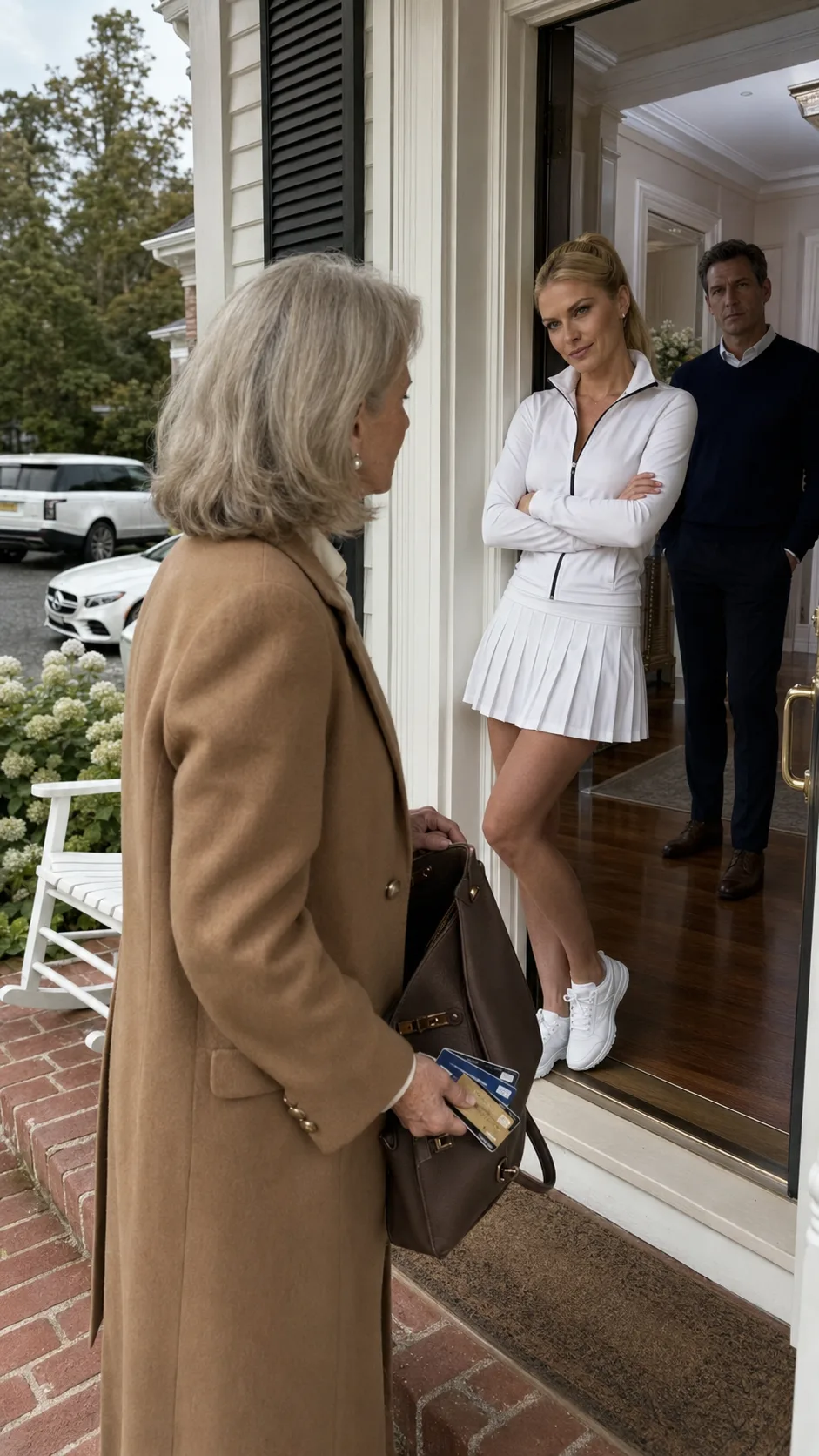
in fact, been the victim of a misunderstanding.
Karen was beautiful in a hard, expensive way. Not warm beauty. Not ease. She had the kind of face that photographs well at charity luncheons and in holiday cards staged beside professionally lit fireplaces. Her blond hair was always too perfect to be accidental. Her teeth looked as if they had been approved by a committee. When Desmond first brought her home, I had genuinely tried to like her. She was bright. Articulate. Impeccably dressed. She sent handwritten thank-you notes. She knew which fork to use at a formal dinner and how to flatter Warren without making it look like flattery. For a year or two I even believed she might be one of those women who appear a little polished until you get to know them, and then prove warm underneath. I was wrong. She was polished all the way through.
“Oh,” she said, making my name sound like something she had not ordered. “Nora. You usually call.”
“My cards have been declined,” I said. “The bank says my accounts were frozen this morning. I need to speak to Desmond.”
She leaned one shoulder against the doorframe and examined one fingernail as if deciding whether to be amused. “He blocked your number.”
The sentence was so casual it took me a second to comprehend it.
“He what?”
“He said it was time for boundaries.”
Boundaries. That word. God, how the selfish love therapeutic language. They wrap greed in vocabulary stolen from healing and expect the rest of us to applaud the sophistication.
Desmond came into the foyer behind her then, and for a second my heart did a terrible, hopeful thing because from a distance he still looked so much like his father that it could catch me unprepared. Same shoulders. Same dark hair, though trimmed in a more fashionable style than Warren ever tolerated. Same height. Same broad hands. But Warren had always carried warmth toward me in his face, even when he was angry. Desmond’s expression was flat and cold and already decided.
“Yeah,” he said. “I froze them.”
He did not look sorry. He did not look nervous. He looked inconvenienced by my arrival.
“We need to have a serious conversation about your spending, Mom,” he said. “Somebody has to protect the family assets.”
For one long beat, I heard nothing but a high-pitched rushing in my ears. Then the words landed one at a time and arranged themselves into meaning.
“Protect the family assets,” I repeated.
Karen sighed theatrically, as if we were all trapped inside an old conversation she had no patience for. “This is exactly why we didn’t want to do it in a dramatic way.”
“What dramatic way would you have preferred?” I asked. “Finding out at the grocery store when I couldn’t buy chicken?”
Desmond crossed his arms. He had Warren’s jaw too, but none of Warren’s honesty in it. “You’ve been making erratic purchases. Large discretionary expenses. Transfers we can’t justify.”
I stared at him. “I bought groceries.”
“This isn’t about groceries. It’s about the larger pattern.”
What pattern? My husband and I had built twelve dealerships across three states. We owned commercial real estate, investment accounts, trusts, liquid assets, and enough paid-off property that even a lazy accountant could have made the numbers sing. I could have bought every avocado in that Whole Foods and still not dented a quarterly interest statement.
“I want my accounts restored,” I said. “Now.”
Karen laughed softly. “You’re not listening. This is bigger than your cards.”
Then Desmond said the sentence that made the morning tip from ugly into catastrophic.
“We’re selling the dealerships.”
I felt the air change around me.
“No,” I said, though it sounded less like an answer than a prayer I had already missed the chance to finish.
He kept going, mistaking my silence for weakness. “Prestige Auto Consortium made an excellent offer. Thirty-eight million cash for all twelve locations. We’ve had preliminary meetings. The papers are being drafted.”
We. Papers. Meetings.
I looked from him to Karen and back again. She held my gaze with almost serene confidence, the expression of a woman who believed the unpleasant work of winning was already done.
“You cannot sell Morrison Auto Group,” I said. “That company belongs to me.”
Karen rolled her eyes. “No, Nora. Parts of it belong to you on paper. But functionally? Let’s be honest. You don’t run it anymore.”
That was a lie, but a strategically chosen one. Since Warren’s death I had shifted out of daily operations because grief and a fifty-year habit of partnership had made the first year impossible to bear in the office we built together. But I remained CEO. I signed off on expansions. I reviewed financials. I approved hires. I handled property decisions. More importantly, I still owned the controlling interest.
“Without my signature, there is no sale,” I said.
Desmond took out his phone, tapped it twice, and held it up. “Actually, we can move forward under the power of attorney you signed before your surgery last year.”
I stared at the document on the screen, my own signature unmistakable at the bottom. I remembered the day I signed it. Gallbladder surgery. Routine, my surgeon said. I would be out for a few days, groggy on painkillers, maybe not at my sharpest. Desmond had brought the paperwork in with a tone of dutiful practicality. “Just in case anything needs a quick decision while you’re recovering, Mom.” I signed because he was my son and because, by then, I had grown used to helping smooth everyone’s life through paperwork.
“You had authority if I was incapacitated,” I said. “I am not incapacitated.”
Karen gave a little laugh. “That’s where things get uncomfortable. Desmond’s attorney believes there’s enough documentation to establish cognitive decline.”
I looked at her and suddenly understood that this had not begun that morning. This had been building. Every time she had corrected me over a small detail at dinner. Every time she had said, “Nora, didn’t we already talk about that?” in front of other people. Every time she had looked at Desmond after I repeated a story from Warren’s early days and made that tiny, almost invisible expression of patient concern. They had been laying groundwork.
“I am seventy-three,” I said. “Not senile.”
Desmond’s eyes did not move. “You forget things. You miss appointments. You repeat yourself.”
“Your father repeated himself constantly,” I said. “Especially after sixty.”
“My father is dead.”
The words were blunt, almost irritated, and I felt them like a slap. Warren’s dead. As if death had stripped his legacy of all authority. As if the business that bore our name was now just a pile of assets waiting to be cut apart and consumed.
Karen took over, as she often did when charm had to give way to precision. “Warren’s legacy is a business, not a museum exhibit. The market is changing. Consolidation is smart. We’re thinking about the children. About long-term security.”
Long-term security. From the woman whose kitchen renovation had cost more than my first house.
They went on then, explaining how sensible it all was. Liquidating. Repositioning. Diversifying. Downsizing me into “something more manageable.” Creating a monthly allowance so I “wouldn’t have to think about bills.” Looking at assisted living communities before “a fall or episode” forced the choice under less ideal conditions. It was breathtaking. They spoke about my life like consultants reorganizing a company division. My house. My money. My business. My grandchildren. Even my future body, reduced to probable inconvenience and estimated risk.
Then Desmond reached into his wallet and held out two twenty-dollar bills.
“Here,” he said. “For groceries.”
Forty dollars.
I have lived through miscarriages, bankruptcy scares, labor pains that made me black out between contractions, my husband’s heart attack, the funeral that followed, the first night sleeping alone in the house we built together, and the sound of my grandson asking after Warren in the present tense six months after we buried him. Few things in life can still truly astonish me. But watching my son offer me forty dollars as if I were some little old woman who needed an allowance from the people using her money to subsidize their lives—that astonished me.
Karen smiled. “You’ll thank us later. Once the dust settles and you stop making this emotional.”
There it was again. Women are always emotional when they object to being erased.
“I would rather starve,” I said quietly, “than take scraps from my own son after he steals what his father and I built.”
Karen’s face hardened. The polish slipped for half a second and something rawer showed through. “Don’t be melodramatic.”
Desmond looked at me then with a level gaze and delivered the most deliberate cruelty of the entire morning.
“If you fight us on this,” he said, “you won’t see Emma and Tyler again.”
I did not move.
“They’re children,” he continued. “We’ll tell them Grandma isn’t well. That you need space. That it’s better not to visit for a while. They’ll adjust. Kids do.”
There are threats, and then there are revelations disguised as threats. Until that moment I had still been trying, against all evidence, to imagine that perhaps Desmond was panicked, manipulated, financially desperate, emotionally overmatched by Karen—something temporary, something that kept him within the boundary of my understanding. But no decent man threatens a mother with her grandchildren to force the surrender of her own life. That was not desperation. That was character.
I turned and walked away because anything else would have been beneath the gravity of what I had just learned.
Back in my car, I sat with both hands gripping the steering wheel, not because I was about to drive, but because my body needed an object to contain itself. Through the windshield I could see the top of Karen’s immaculate hydrangeas nodding in the breeze. A child’s scooter lay on its side near the garage. Somewhere in the house, a dog barked twice. It all looked so normal. That was the terrible part. Betrayal almost always happens in places where life has become comfortable enough to hide it.
I do not know how long I sat there before my phone rang. Unknown number. I nearly ignored it. If it had been a telemarketer and I had picked up, I think I might have screamed. Instead I answered and heard a man introduce himself in a careful professional tone.
“Mrs. Morrison? This is Frederick Peton, senior vice president of private wealth management at First National Bank. We’ve been trying to reach you regarding unusual activity on your accounts.”
Something in his voice told me immediately that the story inside the story was worse. Or perhaps, given the rest of that day, better in the sense that it made the truth clearer.
“What unusual activity?”
“There were several large transfer attempts this morning using your login credentials,” he said. “Approximately twenty-three million dollars across multiple accounts.”
I closed my eyes.
Twenty-three million.
So this had never been about my spending. Or my age. Or caution. Or restructuring. It had always been theft, and theft of a scale so enormous that even hearing the number, even knowing our net worth, made my stomach roll.
“The transfers were flagged by our security systems,” Frederick continued. “The majority did not go through. Some accounts could not be accessed at all because of in-person verification requirements and additional authentication protocols. But your daily operating accounts were successfully frozen and a smaller amount appears to have been moved before the holds triggered.”
My mind flashed backward five years to a hospital room with soft yellow light and the smell of antiseptic and Warren lying propped against pillows, thinner than I had ever seen him, yet still somehow radiating the practical steadiness that defined him. His heart had been failing by then. We both knew it, though we still spoke in euphemisms because the truth sat too large in the room to be named every minute. He had squeezed my hand with surprising strength and said, “Nora, promise me something. Protect yourself from everyone. Not just strangers. Everybody. Money changes people. Sometimes even the people we think it won’t.”
I had protested at the time. “Not Desmond.”
Warren had looked at me in that painfully loving way spouses sometimes do when one of them knows the other is still trying to negotiate with reality. “I hope not. But hope isn’t a plan.”
It was Warren who insisted on the secondary trust structures, the overseas holdings, the accounts requiring physical presence, biometric authorization, and two layers of manual confirmation. At the time, I half thought he was overreacting, a man made suspicious by years of watching his brother chip away at their father’s trust. Now, sitting outside Desmond’s house with Frederick’s voice in my ear, I understood that Warren had not been overreacting at all. He had been loving me in advance.
“What accounts were protected?” I asked.
Frederick listed them. The primary trust. Offshore holdings. A series of investment accounts. Rental income accounts connected to commercial properties Desmond had never once asked about because rental property bored him; it lacked the glamour of dealerships and the immediate gratification of cash flow. Eight million here. Twelve there. Several smaller instruments. Enough protected assets, Frederick said, that despite the freeze on my daily accounts, the majority of my wealth remained untouched and entirely under my control.
I felt my breathing return.
Not because the pain lessened. It didn’t. But because beneath the hurt, something colder and sharper took shape.
He thought he had taken everything.
He thought he had made me helpless.
“My son did not have authority to initiate those transfers,” I said. “And I need someone who understands financial abuse.”
There was the briefest pause. Then Frederick said, in a tone stripped of all banking politeness, “Mrs. Morrison, I have seen situations like this before. I would strongly encourage you to come into our main branch today. Do not alert your son. Bring any documents related to the power of attorney, your trust structures, and your business ownership. We have counsel available. And if what you’re saying is accurate, this is serious.”
It was serious.
It was also, finally, clear.
I drove downtown to the bank with the calm of someone too injured to waste energy performing hysteria. By the time I parked in the private garage and took the elevator to the executive floor, I had already begun sorting the day into actions. Gather documents. Revoke authority. Secure positions. Audit exposure. Protect the grandchildren. Stop the sale. Stop the bleeding. Stop treating this like a family misunderstanding and start treating it like an attempted corporate coup by someone who happened to call me Mom.
Frederick met me himself. He was in his late fifties, silver-haired, neat, with the type of posture that suggested he had been standing correctly in expensive suits for so long that the structure had become part of his bones. His office overlooked the city and the water beyond it, but he did not waste time offering scenery or coffee or any of the polished comforts wealth professionals use to signal calm. He shook my hand, looked me straight in the eye, and said, “I’m very sorry this is happening.”
That mattered more than I expected. Not sympathy. Not pity. Recognition.
We spread documents across his conference table. Signature cards. Trust agreements. Corporate ownership records. My will, which I had last updated after Warren died. The power of attorney. Banking protocols. Property deeds. Every piece of paper that once represented prudence now became a weapon or a shield depending on how I positioned it.
Frederick reviewed everything with the bank’s in-house counsel, a woman named Elise who wore a navy suit and glasses with deep blue frames and read legal language the way a surgeon reads scans. After twenty minutes, she looked up and said, “He exceeded the authority granted here by a wide margin.”
I could have cried from relief at hearing an external voice confirm what my gut had already known. Gaslighting thrives in isolation. The first antidote is often simply hearing a competent stranger say, No, you are not imagining this. Yes, it is exactly what it looks like.
Elise tapped the power of attorney. “This document allows your son to act on your behalf in the event of incapacity. It does not allow him to redefine inconvenience or disagreement as incapacity. It certainly does not authorize self-dealing, freezing personal accounts without legitimate cause, or initiating large transfers into structures he controls. We can revoke immediately.”
“We will,” I said.
Frederick then showed me the transfer attempts. Line by line. Time stamped. Destination accounts. Two of them were linked to shell entities associated with an acquisition vehicle being assembled for the dealership sale. One was an external account in Karen’s maiden name. Another was an investment account newly opened under a trust with Desmond listed as successor beneficiary. He had not only tried to seize control—he had already begun positioning the proceeds.
“How much got through?” I asked.
“One hundred forty thousand before the protocols cascaded,” Frederick said. “We can likely reverse most or all of it.”
One hundred forty thousand dollars. A fraction of what he wanted, but enough to tell me this had not begun that morning. You do not build shell structures and legal narratives in a day. They had been preparing.
I sat back in my chair and for a moment the room blurred, not from tears but from the sheer scale of the recognition. There are people you love so deeply that some part of your mind remains permanently committed to a version of them even when evidence accumulates against it. That day, in that office, I buried the last innocent version of my son.
Frederick asked what I wanted to do.
I remember that very clearly because the question itself restored something. So much of what Desmond had done that morning depended on the assumption that my choices could be preempted, curated, reduced, or frightened into submission. Frederick did not ask what the bank should do. He asked what I wanted.
“I want my day-to-day access restored,” I said. “I want every authority he holds revoked. I want the sale stopped. I want every attempted transfer documented. And I want an attorney who understands how to dismantle this without underestimating him because he is my son.”
To be continued… Click “PART 3” to read the final part: 👉 PART 3 👈