PART 3 — THE REAL WILL ON THE THANKSGIVING TABLE
After James left, something inside me shifted.
Chapter 3
PART 3 — THE REAL WILL ON THE THANKSGIVING TABLE
After James left, something inside me shifted.
I was not the grieving widow stumbling through fog anymore. I was awake. Alert. And I had a plan.
James was right. Caroline was making mistakes. Small ones at first, but they were growing. And the more confident she became, the more careless she got.
So I decided to give her exactly what she wanted.
I stopped arguing. Stopped questioning. When she called, I answered politely. When she visited, I let her walk through the house without protest. When she made suggestions about moving, I just nodded vaguely and changed the subject.
I let her think she had won.
And while she celebrated her imaginary victory, I documented everything.
The first sign that Caroline was getting bolder came three days after James’s visit. My niece called, confused and upset.
“Aunt Maggie, I just got off the phone with Caroline,” she said. “She told me you’re moving to a senior community
and selling the house. Is that true?”
“No,” I said calmly. “It’s not.”
“She made it sound like it was already decided. She even asked if I wanted any of the furniture before she got rid of it.”
My hand tightened around the phone.
“What else did she say?” I asked.
“She said the house is going to her and Eric. That Henry arranged it before he died. That you agreed it was for the best.” My niece paused. “Maggie, this doesn’t sound right.”
“It’s not right,” I said. “But don’t worry. I’m handling it.”
After we hung up, I added the conversation to my journal. Caroline was telling people the house was hers. Not almost hers. Not potentially hers.
Hers.
Two days later, Eric called.
“Mom. Caroline wants to come by this weekend to take measurements.”
“Measurements for what?” I asked.
He sighed.
“For renovations. She’s talking about knocking
down the wall between the kitchen and dining room. Updating the bathrooms. Redoing the floors.”
My kitchen. The one Henry and I had remodeled together ten years ago. The dining room where we hosted every holiday for nearly five decades.
“She wants to renovate my house?” I asked.
“She’s just planning ahead,” Eric said weakly. “You know how she is. She likes to be prepared.”
Prepared. As if the house was already empty. As if I was already gone.
“Let her come,” I said.
Eric sounded surprised.
“Really?”
“Really. Tell her Saturday afternoon is fine.”
Because I wanted to see exactly how far she would go.
Saturday came and Caroline arrived with a contractor. An actual contractor, with a clipboard and a tape measure, ready to discuss structural changes.
I watched from the living room as they walked through my home. Caroline pointing at walls and cabinets and fixtures, talking
about what needed to go, what could stay, what would look better if they just ripped it all out and started fresh.
“The kitchen is so dated,” she said, running her hand along the counter Henry had installed. “We’ll gut the whole thing. New cabinets, new appliances. Maybe an island here in the center.”
The contractor took notes.
“And upstairs,” Caroline continued as they climbed the stairs, “we’ll turn the master bedroom into a suite. Bigger closet, updated bathroom. Maybe a sitting area by the window.”
The master bedroom. The room where Henry died. Where I still slept every night, surrounded by his things.
I followed them quietly, my phone in my pocket, recording every word.
When they came back downstairs, the contractor handed Caroline an estimate.
“This is just preliminary,” he said. “But if you want to move forward, we can start as early as next month.”
“Perfect,” Caroline said. “I’ll be in touch.”
After they left, I sat on the couch and listened to the recording. Every careless word. Every confident claim. Every plan she made for a house that did not belong to her.
Evidence.
The following week, Caroline invited family over for dinner at her house. My cousin mentioned it casually when she called to check on me.
“Caroline said you couldn’t make it because you weren’t feeling well,” she said. “Are you okay?”
“I’m fine,” I said. “I didn’t know there was a dinner.”
“Oh, well, it was nice. She talked a lot about the house. About all the changes they’re planning.”
“What kind of changes?” I asked.
My cousin hesitated.
“Honestly, Maggie, it felt strange. She was talking like the house was already hers. Showing people photos on her phone of renovation ideas. She even had paint samples.”
Paint samples. For my walls.
“Did Eric say anything?” I asked.
“He looked uncomfortable the whole time,” she said. “Like he wanted to be anywhere else.”
I added that to the journal, too.
Then, two weeks before Thanksgiving, Caroline brought the kids by—my grandchildren. Sweet, innocent kids who had no idea they were being used as pawns.
“Grandma!” my youngest grandson ran up and hugged me. “Mom says we get to pick our rooms in your house!”
My heart sank.
“Pick your rooms?” I asked.
“Yeah.” He was so excited. “I want the one with the window seat, and Emma wants the one with the blue walls.”
I looked at Caroline, who was smiling like this was the most natural thing in the world.
“I thought it would be fun for them to feel involved,” she said sweetly. “They’re so excited about living here.”
Living here. In my house. While I was still alive and breathing and standing right in front of them.
“That sounds lovely,” I said, keeping my voice steady. “Why don’t you kids go play in the yard while I talk to your mom?”
After they ran outside, I turned to Caroline.
“What are you doing?” I asked.
“I’m helping them adjust,” she said. “This is going to be their home soon. They should feel comfortable here.”
“Soon,” I repeated. “When exactly is ‘soon’?”
She shrugged.
“After the holidays. We thought it would be easier to wait until after Thanksgiving and Christmas. Give you time to find a place and move your things.”
Give me time. As if she was doing me a favor.
“And you’ve told everyone this is happening?” I said.
“Of course,” she said. “It’s not a secret, Maggie. The paperwork is filed. The transfer is in process. Everyone knows.”
She said it so confidently. So completely sure of herself. And that was exactly what I needed.
“You’re right,” I said quietly. “Everyone should know.”
Her smile widened.
“I’m glad you’re finally accepting this. It’s better for everyone.”
After she left with the kids, I sat at the kitchen table and organized everything I had collected. The recordings. The journal entries. The assessor’s business card with the date written on the back. The contractor’s estimate. The list of family members Caroline had told.
She had built her story so carefully. Told so many people. Made so many plans.
And she had no idea that every confident claim was another piece of evidence against her.
James called that evening.
“How are you holding up?” he asked.
“She’s telling everyone the house is hers,” I said. “She brought contractors. She’s planning renovations. She even had my grandchildren pick their rooms.”
“Good,” he said.
“Good?” I repeated.
“She’s committing,” he explained. “The more public she makes this, the harder she’ll fall when the truth comes out. When are you planning to tell her?”
“Thanksgiving,” I said. “She’ll be here with the whole family. I want everyone to hear it at once.”
James was quiet for a moment.
“That’s bold,” he said.
“She was bold first,” I said. “She announced her lie at my table. I’ll announce the truth at the same one.”
“Do you want me there?” he asked.
“Yes,” I said. “Just in case.”
Over the next two weeks, I prepared. Not just emotionally, but practically.
I made copies of everything. The real will. James’s statement about the forged documents. The assessor’s report with Caroline’s name on it. Every recording. Every note. Every piece of evidence.
I also prepared Thanksgiving dinner. Henry’s favorite recipes. The turkey he always carved. The stuffing he loved. The pies he requested every year.
Because this meal was not just about revenge. It was about honoring the man who built this house, who loved this family, who trusted me to protect what we made together.
And that is exactly what I was going to do.
The night before Thanksgiving, I could not sleep. I lay in bed staring at the ceiling, thinking about what would happen the next day. About Caroline’s face when she realized her plan had failed. About Eric finally seeing the truth. About my grandchildren understanding that some people lie, even family.
Part of me felt guilty. Felt like maybe I should have handled this privately, away from the children, away from the holiday table.
But Caroline made this public. She announced it at Thanksgiving.
So Thanksgiving was where it would end.
I got up and walked downstairs through the quiet house, touching the walls and the furniture and the memories.
“I’m ready, Henry,” I whispered to the darkness. “I hope you’re proud of me.”
And somewhere in the silence, I felt like he was.
Thanksgiving morning came quiet and gray.
I woke up before sunrise, the way I always did on holidays. For forty-seven years, Henry and I had this routine. He would start the coffee while I prepped the turkey. We would work side by side in the kitchen. Him humming old songs. Me reminding him not to eat all the cranberry sauce before dinner.
This year, the kitchen was silent except for my own movements.
I pulled the turkey from the refrigerator, the same size Henry always insisted on—too big for the number of people coming. But he said leftovers were the best part. I seasoned it the way he liked, with rosemary and thyme from the garden he planted.
My hands moved through the familiar motions. Chopping vegetables. Mixing stuffing. Rolling out pie crust. But my mind was somewhere else entirely.
Today was the day.
By tonight, everyone would know the truth. Caroline’s lies would be exposed. The house would be safe. And maybe, just maybe, I could finally breathe again.
But first, I had to get through the meal.
I set the table with our good china, the set we only used for special occasions. Polished the silverware Henry’s mother had given us as a wedding gift. Folded the cloth napkins, pressing each crease sharp and clean.
Everything had to be perfect.
Because this was not just about proving Caroline wrong. This was about honoring Henry. About showing that the home he built, the traditions he loved, the family he cherished—they were still here. Still strong. Still worth fighting for.
Around ten in the morning, my niece arrived early to help.
“The house smells amazing,” she said, giving me a long hug. “Just like always.”
We worked together in comfortable silence for a while, her mashing potatoes while I basted the turkey. She knew something was wrong, had known for weeks, but she did not push. Just stayed close, offering quiet support.
“Are you okay?” she finally asked.
“I will be,” I said. “After today.”
She looked at me carefully.
“What’s happening today?”
“The truth,” I said simply.
She did not ask anything else. Just squeezed my hand and went back to the potatoes.
By noon, the turkey was golden and the side dishes were ready. The house looked beautiful, warm and welcoming, just the way Henry would have wanted.
I went upstairs to change, choosing a soft blue sweater Henry always said brought out my eyes. And in the pocket, I carefully placed a folded envelope. Inside was a copy of the real will, James’s statement, and a printed summary of every lie Caroline had told.
The weight of it in my pocket felt like armor.
When I came back downstairs, James was pulling into the driveway. I met him at the door.
“You came early,” I said.
“I’ll wait in my car until you need me,” he said. “But I wanted to be close, just in case.”
“Thank you.”
He handed me his business card.
“If things get heated, if she tries to leave before you’ve said everything you need to say, call me. I’ll come in and make it official.”
I tucked the card into my other pocket.
“Are you nervous?” he asked.
“Terrified,” I admitted. “But also ready.”
He smiled gently.
“Henry would be proud of you.”
After he left, I stood in the living room looking at everything I had prepared. The table set for eleven. The food warming in the kitchen. The fire crackling softly in the fireplace.
This was my home. My life. My history.
And I was not giving it up.
The first guests started arriving around one. My cousin and her husband. A few neighbors Henry had been close with. My niece’s children running through the house with the kind of energy only kids have.
Everyone hugged me, told me how good everything looked, asked how I was holding up. I smiled and thanked them, and tried not to think about what was coming.
Then, at exactly two, Caroline’s car pulled up.
I watched through the window as she got out, wearing a dress that looked too expensive for a family dinner. Eric followed, helping the kids out of the back seat. Even from a distance, I could see the tension in his shoulders.
Caroline walked up the front path like she owned it. Not like a guest. Like someone surveying property that already belonged to them.
When I opened the door, she smiled that practiced smile.
“Happy Thanksgiving, Maggie,” she said, kissing my cheek. “Everything looks lovely.”
The kids ran past her, already looking for their cousins. Eric hugged me, and I felt him trembling slightly.
“Are you all right?” I whispered.
“I don’t know,” he whispered back.
Caroline walked through the house, greeting people, complimenting the decorations. But I noticed the way her eyes moved. Calculating. Assessing. Like she was already planning where her furniture would go.
She stopped in the living room, running her hand along the mantle.
“This room would look so much better with lighter paint,” she said to no one in particular.
My niece shot me a look.
I shook my head slightly.
Not yet.
By two-thirty, everyone was gathered. The kids were playing in the den. The adults were in the living room, making small talk, sipping drinks, waiting for dinner to be ready. Caroline held court in the center of the room, talking about holiday plans, about the kids’ school activities, about everything except the elephant in the room.
But I saw the way she kept glancing at me. Wondering if I was going to make a scene. Wondering if I had finally accepted defeat.
Let her wonder.
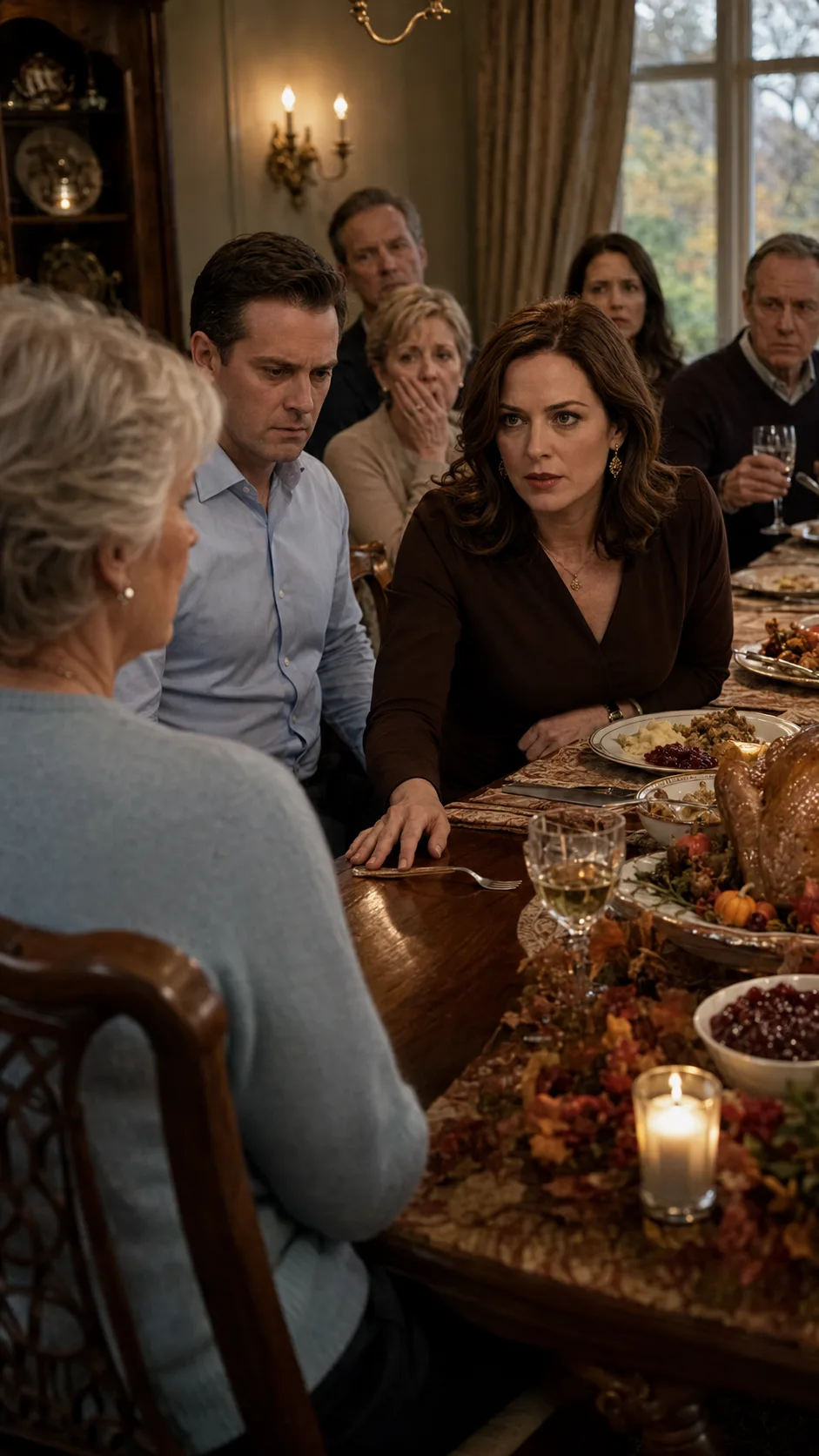
At three, I announced dinner was ready. Everyone filed into the dining room, finding their seats, admiring the spread. The turkey sat golden in the center, surrounded by all of Henry’s favorites. Mashed potatoes with too much butter. Green bean casserole with the crispy onions on top. Cranberry sauce from a can because that was the only kind he liked.
I had saved his seat at the head of the table. Left it empty. Because even though he was gone, this was still his home. His family. His holiday.
Caroline sat to my right. Eric beside her. The kids scattered around the table, excited and hungry. My niece sat to my left, close enough to reach if I needed her.
I asked my cousin to say grace, and we all bowed our heads.
“We’re thankful for family,” he said. “For this home. For the memories we’ve made here and the ones we’ll continue to make. And we remember Henry, who brought us all together.”
Several people whispered “Amen.”
Then we began passing dishes. The normal rhythm of a family meal. Forks clinking against plates. Conversations starting and stopping. Laughter from the kids’ end of the table.
For a few minutes, it felt almost normal.
But I could feel the tension underneath. Eric barely eating, just moving food around his plate. Caroline watching me, waiting for something. My niece’s hand resting near mine, ready to offer support. And in my sweater pocket, the envelope with the truth.
I took a bite of turkey, trying to taste it, trying to appreciate all the work I had put into this meal, but my heart was pounding too hard.
Soon. Very soon.
Caroline set her fork down, and the sound was loud in the momentary quiet. I knew that sound. Had been expecting it. This was it. The moment I had been preparing for. The moment where everything would change.
I glanced toward the window, where I knew James was waiting in his car.
Ready.
My hand moved to my pocket, feeling the envelope. The proof. The truth.
By the time we sat at the table, everything was ready. The food. The family. The evidence. And me.
I was ready.
Everyone had taken their first bites when Caroline’s fork clinked against her plate. The sound cut through the conversation like a knife through silence. Sharp. Deliberate. Impossible to ignore.
The kids kept talking for a moment, caught up in their own world, but the adults stopped. Forks hovering midair. Glasses paused before lips. Everyone turned toward Caroline.
She straightened her back slowly, like someone preparing to make an important announcement. Smoothed her napkin across her lap with careful precision. Then she looked directly at me, and her lips curved into something that was not quite a smile.
My heart started pounding, but I kept my face neutral. Calm. I had been waiting for this moment for weeks.
This was it.
“I think,” Caroline said, her voice steady and clear, “it’s time everyone knew the truth about what’s happening with this house.”
The table went completely silent. Even the kids stopped talking. My niece’s hand found mine under the table, squeezing tight.
Caroline tilted her head slightly, still looking at me.
“Maggie has been through so much these past few months,” she said. “Losing Henry. Dealing with all the paperwork. Trying to manage this big house all alone. It’s been overwhelming for her.”
She said it with such sympathy. Such false concern.
“And that’s why,” she continued, her voice getting stronger, “Henry made arrangements before he passed. To make things easier. To protect everyone.”
Eric set his knife down slowly, his face pale.
“Caroline,” he whispered, “maybe this isn’t the time.”
“It’s exactly the time,” she said. “Everyone’s here. Everyone should know.”
My cousin leaned forward.
“Know what?”
Caroline took a breath, and I could see the satisfaction in her eyes. This was her moment. The announcement she had been building toward for months.
“As of yesterday,” she said clearly, “the house no longer belongs to Maggie.”
The words hung in the air like smoke. Someone gasped. I think it was one of my neighbors. My niece’s grip on my hand tightened so hard it hurt.
“What?” my cousin said.
Caroline did not break eye contact with me.
“Henry signed it over to us,” she said, turning to address the rest of the table. “To Eric and me. Before he died. It was his final wish.”
“That’s not true,” my niece said immediately.
“It is true,” Caroline said, turning to face her. “The paperwork is filed. The transfer is in process. Henry wanted his son to have the family home.”
Eric was staring at his plate, looking like he wanted to disappear into the floor.
“And I’m sorry if this is shocking,” Caroline continued, addressing the whole table now, “but Maggie knew this was coming. We’ve been discussing it for months. She’s had time to prepare.”
Lies. Every word was a lie.
“The reality is,” Caroline said, her voice taking on an edge, “Maggie gets nothing. The house belongs to us now.”
My grandson, sitting three seats away, looked confused.
“But Grandma lives here,” he said.
“Not for much longer,” Caroline said softly. “She’ll be moving to a nice place where she’ll have people to take care of her. It’s what’s best.”
The table erupted.
“You can’t be serious,” my cousin said.
“This is her home,” my niece added, her voice shaking with anger. “Henry would never—”
But Caroline talked over them all.
“Henry did,” she insisted. “He signed the papers. He made the choice. And now it’s done.”
She said it with such finality. Such absolute confidence. I felt my hands go cold. Not from fear this time. From control. From the knowledge that I was about to dismantle everything she had just said.
I set my fork down gently beside my plate. The sound was soft, but somehow everyone noticed. The arguing stopped. All eyes turned to me.
I folded my napkin carefully, placed it on the table, and looked directly at Caroline.
“Should I tell them,” I said, my voice quiet but clear as crystal, “or will you?”
Her smile froze. Just froze. Right there on her face, like someone had pressed pause on her entire existence. The confidence drained from her eyes, replaced by something else. Something that looked like the first flutter of panic.
“Tell them what?” she said.
But her voice had lost its strength.
“Mom,” Eric whispered from across the table. “Please don’t.”
His voice was cracking. Desperate. Like he knew exactly what was coming and could not bear to hear it.
But I kept my eyes on Caroline.
“Tell them what?” she repeated, louder now. Defensive. “What are you talking about?”
The entire table was frozen. My cousin staring wide-eyed. My niece gripping my hand so tight I could feel her pulse. The kids looking between the adults, sensing something important was happening but not understanding what.
I did not answer right away. Just held Caroline’s gaze. Let the silence stretch. Let her feel the weight of what was coming.
Her hands started moving, fidgeting with her napkin. A crack in her perfect composure.
“Maggie,” she said, trying to sound calm but failing, “if you have something to say, just say it.”
“All right,” I said softly.
I reached into my sweater pocket and pulled out the envelope. The one I had been carrying all day. The one that held the truth.
The room inhaled all at once, like everyone drew breath at the exact same moment.
I placed the envelope on the table between us. Did not open it yet. Just let it sit there, white and official-looking, while Caroline stared at it like it was a bomb.
“What is that?” she asked.
And for the first time, I heard real fear in her voice.
“This,” I said calmly, “is the real will. With the real signature. Verified by the attorney who drafted it twenty years ago.”
Her face went pale.
“And this,” I continued, tapping the envelope, “is a written statement from James Abbott, our family lawyer, confirming that the documents you’ve been showing people are not genuine.”
Eric covered his face with both hands.
Caroline’s mouth opened, but no words came out.
“And this,” I said, pulling out another paper, “is the business card from the property assessor you sent to my house. With notes documenting that you hired him without my knowledge or consent.”
Her breathing got faster. Shallower.
“You’re lying,” she finally managed to say.
“No,” I said quietly. “You’re lying. And you’ve been lying since the day Henry died.”
The table stayed silent, except for Caroline’s breathing and the sound of my voice.
“You forged documents. You told my family this house belonged to you. You brought contractors to plan renovations. You had my grandchildren pick their rooms. You told everyone I was moving out.”
Each sentence landed like a stone.
“And you did it all while I was grieving. While I was vulnerable. While you thought I was too heartbroken to fight back.”
Caroline’s hands were shaking now.
“That’s not—I didn’t—”
“Yes,” I said. “You did.”
I looked around the table at my family. At the shocked faces. At Eric, crying quietly into his hands. At my grandchildren, confused and scared.
“And everyone here deserves to know the truth,” I said.
I opened the envelope slowly, deliberately, giving Caroline time to realize just how wrong she had been.
The first document I pulled out was the real will. Thick. Official. With the law office letterhead at the top. I slid it across the table toward the center where everyone could see it.
“This is the will Henry and I created together five years ago,” I said. “Updated two years ago with our attorney, James Abbott. It clearly states that everything goes to me. The house. The accounts. The investments. All of it.”
My cousin leaned forward.
“May I?” he asked.
“Please,” I said.
He picked it up carefully, reading the first page, then flipping through. His eyes moved quickly over the legal language. Then he looked at Caroline.
“This is notarized,” he said. “Signed by witnesses. Dated two years ago.”
Caroline’s hands gripped the edge of the table.
“That’s… that’s not the updated version.”
“Yes,” I said calmly. “It is.”
I pulled out the second document.
“This is James Abbott’s statement. Written and signed by him three weeks ago. Confirming that he drafted this will and never created any transfer documents giving the house to Eric.”
I slid it toward my niece. She read it quickly, her eyes filling with tears.
“The documents Caroline has been showing people,” I continued, “are forgeries. The signature is not Henry’s. The forms are outdated, not used in over a decade. And the dates don’t match reality.”
“You can’t prove that,” Caroline said, but her voice was weak.
“Oh, I can,” I said.
I pulled out a printed comparison I had made. Henry’s real signature from our mortgage papers beside the forged one from Caroline’s documents.
“Look at the difference,” I said. “The H is wrong. The Y slants the wrong direction. The pressure of the pen is inconsistent.”
My neighbor, who worked in a bank, picked it up.
“These are definitely different signatures,” she said quietly.
Caroline stood up abruptly, her chair scraping loud against the floor.
“This is ridiculous,” she said. “You’re all believing her lies.”
“Sit down, Caroline,” Eric said.
Everyone turned to look at him. His face was wet with tears, but his voice was steady.
“Sit down,” he said again.
She stared at him.
“Eric, you know the truth. Tell them.”
“I know you lied to me,” he said. “I know you showed me papers I never questioned because you’re my wife and I trusted you.”
“I didn’t lie,” she insisted.
“Yes, you did.” His voice broke. “You lied about last summer. You lied about the dates. And now you’re lying about this.”
I pulled out another paper.
“This is the property assessor’s card,” I said. “I called him yesterday. He confirmed that Caroline hired him. Told him the house was being transferred. Asked for evaluation for sale purposes.”
I set it on the table.
“And this,” I continued, pulling out my phone, “is a recording of Caroline and a contractor discussing renovations to my kitchen. Renovations I never approved or agreed to.”
I pressed play.
Caroline’s voice filled the room. Confident and clear. Talking about gutting my kitchen, changing the floors, knocking down walls.
The room was so silent I could hear people breathing.
When the recording ended, I looked at Caroline.
“You were so confident,” I said. “So sure you had won. You told family members. You brought contractors. You had my grandchildren pick their rooms in a house that was never going to be yours.”
“I was trying to help you,” Caroline said desperately. “You were lost. Confused. Grieving. I was trying to make things easier.”
“By stealing my home?” I asked.
“It wasn’t stealing,” she said. “Henry wanted Eric to have it.”
“No,” I said firmly. “He didn’t.”
I reached into the envelope one more time and pulled out the folded piece of paper. Henry’s note. The one he had tucked inside the will. My hands shook as I unfolded it.
“Henry wrote this himself,” I said, my voice cracking. “In his own handwriting. James kept it with the will.”
I began to read aloud.
“For Maggie, because she gave me my whole life. This house is yours. The memories are yours. Everything we built is yours. Never let anyone make you feel like you don’t belong here. I love you forever. Henry.”
By the time I finished, I was crying. So was my niece. My cousin had his head bowed. Even Eric was sobbing openly.
Caroline stood frozen, all color drained from her face.
“He didn’t forget me,” I said, looking directly at her. “He didn’t sign the house away. He didn’t make secret plans. He loved me. And he made sure I would be protected.”
The weight of those words settled over the room.
“You tried to take everything from me while I was at my weakest,” I said. “You forged documents. You manipulated my son. You lied to my family. And you did it all because you thought grief made me powerless.”
Caroline’s mouth opened and closed, but no sound came out.
“Well, I’m not powerless,” I said. “And this house stays mine.”
There was a knock at the door.
Perfect timing.
My niece went to answer it, and moments later, James Abbott walked into the dining room. He was wearing a suit, carrying his briefcase, looking every bit the professional attorney.
“Good afternoon,” he said calmly. “I apologize for interrupting your meal.”
Caroline’s eyes went wide.
“What is he doing here?” she demanded.
“I invited him,” I said. “Just in case we needed legal clarity.”
James set his briefcase on the side table and pulled out a folder.
“I’ve been the legal representative for Maggie and Henry for over twenty years,” he said. “I can confirm everything Maggie has stated today is accurate. The will is legitimate. The forged documents are not. And if anyone wishes to challenge this in court, I have extensive documentation ready to present.”
He looked directly at Caroline.
“Additionally,” he continued, his voice cool and professional, “if you continue pursuing this fraudulent claim, we will move forward with formal charges. Forgery is a crime. So is harassment. So is attempting to defraud a widow of her property.”
Caroline grabbed her purse from the back of her chair.
“This is insane,” she said. “You’re all insane.”
“Caroline,” Eric stood up. “Stop.”
“Don’t you dare take her side,” she snapped at him.
“I’m not taking sides,” he said. “I’m accepting the truth. You lied to me. To everyone. You tried to steal from my mother.”
“I was doing this for us,” she said desperately. “For our family. For our future.”
“No,” Eric said quietly. “You were doing it for yourself.”
She stared at him like he had slapped her.
“I think you should leave,” he said.
“I’m your wife,” she said.
“And she’s my mother,” he replied. “The mother who would never lie to me. Never manipulate me. Never try to steal from someone while they’re grieving.”
Caroline looked around the table, searching for support. But everyone was looking at her with expressions ranging from shock to disgust to pity.
“You’ll regret this,” she said to me. “All of you will regret this.”
“The only person with regrets here is you,” James said calmly. “Because you gambled on grief making someone weak, and you lost.”
Caroline grabbed her coat and stormed toward the door. She paused in the doorway, looking back one more time, but no one said anything. No one stopped her. No one defended her.
She left, and the door slammed behind her so hard the windows rattled.
The room stayed silent for a long moment.
Then my grandson, bless his innocent heart, said:
“Does this mean we’re not moving here?”
Despite everything—despite the tears and the tension and the trauma—someone laughed. Then someone else. And suddenly the whole table was laughing. That kind of relieved, exhausted laughter that comes after something terrible almost happens… but doesn’t.
Eric came around the table and knelt beside my chair.
“Mom, I’m so sorry,” he said. “I should have questioned her from the start. I should have protected you.”
I cupped his face in my hands.
“You’re here now,” I said. “That’s what matters.”
“I love you,” he whispered.
“I love you too, sweetheart.”
James packed up his briefcase.
“I’ll leave you all to your dinner,” he said. “Maggie, if you need anything, call me anytime.”
“Thank you, James. For everything.”
After he left, we all just sat there for a moment, processing what had just happened.
Then my niece said, “The turkey’s probably cold. I’ll heat it up.”
“No,” my cousin stood. “You sit. We’ll handle it.”
And just like that, my family surrounded me. Reheating food. Refilling glasses. Bringing out fresh plates. Taking care of me the way I had taken care of them for so many years.
Eric stayed close, helping where he could, apologizing every few minutes until I finally told him to stop.
“It’s over,” I said. “That’s all that matters.”
When we finally sat down to eat again, the mood was different. Lighter. The tension that had been suffocating us all was gone.
We ate Henry’s favorite meal in Henry’s favorite house, surrounded by the family he loved. And for the first time since he died, I felt him there with us. Not gone. Just quiet. Watching over us the way he always did.
Thanksgiving went on without Caroline.
And honestly, it was better that way.
The days after Thanksgiving moved differently. Slower. Quieter. But in a good way this time. The kind of quiet that feels like healing instead of emptiness.
Eric called every morning. Sometimes just to say hello. Sometimes to apologize again, even though I kept telling him he did not need to. Sometimes just to sit on the phone in silence while we both drank our coffee. Him at his kitchen table. Me at mine.
“I should have seen it,” he said one morning about a week after Thanksgiving. “All the signs were there. The way she pushed. The way she talked about the house like it was already hers. I just didn’t want to believe my wife would do that.”
“You loved her,” I said gently. “Love makes us trust when maybe we shouldn’t.”
“I still love her,” he admitted. “But I don’t know if I can forgive her.”
I understood. Love and trust are not the same thing. You can still care about someone and know they are not good for you.
“What matters now,” I said, “is that you’re here. That we’re okay.”
“Are we?” he asked. “Are we really okay?”
I looked around my kitchen. At the morning light coming through the windows Henry always said were positioned perfectly. At the coffee maker he bought me for our anniversary. At the table where we had shared thousands of meals.
“Yes,” I said. “We’re okay.”
Eric started coming by on weekends. Just him, without Caroline. He would help with things around the house. Fixing a loose board on the porch. Cleaning out the gutters. Small tasks Henry used to do.
One Saturday afternoon, we were sitting on the back porch drinking lemonade when he said:
“I’m thinking about separating from her.”
I did not say anything right away. Just let him talk.
“I can’t trust her anymore,” he continued. “Every time she says something, I wonder if it’s true or if she’s manipulating me. That’s no way to live.”
“No,” I agreed. “It’s not.”
“The kids keep asking about her,” he said. “About why we’re not all together anymore. I don’t know what to tell them.”
“Tell them the truth,” I said. “In a way they can understand. That sometimes adults make mistakes. Big ones. And sometimes those mistakes change things.”
He nodded slowly.
“They love you, you know,” he said. “They were so upset when they thought you were leaving this house.”
“I’m not going anywhere,” I said firmly.
And I meant it.
The house itself started feeling different, too. Less like a museum of memories and more like a home again. I rearranged some furniture—not because Caroline had suggested it, but because I wanted to. Packed away some of Henry’s things that were too painful to look at every day. Not throwing them away. Just storing them until I was ready.
I started cooking again. Real meals, not just toast and tea. Invited my niece over for dinner. Had my cousin and his wife stop by for coffee. Slowly, I filled the house with life again.
The kids visited more often. My grandchildren, who had been so confused during Thanksgiving, now understood that Grandma’s house was staying Grandma’s house. They would run through the rooms, play in the yard, ask me to tell them stories about their grandfather.
“Did Grandpa really build this porch himself?” my grandson asked one afternoon.
“He did,” I said. “Took him three weekends, and he hit his thumb with the hammer so many times I lost count.”
The boy laughed.
“Was he good at building things?” he asked.
“He was good at loving things,” I said. “And when you love something enough, you learn how to take care of it.”
Caroline never came back to the house. Eric said she was staying with her sister, refusing to talk to him about anything except the kids. She had not apologized, had not admitted she was wrong. Just disappeared. Her grand plan destroyed. Her confidence shattered.
Part of me felt bad for her. But only a small part. Because what she tried to do was not just wrong. It was cruel. She saw a woman grieving and decided that made her weak. Decided that made her an easy target.
She learned the hard way that grief and weakness are not the same thing.
James stopped by a few weeks after Thanksgiving with final paperwork.
“Everything is secure,” he said. “The house is yours. No question. I’ve filed copies of the real will with the county. If anyone ever questions it, the documentation is ironclad.”
“Thank you,” I said. “For everything. For believing me. For helping me fight.”
“Henry was my friend,” he said. “And you’re a remarkable woman. I was honored to help.”
After he left, I walked through the house one more time. Room by room. Touching the walls. Looking at the photographs. Remembering.
This house held forty-seven years of my life. Births and birthdays. Holidays and heartaches. The day we brought Eric home from the hospital. The night Henry proposed by the fireplace. Every anniversary. Every Christmas morning. Every ordinary Tuesday that felt extraordinary just because we were together.
Caroline tried to take that from me. Tried to erase my history. Tried to push me out of my own story.
But she failed.
Because home is not just a building. It is not just walls and floors and a roof over your head. Home is the place where you belong. Where your memories live. Where the people you loved still exist in every corner, every photograph, every piece of furniture.
Home is the place where you stand your ground when someone tries to take it from you.
One morning in early December, I woke up before sunrise, made coffee, sat in Henry’s chair by the window, and watched the sun come up over the garden he planted. And for the first time since he died, I felt him there with me. Not gone. Just different. Existing in the warmth of the morning light. In the smell of coffee. In the quiet peace of a house that was finally, truly mine again.
“I did it,” I whispered to the empty room. “I protected what we built. Just like you knew I would.”
The house settled around me, creaking softly the way old houses do, and it felt like an answer. Like Henry saying, “I know. I’m proud of you.”
I sat there until my coffee went cold, watching the world wake up outside my window.
This house was not just wood and walls. It was love. It was history. It was the life Henry and I built from nothing. One day at a time. One choice at a time. One moment of staying together at a time.
And nobody—not Caroline, not anyone—could ever take that away.
Because home is not just a place. It is the peace you protect. The ground you refuse to give up. The memories you fight for when someone tries to steal them.
Henry used to say, “Home is where you breathe easy, Maggie.”
And finally, after months of holding my breath, after fighting for what was mine, after standing my ground when it would have been easier to walk away, I could breathe again.
Easy. Free.
Home.
THE END.
Chapter complete
You have reached the end of this chapter.
Continue reading
A few more worlds to get lost in after this chapter.




