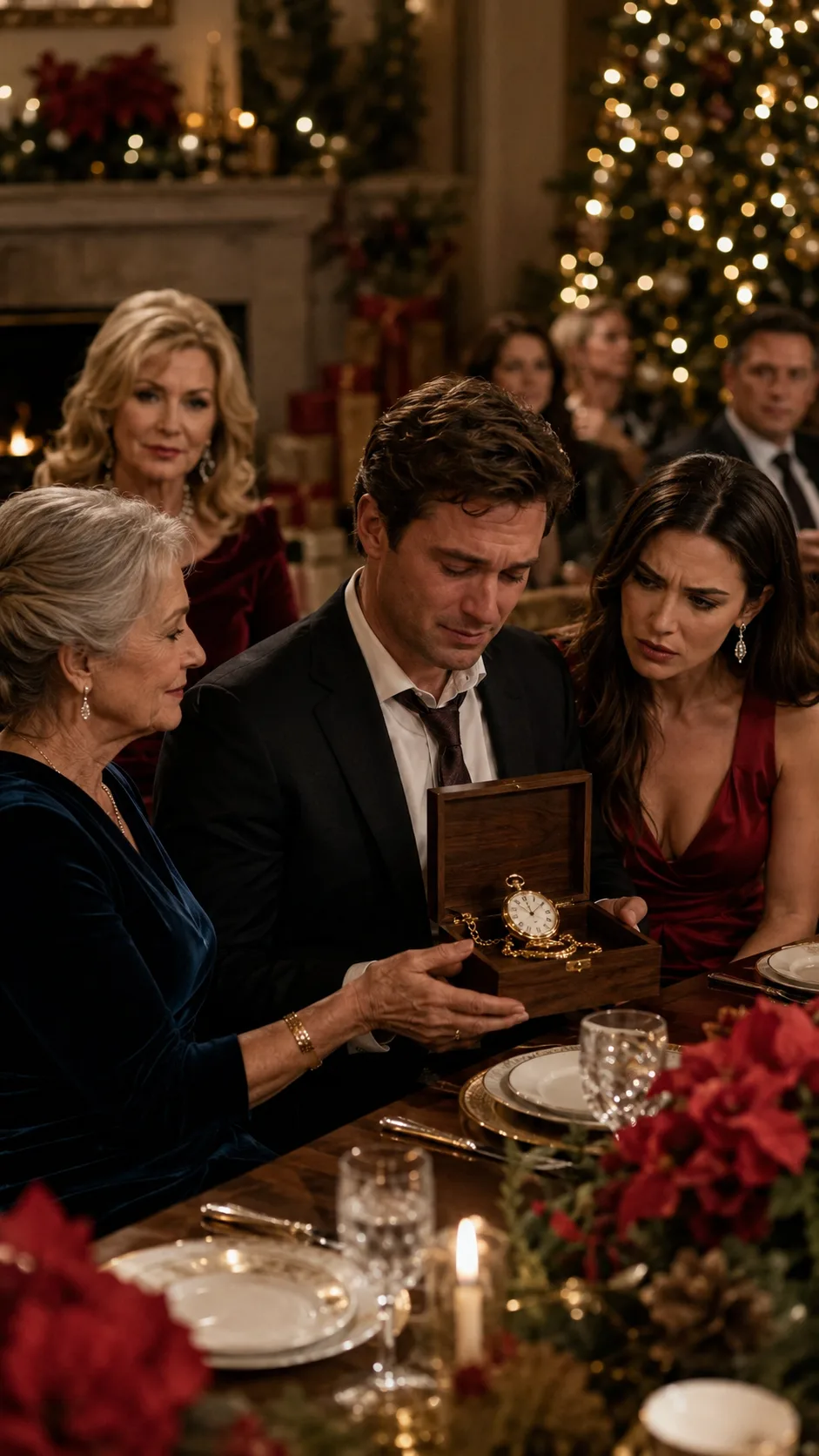
Part 2 — The Wedding, The Lies, And The Watch That Hit The Floor
The wedding was set for six months later—six months Valerie used to transform herself into the perfect bride.
Chapter 2
Part 2 — The Wedding, The Lies, And The Watch That Hit The Floor
The wedding was set for six months later—six months Valerie used to transform herself into the perfect bride.
Photos with mushy captions appeared every week:
“The love of my life.”
“My forever future.”
Every image was calculated to the millimeter. Her followers went wild. The comments multiplied. She responded to each one with sweetness that made my skin crawl.
Away from the camera was another story.
One Saturday morning, she showed up unannounced with a thick folder. She opened it on my dining table and pulled out glossy photos.
“I’ve been looking at venues,” she said. “We want something elegant. Intimate. Special.”
She showed me an estate outside Phoenix—gardens, fountains, chandeliers.
“It’s beautiful,” I admitted.
“The full package is eight hundred fifty thousand.”
My breath caught.
“It includes everything,” she continued, like she was reading a menu. “Banquet for two hundred, premium open bar, décor, live music, five-tier cake. Matthew says you wanted to help with expenses.”
I did want to contribute.
But that number—
“It’s once in
a lifetime,” she said, smile not reaching her eyes. “Besides, you have three successful hardware stores. I know you can afford it.”
There it was.
The first direct hit.
She did not ask.
She assumed.
In the end, I agreed—because refusing meant being the stingy mother-in-law who ruined her only son’s wedding.
Eight hundred fifty thousand dollars.
Nearly everything I had saved that year.
The wedding was exactly as Valerie planned: perfect for social media, cold in person. I sat front row in a dress I bought just for the day, watching my son marry a woman I knew, deep down, did not love him.
During the waltz, Matthew looked for me and smiled—a genuine, happy smile. I smiled back and swallowed my doubts, because that is what mothers do.
They smile even when they are breaking.
The honeymoon was Maui.
Two weeks.
All paid for by me—though that was
never mentioned in Valerie’s photos.
When they returned, I expected them to find their own place. Instead, Matthew arrived one afternoon with two suitcases.
“Mom, can we stay with you while we look for something?”
Valerie stood behind him smiling.
“It’ll only be a few months. The market is crazy. We need time to find something worthwhile.”
What was I supposed to say?
No?
“Of course,” I said. “This will always be your home.”
Months turned into a year.
Then two.
Temporary became permanent occupation.
Valerie began to change things. At first, small details: a new vase, different cushions.
“To modernize a little, Mrs. Elizabeth,” she would say, “with all due respect, but your décor is very traditional.”
Then bigger things: painting the living room gray instead of beige, swapping out my curtains, moving furniture like she owned the air.
One day, I came home and the photo of my
wedding to Robert—hanging in the living room for twenty-five years—was gone.
“Where is my photo?” I asked, trying to keep calm.
“I put it away in your room, Mrs. Elizabeth. It makes the living room look like a museum. We need more neutral spaces.”
Museum.
She called my history a museum.
Matthew stood there hearing everything.
He did not say a word.
“That photo goes back,” I said firmly.
Valerie sighed dramatically.
“As you wish.”
But the message was clear.
This was no longer my house.
It was hers.
And then Grace arrived.
Valerie’s mother showed up on a Thursday afternoon with three large suitcases.
“Mom had problems with her landlord in Houston,” Valerie explained. “She was evicted. She needs to stay with us for a while.”
They did not ask me.
They informed me.
Grace was fifty-eight, round, high-pitched voice, constant opinions. She settled into the guest room like it was a hotel. She never offered to help. She did not cook. She did not clean. She watched soap operas and criticized everything I did.
“Oh, Elizabeth, you’re still using that blender? It’s so old.”
“Elizabeth, those curtains look like the eighties.”
“Why don’t you hire someone for the yard? It looks neglected.”
Valerie backed her on everything. They laughed together. Whispered when I walked by. Looked at me like I was the intruder.
Matthew worked at the hardware stores, but our Sundays disappeared.
No more breakfasts.
No more numbers.
No more “we’re a team.”
“I’m tired, Mom,” he would say. “Valerie and I want to rest on weekends.”
Rest in my house, with my money.
Matthew still drew a salary from the stores—forty-five thousand a month—but it vanished like water. Valerie controlled the finances, reviewed statements, decided what was “normal.”
One day, I checked corporate spending. Matthew had access to a company card for business-related expenses.
The recent charges sent ice through my veins—expensive restaurants, clothing boutiques, a jewelry store at the Grove, one hundred twenty thousand on a bracelet.
I confronted him that night.
“Matthew, what is this?”
“They’re gifts for Valerie,” he said. “We’re married. What’s mine is hers too.”
“But it isn’t yours. It belongs to the company. To the stores we built.”
Valerie walked in then.
“What’s the problem, Mrs. Elizabeth?” she asked sweetly. “You don’t want your son to give things to his wife?”
“The problem is—”
“The problem,” she cut in, “is that you treat Matthew like a child, like he needs your permission for everything.”
Tears welled instantly—an act she mastered.
“I just want you to accept me,” she said, voice trembling on cue. “To trust me, but you always see me as an enemy.”
Matthew pulled her into his arms.
“There, honey. Calm down.”
Then he looked at me like I had done something cruel.
“Mom, you need to stop controlling everything.”
That night, I cried in my room silently so no one would hear me, because I was losing my son—and the worst part was he did not even realize it.
It happened gradually, like boiling a frog. Turn up the heat slowly enough and it does not jump until it is too late.
That is how I lost Matthew.
Sundays had been sacred for thirty-three years. Ranch-style eggs, sweet rolls, hot coffee brewed the traditional way. We talked about life, business, his dreams.
After the wedding, Sundays began to vanish.
“Mom, Valerie isn’t feeling well.”
“Mom, we have plans with Valerie’s friends.”
“Mom, we need time for ourselves as a couple.”
At first I understood. They were newlyweds.
But “another day” never came.
Calls changed too. Matthew used to call every day just to say hello. Now days passed if I did not initiate, and when I did, the conversations were short, cold.
“Everything okay, son?”
“Yes, Mom. Just busy.”
“Busy doing what?”
“We can talk later. I have to go.”
Click.
One Saturday, my friend Linda invited me to lunch downtown. While we waited, she placed her hand over mine.
“Elizabeth, what’s going on between you and Matthew?”
“Why do you ask?”
“I saw him last week at the grocery store with Valerie and her mom. I said hello. Matthew barely looked at me. And when I mentioned your name, Valerie changed the subject immediately.”
A lump formed in my throat.
“They’re busy,” I said, even as I felt the lie rot on my tongue.
“No, Elizabeth,” Linda said gently. “This is something else. Something’s not right.”
That night, I did something I had never done.
I reviewed Valerie’s social media more carefully.
There were recent photos: a gathering in my own house, dinner parties, movie afternoons in my living room.
I was in none of them.
Not once.
In my own home, in events held under my roof, I did not exist.
I kept scrolling.
An entire album labeled “Family.”
Valerie with Matthew.
Valerie with Grace.
Valerie with cousins I did not even know.
Valerie with friends.
Not a single picture of me.
It was as if I had been erased.
I decided to speak to Matthew face to face—without Valerie present. I waited outside the Scottsdale store one afternoon.
When he came out and saw me, his expression was not joy.
It was annoyance.
“Mom, what are you doing here?”
“I need to talk to you alone.”
He sighed.
“Fine. Make it fast. I’m supposed to pick up Valerie.”
We went to a coffee shop. Two coffees neither of us touched.
“Matthew,” I said, “I feel like I’m losing you.”
“Don’t start, Mom.”
“Let me finish. Please.” My voice cracked. “We don’t talk. We don’t see each other. And when we’re together, you feel miles away.”
“It’s because you don’t make it easy.”
“I don’t? What did I do?”
“You constantly make Valerie feel bad—your comments, your looks, your attitude.”
“What comments? What attitude?”
“She tells me everything,” he said, exasperated. “How you correct her, criticize everything she does, make her feel she’s never enough.”
I was speechless because none of it was true.
“Matthew, I would never—”
“I know it’s hard for you,” he said, rubbing his face. “For years it was just you and me. But I’m grown now. I have my own family now, and I need you to respect that.”
“Your own family,” I repeated softly, feeling the words cut. “And what am I?”
“That’s not what I meant.”
“Then what did you mean?” I asked, tasting betrayal.
He dragged a hand through his hair.
“You meant you’re no longer the center of my life. Valerie is my priority.”
My phone buzzed then.
A message from Rose, my trusted manager:
Mrs. Elizabeth, did you authorize Valerie to use the company truck to go shopping?
Heat rose behind my eyes. I showed Matthew.
“Did you give her access to the vehicles too?”
“She’s my wife. What’s wrong with that?”
“They aren’t yours to give away. They belong to the company.”
“You are impossible,” he snapped, pushing back his chair. “I can’t talk to you when you’re like this.”
“Like what?” I asked, voice shaking. “Defending what I built with my own hands?”
“Controlling. Manipulating. Making everyone feel guilty.”
Those words went through me like bullets.
He left, and I sat there watching the coffee cool, feeling everything I had built crumble in silence.
Two weeks later, I discovered something worse.
Danielle sent me screenshots—Valerie’s stories visible only to “close friends.” She was in my living room with Grace and two friends, wine glasses raised. Text on the screen read:
When your mother-in-law goes to work and you can finally breathe.
The comments were worse:
“Oh girl, the patience you have.”
“Just kick her out of her own house. Haha.”
“Tell her to go to a nursing home. She’s served her time.”
Valerie reacted with laughing emojis to every one of them.
I cried so hard that night I thought I might dry out from the inside, but the worst was still coming.
One afternoon, I got home early. I had closed an important sale and wanted to share the news with Matthew. I thought—maybe—we could reconnect.
When I walked in, I heard voices in the kitchen.
Valerie was on a video call, speaker on.
“I can’t take it anymore here. I swear,” she said in a tired voice. “It’s unbearable. All the time watching. All the time with her comments.”
“And what does Matthew say?” a voice asked.
“Matthew does what I tell him. I’ve almost convinced him. In a few months, all of this will be ours. We just have to wait a little longer.”
“And what if she leaves you out of the will?”
Valerie laughed.
“She’s not going to leave her only son with nothing. And when Matthew inherits, I inherit. That’s how it works.”
I froze in the hallway.
Everything clicked—every manipulation, every fake tear, every slow isolation.
She never loved me.
She never loved Matthew.
She wanted what she could take.
I backed away silently, left the house, and drove for hours without a destination. When I returned, it was night.
Valerie and Grace sat in the living room watching television like nothing had happened.
“Good evening, Mrs. Elizabeth,” Valerie said with that perfect smile.
I smiled back.
I could act too.
And as I headed upstairs, an idea formed in my mind.
If she could play a game, so could I.
But my rules would be very different.
November arrived with an unusual cold for Phoenix. I kept smiling. I kept being friendly. I kept behaving like the naive mother-in-law Valerie believed I was.
Inside, something had changed.
I was no longer the woman begging for attention.
No longer the desperate mother trying to win back her son.
I was a businesswoman who had survived the death of her husband, crushing debt, abusive suppliers, and thirty years of tears in a male-dominated market.
And if life had taught me anything, it was this:
Never underestimate a woman who has nothing left to lose.
I began to document everything—every unjustified expense, every improper use of company resources, every card charge, every transfer. I asked Roger, my accountant, to prepare a detailed report of the last three years—confidential, for my eyes only.
When he handed me the folder, I had to sit down.
$1,700,000.
That was the exact amount I had covered since Valerie entered our lives.
The wedding: $850,000.
The BMW Matthew drove but Valerie treated as hers: $320,000 in payments.
Credit cards: $410,000.
Clothes, restaurants, trips, jewelry, spas, salons—everything else.
Matthew had no idea of the true magnitude. Valerie “managed” their money, controlled what he saw, controlled what he believed.
One night, reviewing those numbers in my office, Olivia called.
“Elizabeth, are you okay? You seem strange lately.”
“I’m fine,” I lied.
“I’ve known you since you were born,” she said. “What’s going on?”
For the first time in months, I broke. I told her everything—the manipulation, the isolation, the call I overheard, the numbers.
Olivia went quiet.
“And what are you going to do?” she asked finally.
“I don’t know yet,” I said, wiping my face. “But something has to change.”
“I support you,” she said softly, “but be careful. That woman is dangerous.”
“I know,” I said. “That’s why I have to be smarter than her.”
December arrived, and with it the pressure of the holidays.
Valerie began talking about Christmas dinner weeks in advance.
“This year we should do something big, Mrs. Elizabeth. Invite the whole family—my friends too. It would be perfect for my social media.”
Of course.
Her social media.
“Sounds good,” I said calmly. “I’ll take care of everything.”
Her surprise was almost comical. She expected resistance.
“Really?”
“Of course,” I said. “It’ll be my Christmas gift to you.”
I planned like a woman preparing for war.
I hired catering. Bought decorations, Christmas lights, a huge tree that reached the ceiling. I spent thirty-eight thousand dollars on that dinner.
Valerie supervised with a critical eye.
“These flowers are too simple. You should use white roses.”
“The table looks traditional. It needs a modern centerpiece.”
“Aren’t you going to hire a photographer? All my friends will want photos.”
Grace had opinions too.
“Oh, Elizabeth, that tablecloth is so old. Don’t you have something more elegant?”
“Are you making that dry turkey again? You should order one from a fancy place.”
I nodded at everything.
I smiled.
I indulged.
Because the dinner was not the important part.
The gift was.
I thought carefully about what to give Matthew—something meaningful, something that said everything I could not say out loud.
One afternoon, I opened the safe in my room. Wrapped in navy velvet was my grandfather’s watch. I had put it away after Robert died; it hurt too much to look at.
I took it out carefully. Cleaned it with a soft cloth. The metal shone under the light. On the back was the inscription engraved in 1952:
Courage is in continuing when everyone else gives up.
I opened the watch. Inside, my grandfather had tucked a tiny photo of him and my grandmother on the day they opened the first hardware store—young, smiling, full of hope.
Tears fell without permission.
This watch had witnessed four generations of honest work, early mornings, sacrifice, dignity.
And now I would hand it to the fifth generation—my son—as a symbol of continuity, forgiveness, and the fragile faith that I could still bring him back.
I bought a new walnut box with brass hinges. I had the interior lined with wine-colored silk.
And I wrote a letter.
Matthew,
This watch belonged to your great-grandfather Nest, then to your grandfather, then to me, and now it belongs to you. Every scratch on its surface tells a story. Every mark is a day of work. Every second it counts is a heartbeat of our family.
I give it to you not because it is valuable in money. I give it to you because you are the continuation of everything they built. You are my pride. You are my legacy. And no matter what happens, you will always be my son.
With all my love,
Mom.
I folded the letter and placed it in the box beside the watch.
The night of December 23rd, I could not sleep. Something in my chest warned me something would go wrong—a premonition.
At 3:00 a.m., I walked through the house in silence. Everything was ready: the table set, lights glowing, gifts stacked under the tree.
I stopped at a family photo in the hallway.
Matthew at twelve.
Robert’s arm around my waist.
The three of us smiling like the world could not touch us.
“Give me strength,” I whispered. “Because I think everything is going to change tomorrow.”
I did not know how right I was.
The morning of the 24th arrived cold and cloudy.
Valerie came down for breakfast in a tight red dress, heels, perfect makeup.
“It’s going to be epic today,” she said, snapping a photo in front of the tree. “I can feel it.”
Grace appeared behind her, laughing at something on her phone. Matthew came down last—tired, dark circles beneath his eyes.
“Good morning, Mom.”
“Good morning, son.”
I wanted to hug him, to tell him everything.
I only smiled.
“Ready for tonight?” I asked.
He nodded vaguely.
As I watched the three of them laughing in the living room—detached from me, as always—I held the box with the watch in my hands and felt the invisible line approaching.
In a few hours, that piece of metal and memory would become the blade that split my life into before and after.
The guests began to arrive at 7:00 p.m.
Olivia was first—her husband Richard, my nieces Danielle and Carmen. She hugged me hard at the door.
“Are you sure about this?” she whispered.
“There’s no turning back now,” I whispered back.
Cousins arrived.
Friends.
Business acquaintances.
In total, twenty-two people filled my house with laughter and coats and small talk.
Valerie was in her element. She posed. She hugged people like they were lifelong friends. Her phone buzzed nonstop.
“I’m uploading everything live,” she told one of her influencer friends. “My followers are going crazy over the decor.”
Grace wandered with a wine glass, commenting on everything.
“Oh, this turned out so nice—although I would’ve put the lights differently. More modern, right?”
I took a deep breath and kept smiling.
At 8:00 p.m., we sat down to dinner.
The table was beautiful: white porcelain plates, silver cutlery, crystal glasses reflecting tree lights, the turkey in the center—golden, steaming.
Matthew sat to my right.
Valerie sat beside him.
Grace sat across from me, because of course she claimed that seat.
Before we started, I raised my glass.
“I want to thank everyone for being here,” I said. “Family is the most important thing we have, and tonight we celebrate that.”
“Cheers,” everyone said in unison.
Valerie looked at me with something strange in her expression, like she was measuring me.
Dinner went on normally—crossed conversations, laughter, Christmas music in the background—but I barely ate. My stomach was knotted. My hands sweated beneath the napkin because I knew what was coming.
At 9:30, after dessert, Valerie tapped her glass with a spoon.
“It’s gift time!” she announced. “I want to start.”
She pulled boxes wrapped in gold paper from under the tree.
“This is for you, Mrs. Elizabeth,” she said, handing me one.
I opened it.
An apron that read:
World’s best mother-in-law.
The laughter was uncomfortable. Olivia’s eyes narrowed.
“Thank you,” I said, setting it aside.
Valerie continued distributing gifts.
An Italian leather wallet for Matthew.
Expensive perfume for Grace.
Name-brand cosmetics for her friends—bought with money she did not earn.
Then it was my turn.
I had bought gifts for everyone: cashmere scarves, silk ties, fine wine, simple but elegant jewelry.
When Valerie opened her gift—a Cartier bracelet that cost ninety-five thousand—her reaction was lukewarm.
“Oh. Thanks. I guess it’s nice.”
She did not even put it on.
Grace opened her eighteen-thousand-dollar scarf, glanced at it, and left it on the table unopened.
“How thoughtful,” she mumbled without emotion.
Anger stung, but I swallowed it.
Finally, I lifted the walnut box and placed it in front of Matthew.
“This is for you, son.”
The whole room went quiet.
He took it carefully, fingertips tracing the polished wood.
“Mom… the box is beautiful.”
“Open it.”
He did it slowly. First, he took out the letter and read it in silence. His eyes grew wet. Then he lifted the watch.
“Mom…” His voice cracked. “Is that great-grandpa Nest’s watch?”
“It was his,” I said. “Then your grandfather’s, then mine. Now it’s yours.”
I told the story—every generation that wore it, every sacrifice it represented, every early morning, every difficult decision.
“This watch saw the hardware store start,” I said. “It saw your father grow up. It saw you being born. I want you to wear it remembering where you came from—remembering everything we have was built with work and dignity.”
Matthew held it with both hands. Tears ran down his cheeks.
“It’s… it’s the best gift you’ve ever given me, Mom.”
He stood up and hugged me, and for one small second, I felt my son return.
Then Valerie spoke.
“Can I see it?”
Still emotional, Matthew handed it to her.
Valerie examined it, turning it over, frowning like a jeweler appraising scrap.
“Is this a Rolex? An Omega?”
“No,” I said. “It’s a Longines from 1952. They don’t make that model anymore.”
“And how much is it worth?” she asked.
The question hit like a slap.
“It’s not about how much it’s worth, Valerie. It’s about—”
“Well, it looks very old,” she interrupted, “and it has scratches all over it.”
She lifted it for everyone to see.
“I mean, it’s nice for a museum, I guess. But as a Christmas gift…”
The air thickened.
“What are you saying?” Matthew asked softly.
Valerie let out an uneasy laugh.
“Don’t get me wrong, honey. I know it has sentimental value, but seriously…”
She looked straight at me.
“Seriously, Mrs. Elizabeth—an old, scratched watch. Is that the best you can give?”
“Valerie,” Matthew warned.
She did not stop.
“I mean, you have three successful hardware stores. You can buy me a Cartier bracelet. But for your only son… you give him cheap trash.”
Cheap trash.
The words floated in the room like poison.
“That watch,” I said, voice trembling, “has more history than anything you’ve ever owned in your life.”
“History doesn’t pay bills,” she replied coldly.
And then she did it.
With a quick, almost theatrical movement, she let the watch drop.
The sound of metal and glass shattering against the wooden floor cracked through the room like a gunshot.
Absolute silence.
I stared at the watch on the floor—crystal in pieces, face down—and something inside me went dark.
Grace laughed next—loud, mocking.
“Oh, Elizabeth,” she said, delighted. “Always so dramatic. Couldn’t you buy something decent? Something actually worthwhile for your son?”
Olivia stood up so fast her chair nearly toppled.
“Enough is enough. Who the hell do you think you are?”
“Sit down, Olivia,” Valerie snapped. “This is between direct family. Don’t get involved where you’re not wanted.”
I turned to Matthew.
“My son,” I said softly. “Say something.”
He looked at the watch. His hands trembled. His breathing was labored. He looked at me. Then he looked at Valerie.
He opened his mouth.
And he said nothing.
Thirty-eight seconds.
I counted them in my head.
Thirty-eight seconds of silence while his wife destroyed the memory of his great-grandfather—and he did nothing.
I stood up with a calm I did not know I possessed.
I bent down and picked up the watch carefully. I wiped it with my napkin. I slid it into my dress pocket.
Then I took out my phone.
And there, in front of twenty-two witnesses, I made the calls that changed everything.
My fingers did not shake. Adrenaline surged like liquid fire, but my mind was clear—clearer than it had been in years.
I dialed Mr. Salazar, the manager at the BMW dealership. He answered on the second ring.
“Salazar, good evening. This is Elizabeth Montero.”
“Mrs. Elizabeth, what a surprise. Merry Christmas.”
“Same to you. I apologize for calling on Christmas Eve, but I need you to recover a vehicle. A BMW 5 Series, 2023 model, license plate XYZ 923K.”
Silence.
“Recover?” he asked. “Was there a problem?”
“I’m the title holder,” I said evenly, “and I want you to pick it up tonight. Right now, if possible.”
“Mrs. Elizabeth, it’s Christmas Eve.”
“I’ll pay triple the tow fee,” I said. “But I want that vehicle off my property within an hour.”
“Understood,” he said. “I’ll send a unit immediately.”
Valerie had stopped smiling. Her face began to pale.
“Wait—what are you doing?” she demanded.
I did not answer.
I dialed Roger, my accountant. Christmas music played behind his voice.
“Elizabeth, everything okay?”
“Roger,” I said. “Log into the system right now. Remove Matthew Montero from all corporate access. All of it.”
“Elizabeth, I’m with my family—”
“It’s urgent,” I cut in. “Please.”
I heard a sigh, footsteps moving away from noise.
“Give me two minutes,” he said.
“Thank you.”
Matthew finally reacted.
“Mom, what are you doing? This is an exaggeration.”
I looked at him, and in that moment, I did not see my son.
I saw a stranger.
“Exaggeration?” I said quietly. “Your wife just threw your great-grandfather’s watch on the floor. And you didn’t say anything.”
“I was in shock. I didn’t know—”
“You had thirty-eight seconds, Matthew,” I said. “I counted them. Thirty-eight seconds to defend your family’s memory. To defend your mother. And you chose silence.”
I dialed telephone banking.
“Good evening. This is Elizabeth Montero, customer number 4M78829B.”
“Good evening, Mrs. Montero. How can we help you?”
“I need to cancel two additional credit cards on my account ending in 4156 and 8923.”
“Cancel immediately,” I repeated.
“You can’t do this,” Valerie snapped, standing so abruptly the glassware rattled. “Matthew—say something. Do something!”
“Understood, ma’am,” the representative said. “The cards will be canceled immediately. Anything else?”
“That is all,” I said. “Thank you.”
I hung up.
The dining room was deathly quiet. Only the Christmas music from the living room kept playing, oblivious to the earthquake.
I walked to Rodrik.
I had invited him for a reason.
“Rodrik,” I said.
He nodded, understanding perfectly what was coming.
“Tomorrow at 9:00 a.m. at my office.”
“I’ll be there,” he said.
“Perfect,” I replied. “I need to update my will.”
Valerie’s face lost all color. Even her makeup could not hide the pallor spreading across her cheeks.
“No,” she whispered. “You can’t.”
“I can’t what?” I turned toward her. “Decide what to do with my money? With my assets? With the companies I built?”
“You’re a bitter, manipulative old woman,” she spat. “This is because you’ve never accepted me. Because you can’t stand that Matthew loves me more than you.”
“Love you?” I let out a dry laugh. “Valerie, you don’t love Matthew. You never have.”
“That’s not true.”
I took out my phone again and opened my voice notes. I found the recording I had made three weeks earlier—the conversation I overheard when I came home early.
I pressed play.
Valerie’s voice filled the dining room.
“I can’t take it anymore here. I swear it’s unbearable. All the time watching. All the time with her comments.”
“And what does Matthew say?” a voice asked.
“Matthew does what I tell him. I’ve almost convinced him. In a few months, all of this will be ours. We just have to wait a little more.”
“And what if she leaves you out of the will?”
Valerie laughed.
“She’s not going to leave her only son with nothing. And when Matthew inherits, I inherit. That’s how it works.”
I stopped the recording.
Silence crashed down like a ceiling.
Matthew stared at me, eyes wide, like he had just woken from a dream.
“Three weeks ago,” I said softly, “I came home early. Valerie was on a call with speaker on. That’s what I heard.”
Valerie tried to compose herself.
“That’s out of context.”
“Out of context?” Olivia’s voice shook with fury. “What context justifies you saying you’re waiting for my sister to die so you can take everything?”
Grace stood too, defensive.
“You don’t understand anything. Elizabeth has more money than she needs. Why can’t she share it with her own family?”
“Because Valerie is not my family,” I said firmly. “She is an opportunist who saw a chance and took it.”
I pulled out the folder I had prepared—hidden in the sideboard drawer for days, waiting for the right moment.
I opened it in front of everyone.
“In the last three years,” I read, “I have covered expenses totaling $1,700,000. Everything is documented. Every restaurant. Every trip. Every piece of clothing. Every piece of jewelry. The BMW: $320,000 in payments. The wedding: $850,000. Credit cards: $410,000.”
I handed the pages to Matthew.
“This,” I said, “is what your wife has spent. This is what I have paid. While she posts a luxury life she cannot afford.”
Matthew flipped through the pages with trembling hands.
Page after page.
His face moved from shock to disbelief to rage.
“Valerie,” he said hoarsely, “is this true?”
“Honey, I can explain—”
“Is it true?” he shouted, and the sound of his voice made the room flinch.
Valerie stepped back. She looked at her mother, then at me.
Then she did what she always did.
She cried.
“It’s just that… it’s just that you never told me no,” she sobbed. “Whenever I wanted something, you bought it. I thought… I thought it was part of being married to you.”
“Part of being married?” Matthew echoed, dropping the papers. “Spending $1,700,000 is part of being married?”
At that moment, the doorbell rang.
The tow truck had arrived.
Valerie ran to the window, saw the driver checking the BMW in the driveway.
“No,” she whispered. “Not that. Not that car.”
She ran outside in heels, screaming, while guests peered through windows or looked away in discomfort.
I stayed where I was and watched.
Matthew slumped into his chair, head in his hands.
“Who are you?” he whispered to Valerie. “Who are you really?”
And I, with the broken watch still in my pocket, said quietly:
“I am the woman who just recovered her dignity.”
Outside, Valerie screamed as the tow truck lifted the BMW.
For the first time in three years, I could breathe.
To be continued… Click “PART 3” to read the final part: 👉 PART 3 👈
Chapter complete
You have reached the end of this chapter.
Continue reading
A few more worlds to get lost in after this chapter.




