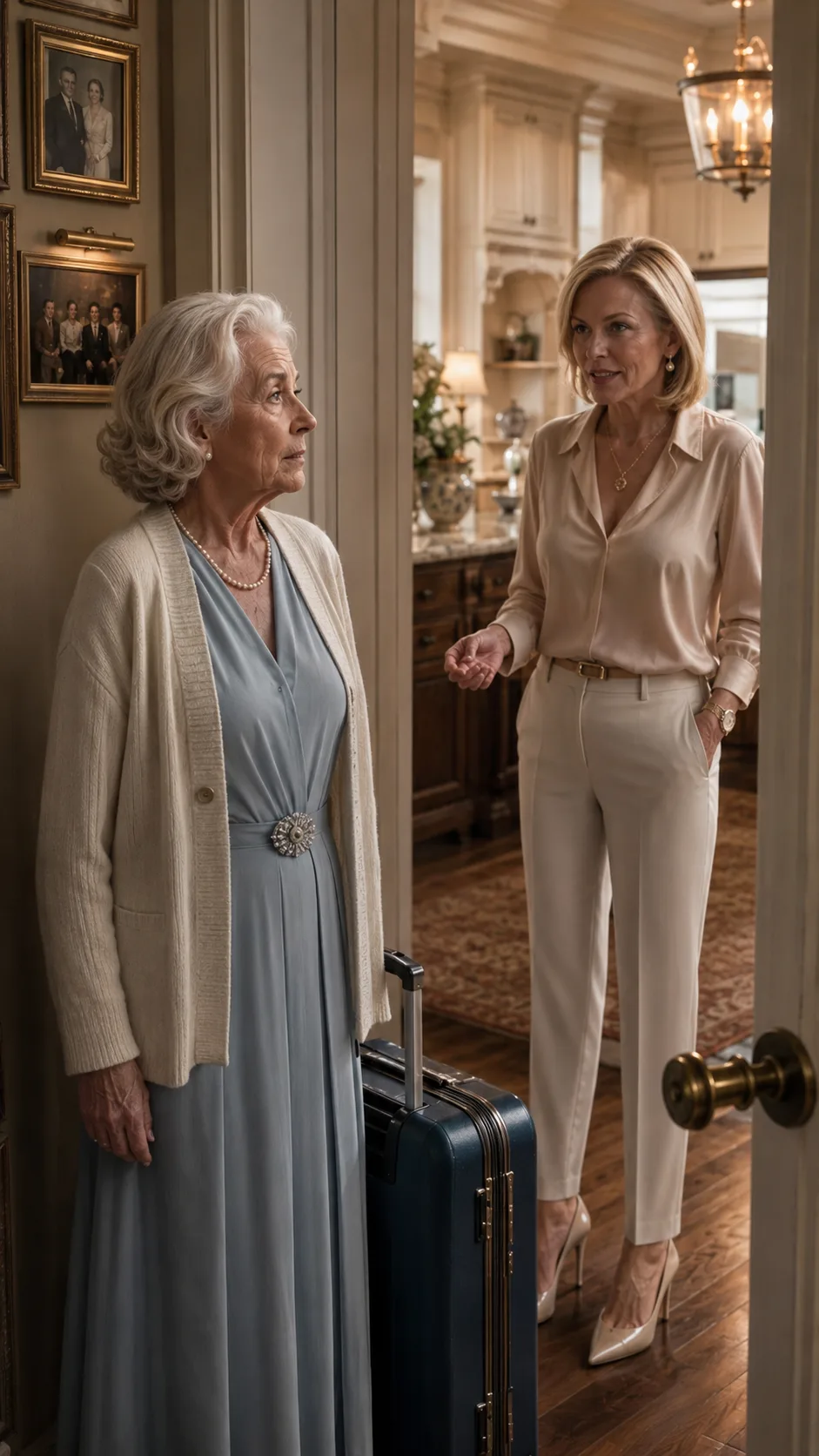
PART 3: THE WOMAN THEY UNDERESTIMATED
The meeting that followed had been James’s idea, and he framed it with the precision I had come to rely on from him over twenty-two years.
Chapter 3
PART 3: THE WOMAN THEY UNDERESTIMATED
The meeting that followed had been James’s idea, and he framed it with the precision I had come to rely on from him over twenty-two years.
“If Craig intends to pursue a guardianship or incompetency claim,” he told me on the phone the Monday after their visit, “he will almost certainly file within the next two to three weeks. He’ll want to move before you and Walter establish further public and legal normalcy. We should move first.”
Moving first meant convening a meeting—formal, documented, attended by counsel on both sides—at which the full scope of what we knew would be presented clearly before any filing could be made. James would invite Craig and Linda’s attorney, a man named Pruitt who worked out of a midtown Atlanta firm and whom James, it turned out, had met several times professionally.
James would present our documentation.
I would be present.
Walter would be present.
And so, at my request, would Robert—Pauline’s son, the retired judge, now formally my secondary trustee.
The meeting was held in James’s office on a
Tuesday morning, two weeks after the Sunday visit. I arrived early and sat in the chair I always took, the one facing the window overlooking Bull Street and the azaleas. I drank the coffee James’s assistant brought me. I breathed slowly. And I thought about Gerald—not sentimentally, but practically.
Gerald had been a man who believed that the most dangerous thing you could do in a difficult situation was allow yourself to be frightened out of clarity.
See what is, he used to say.
Not what you’re afraid of.
What is.
What was, was this:
I was prepared.
They were not.
Craig and Linda arrived with Pruitt, who was a careful, youngish man who clearly had not been given the full picture by his clients. I watched his face as James laid out the documents on the conference table, and what I saw there was a lawyer’s very specific expression
upon discovering that a case is not what he was told it was.
He turned over the first page slowly. His expression did not change—lawyers train themselves against that—but his stillness intensified in a way that told me everything.
James presented the timeline first: the cruise, the relationship, the marriage, the preemptive capacity evaluation, the prenuptial agreement, the trusteeship appointment, the estate revisions.
Then he presented Harold’s email.
He read the relevant passage aloud. He noted the date, which predated our marriage by six weeks, and the language: estate being managed through family agreement pending transfer.
Craig tried to speak.
Pruitt put a hand on his arm.
James continued.
He produced county records showing three building code violations and a contractor dispute attached to Craig’s development company in the past four years. He noted that these were matters of public record. He noted that they established a pattern of the
company operating in advance of legal clearance.
Then he placed a single page in front of Pruitt.
It was a letter from the Atlanta real estate agent—the one who had sent Harold the email—who had, upon being contacted by James’s paralegal and informed that the conversation was likely to become part of a legal record, provided a written statement confirming that Craig Holloway had explicitly discussed the Oleander Street property as an anticipated acquisition and had used the phrase:
“The old lady can’t hold on forever.”
I had read that sentence a dozen times since James first showed it to me, and each time it produced the same response. Not hurt, exactly. Something colder and more useful than hurt.
A kind of absolute confirmation.
There are moments in life when you understand, without any remaining ambiguity, exactly what you have been dealing with.
This was mine.
Not a daughter worried for her mother.
Not a family anxious about the future.
A business calculation.
A timeline.
An asset awaiting management.
Linda made a sound—small and sharp, the sound of someone whose footing has disappeared beneath her.
Pruitt looked at the page. Then he looked at Craig. Then he made the expression of a man doing rapid arithmetic.
“Mr. Holloway,” he said quietly, “I think we should pause.”
Craig did not pause.
Craig, who had spent the last three weeks convincing himself that he held all the advantages—age, resources, and the persuasive American tendency to see an elderly woman as a passive figure in her own story—looked across the table at me and said, “You went digging through my business records. This is harassment. This is a coordinated attack.”
Linda lifted her chin, trying to recover the argument they had already lost.
“She’s eighty-three years old,” Linda said, her voice tight and unsteady. “She’s been manipulated by a man who appeared out of nowhere.”
“And Walter Brennan’s business and personal history are also documented in the folder in front of you,” James said pleasantly. “Page twelve.”
Linda did not speak again for several minutes.
I looked at her.
She was looking at the table. Her hands were folded in her lap.
She had her father’s hands. I had always thought so.
And seeing them folded that way, very still, I felt something move through me that was not anger and not pity, but something older and sadder—the particular sorrow of watching a person you once held in your arms become someone you do not recognize and cannot reach.
I spoke directly to her.
“Linda,” I said, “I don’t want to damage your husband’s business or create a public record that follows your family. That has never been my goal.”
She looked up.
“My goal,” I said, “was to be left alone. To live the rest of my life without being managed or anticipated or arranged around. I believe I have now demonstrated that I am capable of doing that.”
Pruitt closed his folder.
“Mrs. Brennan,” he said—and I noticed he used the new name without any drama, as though it were simply the accurate thing—“I don’t believe there is a viable claim here. I’ll be advising my clients accordingly.”
Craig stood up so quickly he knocked his chair back. He said something about how he knew what this really was and that we had not heard the last of it. His voice had the particular brittleness of a man who is angry because he is afraid, and afraid because he has just realized he overestimated his own position by a very wide margin.
Nobody in the room responded.
He walked out.
Linda followed him.
At the door, she paused.
She turned.
She looked at me for a long moment with an expression I could not entirely read. There was anger in it, and humiliation, and something else—something that might, in another life, have been grief.
I held her gaze.
I did not look away.
I wanted her to see, clearly and without softening, that I was not diminished, not undone, not the woman she had decided I was.
She left without speaking.
James refilled my coffee. Robert said, “That was cleanly done.” Walter, who had not spoken once during the entire meeting, took my hand under the table.
Outside on Bull Street, the azaleas were in full bloom.
Pruitt was as good as his word. James received a formal letter from the Atlanta firm within ten days confirming that no legal action regarding Dorothy Brennan’s mental capacity or estate management would be pursued. The letter was written with the careful neutrality of attorneys withdrawing from an untenable position, and James described it with characteristic understatement as conclusive.
He called me when it arrived and read me the relevant paragraph over the phone in his measured, deliberate voice. And when he finished, there was a small silence between us that was not awkward, but simply full—the silence of two people who have completed a long piece of work together and are acknowledging it without unnecessary ceremony.
“Well,” I said.
“Well indeed,” said James.
Craig’s real estate agent issued a formal retraction of the email sent to Harold, acknowledging that he had spoken beyond the scope of any authorized representation. The retraction was delivered in writing to Harold, to James, and, at James’s insistence, to the county clerk’s office as a matter of record.
Harold, who had been anxious about the whole business, called me when he received his copy and said he felt considerably better.
I thanked him again for bringing me that envelope. I told him it had changed things considerably.
“I had a feeling,” Harold said. “You had that look.”
“What look?” I asked.
“The look of a person who’s been underestimated.”
I thought about that for a long time after I hung up.
How strange it is, how persistent it is, and how costly—the human tendency to look at a person who has grown old and assume that age has hollowed them out rather than filled them.
Linda had looked at my eighty-three years and seen diminishment. She had not considered that those years contained fifty-one years in this house, twenty-two years of working with James Whitfield, and a lifetime of watching people carefully and drawing accurate conclusions.
She had not considered that a woman who raised two children, managed a household through grief and economic uncertainty, taught herself to invest sensibly, and read Middlemarch three times might have developed, along the way, a very precise understanding of how the world works and how to move within it.
She had seen the age.
She had not seen the woman inside it.
What happened to Craig’s company in the months that followed was not something I engineered. I want to be precise about that. I had not reported him to any regulatory body. I had not shared his records with the press or with competitors.
What James had done was simply make those county records part of an organized and accessible file.
Which meant that when Craig’s company subsequently attempted to acquire a development site in a neighboring county, and the county commissioner’s office ran a background check as they routinely did, they found the violations.
The project was denied.
Two investors withdrew.
I did not feel satisfaction about this.
I felt a kind of grim fairness, the same feeling one gets when a natural consequence arrives in its own time without needing to be arranged.
Craig had built his professional life on the assumption that small transgressions go unnoticed and that the architecture of other people’s trust is available for use without permission. He had applied that same logic to me.
What he had not anticipated was that I had spent decades building an architecture of my own—of documents and relationships and careful attention—and that when the moment came, it held.
The reaction in their social circle was, if anything, more damaging to them than the legal retreat.
Walter and I made no announcements and told no stories. We simply lived. We attended a gallery opening on Jones Street, had Sunday dinners with Pauline and Robert, entertained Thomas and his family when they visited from Atlanta, and existed visibly and contentedly in the ordinary life of the city.
The two wedding photographs remained on our respective accounts, liked by hundreds of people and shared by some.
Linda’s friends, several of whom were women I had known for decades—women who had watched Linda grow up and visited my house for Christmas parties in the 1980s—began quietly to ask questions, not of me, but of each other. The story reached them in fragments: the real estate email, the meeting with attorneys, the formal withdrawal.
People who had been present at family events over the years and had noticed the increasing frequency of Linda’s comments about my house, my health, and my independence began to assemble a picture.
One woman, a friend of Linda’s named Barbara, who had known our family since the children were in elementary school, called me directly. She did not ask for my version of events. She simply said, “Dorothy, I want you to know that I think you handled everything with extraordinary dignity.”
I thanked her and changed the subject, because that was the correct thing to do.
But I noted it.
I did not help them assemble that picture.
I didn’t need to.
Linda called me once more, four weeks after the meeting. Her voice was different again—not the cold anger of the confrontation, not the performed warmth of the Sunday visit. There was something exhausted in it that I recognized, because I had heard it in my own voice once, long ago, when I had finally stopped fighting something that could not be fought and simply had to be accepted.
“I want you to know,” she said, “that I didn’t think of it as greed. I thought I was protecting you.”
I sat with that for a moment.
I thought about whether it was true.
I thought it was probably partially true, the way most self-justifications contain a partial truth—enough to feel real, not enough to be the whole story. Linda had perhaps genuinely believed, somewhere in the architecture of her reasoning, that her mother needed to be managed.
But that belief had been convenient.
It had aligned too precisely with what she stood to gain.
“Linda,” I said, “you thought I was finished. There is a difference between protecting someone and deciding for them that they are done.”
She did not answer.
“I was not finished,” I said. “I am not finished.”
She said she understood.
I believed she was beginning to, whether that understanding would become something useful in her, whether it would change how she looked at other people, at other lives she had quietly assumed were winding down—I could not know.
That was her work to do, not mine.
What I knew was this:
My house on Oleander Street was mine.
My accounts were mine.
My estate was documented, secured, and clearly structured.
My capacity was certified.
My husband was sitting on the back porch reading a biography of Eisenhower with Admiral at his feet and the late afternoon coming in gold through the jasmine.
I hung up the phone.
I went to the back porch.
I sat down beside Walter.
He looked over at me with that quiet, attentive expression I had come to understand was simply how he was—how he had always been—the look of a man who is genuinely interested in the person in front of him.
“Okay?” he said.
“Yes,” I said.
The marsh grasses moved in the low wind. A heron stood absolutely still in the shallow water at the edge of the yard, the way herons always do, as though time is a thing they have long since made their peace with.
I thought:
I am eighty-three years old, and I am okay.
More than okay.
Six months after the courthouse ceremony, Walter sold his apartment in Atlanta and moved to Oleander Street. We repainted the front bedroom pale blue, the color of the Adriatic on the morning I first understood that the world had not finished with me. Walter contributed a set of dark wood bookshelves from his first house in Charleston, and we spent an entire Saturday arranging our combined libraries, arguing comfortably about whether to organize by subject or by author and settling on a hybrid system that satisfied neither rule entirely but suited us both.
He fixed the kitchen faucet that had been dripping since February.
I taught him where the good farmers market was.
Within a month, half the street knew his name, because Walter was the kind of man who stopped to talk to people genuinely, and people felt it.
We traveled deliberately—two weeks in Ireland in June, following coastlines that felt ancient and indifferent to human trouble; in September, a slow drive through Virginia and Maryland with no particular agenda; four days in a small inn near the Blue Ridge with a library of water-stained paperbacks and the best biscuits I have eaten in my life.
Thomas and his family visited twice. His wife, Carol, was warm and practical, and their two teenage daughters were politely suspicious of me at first, as teenagers are, and by the end of the afternoon were showing me things on their phones and asking my opinion about matters I did not entirely understand.
The intent was the thing.
The intent was inclusion.
Walter’s younger son, David, told me once, with a directness that reminded me of his father, “He laughs now. He didn’t laugh much after Mom died. He laughs now.”
I carried that around with me for days.
Robert and Pauline became part of our regular life too. Dinners, Saturday walks, the easy companionship that does not require an occasion.
Harold sold his house to a young family from Raleigh with three small children and a dog who dug holes in the yard. I considered this an improvement in every direction.
As for Linda and Craig, I knew what I knew mostly through Ashley, who called occasionally with a diffidence I chose to meet with warmth. Craig’s company lost two major contracts. One was the county rejection. The second came when a private investor, aware through professional networks that the company had governance problems, withdrew his interest.
Craig spent considerable money attempting to recover and was, by Ashley’s account, neither easy to live with nor willing to examine his own role in the situation.
Linda was changed.
Not transformed.
But changed.
She had joined a women’s group at her church. She called me twice in the year that followed, short and careful and without agenda. Once she asked about Walter.
I told her he was well.
She said she was glad.
I did not know whether we would find our way back to something resembling a relationship.
I held the possibility lightly, without pressure.
What I knew was that I was not waiting for her permission to live.
I was eighty-four years old by the time spring came again to Savannah. The magnolia Gerald and I had planted had a new branch reaching toward the porch—toward light, perhaps, or simply toward space. That seemed about right.
Looking back, here is what I know to be true:
No one gets to decide when you are finished.
Not your children.
Not your age.
Not anyone who has mistaken your silence for surrender.
I was eighty-three years old when someone who loved me—or believed she did—looked me in the eye and told me no one wanted me.
And I nodded because I already knew something she didn’t.
I was not finished.
Not even close.
THE END.
Chapter complete
You have reached the end of this chapter.
Continue reading
A few more worlds to get lost in after this chapter.




