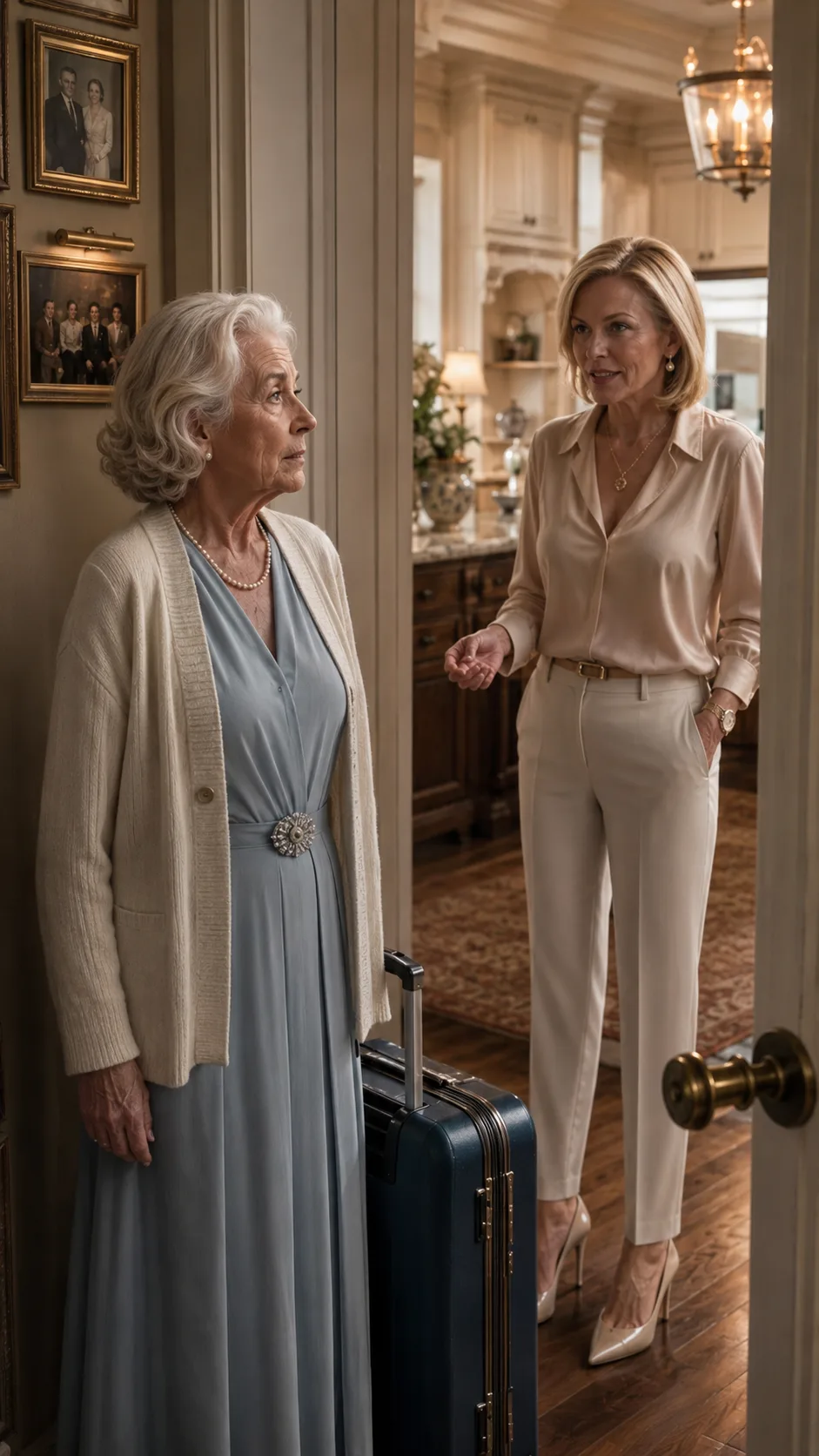
PART 2: THE WIDOWER FROM THE CRUISE
After they left, I sat at the kitchen table for a long time.
Chapter 2
PART 2: THE WIDOWER FROM THE CRUISE
After they left, I sat at the kitchen table for a long time.
Admiral jumped onto the chair beside me—Gerald’s old chair—and watched me with the particular gravity cats reserve for moments of human reckoning. Outside, the magnolia moved in the evening wind. The Lisbon vase was still on the counter where Linda had set it down carelessly, slightly too close to the edge. I got up and moved it back to its proper place.
Then I sat down again and did what I have always done when something important needed to be understood.
I thought carefully, without rushing, and I was honest with myself.
The first honest thing I admitted was that I had seen this coming for years and had chosen not to see it. The comments about my will, the questions about the house, the way Craig’s eyes moved across my possessions with a particular attentiveness that had nothing to do with admiration.
I was not a naive woman. I
had simply been a woman who did not want to believe that her daughter was capable of what her daughter was, in fact, capable of.
The second honest thing I admitted was that I was afraid. Not of Linda’s contempt. Contempt I could survive. I had survived worse. What frightened me was the machinery behind the contempt. Linda was methodical. Craig was a businessman, and not an entirely honest one, though I had never been able to prove it. If they had decided that my assets—the house, Gerald’s investment accounts, the small but real portfolio I had managed quietly for thirty years—needed to come under their control, they would not simply wait for me to die.
They would maneuver.
The third honest thing I admitted was this:
I still had cards to play.
I opened the small drawer beside the refrigerator where I kept important papers, found the notepad with
the blue cover, and began to write. Not dramatically. Not in anger. Methodically, the way Gerald had taught me to approach any problem.
List what you know.
List what you need to know.
List what you can do.
What I knew was that Linda believed I was isolated, dependent, and without meaningful allies. She believed the cruise had been a pathetic gesture of loneliness. She believed I had come home unchanged and diminished.
She was wrong on every count.
Because on the third day of that Mediterranean cruise, somewhere between Dubrovnik and the island of Corfu, on a deck where the evening light turned the water a color I don’t have a name for, I had met Walter Brennan.
Walter was seventy-nine years old. He was from Charleston originally, though he had spent most of his adult life in Atlanta, where he had built a commercial real estate and logistics
company over forty years. He was a widower. His wife, Margaret, had died four years earlier after a long illness he spoke of with quiet sorrow and no self-pity. He had two adult sons who were, he said, good men with full lives, and he saw them regularly and without drama.
He was not a flashy man. He wore linen shirts and read histories. He had laugh lines deep enough to have been earned honestly.
On the fourth evening, we had dinner at a table for two because the dining room was full and the maître d’ had asked if we minded sharing. We talked for three hours. When the conversation finally ended, I realized I had not thought about Oleander Street or Linda or my checkbook once.
We spent the rest of the cruise in each other’s company—not urgently, not foolishly, but with the ease of two people who had lived long enough to know the difference between companionship and desperation, and to prefer the former unreservedly.
He held my hand on the upper deck during a sunset near Santorini.
I let him.
It felt entirely natural.
When we parted in Barcelona, he took both my hands and looked at me with steady gray eyes.
“Dorothy,” he said, “I haven’t felt like myself in four years. I’d like to keep talking to you, if you’ll allow it.”
I allowed it.
We had spoken every day since my return. Long calls, easy and wide-ranging, about books, about our children, about what we had learned and what we regretted, and what still made us laugh. He had mentioned, matter-of-factly, that he intended to visit Savannah.
I had told him he was welcome.
Now, sitting at my kitchen table with Admiral beside me and my blue notepad open, I understood something with sudden and absolute clarity.
Linda thought I was alone.
I was not alone.
And she had made a serious error in showing her hand before she understood mine.
I picked up the phone and called my attorney, James Whitfield, whom I had trusted for twenty-two years. I told him I needed an appointment soon. I said I had questions about my estate documents and a few other matters. He heard something in my voice—James always did—and said he could see me Thursday morning.
I also called Walter.
I said, “You mentioned coming to Savannah. Perhaps sooner rather than later.”
He was quiet for a moment. Then he said, “I’ll look at flights tomorrow.”
I wrote two things in my blue notepad and underlined them both.
Get the documents right.
Don’t be in a hurry, but don’t wait either.
James Whitfield’s office was on Bull Street in one of those old Savannah buildings where the floorboards remember the nineteenth century and the ceiling fans turn slowly regardless of season. I had been coming there since Gerald and I first drew up our wills in the early 2000s. James was now in his sixties, silver-haired and careful with language in the way good attorneys are, meaning he said exactly what he meant and nothing extra.
I arrived Thursday morning with my blue notepad and a folder of documents I had organized the night before.
I told him everything.
Not the emotional version. Not the kitchen-table scene with Linda and Craig and Ashley’s averted eyes. The factual version. The comments about the will. Craig’s questions about the house. The pattern laid out plainly and in sequence.
James listened without interrupting.
When I finished, he was quiet for a moment.
Then he said, “Dorothy, you were right to come in. Let me tell you what I think we should address.”
We spent two hours in that office. By the end of it, I had instructed James to review my current estate documents for any vulnerabilities, specifically regarding power-of-attorney provisions, which he explained carefully were sometimes the avenue through which family members applied pressure on elderly individuals. I also asked him to draft a new document clarifying that any decisions about my property or finances required my sole written consent, with a secondary trustee—not Linda, not Craig—named only in the event of my genuine incapacitation.
I named Pauline’s son Robert, a retired judge I had known since he was twelve years old.
James made notes.
When I mentioned Walter briefly—factually, describing him as a friend I had met on the cruise and was considering a closer relationship with—James looked at me over his reading glasses for a moment, then nodded, as though confirming something he had already suspected.
“I’ll have the documents ready by next week,” he said. “And Dorothy—good for you.”
I drove home along the river road. The azaleas were beginning. Savannah in March has a particular quality: the air is soft, but the light is sharp, and everything seems to be making a decision.
I was making several.
But the real turning point came the following Saturday, and it came not from any action of my own.
My neighbor on the other side, an older gentleman named Harold, had mentioned some months earlier that he was thinking about selling his house. He had approached me informally to ask whether I knew anyone interested, and I had mentioned it in passing to Craig at a family dinner—a small, forgettable conversation, or so I had thought.
On Saturday morning, Harold came to my door looking uncomfortable. He held a manila envelope with the reluctant care of a man who would rather not be the bearer of trouble.
“Dorothy,” he said, “I don’t want to create any difficulty, but I think you ought to see this.”
Harold explained that a real estate agent had approached him the week before, apparently on behalf of Craig Holloway’s company, inquiring about his property. During the conversation, the agent had mentioned—conversationally and perhaps unwisely—that the acquisition was part of a larger plan involving the adjacent Oleander Street property. When Harold had expressed surprise, since as far as he knew that property was not for sale, the agent had smiled and said that it would be in time.
Harold, being a cautious man, had asked for the communication in writing as a routine matter. The agent had sent a follow-up email.
Harold had printed it and brought it to me.
I stood in my doorway and read that email twice. It referenced Craig Holloway’s development company. It referenced a proposed acquisition of two adjacent lots—Harold’s and mine. It referenced a projected timeline, and it contained a phrase I have not forgotten since:
The estate being managed through family agreement pending transfer.
I was not dead.
My estate was not being managed.
There had been no family agreement, and no one had asked my permission for anything.
I thanked Harold quietly, took the envelope, and went inside. I sat down at the kitchen table. Admiral came and put his paw on my arm, which he had never done before.
I looked at the email for a long time.
This was not suspicion anymore.
This was evidence.
Craig and Linda were not waiting for me to die. They were planning around me as though I were already a matter of logistics. My house, my land, my life’s address—reduced to a line item in a development proposal.
I called James Whitfield and asked him to add one more item to our agenda.
Then I called Walter and told him what I had found.
He was very quiet on the phone. Then he said, in a voice I had not heard from him before—measured and certain—
“Dorothy, I was going to wait until I arrived to ask you this properly, but I don’t think I want to wait anymore.”
I didn’t say anything. I waited.
“Would you consider marrying me?” he said. “I’m serious. I’ve been serious since Corfu.”
Outside, the magnolia was perfectly still.
“Come to Savannah, Walter,” I said. “We’ll talk.”
Walter flew into Savannah/Hilton Head on a Wednesday afternoon. I picked him up myself. I want to be precise about that, because Linda later suggested—with her characteristic implication—that I had been swept away and was not thinking clearly. I drove my own car to the airport. I parked in the short-term lot. I walked to the arrivals area with my handbag over my arm and waited.
When Walter came through the doors rolling a single leather bag and found me in the small crowd, he stopped for a moment and smiled. It was the kind of smile that doesn’t perform anything and doesn’t ask for anything. It simply arrives.
I felt something in my chest that I recognized dimly as the same feeling I had had on that deck above the Adriatic when I first understood that I was not ready to stop living.
We drove along the marsh road into the city. He looked out at the Spanish moss and said, “Lord, it’s beautiful here.”
“Yes,” I said. “I know.”
He stayed at the Bohemian Hotel Savannah Riverfront on River Street. I had arranged it before his arrival, a choice that reflected the seriousness with which we were both approaching the situation. We were not young people playing at romance. We were deliberate people making deliberate decisions.
Over the next three days, we talked, walked the squares, had dinner at my kitchen table twice, met James Whitfield together, and on the evening of the third day, sitting on the back porch with the jasmine and the late light, Walter asked me again—formally, without theater, holding my hand and looking at me directly—whether I would marry him.
I said yes the same way I had said everything important in my life.
Quietly.
And meaning it absolutely.
James had already prepared the paperwork we needed: a prenuptial agreement. Walter had insisted on it, in fact—not to protect himself from me, but to protect me legally, ensuring that my assets remained unambiguously mine and that no future claim could be made against me through our marriage. Walter’s attorneys in Atlanta had reviewed it. James had reviewed it.
We signed it on Thursday morning.
On Friday afternoon, at the Chatham County Courthouse, with James as one witness and a kind clerk named Mrs. Everett as the second, Walter Brennan and I were married.
I wore the cream linen dress I had bought in Barcelona. The photographer was a young woman recommended by James’s assistant. We spent twenty minutes on the courthouse steps in the March light. Then Walter and I had lunch by the river, and I felt—this is the exact word I want—settled.
Not giddy.
Settled, like a house that has found its foundation.
We posted two photographs that evening. I had an old Facebook account I had barely used. Walter’s son had helped him set up his. We posted the same two images, tagged each other, and wrote one simple sentence:
Married today in Savannah. We are very happy.
By Saturday morning, my phone was ringing.
Linda called four times before I answered.
When I did, her voice had a quality I had rarely heard from her: a compressed, high-pitched tone trying very hard to sound concerned while being unmistakably furious.
“Mom, what have you done? You don’t know this man. This is not rational.”
Craig was on the line within the hour. His tone was different—colder, more managerial. He used words like capacity and undue influence and we have an obligation to protect your interests.
I listened to all of it without interrupting.
Then I said, “James Whitfield has all of the documentation. The prenuptial agreement. The capacity evaluation, which I requested preemptively for this exact reason. The witness statements. The timeline. If you’d like to contact James, his number is on the letterhead you’ve had for years.”
There was a silence on the phone.
I added, “And Harold has made a copy of the email from your real estate agent. James has the original.”
The silence became a different kind of silence.
Craig said he would be in touch.
He said it carefully—the way a man says something when he realizes the room has changed around him without his permission.
Linda said, “Mom, I can’t believe you would do this to us.”
I thought about what she had said at my kitchen table. Nobody wants you. The laughter. The shrug.
“Goodbye, Linda,” I said.
And I hung up.
I turned to Walter, who was reading on the back porch with Admiral beside him—Admiral, who had taken to Walter with an immediacy I chose to read as a character reference—and I said, “They’ll be quiet for a few days.”
Walter looked up.
“Good,” he said. “Let’s have those days.”
We did.
We took them deliberately and without apology.
The few days of quiet lasted almost a week. I had expected a faster second move. Linda was not a patient woman, but I suspect Craig counseled her to wait. Craig, who always preferred to let pressure build before applying it, who understood leverage the way a certain kind of businessman understands it—not as force, but as positioning.
During that week, Walter and I settled into a routine that surprised me with its ease. He was an orderly man who made excellent coffee and did not leave things on the counter. He read in the mornings, walked in the afternoons, and in the evenings sat with me on the back porch or at the kitchen table and talked the way I had almost forgotten people could talk—attentively, curiously, without an agenda.
He called his sons in Atlanta every other day. The elder one, Thomas, called me directly on the third day to introduce himself, which I found both touching and sensible.
I also reached out to people I had perhaps been too private to reach before.
Pauline, of course, was the first.
I told her everything. The kitchen-table scene. The email. Harold’s visit. Walter. The courthouse.
She listened without a single interruption, which from Pauline was an act of extreme discipline. When I finished, she was silent for two full seconds and then said, “Dorothy Harper, you are the most quietly extraordinary person I have ever known.”
Then she cried a little, which made me cry a little.
And then we both stopped, and she told me she was going to call her son Robert to make sure he was fully briefed as secondary trustee.
Robert called me the next morning. He was direct and professional and warm in equal measure. He confirmed he had received the trustee documents from James, had reviewed them, and was prepared. He also mentioned in passing that Craig Holloway’s company had had some regulatory difficulties in the past few years—building code violations, a disputed contractor settlement that had never become public but was a matter of county record.
He said it not as a threat, but as information.
I wrote it in my blue notepad.
The call I had not expected came from Ashley.
My granddaughter called on a Thursday evening when Walter had gone for a walk along the river. Her tone was different from her parents’—softer, less certain.
“Grandma,” she said, “I just… I wanted to say I saw the pictures. You look really happy.”
I waited.
“I didn’t know about the email,” she said. “The one from Dad’s company. I didn’t know they were doing that.”
I believed her.
Ashley was not a warm person, but she was not, I thought, a cruel one. She had been shaped by her parents’ values and was only now, perhaps, beginning to examine them from the outside.
“Thank you for calling, Ashley,” I said.
“Are you okay?” she asked. “Like, genuinely?”
“I am genuinely wonderful,” I said.
She laughed a little. A real laugh. Small and surprised.
That was the moment the temptation arrived.
Two days later, Linda called—not with anger this time, but with warmth, which was more alarming.
She said she had been thinking. She said she had overreacted. She said Craig felt terrible about the real estate situation, that it had been a miscommunication, that the agent had spoken out of turn. She said she was happy for me, truly. She just wanted to make sure I was protected.
“What if we all had dinner?” she said. “You, me, Walter. Just family. Just to clear the air.”
I sat with the phone in my hand and looked at the Lisbon vase on its shelf.
I understood what she was doing.
A dinner was not a dinner.
A dinner was a performance for Walter’s benefit and perhaps for mine, designed to make us both feel that the conflict had been exaggerated, that the family was reasonable, that there was no real threat. And once Walter believed there was no real threat, perhaps he would be less inclined to stay, and perhaps I would be less inclined to hold my ground.
I also understood something else.
Linda was afraid.
And afraid Linda was more dangerous than angry Linda, because afraid Linda was careful.
“I’ll think about it,” I said pleasantly.
I did not think about it.
I called James and told him that Linda had made contact and that I expected an escalation, possibly disguised as reconciliation.
James said, “I’ve handled three cases like this in the last decade, Dorothy. You’re reading it exactly right.”
I sat with that knowledge—the knowledge that I was not being paranoid, not being dramatic, not being, as Linda had once said, too sensitive for your own good. I was being accurate, and accuracy at eighty-three is a form of armor.
They came on a Sunday.
I had not agreed to a dinner, but Linda apparently decided that the lack of a refusal was an invitation. She and Craig arrived at Oleander Street at two o’clock in the afternoon—Linda with a bakery box, Craig with a bottle of wine that probably cost more than the cake—and stood on my front porch wearing expressions of studied normalcy.
Walter was home. I had told him they might come, and we had agreed, simply and without drama, that he would be present—not as a display, just as himself.
I opened the door and let them in.
The first twenty minutes were performance.
Linda admired the kitchen. Craig shook Walter’s hand with the particular grip of a man demonstrating that he is unthreatened. There was coffee and the bakery cake. Lemon, which I don’t especially like, but which Linda had always considered a gesture of effort.
We sat in the front room, the good room Gerald and I had saved for company, and we were polite. I poured the coffee into the cream-and-gold cups we had received as a wedding gift in 1965 and set the lemon cake on the blue plate.
And we all sat there with the careful pleasantness of people pretending together that they were not pretending.
I noticed Craig’s eyes move across the room—across the bookshelves, the side table with Gerald’s photograph, the tall secretary desk in the corner where I kept my personal papers. He was doing it subtly, the way he always had, but I had been watching Craig Holloway for twenty-six years, and I knew the difference between a man who looks at a room with appreciation and a man who looks at a room with calculation.
Then Craig set down his coffee cup and looked at Walter.
“Walter, I want to be straight with you. Man to man,” he said. “We were caught off guard. You can understand that. Linda’s mother, a woman we care about, comes home from a trip and two weeks later she’s married to someone none of us have met. That’s alarming from a family perspective.”
“Of course,” Walter said mildly.
“Dorothy is… she’s at an age where she’s vulnerable,” Craig continued. “We’re not accusing you of anything, but a responsible family has to ask questions.”
I watched Walter.
He was looking at Craig with the patient attention of a man who had sat across conference tables from difficult people for forty years. He did not shift in his chair. He did not reach for his coffee. He simply waited with the perfect steadiness of a man who had nothing to defend.
“What questions would you like to ask?” Walter said.
Craig smiled.
It was not a warm smile.
“Well, for instance, the prenup—that’s very unusual for people at your stage of life. It suggests…” He paused. “Well, it suggests some people are thinking about assets.”
I spoke before Walter could.
“I requested the prenuptial agreement, Craig,” I said. “Walter’s attorneys initially resisted it because it was unnecessarily favorable to me. James can confirm that.”
Craig’s smile did not change, but something behind his eyes shifted.
Linda turned to me then. She put her hand over mine on the armrest, a gesture so unfamiliar from her that it took me a moment to identify what it was.
Practiced.
Her fingers were cool. She had always had cool hands, even as a child. I used to warm them between my palms in winter.
I thought of that now, sitting in the good room with the lemon cake untouched on its plate.
“Mom,” she said, “we love you. We’re scared for you. Don’t you think it’s worth just slowing down? Having an independent evaluation? Not because anything is wrong, but just to protect yourself—and to protect the family from any, you know, future legal complications.”
There it was, dressed in love, delivered in a soft voice.
Have yourself declared incompetent so we can manage your affairs.
I looked at my daughter’s hand on mine.
“Linda,” I said, “I had a capacity evaluation done before the wedding, voluntarily, with a certified neuropsychologist, because I anticipated exactly this conversation. The results are on file with James Whitfield. I scored in the ninety-first percentile for my age group.”
Linda removed her hand from mine.
“Furthermore,” I said, “James has advised me that the email from Craig’s real estate agent—the one referencing my property as part of a pending acquisition—constitutes a documentable conflict of interest. If anyone pursues a guardianship claim, that document will be part of the response.”
The room was very quiet.
Outside on Oleander Street, a car passed slowly, and the afternoon light moved across the floor the way it always does in that room at that hour—long and gold and indifferent to human drama.
Craig’s jaw tightened.
Linda’s eyes went somewhere cold and flat that I recognized. I had seen it when she was twelve and understood she had lost an argument and was deciding whether to escalate or retreat.
She chose a middle path, which was somehow worse.
“You’ve been talking to lawyers about your own family,” she said. “Do you know how that makes us feel?”
“I imagine it makes you feel cautious,” I said. “That is appropriate.”
Craig stood up so abruptly he knocked his chair back. He said something about how they had come in good faith and were being treated like criminals. He said Walter had clearly poisoned my mind. He said he was not going to sit in my house and be accused.
“You haven’t been accused of anything,” Walter said from the armchair without raising his voice. “Dorothy has simply stated facts.”
Craig looked at Walter for a long moment—the kind of look men exchange when one of them has just understood that the other is not going to move. Then he turned and picked up his jacket from the back of the chair, smoothing it unnecessarily, a gesture I recognized as the physical habit of a man collecting himself.
They left.
Linda did not say goodbye.
I stood in the doorway and watched Craig’s car pull away from Oleander Street. I noticed, to my surprise, that my hands were trembling slightly—not from age, but from the body’s old animal response to conflict, the particular fear of being cornered.
Was this how it would go now? Would every conversation with my daughter end with the sound of a door closing and tires on asphalt?
But the trembling passed.
And what replaced it was not relief.
It was resolve.
Good, I thought.
Now I know exactly who they are and exactly what they planned. And they know that I know.
We were past pretending now.
That, in the end, was clarifying.
To be continued… Click “PART 3” to read the final part: 👉 PART 3 👈
Chapter complete
You have reached the end of this chapter.
Continue reading
A few more worlds to get lost in after this chapter.




