PART 3 — Welcome To My Home
The silence was immediate and total.
Chapter 3
PART 3 — Welcome To My Home
The silence was immediate and total.
It filled the room so completely I could feel it behind me.
Then I turned.
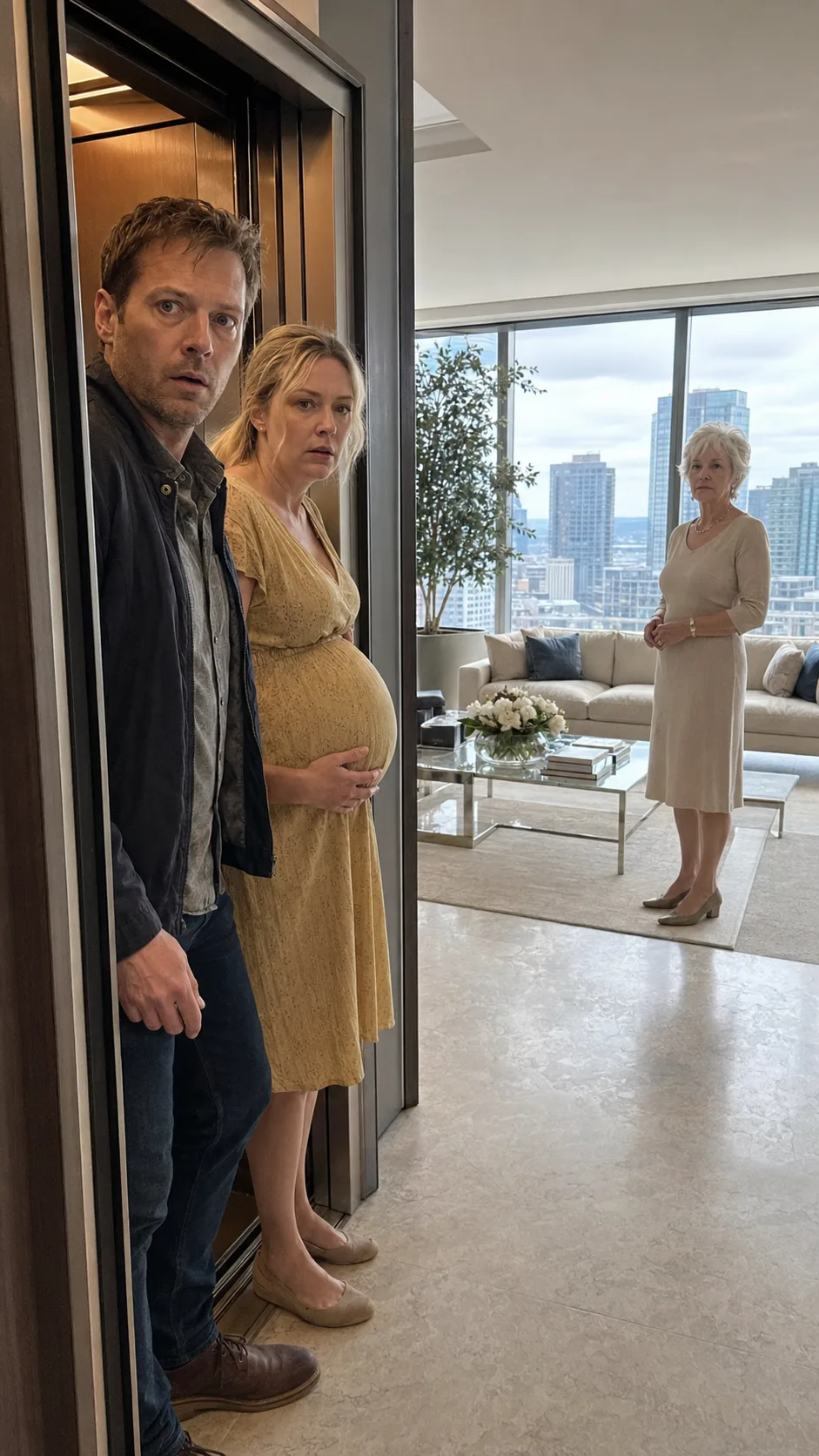
Ryan stood just inside the entry wearing worn jeans and a wrinkled shirt, looking as if he had not slept properly in weeks. Dark circles shadowed his eyes. There was stubble on his face, and his shoulders had the defeated slope of a man whose confidence had been repeatedly broken by circumstances he could no longer manage.
Brooke stood beside him with one hand resting protectively over her stomach. She was heavily pregnant now. The yellow maternity dress she wore had been chosen for utility rather than style, and stress had flattened whatever polish she once relied on. Her hair was frizzing at the edges. Her shoes were worn. Her face looked pale and tired.
They stared at the glass walls, the view, the furniture, the scale of the terrace, the quiet luxury of the
place.
“Hello, Ryan,” I said. “Hello, Brooke. Welcome to my home.”
Ryan blinked several times.
“Mom… how is this possible?”
He looked around again, then back at me as though my existence in that room defied reason.
“All of this,” he said. “This apartment. This life.”
Brooke said nothing at first, but I could see tears filling her eyes. Not tears of affection. Tears of realization.
I gestured toward the sofa.
“Sit down. We have a lot to discuss.”
They sat stiffly, like two people called into a formal hearing rather than a family visit. The contrast was almost too perfect: them collapsed inward on one side of the room, me fully at ease in the life they had once assumed I could never touch.
Only moments earlier, before they saw what waited upstairs, they had still been bold enough to arrive with the line Ryan later admitted they had
rehearsed on the way there.
We heard you bought a penthouse. We came to move in and make peace.
The sheer nerve of it.
“Can I get you something?” I asked. “Mineral water? Coffee? Wine?”
I named each option with deliberate calm, letting the quality of the choices speak for itself.
“Water is fine,” Brooke said quietly.
I went into the kitchen, poured water into crystal glasses, and when I returned, I heard them whispering.
“How did she get all this?” Brooke murmured.
“I don’t know,” Ryan said. “When she left the house, she couldn’t afford a decent hotel.”
“Did Dad have money saved?”
“He never said anything. We lived on his paycheck. That was it.”
I set the glasses down and took the single chair opposite them. The room arranged itself instantly into a balance of power. They sat together, huddled almost unconsciously. I sat alone, centered.
“All right,”
I said. “You wanted to talk. I’m listening.”
Ryan cleared his throat.
“First, we’re sorry for how we treated you. We were under a lot of stress. The pregnancy, money—”
“Stress?” I interrupted, my voice even. “That is your explanation for forcing your own mother out of her home after forty-five years of marriage?”
“It’s not an excuse,” he said quickly. “It’s just—”
“Just what?”
Brooke spoke then, her voice breaking.
“I said terrible things. I know I did.”
“Which terrible things?” I asked. “Be specific. I remember every one.”
Her face drained further.
“I said you were a burden,” she whispered. “I said the baby needed a stable home, not… not your complaints. I said things about Robert that I should never have said.”
“At least now you’re telling the truth.”
I stood up and walked to the glass wall, looking out over Seattle while their reflections hovered faintly in the glass behind me.
“You know what’s most interesting?” I said. “You thought you knew my whole story. You thought you understood exactly what I was worth. A widow. Dependent. Limited. Easy to move aside.”
Ryan swallowed.
“Can you explain where the money came from?”
I turned back.
“Do you want to know because you care about what happened to me? Or because you’re trying to calculate how much help you can ask for now that you think I’m wealthy?”
“That’s not fair,” he said weakly.
“No? Then why did it take six months for you to call? Why didn’t you come looking for me when I was in a motel eating one meal a day?”
He looked down.
I circled behind the sofa slowly before speaking again.
“When your father died, I was exactly the woman you thought I was. Alone. Vulnerable. Uncertain. I needed kindness. I needed family. Instead, you treated me like someone whose life could be rearranged for your convenience.”
I stopped beside Brooke.
“And in doing so, you forced me to become someone else.”
Then I told them.
Not everything at first. But enough.
I told them Robert had left letters. That he had quietly built protection I never knew I had. That he had invested years ago, held property, left records, left instructions. I told them there had been land. Appreciated land. A fortune, in the end.
“Your father left me security,” I said to Ryan. “Far more than either of us knew.”
Ryan stared at me in disbelief.
“Dad had that kind of money?”
“Yes,” I said. “And you might have shared in it one day if you had been the kind of person who deserved to.”
Brooke burst into tears.
“We didn’t know,” she said. “If we had known—”
I stopped her with a look.
“That,” I said quietly, “is exactly the problem.”
She covered her face.
“You’re saying if you had known I had money, you would have treated me better. That respect, in your mind, should have been tied to assets. That a woman without visible resources could be dismissed, but a rich woman must be handled carefully.”
“No,” she said, but not convincingly.
I sat again, leaning forward now.
“You did what you did because you thought there would be no consequences. You thought I had no power. You thought I was weak. And you were wrong.”
Ryan gathered himself enough to ask the question that had been sitting in his eyes since he walked in.
“How much money do you have?”
I smiled without warmth.
“Enough.”
“Enough for what?”
“Enough to buy the building you live in if I choose to. Enough to change your future. Enough to protect my grandchild’s education. Enough to help you. Enough to leave you out entirely. Enough that the limits you placed on me no longer apply.”
They sat in stunned silence.
“And I have something else now, Ryan,” I continued. “Connections. Information. I know you lost your job. I know Brooke sold the car. I know you’re behind on the mortgage.”
Brooke folded inward as if the truth itself had weight.
“How do you know all that?” Ryan asked.
“When you have means and reach in a city like this, information travels.”
I let that sit between us.
“We don’t know what to do,” Brooke said at last. “The baby is due in a month. We’re out of money. The foreclosure notice came. We have nowhere to go.”
“That sounds very frightening,” I said.
She began crying again.
Ryan rubbed his face hard with both hands, as if he could physically erase the situation.
I looked at them and saw, with startling clarity, that they finally understood something close to what they had once handed me: uncertainty, shame, helplessness, dependence.
Exactly the feelings they had told me were not their problem.
“Please,” Brooke said. “Whatever happened between us, the baby didn’t do anything wrong.”
There it was: the child as the final appeal.
And to my surprise, something in me softened—not toward them, exactly, but toward the small innocent life about to arrive in the middle of all this damage.
“My grandchild,” I said slowly. “What makes you so certain I want to be involved after everything that was said?”
“Because I was wrong,” Brooke said. “I was scared, and I said awful things, and I was wrong.”
“Six months ago,” I said, “I was a burden. Now I’m extraordinary?”
She lowered her eyes.
Ryan spoke next.
“We don’t deserve forgiveness. I know that. But we are desperate. I’ve been out of work for two months. I’ve applied everywhere. It feels like every door is shut. Brooke can’t get hired this late in the pregnancy. We’re three payments behind. In two weeks, they’ll take the house.”
“The house that used to be mine,” I said.
He nodded.
“Yes.”
I moved my chair closer so there would be nowhere for either of them to hide their faces from me.
“Let me be very clear about what we are right now,” I said. “We are not a normal family. You ended that when you decided my value depended on what I could still provide you. At this moment, you need something from me, and I have the power to give it or withhold it. That is the truth.”
Ryan’s voice turned rough.
“What do you want from us?”
“Wrong question. The real question is: what are you willing to do to earn help from someone you treated as disposable?”
“We’re your family,” Brooke whispered.
“No,” I said firmly. “You lost the right to use that word as a shield.”
I stood and walked slowly around them, speaking with deliberate calm.
“From now on, you are not relatives who made a mistake. You are two adults who made a decision. A cruel one. If you want anything from me, you will first prove that you understand exactly what you did.”
“How?” Ryan asked.
I stopped in front of them.
“Tomorrow morning, you will go to every neighbor on that block who witnessed what happened or knows the story you told. You will tell the truth. You will apologize. You will say plainly that you treated me unfairly and that your own choices brought you where you are.”
Ryan stared at me.
“To everyone?”
“Especially the neighbors.”
Brooke gripped her belly as if bracing herself.
“There’s more,” I said. “You will each bring me a handwritten letter. No typing. No shortcuts. I want to see, in your own hands, what you think you’ve learned.”
Ryan’s voice dropped.
“If we do that… will you help?”
“I haven’t decided.”
Brooke shifted, wincing slightly.
“Are you all right?” I asked before I could stop myself.
She nodded after a breath.
“The baby kicks hard when I’m stressed.”
For the first time that afternoon, my expression changed.
“No matter what happens between us,” I said, “when it is time for that child to be born, I will not punish an innocent baby for the failures of the adults involved.”
Ryan covered his eyes with one hand.
“How did we end up here?”
“Because you chose advantage over love,” I said. “Because you believed you could act without consequence.”
I gave them until the next day.
When they left, I stood alone in the penthouse and felt an emotion I had not expected: not triumph exactly, but a hollow echo beneath it. I had wanted this moment for months. I had imagined their shock, their shame, their recognition. And yet once it happened, I found myself sitting on the balcony long after dark, watching Seattle’s lights glitter through the mist and asking whether justice always felt this cold while it was happening.
Then I remembered the motel ceiling. The hunger. Brooke’s message telling me to stay away. Ryan’s refusal to return a single call.
And my uncertainty hardened again.
The next morning, reports began arriving almost immediately.
Ryan and Brooke were doing exactly what I had told them to do. They were going door to door on the block, apologizing. One of the first people to call me was Mrs. Bonita, my former neighbor, a woman who had seen more over her hydrangea bushes in twenty years than most detectives saw in a lifetime.
“Lori,” she said, nearly breathless with the pleasure of carrying news, “your son and daughter-in-law came here this morning and told me everything. Everything. He admitted what they did. She was crying. I told them I always knew you deserved better than that.”
Similar updates followed all day. At every house, Ryan and Brooke repeated the story. Publicly. Plainly. By noon, the entire block knew the truth. Whatever version they had once used to protect themselves had been replaced.
That afternoon, I prepared for their return.
I wore a gray pantsuit that made me look exactly how I intended to look: composed, authoritative, not sentimental. This was not reconciliation in any soft, easy sense. It was negotiation. It was reckoning. It was the formal beginning of whatever came next.
I had several files ready on the table.
Debt records. Debt relief documents. A proposed employment opportunity for Ryan through Meridian Construction, one of the stronger firms in the city. A list of apartments. A framework for a trust. Conditions.
Right on time, the bell rang.
They looked different when I opened the door. Smaller somehow. Not physically, but inwardly. The sharp edges had fallen away. What remained was something closer to honesty.
“Did you bring everything?” I asked.
Ryan held out the letters.
“We did.”
They sat where they had sat the day before, but this time there was no attempt at posture, no residual entitlement.
I opened Ryan’s letter first.
He wrote that in the past days he had looked hard at the man he had become and felt ashamed. He admitted that he had forced me out because he believed he could. He admitted that he had evaluated me in terms of usefulness, not dignity. He wrote that he had behaved like a selfish son, not the man I had tried to raise, and that he wanted to become a better father than he had been a son.
It was short. Plain. More honest than I had expected.
Brooke’s letter was longer.
She wrote that she had used words like weapons because fear and selfishness had made her cruel. She wrote that after her own life began falling apart, she had finally understood what it felt like to be frightened, dependent, and uncertain of who would show kindness. She wrote that I had experienced all of that without deserving any of it. She asked for nothing directly, but ended by saying she hoped one day to be worthy of letting her child know me.
I set both letters down and let the silence do some of the work for me.
“All right,” I said at last. “You have apologized publicly. You have shown at least some understanding. Now you will hear my terms.”
They both straightened.
I opened the file in front of me.
“First: the ten thousand dollars in past-due mortgage payments will be cleared.”
They stared at me.
“Second: the house will not remain simply yours. It will be placed in trust for my grandchild. You may live there while raising the child, but the property’s future will ultimately belong to that next generation, not to your impulses.”
Ryan’s mouth opened slightly.
“Third: Ryan, you will begin work Monday at Meridian Construction. Starting salary, five thousand dollars a month.”
His head jerked up.
“That’s more than I was making before.”
“Yes,” I said. “Because I arranged a real opportunity. Don’t mistake that for softness. It is also a test.”
I held his gaze until he understood.
“During your first year, one serious lapse in discipline, one display of the arrogance that helped put us here, one failure to treat others decently, and that job will disappear. Do you understand?”
“Yes.”
“Fourth: Brooke, your prenatal care from here forward will be handled through a top clinic. I will cover it.”
Her eyes filled again, this time from relief.
“Fifth: when the baby is born, I will be there if you want me there. And after that, I will have regular access to my grandchild—not as a favor casually granted when convenient, but as a recognized right in this family.”
They both nodded immediately.
I continued.
“Sixth: for the next year, major decisions affecting the household, finances, and the child’s future are not to be made in secrecy or panic. We will discuss them. I am done being excluded while also being expected to absorb the consequences later.”
Brooke hesitated.
“That feels a little—”
“Controlling?” I supplied. “Perhaps. But the two of you already demonstrated what happens when you operate solely according to your own immediate wants.”
Ryan touched her arm slightly, and she fell silent.
“Seventh,” I said, “once a month for the next five years, the two of you will come to dinner with me. Not to perform happiness. Not to pretend nothing happened. To keep communication open. To show consistency. To build, if possible, something new.”
I closed the file.
“These terms are not negotiable. If you refuse them, the legal pressure resumes immediately. The house will be lost. The opportunities I’ve arranged disappear. If you accept them, then we begin again—not where we left off, because that place no longer exists, but from somewhere truer.”
“We accept,” Ryan said at once.
Brooke nodded, tears sliding down quietly this time.
I looked at them for several seconds before sliding the documents across the glass table.
“Then sign.”
We spent the next hour reviewing every page, clarifying every condition, setting dates, recording obligations. When it was done, they sat back looking dazed, not because they had been rescued, but because they had finally understood the cost of being restored to even partial trust.
As Brooke gathered the signed papers, she hesitated.
“Can I ask one thing?”
“Yes.”
“Will there ever be a time when you really forgive us? Or will this always just be… an arrangement?”
The question caught me off guard because it asked for the one thing I had not fully planned. I had planned leverage. Terms. Structure. Boundaries. Consequences. I had not planned the shape of forgiveness because forgiveness is not something you can draft like a contract.
“I don’t know yet,” I said honestly. “Forgiveness isn’t something I can schedule for a date on a calendar. It grows, if it grows at all, from repeated truth. Repeated effort. Repeated change.”
I looked from one to the other.
“What we had before is gone. It died the day you forced me out. But something else might still be built, if you mean what you have said and if your actions stay in step with your words.”
For the first time, I smiled without bitterness.
“Ask me again in five years.”
When they left, the penthouse fell quiet around me.
I stood alone in the living room with the marble under my feet and the city beyond the glass, and what I felt was not victory in the dramatic sense I might once have imagined. It was peace, or the beginning of it. Not because the past had been erased, but because it had finally been named clearly and answered with something stronger than silence.
A few months later, when my grandchild was born, I was there.
The hospital room smelled faintly of antiseptic and warm linen. Rain moved softly against the windows in that familiar Seattle way, and Brooke looked exhausted and younger than I had ever seen her, stripped of performance by pain and tenderness and relief. Ryan stood beside her with the humbled expression of a man who finally understood how fragile and costly a family really is.
When they placed that baby in my arms, everything in me shifted.
Not because the pain vanished. Not because all was suddenly forgiven.
But because in that small warm weight, I felt the possibility of beginning again without pretending the damage had not happened.
I had not chosen boundaries instead of love.
I had chosen boundaries so that love, one day, might have somewhere solid to stand.
And that made all the difference.
THE END.
Chapter complete
You have reached the end of this chapter.
Continue reading
A few more worlds to get lost in after this chapter.




