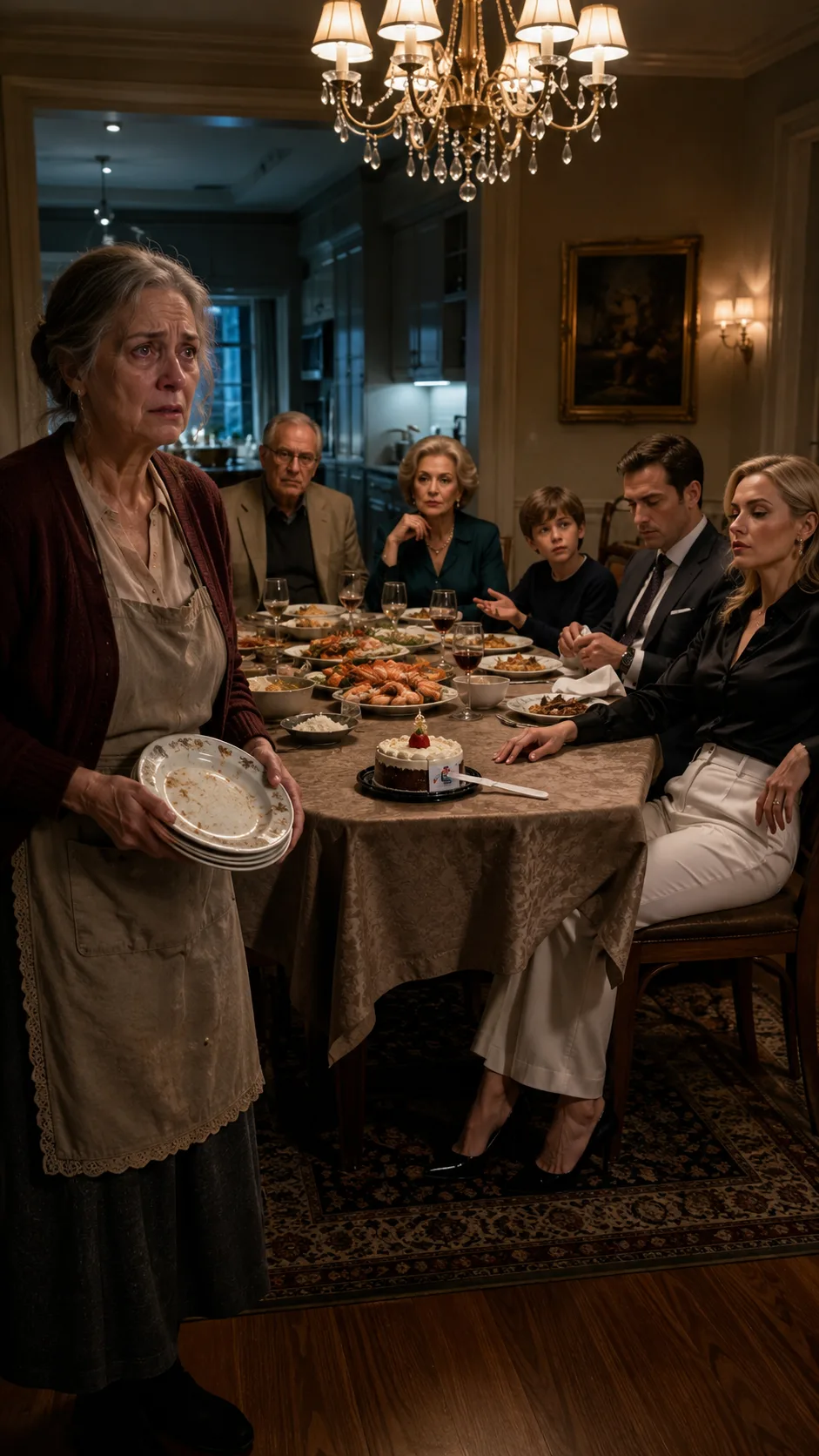
PART 3 — THE FAMILY THAT BROKE ME BEGAN TO CHANGE
The morning broadcast at Willow Creek had just started when I was jolted awake by a frantic knocking on my door.
Chapter 3
PART 3 — THE FAMILY THAT BROKE ME BEGAN TO CHANGE
The morning broadcast at Willow Creek had just started when I was jolted awake by a frantic knocking on my door.
“Helen, Helen, open up.” It was Miss Davis’s voice, sounding both excited and urgent.
I hurriedly threw on my robe and opened the door to find Miss Davis beaming, waving a newspaper in her hand.
“You’re in the paper! You’re in the paper!”
“What?” I took the newspaper from her, completely bewildered. On the front page of the community section, the headline read, “60-year-old woman bravely seeks dignity, becomes senior social media star with culinary skills.” Next to it was a photo of me making meatballs at the talent show.
“What? What is this?” My hand trembled slightly.
“A reporter came to cover our talent show yesterday and was really interested when he saw you teaching your cooking class,” Miss Davis explained excitedly. “I didn’t expect it to be published today—and on the front page, no less.”
I read the article, my heart beating faster and faster. The reporter not
only described my cooking in detail, but also interviewed several seniors about their opinions of my food. He even mentioned my experience of choosing to live independently after enduring verbal abuse from my daughter-in-law.
“Isn’t this a bit of an exaggeration?” I asked nervously.
“Exaggeration? It’s all true.” Miss Davis patted my shoulder. “Helen, you’re going to be famous. Three different news outlets have already called this morning asking to interview you.”
Sure enough, within an hour, my small room was crowded with reporters from two different media outlets. They were extremely interested in my story of transformation from a downtrodden mother-in-law to a culinary expert. The questions came one after another.
“Helen, what made you decide to leave your son’s home?”
“Does your daughter-in-law know that you’re teaching cooking classes here?”
“What are your thoughts on the widespread issue of disrespect towards the elderly in society today?”
Facing the
cameras and microphones, my palms were sweating, but I tried my best to calmly recount my experiences. Of course, I omitted my family’s real names and some of the more private details.
“I’m not here to accuse anyone,” I said to the camera. “I just want to tell all the seniors like me that age is not a reason to be disrespected. We have the right to live with dignity—to pursue our own value.”
After the interviews, I sat on the edge of my bed exhausted. But my phone started ringing off the hook—texts, messages, missed calls. Almost all my old colleagues and neighbors had seen the report and were sending their support.
The most surprising call was from my son, Ryan.
“Mom.” His voice was a mix of excitement and anxiety. “You’re in the paper. The whole office is talking about it.”
“You saw it? What about Megan?” I
asked nervously.
“She saw it, too.” He paused. “She’s upset that you made our family matters public, but she also understands that it’s your right.”
I breathed a sigh of relief, but also felt a twinge of guilt. Maybe I should have told them beforehand.
“Mom, the reporters didn’t reveal our identities, did they?” he asked worriedly.
“No, I made sure not to mention your names,” I reassured him. “I just wanted to share my story. Maybe it can help other seniors in similar situations.”
“I understand,” he said softly. “Mom, I’m proud of you.”
Really? That phrase—”I’m proud of you”—made my nose sting. For so many years, I had been the one who was proud of his achievements. Today, it was the other way around.
Not long after I hung up, the front desk at the community called to say I had visitors. When I went downstairs, I saw the community director in a formal suit along with several middle-aged people I didn’t recognize.
“Helen,” the director shook my hand warmly. “These are officials from the City Council on Aging. They saw your story and came specially to visit you.”
It turned out my story had caught the attention of the City Council on Aging. They were planning an Elder Appreciation Month and wanted to invite me to be a senior dignity ambassador and to lead a public project on preserving traditional cuisine.
“Helen, your experience and your culinary skills are very representative,” an official named Mr. Chen said sincerely. “We hope to use your influence to raise public awareness of the rights of the elderly.”
I stood there flustered, never imagining I would suddenly become a public figure. With the encouragement of Ruth and Miss Davis, I finally agreed to participate, but I insisted on doing only what I was capable of.
After seeing the officials off, Miss Davis announced excitedly, “Helen, you’re going to be a celebrity, and our community will get some recognition, too.”
The news spread like wildfire. At lunch, all the seniors in the dining hall looked at me with admiration, and people kept coming over to shake my hand and congratulate me. This feeling of being respected and valued was both strange and wonderful.
In the afternoon, as I was about to rest, my phone rang again. It was an unknown number.
“Hello, is this Miss Helen Fun?” A young woman’s voice asked. “I’m a reporter from Family Magazine, and I’d like to schedule an interview with you.”
For the next few days, my life was turned upside down. Interviews, photoshoots, and meeting invitations came one after another. The local television station even sent a film crew to the community to film me teaching my cooking class and my daily life.
“Helen, is this angle okay?” The young cameraman kept adjusting his equipment.
“Do I sound natural when I talk like this?” Facing the camera, my palms were sweating.
“You’re doing great,” the female host encouraged me. “Just be yourself—like you’re teaching a normal class.”
Gradually, I got used to the attention. The other seniors also got used to the film crew, and some even took the initiative to praise my cooking and character on camera.
“Helen is our star here,” Ruth said into the microphone. “Her meatballs are even better than those from a five-star hotel.”
The most surprising thing was that all this publicity brought about real change. The community allocated funds to upgrade the kitchen equipment. The Council on Aging organized a traditional food culture workshop with me as a consultant, and several restaurant businesses even contacted me about buying my private recipes.
“Helen, look at this proposal.” Miss Davis showed me a contract excitedly. “A well-known restaurant wants to hire you as a consultant—one visit a month for $2,000 each time.”
Two thousand dollars. That was half of my previous monthly retirement pension. Holding the pen, my hand trembled so much I could barely sign my name. At 60 years old, for the first time, someone was paying for my knowledge and skills. For the first time, someone truly recognized my value.
However, as my exposure grew, so did the pressure on my son’s family. Although the reports had omitted their real information, the news had spread among their acquaintances.
“Mom,” Ryan’s voice was tired over the phone. “Megan’s parents are furious. They say we mistreated an elder. My colleagues at work are also gossiping.”
“I understand this is your life, but—”
“But it’s affecting your lives, isn’t it?” I asked softly.
“No, that’s not what I mean,” he said hastily. “We deserve this. It’s just—Leo. At school, his classmates are asking if it’s true his mom drove his grandma away. He’s very upset.”
My heart ached. The conflicts between the adults had ultimately hurt an innocent child.
“I’ll handle it,” I promised him. “Don’t worry about Leo.”
After hanging up, I immediately contacted the reporter from Family Magazine and asked her to specifically state in the follow-up report that my decision was a personal choice, that my son and daughter-in-law had realized their mistakes and were actively trying to improve, and I hoped the public would not disturb their lives.
“Helen, you are too kind,” the young reporter sighed. “Still thinking of protecting your family in this situation.”
“They are my family,” I said simply. “Conflict is one thing; love is another.”
After the follow-up report was published, public opinion did indeed soften. My son sent me a text to thank me, saying that Megan was deeply moved and was trying hard to be a better daughter-in-law.
As Elder Appreciation Month approached, my schedule became increasingly packed. In addition to my twice-weekly cooking classes, I had to participate in citywide promotional events, give media interviews, and prepare for a traditional food exhibition.
“Helen, you don’t look so well lately,” Ruth said with concern. “Don’t push yourself too hard. Your health is important.”
“I’m fine,” I smiled and shook my head. Being busy actually gives me energy.
But the body is always honest. One busy morning, while demonstrating how to season a dish, I suddenly felt dizzy and nearly fainted at the cooking station.
“Helen!” The students cried out, rushing to support me. Miss Davis immediately called the community doctor.
After an examination, the doctor said sternly, “Overexertion and an irregular diet. Your blood pressure is a bit high, Helen. You need to rest for a few days.”
When the news got out, the Council on Aging sent a young woman named Sarah to be my temporary assistant—to help me handle various tasks and ensure I didn’t overwork myself.
“Helen, today you’re just in charge of giving directions,” Sarah said energetically. “Leave the heavy lifting to us young people.”
With her help, my life became much easier, and I was able to better enjoy this unexpected new career. Gradually, I found that I was no longer just Ryan’s mother or Leo’s grandmother. I had become the respected Chef Helen, Consultant Fun, and even Master Helen.
The opening ceremony for Elder Appreciation Month was held in the city’s cultural plaza. As the senior dignity ambassador, I was invited to give a speech. Hundreds of seniors and citizens sat in the audience along with cameras from multiple media outlets.
“Friends,” I stood at the microphone, my voice trembling slightly with nervousness. “A few months ago, I was just an unknown housewife—my days revolving around the stove and my grandson, enduring the cold words of my daughter-in-law.”
As I spoke, I gradually relaxed, telling my story—how, on my humiliating 60th birthday, I decided to fight back; how I found a new purpose in life at the senior living community; and how I rebuilt my relationship with my son’s family.
“Age is not a limitation but a new starting point,” I said into the microphone. “Every senior has unique value and talent and deserves to be respected and loved. Today I stand here to tell all the seniors like me: It is never too late to live bravely for yourself.”
The applause was thunderous and went on for a long time. After my speech, a city official personally presented me with a “Model Senior” certificate and medal. The media swarmed me for interviews, the flash bulbs so bright I could barely open my eyes.
On the outskirts of the crowd, I suddenly saw a familiar figure. It was my son, Ryan. He stood there in a sharp suit, holding Leo’s hand. When he saw that I had noticed them, Leo waved excitedly.
“Grandma! Grandma!”
I apologized to the staff and quickly walked toward them. Ryan’s eyes were shining with pride.
“Mom, you were amazing.”
“What are you two doing here?” I asked, surprised, bending down to hug Leo as he ran to me.
“The city sent an invitation,” my son explained with a smile. “I took the day off to bring Leo to see you shine.”
“Grandma is so cool,” Leo said, looking up at me with admiration. “Everyone was clapping for you.”
In that moment, all the hardship, all the grievances felt worthwhile. I held my grandson’s hand with one hand and linked arms with my son with the other, feeling a long-lost family warmth.
“Where’s Megan?” I asked softly.
“She—she was too embarrassed to come,” Ryan said awkwardly. “But she wanted me to tell you that she’s proud of you.”
“Really?” I nodded, not asking further. Change takes time. I knew that better than anyone.
After the event, my son insisted on treating me to a nice dinner. In the restaurant, Leo excitedly looked at my certificate and medal, while Ryan seriously looked at my recent photos and reports.
“Mom,” he said suddenly. “I never knew you were so outstanding.”
“That’s because you never really looked at me,” I said half jokingly. “In your eyes, I was probably just a piece of furniture that could walk and cook.”
His face turned red. “I’m sorry, Mom. I—”
“It’s okay,” I patted his hand. “Let the past be the past. The important thing is that we’re all trying to be better now, aren’t we?”
He nodded, his eyes glistening with tears. Leo, not understanding what was going on, looked back and forth between us, then announced loudly, “When I grow up, I want to be on TV like Grandma!”
We all laughed. In that moment, I saw a glimmer of hope for the future. A family relationship built on mutual respect and understanding was being rebuilt.…
Back at the community, I carefully placed the certificate and medal on my nightstand next to the family portrait. At 60 years old, my life had just begun. And this time, I would live for myself—and I would also speak up for all the seniors like me.
Autumn at Willow Creek was especially beautiful. The ginkgo trees in the courtyard were dressed in gold. When the breeze blew, the leaves fell like rain, carpeting the ground in a golden blanket. I stood by the window, admiring the picturesque scenery, holding a freshly brewed cup of chrysanthemum tea. Through the steam, my thoughts drifted.
Since the Elder Appreciation Month event, my life had changed dramatically. Besides continuing to teach cooking classes at the community, I was also invited to participate in several citywide senior charity projects. And I even began to compile a cookbook of traditional family recipes.
Sarah, my temporary assistant, had been so outstanding that the Council on Aging had officially appointed her as my full-time assistant.
“Helen, what do you think of this layout design?” Sarah turned her laptop toward me. On the screen was a draft of the cookbook. “The publisher said if all goes well, it could be printed next month.”
I leaned in for a closer look. “Make the font a little bigger. We seniors don’t have the best eyesight.”
“Got it,” she said, her fingers flying across the keyboard. “Oh, and that cooking show on the local TV station sent another invitation. Have you considered it?”
I shook my head. “Let’s pass. I get too nervous on camera. They should find some younger people.”
“But you’re a ratings guarantee,” Sarah insisted. “The last episode you were on broke records.”
Just then, my phone rang. It was my son, Ryan.
“Mom.” His voice sounded a bit weary. “Are you free today? I’d like to talk to you alone.”
“Of course,” I said, checking my watch. “What time can you get here?”
“I’m already at the gate.”
I looked out the window in surprise and saw my son’s car parked by the curb. He was leaning against the car door, looking up at my window.
“Come on up,” I said into the phone. “I’ll make you some tea.”
After hanging up, I quickly tidied up the room. Since the event, my son had been bringing Leo to visit me every week, but this was the first time he had come alone. My intuition told me he had something important to say.
A knock sounded at the door. I opened it to find my son standing there in a suit holding a fancy cake box.
“Mom,” he said a little awkwardly. “I hope I’m not interrupting your work.”
“Not at all. Come in,” I said, taking the cake box. It was heavy. “What’s this?”
“To make up for your birthday cake,” he said softly. “The one from last year.”
My fingers trembled slightly. The palm-sized discounted cake from a year ago stood in stark contrast to the exquisite gift box in my hands.
“Thank you,” I said softly, placing the cake on the table. “Have a seat. The tea will be ready in a minute.”
My son looked around my small room, his gaze lingering on the medals and certificates on the nightstand, then sweeping over the photos of me with the other seniors and finally landing on the stack of cookbook manuscripts on my desk.
“Mom, you’re really incredible,” he said, sitting in the only chair, his tone complex. “I never imagined you could achieve all this.”
“What achievements?” I smiled, handing him a cup of tea. “It’s just some home cooking that a few people happen to appreciate.”
“No.” He shook his head. “It’s not just the cooking. It’s you. Your resilience, your courage.” His voice choked up. “I’m so sorry.”
The teacup trembled in his hands and a few drops splashed onto his suit pants, but he didn’t seem to notice.
“Why are you suddenly saying this?” I sat down across from him. “Let the past be the past.”
“I can’t, Mom.” He looked up, his eyes red. “I read the letters and the diary you left for me last night. I didn’t sleep at all.”
The letters and the diary. I paused. I remembered that on the day I left, I had indeed left a few letters under the pillow and placed an old diary on the dresser. That diary chronicled my life from my son’s birth to my husband’s death, including the time I sold my gold bracelets when his business failed and the hardship of taking care of my husband alone when he was sick.
“You read all of that?” I asked softly.
“I did. From beginning to end,” he said, wiping his face. “Mom, I—I had no idea you had sacrificed so much for me. I’m such a jerk.”
Seeing his anguish, my heart ached. As a mother, I never intended to use those sacrifices to hold him hostage. I just loved him purely and was willing to do anything for him.
“Son, I did those things because I wanted to.” I patted his hand. “It’s natural for parents to love their children, but it’s not something to be taken for granted.”
He suddenly raised his voice. “I—I took your sacrifices for granted. I even—I even let Megan treat you that way.”
At the mention of Megan, we both fell silent. Over the past six months, although she was no longer verbally abusive, she was still reserved and distant whenever she visited—like a child who had done something wrong.
“How has Megan been lately?” I broke the silence.
“We’ve separated,” he said in a low voice.
“What?” I looked at him in shock. “When? Why?”
“Two weeks ago,” he said, staring into his teacup. “She could never truly face her own issues. Every time we talked about the past, she would either avoid it or get angry. I—I couldn’t take it anymore.”
I then noticed the dark circles under my son’s eyes and how thin his face had become. Every time he had visited with Leo, he had acted as if nothing was wrong. I had no idea he was carrying such a burden.
“Is it because of me?” I asked, guilty.
“No,” he looked up sharply. “Absolutely not. It’s our own problem, Mom. You know, after reading your diary, I started to think about our marriage.” He sighed. “Megan’s attitude toward her own parents is just like how she was with you—ordering them around with no respect. I thought it was just her being strong-willed, but now I realize it’s the trauma from her family. Her mother treated her grandmother the same way.”
I silently recalled Megan’s tearful apology. She had said she grew up watching her mother mistreat her grandmother and thought it was a normal way for in-laws to interact.
“I suggested she see a therapist,” Ryan continued. “She refused. She said I was trying to humiliate her. We had a huge fight, and she moved back to her parents’ house.”
“What about Leo?” I asked urgently.
“He’s with me,” he managed a weak smile. “The little guy is so grown up now. He packs his own school bag and even helps me make simple breakfast. He said, ‘Grandma taught me how to beat eggs.’”
My eyes welled up. The little boy who had once mimicked his mother and called me an “old thing” now remembered the life skills I had taught him.
“Mom!” My son suddenly knelt before me, clutching my hands tightly. “Give me a chance to make it up to you. Let me—let me be a good son again.”
Seeing his tear-streaked face, my heart melted. I helped him up and said softly, “You’ve always been my good son. We just both needed to learn and grow.”
“Then will you move back in?” he asked hopefully. “It’s just me and Leo at home now. The house feels so empty.”
I shook my head. “I’m happy here, but you can visit me anytime, and I can go spend time with Leo on the weekends.”
His face fell with disappointment, but he quickly composed himself. “I understand. You have your career here, your friends. It was selfish of me to ask.”
“It’s not selfish,” I corrected him with a smile. “It’s love. I’m happy that you want me to live with you, but we both need our own space, right?”
He nodded, wiping his tears. “Then at least let me do something for you. Do you need funding for your book? I know some people in publishing.”
Seeing how eager he was to make amends, an idea came to me. “Actually, there is something you can help with.”
“What is it? Just say the word.”
“My cookbook is missing a few traditional banquet dishes,” I explained. “Your grandfather—my father-in-law—was a head chef at a state-run restaurant back in the day. He had a few signature dishes I never learned. Your father should remember how to make them.”
“My father?” He paused. “You want me to ask him?”
“Yes, ask your father,” I said calmly. “He’s living at the Green Mountain Nursing Home, isn’t he?”
My son’s expression was complicated. Before my husband passed away, a misunderstanding had caused a rift between father and son, and they had barely spoken since. Over the years, Ryan rarely visited his father, even on holidays—just making a perfunctory phone call.
“Mom, I—” He hesitated.
“No rush.” I patted his hand. “Think about it. The old man is over 80. You have fewer and fewer chances to see him.”
He nodded gravely, then changed the subject. “Oh, you should try this cake. It’s from—it’s from Megan’s favorite bakery.”
I opened the exquisite cake box. Inside was a beautiful cream cake with “Happy Birthday, Mom” written in fruit jam, decorated with six small strawberries.
“But it’s not my birthday,” I said, confused.
“It’s for last year,” he said softly. “To make up for that one. I’m sorry.”
I cut a small piece of cake and took a bite. The cream was rich and smooth, the strawberries fresh and juicy. This birthday cake, a year late, seemed to hold a symbolic meaning. Some regrets could be mended. Some mistakes could be corrected—as long as the heart was willing.
“Is it good?” my son asked expectantly.
“It’s delicious,” I nodded with a smile. “Very sweet.”
He let out a sigh of relief, and his smile reminded me of him as a little boy—the one who would hug me and say my cooking was the best in the world.
“Oh, right.” He suddenly remembered something and took an envelope from his briefcase. “This is for you.”
“What is it?” I took the envelope. It was heavy.
“Rent for the past five years,” he said seriously. “You lived with us, cooked for us, took care of our child, cleaned the house—at market rate. We should at least pay you this much.”
I opened the envelope. Inside was a thick stack of $100 bills, probably $2,000 or $3,000.
I looked at him in shock. “This—this is too much.”
“It’s not.” He shook his head. “A live-in nanny costs at least $5,000 a month. That’s $300,000 for five years. This is just a down payment.”
“Son—” I didn’t know whether to laugh or cry. “How can I take money from you?”
“You must,” he insisted. “This isn’t for my mother. This is the service fee for Miss Helen Fang. You taught me that to respect a person, you must first respect their labor and their value.”
His words stunned me. It was true. For five years, I had given my all without compensation precisely because my labor was not respected and my value was not recognized.
“Then I’ll accept it,” I finally nodded. “I can use it to publish my cookbook.”
“If it’s not enough, just let me know,” he said, relieved. He then added, “Oh, and next week is Leo’s school’s parent-child event. They need a parent to participate. Do you have time?”
“Of course.” My eyes lit up. “What’s the event?”
“A dumpling-making contest,” he said with a smile. “Leo insists on having his grandma there. He says, ‘Grandma makes the best dumplings.’”
“That child.” I shook my head with a smile, my heart filled with sweetness.
My son stayed until evening. As he was leaving, he hugged me tightly and whispered in my ear, “Mom, I love you.”
“Really?” Those three simple words made me cry. How many years had it been since I heard my son express his feelings so directly?
After closing the door, I leaned against it, letting the tears flow. Our conversation today had opened a new door in our relationship. From now on, we were not just mother and son by default, but two people who truly respected and understood each other.
Outside, the sun was setting, and the ginkgo leaves glowed in the fading light. Life at 60, it turned out, could be so brilliant.
The Green Mountain Nursing Home was nestled on a small hill in the suburbs, surrounded by lush trees—a tranquil environment. I stood at the main gate, took a deep breath, and adjusted the insulated container in my hand. Inside were freshly made meatballs and braised fish, my late husband’s two favorite dishes.
“Helen, you’re here.” The young nurse at the front desk greeted me warmly. “Mister Fun is sunbathing in the garden. I’ll take you to him.”
Following the nurse down the long corridor, my heart beat faster and faster. It had been five years since my husband George moved into the nursing home. We had seen each other only a handful of times. It wasn’t that I didn’t want to come, but every visit ended in an argument. He would blame me for spoiling our son, and I would resent him for being too strict. After our last fight, he refused to see me, even when he was hospitalized for surgery.
In the garden, several seniors were playing chess and chatting. The nurse pointed to a bench in the distance. “The one in the gray sweater—that’s Mr. Fang.”
I looked in the direction she was pointing and almost didn’t recognize him. The stooped white-haired man—could that really be the tall, strong husband I remembered?
“George,” I called out softly, walking up to him.
He slowly looked up, a flicker of surprise in his cloudy eyes, which then returned to a calm expression. “What are you doing here?”
“I brought you something to eat,” I said, holding up the container. “Meatballs and braised fish—your old favorites.”
He stared at the container for a few seconds, then finally scooted over, making room for me on the bench. I sat down and opened the lid. The aroma immediately filled the air. His nose twitched and his expression softened slightly.
“Have some?” I handed him the chopsticks.
He took them, picked up a piece of fish, and slowly chewed. Suddenly, a tear dropped into the container.
“It still tastes the same.” His voice was hoarse.
After five years, my eyes welled up, too. “Yes, five years.”
In these five years, he had missed our son’s wedding, the birth of our grandson, my 60th birthday, and any chance for us to reconcile.
“How have you been?” he broke the silence.
“I’m doing well,” I said softly. “I moved out. I’m at Willow Creek Senior Living now.”
“I heard.” He nodded. “The young nurses here are all talking about some old lady on TV teaching people how to cook. I figured it had to be you.”
“You’ve been watching TV?” I asked, surprised.
He looked a little embarrassed. “I sneak a peek when the aides aren’t looking. They say it’s bad for my eyes.”
We shared a smile, and for a moment, it felt like we were young again, sneaking around on our dates. Back then, he was just an apprentice at a state-run restaurant, and I was a worker at the textile mill. Every meeting felt like a secret mission, hiding from his master chef.
“George,” I gathered my courage. “Ryan—Ryan wants to come see you.”
His hand paused, and the meatball on his chopsticks fell back into the container. “What does he want?”
“He wants to learn how to cook from you,” I explained softly. “I’m putting together a family recipe book, but I’m missing some of your signature dishes.”
“Hmph,” he scoffed. “Now he remembers his old man. Where was he when I was having surgery? Where was he on my 80th birthday?”
I remained silent. It was true—our son had been too distant with his father over the years—but who could really say who was right and who was wrong? The father and son were two peas in a pod: stubborn, proud, and terrible at expressing love.
“He knows he was wrong,” I said softly. “He read my diary and realized you didn’t intentionally miss his graduation ceremony.”
“I was in the hospital with a work injury,” George said, agitated. “My leg was broken in a cast. How was I supposed to go? And he held a grudge against me for his whole life.”
“He was young then. He didn’t understand.” I patted his hand. “He understands now. He wants to make it right. George, give our son a chance. He’s over 40 now.”
George was silent for a long time, then finally sighed. “Whatever. If he wants to come, he can come. But I’m not promising I’ll teach him.”
I knew this was the biggest concession he could make.
We chatted a little longer. Then I got up to leave. As I was walking away, he suddenly called out, “Helen, will you—will you come again?”
“Of course,” I nodded with a smile. “I’ll bring dumplings next week, your favorite chive-filled ones.”
Leaving the nursing home, the warm sun shone on my face. My phone rang. It was a message from Sarah. “Helen, the publisher is asking for the manuscript. When can you submit the last few recipes?”
I replied, “Just a few more days. I’ve sent my son to consult with his grandfather.”
Just as I sent the message, another call came in. It was my son, Ryan.
“Mom?” His voice was a little nervous. “I—I went to see Dad.”
“What now?” I asked, surprised.
“I just left the nursing home.”
“I know. I saw your car,” he said in a low voice. “I waited in the parking lot until you left before going in.”
That silly boy—so nervous he had to hide from me.
“How did it go?” I asked with concern.
“Not great,” he said with a bitter smile. “He yelled at me for half an hour, called me an ungrateful brat. Then he threw a notebook at me, said it contained all his life’s work, and told me to figure it out myself.”
I couldn’t help but smile. That sounded just like George—soft-hearted, but with a sharp tongue.
“Is the notebook useful?”
“Incredibly useful.” My son’s voice suddenly became excited. “It’s full of treasures. Mom, do you know the secret to a perfect broth? Dad’s notebook explains it all.”
Listening to him ramble on about cooking techniques, my heart felt warm. That notebook was George’s prized possession. He wouldn’t even let me touch it back in the day. The fact that he was willing to give it to our son meant that he had mostly forgiven him.
“Mom, thank you,” my son said seriously. “If it weren’t for you, Dad and I might never have reconciled.”
“There’s no overnight feud between a father and son,” I said softly. “Oh, and Leo’s parent-child event is next Wednesday, right?”
“Yes, at 10:00 in the morning.” He paused. “Megan—Megan will be there, too.”
“Oh.” I was a little surprised. “Are you two back together?”
“No,” his voice dropped. “She’s going as a parent representative. We’re still separated.”
I could hear the disappointment in his voice and didn’t press further.
After hanging up, I decided to go see Megan. No matter what, she was still Leo’s mother—and perhaps my daughter-in-law again in the future.
Megan was staying at her parents’ house. I bought some fruit and stood in front of the familiar villa, ringing the doorbell. Her mother, a well-maintained middle-aged woman, opened the door and was clearly stunned to see me.
“He—Helen,” she stammered. “What are you—?”
“I came to see Megan,” I said calmly. “Is she here?”
“She is, but—” she hesitated, then stepped aside. “Please come in.”
The house was as immaculate and luxurious as ever, but it felt cold. Megan was sitting on the sofa in the living room. When she saw me, she shot up in surprise.
“He—Helen.”
“Megan.” I smiled, handing her the fruit. “I heard you’re going to Leo’s school event. I came to see if I could help.”
She stood there fidgeting, her eyes darting away. “You—you don’t hate me?”
“Hate?” I shook my head. “Why would I hate you?”
“Because of what I did to you,” her voice trailed off.
“Let the past be the past,” I said softly. “What matters is the now and the future. Speaking of which, the event is a dumpling-making contest. Do you need me to teach you a few tricks?”
Her mother stood by, utterly bewildered, clearly having no idea what had transpired between us. Megan’s eyes turned red, and she nodded slightly.
“Thank you, Helen. I—I really don’t know how to make dumplings.”
“Then let’s start now,” I said, rolling up my sleeves. “Where’s the kitchen?”
For the next two hours in the luxurious kitchen, I taught Megan the art of making dumplings—the technique for kneading the dough, the secret to a flavorful filling, and various ways to fold them. She was a diligent student, clumsy but sincere. Her mother watched from the side, her expression complex.
“Helen?” Megan suddenly asked. “Why—why are you still willing to teach me?”
“Because you’re Leo’s mother,” I said, demonstrating how to make a pleated dumpling. “And I believe that people can change—just like me. I only started learning to live for myself at 60.”
Her mother overheard this, gave me a thoughtful look, and quietly left the kitchen.
“Helen,” Megan lowered her voice. “I—I went to see a therapist like Ryan suggested.”
“Really?” I asked, pleasantly surprised. “Did it help?”
She nodded, her eyes shining with tears. “The doctor said my attitude toward you was a form of intergenerational trauma. My mother treated my grandmother the same way.” She haltingly recounted her therapy sessions—how she began to recognize her behavioral patterns and confront her family issues.
Listening to her, my own eyes grew moist. This daughter-in-law, who I had once despised, was also a wounded child.
“Helen, I will get better,” she said, wiping her tears, her voice firm. “For Leo, for Ryan, and for myself.”
When I was leaving, Megan insisted on walking me to the gate. Her mother suddenly ran out after us and handed me an exquisite gift box.
“Helen, this—this is just a small token. I’m so sorry about Megan’s behavior.”
I opened the box. Inside was a beautiful silk scarf. I looked up at her. This usually proud woman had a hint of shame in her eyes.
“Thank you, but there’s no need,” I said gently but firmly, handing the box back to her. “Megan and I will work things out ourselves.”
Walking home, I felt lighter than ever. It turned out that forgiving others was also a way of liberating oneself. At this stage of life, past grievances suddenly seemed less important.
Back at the community, Ruth pulled me aside conspiratorially. “Helen, I have some good news for you.”
“What is it?”
“The city is selecting the ‘Most Beautiful Senior,’ and our community nominated you,” she said excitedly. “If you win, you can even go to the state competition.”
I didn’t know whether to laugh or cry. “I’m this old. What competition am I going to enter?”
“What’s wrong with being old?” Ruth retorted. “You’re the representative for seniors in our city now. You’re a great cook. You have a great attitude, and you’ve handled your family situation so well.”
Handled my family situation well. I shook my head. My family was a mess—separated from my husband for years, my son and daughter-in-law’s marriage in crisis, my grandson caught in the middle. But then I thought again. Weren’t we all trying to mend, trying to grow?
That evening, a text came from my son. “Mom, Dad agreed to let me visit him every week. Today, we made braised pork together. He said my cooking technique was pretty good.”
This was followed by a message from Megan: “Helen and I practiced all afternoon and finally made some decent dumplings. Leo said they’re better than the school cafeteria’s.”
Looking at these two messages, I smiled as I fell asleep. I dreamed of a scene: During the holidays, our whole family was gathered together making dumplings—George teaching Ryan how to season the filling, me teaching Megan how to roll the dough, and Leo happily playing with a piece of dough on the side.
The day of the parent-child event was bright and sunny. I arrived at Leo’s school early, carrying a bag of prepared ingredients. The school gate was already crowded with parents and children. From a distance, I saw my son’s tall figure with Megan and Leo standing beside him.
“Grandma!” Leo spotted me and ran into my arms.
“Sweetie,” I kissed his cheek. “Are you ready for the competition?”
“I’m ready.” He puffed out his chest proudly. “Mommy has been practicing a lot.”
I looked at my son and daughter-in-law as they walked over. Ryan was in a suit, while Megan was in a simple T-shirt and jeans with no makeup. This was a first in my memory.
“Mom,” my son smiled, taking the bag from me.
“Helen,” Megan greeted me softly, her gaze steady.
“Everyone’s here. Let’s go in,” I said, taking Leo’s hand and leading the way.
The activity room was set up with a dozen tables, each with dough and filling. Families found their spots, eagerly waiting for the competition to begin.
“Parents and students,” the principal announced over a microphone. “The family dumpling-making competition will now begin. You have 30 minutes. Both quantity and quality will be judged. Begin!”
At the signal, everyone got busy. Our team had a clear division of labor. I rolled the wrappers. My son seasoned the filling, and Megan and Leo folded the dumplings.
Watching my daughter-in-law’s clumsy but earnest movements, I couldn’t help but guide her. “Like this—use a little more force when you pinch it. Yes, just like that.”
“Grandma, look at mine!” Leo held up a lopsided dumpling, his face beaming with pride.
“That’s wonderful,” I praised him sincerely. “Much better than the first one I ever made.”
Megan’s dumplings gradually started to look better, though not as neat as mine. At least they didn’t fall apart. The aroma from my son’s filling drew envious glances from the other parents.
“Mr. Fong,” one parent said in surprise, looking at Ryan’s skillful movements. “I didn’t know you had this talent.”
“It runs in the family,” my son replied with a smile. “My dad was a chef, and my mom is even better. She’s about to publish a cookbook.”
Hearing the pride in his voice warmed my heart. For so many years, my son was finally proud of me instead of seeing me as an uneducated old woman.
After the competition, the judges tasted the dumplings from each group. When they got to ours, the teachers all praised them—thin wrappers, generous filling, perfectly seasoned.
“The first prize is well-deserved.”
“We won!” Leo jumped up and down. “Grandma is the best!”
When we went up to receive the award, the principal specifically asked me to represent the family. Holding the small trophy, looking at the happy smiles of my son’s family below the stage, I suddenly felt that this was happiness—simple, ordinary, yet real.
After the event, we left with our prize, a set of children’s cooking utensils. At the school gate, Megan suddenly took my hand.
“Helen, thank you. We couldn’t have won without you.”
“It was a team effort,” I patted her hand. “You’ve improved a lot.”
She hesitated, then said softly, “Ryan and I were thinking about getting back together.”
I looked at my son. He nodded, his eyes filled with hope and trepidation.
“That’s your decision to make,” I said gently. “But no matter what, Leo needs a complete family.”
“Helen.” Megan’s eyes turned red. “Will you—will you move back in with us? I promise—”
“Megan,” I interrupted her softly. “I’m happy at the community, but we can visit each other often, okay?”
She looked a little disappointed, but nodded. My son came over and put his arm around her shoulder, comforting her silently. Watching them, I knew this young couple was finally learning to understand and support each other.
That weekend, I took dumplings to see George as promised. When I pushed open the door to the activity room at the nursing home, I was surprised to find my son there, too. He and George were huddled over the notebook with various ingredients spread out on the table.
“Mom!” My son saw me and waved excitedly. “Dad is teaching me the secret to making three-non-stick pudding.”
“Helen, you’re here.” George looked up, a rare smile on his face. “Just in time—try your son’s pudding. It’s almost as good as mine was back in the day.”
I tasted the dessert my son made. It was indeed sweet and soft, not sticking to the plate, the chopsticks, or the teeth.
“Delicious,” I praised him sincerely. “Much better than your dad’s first attempt. He nearly burned down the kitchen back then.”
“Nonsense.” George’s old face flushed, and my son laughed heartily.
Seeing the father and son getting along so well, my eyes grew moist. Years of estrangement had finally melted away. George even agreed to come to my son’s house for the holidays—a first in ten years.
On the way home, my son insisted on driving me. In the car, he excitedly talked about the cooking techniques he was learning from his father and how he planned to incorporate these traditional skills into a modern restaurant.
“Mom,” he said suddenly. “Megan and I have talked it over. After we get back together, we want to open a small restaurant specializing in traditional family banquet dishes. What do you think?”
“That’s a wonderful idea,” I said, delighted. “Do you need an investor?”
“No,” he shook his head with a smile. “We just need your expertise. You can be our chief consultant.”
“Chief consultant?” I chuckled. “A 60-year-old housewife becoming a restaurant consultant. Life is full of surprises.”…
As the winter solstice arrived, according to northern tradition, it was a day for eating dumplings. My son’s family invited me over, and George also came from the nursing home. The house was full of life and laughter as we all worked together—kneading dough, mixing filling, rolling wrappers, and folding dumplings. Megan’s dumpling-making skills had improved significantly, and Leo could now fold simple ones on his own. George and my son were in charge of the filling while I was the quality-control expert, tasting for seasoning.
“Grandma,” Leo suddenly asked, “when are you moving back? I want to eat your dumplings every day.”
The room fell silent and everyone looked at me expectantly. I knelt down to Leo’s level.
“Sweetie, Grandma has her own little house now and her own job, but I promise to visit you every week, okay?”
“Okay,” he pouted reluctantly, agreeing.
“Mom,” my son said softly. “We respect your choice, but you will always have a room in our home. You’re welcome back anytime.”
“Thank you,” I nodded with a smile. “Come on, let’s cook the dumplings.”
Steaming hot dumplings were served, and we all gathered around the table like countless ordinary families, enjoying this simple and precious moment of reunion. George even had a small glass of wine, his face flushed, looking years younger.
After dinner, my son suddenly brought out a beautifully wrapped box. “Mom, this is for you.”
I opened it. Inside was a brand-new smartphone.
“This—this is too expensive,” I said in surprise.
“Not at all,” my son said, helping me set it up. “You’re a celebrity now. You need the right equipment. See, I’ve already downloaded all the apps for you. You can upload your cooking videos directly.”
“I don’t know how to make videos,” I said, not knowing whether to laugh or cry.
“I’ll teach you,” Leo volunteered. “We have a computer class at school.”
Seeing my family’s enthusiasm, I had to accept this sweet burden. Megan even helped me register a video account called “Grandma Helen’s Kitchen.”
“What should we film for the first video?” my son asked eagerly.
“Let’s just film us making dumplings,” I said, looking at the leftover ingredients. “The whole family together.”
And so, on that ordinary winter solstice evening, we recorded our first family video. George explained the secret to the filling. My son demonstrated how to knead the dough, and I taught Megan and Leo how to pleat the edges. The room was filled with laughter.
“Perfect,” my son said, reviewing the footage. “Mom, you’re going to be a social media star.”
“What star?” I shook my head with a smile. “It’s just for a keepsake.”
Late at night, it was time for George to go back to the nursing home. My son drove him. Before leaving, my husband suddenly took my hand.
“Helen, have you considered moving into the nursing home with me? They have rooms for couples.”
I looked at him in surprise, never expecting to hear such a proposal at this time in this place.
“I’ll think about it,” was all I could say.
After they left, Megan stayed behind to help me clean the kitchen. We stood side by side at the sink, working in perfect harmony, like a real mother and daughter.
“Helen,” she said suddenly. “Thank you for giving all of us a second chance.”
I didn’t say anything, just gently squeezed her sudsy hand. Some gratitude needs no words.
On the eve of the new year, Grandma Helen’s Kitchen had already released over 20 videos, and the number of followers had surpassed 100,000—from simple dumplings to complex banquet dishes. My son, daughter-in-law, grandson, and I filmed the process of making homestyle food, complete with detailed instructions. I never expected such a positive response. The comment section was filled with messages like, “This reminds me of home,” and, “This tastes like my grandma’s cooking.”
“Mom, look at this one,” my son pointed to a comment excitedly. “It’s a producer from the provincial TV station. They want to invite you to be on their New Year’s special.”
“No, no,” I waved my hands. “It’s the holidays. It’s better to be at home.”
“Please, Grandma,” Leo begged, hugging my arm. “I want to be on TV, too.”
“Helen,” Megan also chimed in. “This is a great opportunity to let more people know about our traditional food culture.”
Under their persistent persuasion, I finally agreed. The recording went smoothly. I, along with several other seniors, demonstrated how to make traditional New Year’s dishes from different regions and shared our holiday memories. The host specifically introduced my story—how I went from a mistreated mother-in-law to a culinary expert, and how I repaired my family relationships.
After the show aired, the followers of Grandma Helen’s Kitchen skyrocketed, and the pre-orders for my cookbook doubled. The publisher had to do an emergency reprint and even arranged a national book-signing tour. Of course, I declined most of it, only agreeing to attend a few local events.
On New Year’s Eve, the whole family gathered at my son’s house for dinner. Unlike the nightmarish birthday a year ago, today’s dinner table was filled with laughter. George had come from the nursing home, looking vibrant. My son and daughter-in-law worked together seamlessly—one cooking, the other assisting. Leo acted like a little adult, setting the table.
“Dinner’s ready,” my son announced, bringing out the last dish, a fortune chicken made according to George’s secret recipe. We all sat together and raised our glasses. The New Year’s gala was playing on TV, and fireworks occasionally exploded outside while the house was filled with warmth.
“Mom,” my son suddenly stood up, holding his glass. “I’d like to propose a toast to you. Thank you for teaching me so much this year. I’ve learned how to be a son, how to be a father, and how to be a better person.”
“It’s the holidays. Why are you saying all this?” I said, embarrassed, but couldn’t stop my eyes from tearing up.
“I want to toast Grandma, too,” Leo mimicked him, raising his glass of juice. “Grandma is the best.”
“Helen—” George also stood up, his voice a little choked up. “I’m sorry for all the years of hardship.”
Looking at all the people I loved in this room, my tears finally broke free. The past year flashed before my eyes like a movie—the humiliation of my 60th birthday, the determination to leave home, the new life at the senior community, the chaos of media attention, and the emotional reconciliation with my family.
“All right, all right. It’s the holidays. Let’s not talk about sad things,” I said, wiping my tears and raising my glass. “Here’s to our family. Cheers.”
“Happy New Year!” Everyone chimed in, their glasses clinking together.
After dinner, we all made dumplings for good luck. George and my son discussed the renovation plans for their restaurant. Megan and Leo carefully folded dumplings, and I supervised. The TV host began the countdown.
“5—4—3—2—1—Happy New Year!”
Outside, fireworks lit up the night sky. My son suddenly brought out an exquisite gift box.
“Mom, your New Year’s gift.”
I opened it. Inside was a shiny golden key.
“It’s the key to the restaurant,” my son said with a smile. “You will always be our chief consultant. Welcome to supervise us anytime.”
“And this—” Leo also handed me a handmade card. “With ‘Grandma, I love you’ written in crooked letters.”
“Helen,” George said mysteriously. “I have a gift for you, too. I’ve applied for a couple’s room at the nursing home. It’ll be ready in the spring.”
I looked at him in surprise, then at my son’s family. They were all smiling at me, their eyes full of anticipation.
“Are you all plotting against me?” I pretended to be angry, but couldn’t help but smile.
“Mom, please consider it,” my son said softly. “Dad is getting older and needs someone to take care of him. Besides, you can teach classes and film videos from anywhere.”
I looked at George’s hopeful eyes and remembered our promise when we were young—to grow old together, sunbathing and reminiscing. A promise that had been delayed but not forgotten.
“I’ll think about it,” was all I could say. But in my heart, I already had the answer.
On the first morning of the new year, I woke up early and prepared a lavish breakfast. Watching my sleepy-eyed family come downstairs one by one, their faces lighting up at the smell of food, I suddenly understood something. Love is not about sacrifice or tolerance. It’s about mutual respect and mutual fulfillment. Only by first finding one’s own value can one truly love and be loved.
My phone chimed with a new notification. It was a new comment on Grandma Helen’s Kitchen: “Your story moved me so much. I’ve decided to go home and see my parents for the holidays.”
I smiled and replied, “It’s good to be home. Happy New Year.”
Outside, the New Year’s sun bathed the earth in light. Life at 60, it turned out, could be so wonderful. A broken family, it turned out, could be rebuilt even stronger. In the days to come, I would still be Helen Fun—not just someone’s wife, someone’s mother, or someone’s grandmother, but myself. A person with dignity.
THE END.
Chapter complete
You have reached the end of this chapter.
Continue reading
A few more worlds to get lost in after this chapter.




