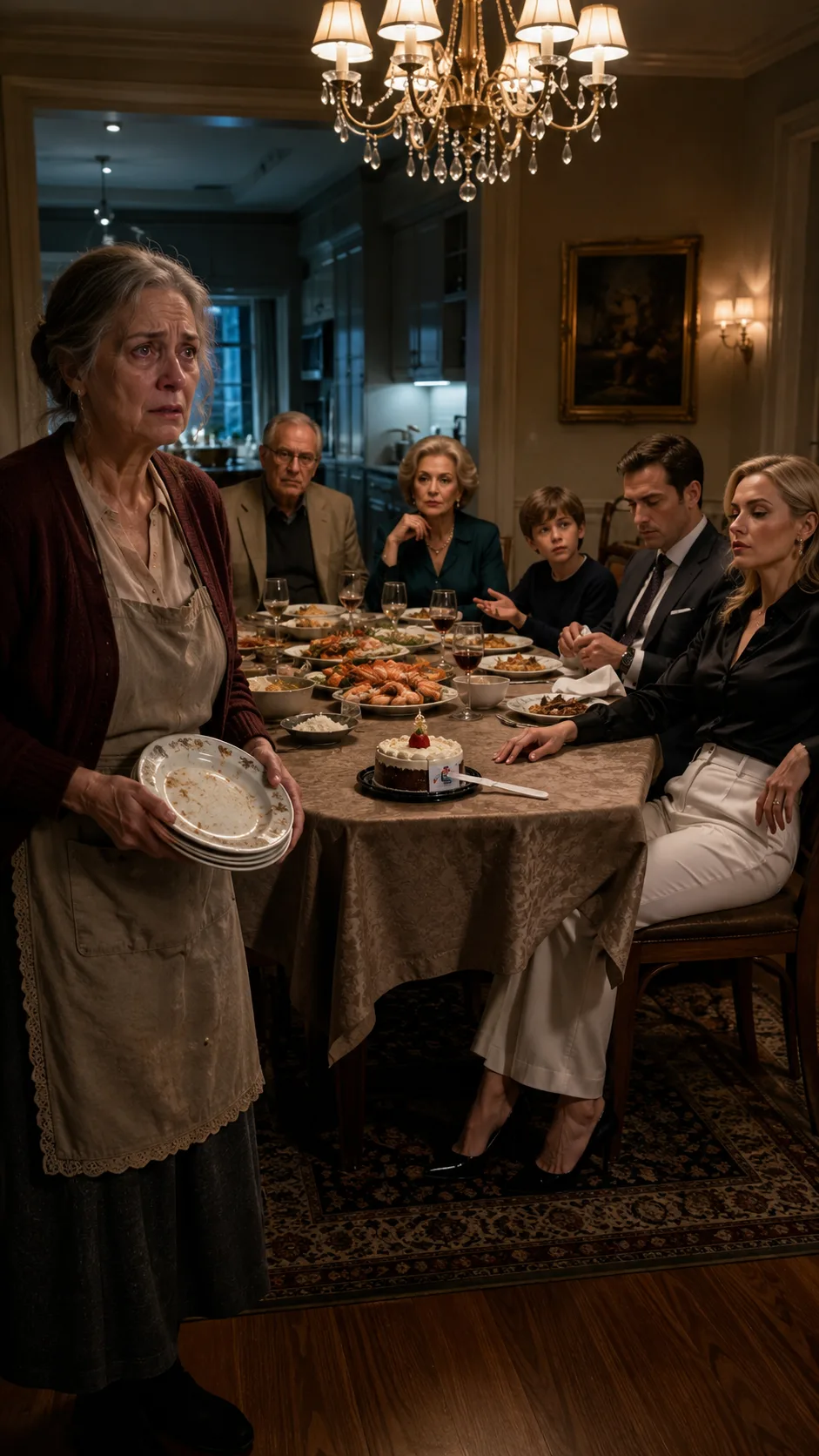
PART 2 — I LEFT THE HOUSE AND FINALLY LEARNED MY WORTH
For lunch, I made a simple bowl of noodles for myself.
Chapter 2
PART 2 — I LEFT THE HOUSE AND FINALLY LEARNED MY WORTH
For lunch, I made a simple bowl of noodles for myself.
Just as I finished, the plumber arrived. Seeing me home alone, the repairman asked casually, “Ma’am, where are your kids?”
“They’re at work,” I managed to smile.
“Isn’t it your birthday today?” he asked, pointing to the calendar on the wall. “My grandma turned 60 last year, and our whole family—more than 20 of us—threw her a huge backyard barbecue.”
I didn’t know how to respond, so I just changed the subject back to the pipes. After he finished and left, I finally broke down. I sat in front of Arthur’s picture and cried. Sixty years old. It was supposed to be an age for being surrounded by children and grandchildren, for enjoying a peaceful retirement. Instead, I was like an unpaid maid serving the entire family, young and old. And all I got in return was criticism and commands.
Wiping my tears, I grabbed my basket and headed to
the market. As I passed the community park, I saw a group of seniors doing line dancing. The music was cheerful and they were all smiling, so happy. I stood watching from a distance for a long time until my phone buzzed. It was a text from my son: “Mom, make a few extra dishes tonight. My in-laws will be here at 7:00. Megan wants shrimp scampi, no spicy peppers.”
I didn’t reply. I just shoved the phone back in my pocket and continued toward the market. As I passed a CVS, I stopped, staring at the bottles of sleeping pills in the window for a long, long time.
“Ma’am, can I help you with something?” a young clerk called out cheerfully.
“Oh, no, thank you,” I said, hurrying away, my heart pounding like a drum.
The market was bustling with noise. I mechanically selected ingredients, my mind replaying scenes
from the past five years: my daughter-in-law right in front of me, dumping a dish I made into the trash can, saying, “Even a dog wouldn’t eat this.” My son, growing more and more impatient with me, as if speaking one extra word to me was a great charity. My grandson, starting to imitate his mother, calling me “old thing.”
“Helen. Helen.” A familiar voice pulled me back to reality. I turned and saw my old colleague from the textile mill, Ruth. She was five years older than me but looked younger than her age. After retiring, she had started taking classes at the senior center and was absolutely glowing.
“Helen, I heard today is your 60th birthday,” she said, taking my hand. “Why are you out buying groceries by yourself? Didn’t your son and daughter-in-law throw you a party?”
I forced a smile. “They’re busy with work.”
“Busy, my
foot,” Ruth scoffed. “My boy used to be like that, too. Then I moved into a senior living community, and now he remembers to visit me every other week.”
“A senior living community?”
“Yes, the one called Willow Creek. The facilities are fantastic,” she said, lowering her voice. “A lot of the residents there moved in because they couldn’t stand their kids anymore. You should come visit sometime. We’re looking for someone who knows how to cook.”
I gave a noncommittal answer, but her words sent waves through my mind. Live for yourself. Leave this house. The thoughts grew like weeds, spreading wildly through my heart.
When I got home, I started preparing dinner—washing vegetables, chopping meat, simmering soup. Every action was more forceful than usual, as if I were trying to chop all my grievances into the vegetables, to boil all my anger into the soup.
At 6:30, my son’s family returned and my in-laws arrived right on time. I was still busy in the kitchen when I heard peals of laughter from the living room.
“Mom, is dinner ready? I’m starving,” my son called out.
“Almost,” I answered stiffly, plating the last dish. Looking at the feast that had taken me all afternoon to prepare, I suddenly made a decision. From the back of a drawer, I took out an old digital voice recorder. It was something Arthur had used to record his last wishes. I had kept it all these years. I pressed the record button and slipped it into my pocket.
“Mom, what’s taking so long?” Ryan’s voice called again, this time with clear impatience.
“Coming,” I said, taking a deep breath. I picked up the first platter and walked toward the dining room. The 60th birthday banquet was just getting started.
In the dining room, six people were already seated around the table. My spot, if you could call it that, was at the farthest end near the kitchen door—convenient for me to get up at any moment to refill rice bowls or serve more food.
“Helen, this spread looks wonderful,” my father-in-law remarked politely, though his eyes never left his phone.
I placed the grilled salmon in the center of the table, the head of the fish pointing toward him. It was an old tradition, a sign of respect for the eldest at the table. Even though it was my birthday—who in this house remembered?
“Mom, where’s my red wine?” my son asked with a frown. “Didn’t I ask you to chill a bottle?”
“I forgot. I’ll go get it now,” I said, turning back to the kitchen.
I heard my daughter-in-law snicker behind me. “She’s getting so forgetful. Can’t even remember one simple thing. Ryan, I told you we should have hired a maid instead of relying on this free labor.”
I gripped the refrigerator door handle, the cold metal seeping through my palm and spreading through my body. Free labor? Yes. For five years, that’s all I was in their eyes—an unpaid maid, an unpaid chef, an unpaid nanny.
Returning to the dining room with the wine, I found my mother-in-law admiring Megan’s new handbag while my grandson was engrossed in his tablet. My son and father-in-law were discussing the stock market. No one paid any attention to me, as if I didn’t exist.
“Mom, pour the wine,” my son said, pushing his glass toward me without even looking up.
I silently filled everyone’s glass, saving a small pour for myself last. Just as I was about to sit down, my daughter-in-law spoke again.
“Where’s the soup? I don’t see any soup. It’s a cold night, and there isn’t even any hot soup.”
“It’s in the kitchen. I’ll go get it,” I said, putting down the fork I had just picked up.
“Never mind. I’ll get it myself,” Megan sighed dramatically. “If I wait for you, everything will be in slow motion.” She got up and walked to the kitchen, her high heels clicking sharply on the hardwood floor.
The dining room fell silent for a moment, the awkward quiet filled only by the noise of a New Year’s Eve special rerun on the television.
“Grandma, I want shrimp,” my grandson Leo suddenly shouted, pointing at the platter of shrimp scampi on the other side of the table.
I quickly stood up to move the platter closer to him, but he pushed it away. “I don’t want you to peel it. It’s dirty. I want Mommy to do it.”
“Leo, how can you talk to your grandma like that?” My son finally looked up, but his tone was mild. He turned his head and went right back to his conversation.
Megan returned with the soup and, hearing this, actually smiled. “Leo’s right. Old people have more germs on their hands. It’s unhygienic.” She sat down, elegantly, pulled on a pair of disposable gloves, and began to peel a shrimp. “Here you go, sweetie. Mommy will peel it for you.”
I sat there, the food in front of me untouched. I was already full—full of anger. The voice recorder in my pocket felt heavy, like a piece of burning charcoal searing my thigh.
“Oh, by the way, Helen,” my mother-in-law suddenly turned to me. “I hear it’s your birthday today.”
My heart leaped as if struck by lightning. Finally. Someone finally remembered.
“Ah, yes, it is,” my voice trembled slightly.
“Oh, perfect,” she said, turning to her daughter. “Megan, why don’t you bring out that cake you bought? It’ll save us a trip.”
Cake? I was stunned. They—They had gotten me a cake.
Megan reluctantly got up and pulled a small palm-sized cardboard box from the refrigerator. She casually tossed it on the table in front of me. “It was on sale at the supermarket. It’ll have to do.”
My hands shaking, I opened the box. Inside was a small misshapen cake. The frosting had collapsed and the strawberry on top was half rotten. The price tag read: “Special $15. Limited time offer.”
“Mom, don’t be offended,” my son finally glanced at me. “Megan meant well.”
Meant well. I stared at the pathetic cake and suddenly wanted to laugh. My 60th birthday. And this was their so-called good intention. A discounted, deformed, palm-sized cake.
“Thank you,” I said mechanically, feeling something inside my chest shatter.
“Hurry up and cut the cake. We still need to eat,” Megan urged. “Oh, and after you cut it, remember to clean up the kitchen. The cleaning lady is coming tomorrow, and she’ll charge extra if she sees it’s greasy.”
I picked up the plastic knife, my hand shaking so badly I could barely hold it. At that moment, the recorder seemed to grow even heavier, reminding me of everything it was capturing.
“Mom, can you hurry up?” my son said impatiently. “We’re hungry.”
I took a deep breath and made the first cut. The frosting stuck to the knife like a glob of white sludge.
“Happy birthday to you,” my mother-in-law sang a half-hearted line. The others hummed along for a second, and the ritual was complete. The cake was divided into seven pieces. They each took a small bite and then pushed their plates aside. My piece remained on its plate, untouched, slowly melting into a pool of sickly sweet liquid—just like my life, silently collapsing.
Dinner continued in a strange atmosphere. They chatted and laughed, discussing their plans for the upcoming Christmas vacation. No one asked if I wanted to go. I was an invisible person, only noticed when it was time to serve food, pour wine, or clear plates.
“Mom, can I have another bowl of rice?” my son asked, holding out his empty bowl.
“Helen, my tea is cold. Get me another cup,” my father-in-law said without looking up.
“Grandma, I want fruit,” Leo commanded.
I spun like a top between the kitchen and the dining room. The recorder in my pocket capturing every order, every harsh word.
After dinner, they moved to the living room to watch TV, leaving the table in a complete mess for me to clean up. I mechanically cleared the dishes, their laughter echoing in my ears. Suddenly, one sentence cut through the noise.
“Ryan, your mother is becoming more and more useless. She walks so slowly. Why don’t we just send her to a nursing home?” It was Megan’s voice. “My cousin said the one on the east side of town is pretty good. It’s only $3,000 a month.”
The plate in my hand nearly slipped. I had to grab the edge of the table to steady myself. A nursing home? They wanted to send me to a nursing home.
“We’ll see,” Ryan’s voice was full of evasion. “She can still work now. We can talk about it when she really can’t move anymore.”
“By then, it’ll be too late. The good nursing homes all have waiting lists,” Megan pressed. “Besides, this house isn’t that big. When Leo gets older, he’ll need his own room.”
I held my breath, waiting for my son’s response. Would he speak up for me? Would he remember that this house was bought with the life savings of his father and me? Would he remember that when his startup failed, I sold my gold bracelets to help him pay off his debts?
“Fine, fine. You handle it,” Ryan’s reply was a knife straight through my heart.
At that moment, I understood my situation completely. In this family, I was nothing more than a burden—an old thing that could be thrown away at any time.
After cleaning the kitchen, I quietly returned to my room, locked the door, and took out the voice recorder. Playing it back, the sound clearly documented the truth of this family. My daughter-in-law’s cruelty, my son’s indifference, the in-laws’ hypocrisy, my grandson’s disrespect.
I sat on the edge of the bed and looked at the family portrait on the wall. It was taken three years ago. I was squeezed into the very edge of the frame like a stranger who had accidentally wandered into the shot. Arthur’s picture was on the nightstand. He seemed to be looking at me, his eyes filled with reproach.
Helen, how much longer are you going to endure this?
From under the bed, I pulled out an old leather suitcase and began to pack. There wasn’t much to pack, really. My entire fortune consisted of a few old clothes, a pair of cloth shoes, a photo album, and a small wooden box. The box contained my dowry, a pair of silver bracelets—the only valuable thing my mother had left me. When my son’s business failed, I had sold my gold bracelets to help him, but I had secretly kept these silver ones, thinking I would save them for my future granddaughter-in-law. Now, it seemed that wasn’t necessary.
After closing the suitcase, I sat down at my desk and started to write. A letter to my son telling him why I was leaving. A letter to my daughter-in-law telling her what respect means. And a letter to my grandson hoping he wouldn’t become like his parents.
When I finished, I checked the time. It was 11:00 at night. They should all be asleep, except for my son. He had a habit of staying up late to play video games.
Pushing my door open gently, I was surprised to find the living room light still on. My son was sitting alone on the sofa with several documents spread out in front of him. When he saw me, he frowned.
“Mom, why are you still up?”
“Ryan, I need to talk to you,” I said, gathering my courage and walking toward him.
“Now?” He glanced at his watch. “I’m busy. I have an important contract to sign tomorrow.”
“Just five minutes,” I insisted, sitting down across from him. “Today was my 60th birthday.”
He froze for a second, his expression a little awkward. “Oh, right. Happy birthday. That cake—Megan, she—”
“It doesn’t matter,” I cut him off. “Ryan, do you remember when you were 10 and had a fever of 104°? It was me, your mother, who carried you on my back and ran three miles to the hospital.”
“Mom, why are you suddenly bringing this up?” He was clearly getting impatient.
“Do you remember when you were in college and liked that girl? It was me who woke up early for three months straight to work two jobs just to save enough money to buy her a gift.”
“That’s ancient history.”
“Do you remember when your father was sick? It was me who took care of him alone for two years, right up until the day he died.” My voice started to tremble. “Where were you then?”
“I was overseas for a project.” My son’s face changed. “Mom, what are you trying to say?”
“I’m trying to say,” I took a deep breath, “that I’m tired. I’m 60 years old. I want to live for myself for once.”
He looked at me like I was crazy. “What do you mean?”
“I’m leaving,” I said calmly. “First thing tomorrow morning.”
“Leaving to where?” He frowned.
“A nursing home. Megan was just talking—Don’t take it to heart.”
“Not a nursing home,” I stood up. “To a place where I don’t have to walk on eggshells.”
He chuckled. “Mom, you’re 60 years old. Where could you possibly go? Stop being dramatic. You have to take Leo to school tomorrow.”
I didn’t answer. I just turned and went back to my room, leaving him sitting there with a bewildered look on his face. Closing the door, I leaned against it, my legs feeling weak. This was the first time I had ever fought back. The first time I had ever said no. Strangely, beyond the fear, I felt a sense of release. Tomorrow, everything would change. At 60 years old, my life was just beginning.
Just as the sky began to lighten, I woke up. I hadn’t slept well, my dreams filled with the past—my son’s adorable smile as a child, my husband’s warm embrace, and the home that was once filled with laughter. I got out of bed quietly, put on my warmest clothes, and placed the three letters I had written under my pillow. On the dresser, I left the voice recorder and the silver bracelets next to the house keys. These were my parting gifts to my son so he could hear the truth about this family.
Dragging the old suitcase to the front door, I looked back one last time at the house I had lived in for 20 years. The family portrait on the wall, the remote control on the coffee table, my grandson’s roller skates by the shoe rack. Every object held a memory, but none of them could hold me back any longer.
“Mom, what are you doing?” My son’s voice came from behind me, making me jump. He was standing at the top of the stairs in his pajamas, his glasses still on, staring intently at my suitcase.
“I told you last night. I’m leaving,” I said calmly, my hand already on the doorknob.
“You’re serious?” He rushed down the stairs, taking them two at a time. “Where are you going? Why?”
“To a place where I am respected.” I looked him straight in the eye. “As for why, you’ll understand after you listen to what’s on that recorder.”
“What recorder? Mom, are you getting senile?” He reached out to grab me, but I dodged him.
“Ryan.” I rarely used his full name. “From the day you were born, I gave you everything. After your father died, I transferred the house to your name, and I used all my retirement savings to support this household. For five years, day in and day out, I’ve served you three—and what I get in return is being called senile.”
He was stunned, apparently not expecting me to speak to him this way. “You—You just calm down.” His tone softened. “Did Megan say something to upset you? You know how she is. She speaks before she thinks, but she doesn’t have a bad heart.”
“Doesn’t have a bad heart?” I laughed coldly. “She dumps my cooking in the trash in front of me, calls me an old hag, and plans to send me to a nursing home. Is that what you call not having a bad heart?”
My son’s face turned red, then pale. “She—She didn’t mean it like that.”
“Then what did she mean?” I shot back. “And you, my own son—have you ever said a single word in my defense?”
He was speechless, his eyes darting away.
Just then, Megan’s voice came from upstairs. “Ryan, what’s all the noise so early in the morning?”
“It’s nothing,” he called up, then lowered his voice to me. “Mom, let’s go inside and talk. We don’t want the neighbors to hear.”
“There’s no need,” I said, pulling open the door. A blast of cold air rushed in. “I’ve called a car.”
“Mom,” he grabbed my suitcase. “You can’t just leave like this. What about Leo? Who’s going to make his breakfast? Who’s going to take him to school?”
That last sentence was the final straw. I yanked the suitcase back with all my might, my voice trembling with rage. “Even now, all you can think about is who is going to serve your son? Ryan, I am not a slave to this family.”
“What’s going on?” Megan came down the stairs in a silk robe. Seeing my suitcase, her eyebrows shot up. “Well, well, what’s this little drama? Running away from home?”
“Megan, that’s enough,” my son snapped at her—a rare occurrence. He turned back to me. “Mom, please calm down. Let’s just talk about this.”
“Talk?” I laughed, but tears streamed down my face. “For five years, has anyone ever talked to me? Has anyone ever asked me what I want to eat, where I want to go, what I want for my birthday?”
Megan scoffed. “You’re 60 years old and you’re acting like a teenager demanding romance. Isn’t having a roof over your head and food to eat enough?”
“Megan—” Ryan glared at her.
“Am I wrong?” she crossed her arms. “Old lady, if you want to leave, fine. But first, tell us how we’ve mistreated you. Did we not feed you? Did we not clothe you?”
I looked at this woman with her perfect makeup and expensive clothes and suddenly felt the absurdity of it all. This was the woman I sold my dowry to help my son marry. This was the person I served every day like a queen.
“You didn’t mistreat me,” I said calmly. “You just never treated me like a human being.”
With that, I dragged my suitcase out the door. My son ran after me and grabbed my arm.
“Mom, it’s snowing outside. Where can you go?”
“Let go.” I shook his hand off. “Ruth told me about a senior living community. I’m going to check it out.”
“A senior living community?” Megan’s eyes lit up. “Which one? What are the conditions like? How much is it a month?”
I ignored her and walked toward the elevator. My son followed me out barefoot.
“Mom, don’t be rash. At least wait until the snow stops.”
The elevator door opened. I stepped inside and pressed the button for the first floor. In the final moment before the door closed, I said to my son, “There are letters under the pillow and a recorder and bracelets on the dresser. Listen to it and think about it.”
As the elevator descended, my heart felt lighter than it had in years. For the first time in five years, I had made a decision for myself. For the first time, I had fought back against unfair treatment. The feeling was surprisingly good.
At the entrance to the complex, a taxi was already waiting. The driver was a friendly middle-aged man who helped me put my suitcase in the trunk.
“Where to, ma’am?” he asked.
“Willow Creek Senior Living,” I said, my voice trembling slightly as I spoke the address.
The car started and the familiar neighborhood scenery slowly receded—the supermarket, the park, my grandson’s school. The places that had once made up my entire world were now part of the past.
“Visiting family, ma’am?” the driver asked casually.
“No,” I said, gazing at the falling snow outside the window. “I’m going to start a new life.”
The car drove through the city center and stopped in front of a red-brick building. The words “Willow Creek” stood out brightly against the snow. As soon as I got out of the car, I saw Ruth walking toward me with an umbrella.
“Helen, you really came,” she said warmly, taking my suitcase from me. “Come on, let’s go see the room. There’s a sunny single room that just opened up.”
I followed her into the lobby, and a wave of warmth washed over me. A few seniors were playing chess, reading, and knitting. When they saw me, they all nodded and smiled in a friendly way. This kind of natural, easy respect was something I hadn’t felt in my own home for a very long time.
“This is the activity room. That’s the dining hall. And over there is the library,” Ruth explained as she led the way. “A doctor comes for checkups every week, and we have a social event once a month. Oh, do you know how to play bridge? We’ve been looking for a fourth for ages.”
I couldn’t help but smile a little. “But my real skill is cooking.”
“That’s fantastic.” Her eyes lit up. “We’re in desperate need of a good cook around here. A lot of the ladies can’t stand the cafeteria food. If you’re willing, you could organize a little cooking club. We could all chip in for the ingredients.”
The single room was much nicer than I had imagined—a single bed, a small desk, a wardrobe, a television, and a private bathroom. It had everything. Outside the window was a small garden. Although it was covered in snow now, I could imagine how beautiful it would be in the spring.
“So, what do you think?” Ruth asked expectantly.
“It’s wonderful,” I said, running my hand along the windowsill. The sunlight streamed through the glass, warming my skin.
“So, you’ve decided to stay?”
I took a deep breath and nodded. At 60 years old, I finally had a space that was completely my own—a place where I didn’t have to walk on eggshells.
“That’s great.” Ruth clapped her hands. “Come on, I’ll take you to get the paperwork done, and then you can meet the other ladies.”…
The paperwork was simple. I signed a form and paid a three-month deposit, which I was able to cover with the money from my silver bracelets. The community director was a very kind, middle-aged woman. When she heard that I used to work in the cafeteria at the textile mill, she immediately invited me to help improve the senior living community’s dining services.
“Helen, we are so in need of an experienced chef like you,” she said enthusiastically. “If you’re willing, you could give our cooks some suggestions or even teach a class on homestyle cooking every now and then.”
I readily agreed. It felt so good to be needed.
At noon, Ruth took me to the dining hall. The food was served buffet style. It was simple but clean and wholesome. A few elderly ladies warmly invited me to sit with them, and they chatted away, asking me where I was from and what I used to do for work.
“I used to work at the textile mill,” I said shyly. “Later, I helped out in the cafeteria, and then I retired to take care of my grandson.”
“How old is your grandson?” a woman with a full head of silver hair asked.
“Eight,” I replied, a sudden pang of sadness hitting me. Was Leo out of school yet? Who was picking him up? Who was making him dinner?
“Missing your grandson?” Ruth sensed my change in mood and gently patted my hand. “It’s always like this at the beginning. It gets better after a while. Besides, it’s not like you can’t see him. If you miss him, just go visit.”
I forced a smile and looked down at my plate. Just then, my phone rang. It was my son.
“Mom, are you really there?” His voice was frantic. “I just listened to the recording. I had no idea. Megan said those things—”
“It was all recorded,” I said calmly.
“Mom, I’m sorry. I really didn’t know. Please come back. We can talk this out.”
“No,” I said, looking out at the snowy landscape. “I’m happy here.”
“But Leo keeps asking where Grandma went. He—he really misses you.”
My heart softened at the mention of my grandson, but it hardened again just as quickly. “Ryan, I love you and I love Leo. But first and foremost, I am a person, a person with dignity. If you and Leo want to see me, you can come here. But I will not go back to being your unpaid maid.”
There was a long silence on the other end of the phone. Finally, he said, “Mom, I’ll bring Leo to see you tomorrow.”
After hanging up, I realized the ladies at my table were all looking at me with eyes full of understanding and approval.
“Good for you,” Ruth said, putting a piece of fish on my plate. “When children are ungrateful, we old folks have to stand up for ourselves.”
“Was I too harsh?” I asked in a small voice. “Leo is still so young.”
“Harsh?” An elderly woman with glasses scoffed. “When my daughter kicked me out of her house, that was harsh. If you don’t set boundaries now, you’ll have even less standing later.”
In the afternoon, I joined the community’s craft class and learned how to make decorative knots. My fingers weren’t as nimble as they used to be, but I slowly got the hang of it. In the evening, I watched TV and chatted with a few of the other ladies. I listened to their stories. Some had been cast aside by their children. Some had chosen to move out on their own. And some had no children at all. It turned out I wasn’t alone. There were so many seniors, all fighting to live with their own dignity.
Before going to bed, I stood by the window, looking out at the city lights twinkling in the snow. I wondered what my son was doing. Had he listened to the entire recording? Had he read my letters? Was Leo crying for his grandma?
My phone buzzed again. It was a text message. I opened it. It was a voice message from Leo. “Grandma, where are you? I want you to make me your pancakes.”
Listening to my grandson’s innocent voice, the tears finally came. But this time, I didn’t regret my decision. At 60 years old, I had learned to say no. I had learned to live for myself. And perhaps that was the best birthday gift of all.
The morning at Willow Creek Senior Living was much livelier than I had imagined. Just as the sky was beginning to lighten, I could hear the soft shuffle of feet and hushed laughter in the hallway. I opened the curtains and saw several elderly ladies already in the small garden below doing their morning exercises. Their movements were synchronized and graceful, looking especially vibrant in the morning light.
“Helen, are you up?” Ruth’s voice came from outside my door, followed by a gentle knock.
I quickly put on my robe and opened the door. Ruth was standing there with a tray on which sat a steaming bowl of oatmeal and two small muffins.
“I know you’re not used to the cafeteria yet, so I brought you some breakfast,” she said with a warm smile. “Eat up, and I’ll come back later to introduce you to some of the local celebrities around here.”
I took the tray, a wave of warmth spreading through my chest. How long had it been since someone brought me breakfast? Since Arthur passed away, I was always the first one up every morning preparing breakfast for the whole family, but no one ever cared what I wanted to eat.
“Thank you. This is too much trouble,” I said, a little embarrassed.
“Don’t be silly,” Ruth waved her hand. “Here, all the seniors look out for each other. Take your time eating. I’ll be back at 8:00 to get you.”
Closing the door, I sat at the small table and slowly savored the simple breakfast. The oatmeal was cooked perfectly—thick and creamy. The muffins were soft and fluffy with a hint of sweetness. Compared to the scraps I used to hurriedly swallow at my son’s house, this breakfast felt like a feast.
After eating, I washed up and began to organize the few clothes I had brought. The small room, though not large, was filled with sunlight. The wardrobe, desk, and nightstand were all in good condition. There were even a few landscape paintings on the wall, adding a touch of homeliness to the space.
From the bottom of my suitcase, I took out the old photo album and gently caressed the cover. It held my entire life—the innocence of my youth, the joy of my wedding day, the pride of holding my newborn son, and the years of growing old with Arthur. The last few photos were of the whole family. I was squeezed into the very edge, looking like an outsider.
Knock, knock, knock. The door sounded again. I opened it to find Ruth, now changed into a bright red jacket that made her look incredibly energetic.
“Wow, Helen, that outfit.” She looked my faded old robe up and down and frowned. “No, no, that won’t do. Today is a big day. You have to dress up a bit.”
“What big day?” I asked, confused.
“It’s the monthly senior talent show,” she said excitedly. “You’re just in time. You can show off your cooking skills.”
I quickly waved my hands. “No, no, I don’t have any talents.”
“Don’t be so modest,” Ruth said, pulling me out the door without taking no for an answer. The community director was just saying yesterday that she wanted to ask you to help improve the cafeteria food. This is the perfect opportunity.”
She half-dragged me to the activity room, which was already filled with more than 20 seniors all chatting and laughing. It was a lively scene. When they saw us, a few of the ladies waved enthusiastically.
“You must be the newcomer, Helen. Come sit over here.”
I was seated in the front row with a small table of fruit and tea in front of me. The community director, Miss Davis, walked onto the small stage and clapped her hands.
“All right, everyone. It’s time for our favorite event of the month—the talent show. Today, we have a special welcome for our new resident, Helen Fun.”
Everyone turned to look at me, applauding and smiling. I nodded awkwardly, my face flushing.
“Helen used to be a key member of the cafeteria staff at the textile mill,” Miss Davis continued. “Her cooking skills are legendary. Today, we are honored to have her show us one of her signature dishes. What do you all say?”
The applause grew even louder.
I stood up, flustered, and stammered, “I—I didn’t prepare anything.”
“That’s okay,” Miss Davis said with a smile. “The kitchen has already prepared all the ingredients and equipment. You can make anything you like.”
And just like that, I was pushed onto a small temporary cooking station. Looking at the fresh ingredients and gleaming utensils on the counter, I suddenly felt a long-lost sensation—the feeling of being needed, of being respected.
“Well, I’ll just make a simple meatball dish then,” I said, rolling up my sleeves and washing my hands.
For the next half an hour, I was completely immersed in the joy of cooking. The ground meat became tender and elastic in my hands, and the proportions of the various seasonings were etched into my memory. When I dropped the meatballs into the hot oil, a delicious aroma filled the entire activity room.
“That smells amazing,” the seniors exclaimed, some even crowding around to watch me work.
After the meatballs were done, I used the remaining ingredients to quickly stir-fry some sweet-and-sour cabbage. The two dishes were placed on the display table, a feast for the eyes and the nose, drawing gasps of admiration.
“Helen, this is incredible,” Miss Davis said, taking a bite of a meatball. Her eyes lit up. “Crispy on the outside, tender on the inside, and seasoned just right. It’s even more authentic than my mother’s.”
The seniors took turns tasting the food, all of them praising it endlessly. I stood to the side, watching their satisfied expressions, a sense of accomplishment swelling in my chest. How long had it been since I was genuinely praised like this? At my son’s house, my cooking was never healthy enough, never refined enough—always criticized.
“Helen, would you be willing to teach a cooking class for us once a week?” Miss Davis suddenly asked. “The community will cover the cost of ingredients. You would just need to teach everyone how to make these homestyle dishes.”
I was stunned. Teach a class? Me? A retired factory worker with only a high school education?
“I—I can’t,” I stammered, shaking my head. “I’m not educated. I don’t know how to teach.”
“Who says?” Ruth interjected. “Your skill is the best education. None of us old folks care about diplomas.”
“That’s right. That’s right,” the other seniors chimed in. “Helen, please teach us.”
Looking at their expectant faces, I found myself nodding. The applause erupted again, even more enthusiastic than before. In that moment, I finally understood what it felt like to be needed.
After the talent show, Miss Davis took me on a tour of the community’s shared kitchen. It was spacious and bright with modern equipment—even nicer than the kitchen at my son’s house.
“Helen, from now on, this is your domain,” Miss Davis said with a smile. “How about a cooking class on Tuesday and Thursday mornings?”
“Okay,” I nodded, then suddenly remembered something. “What about buying the ingredients?”
“Don’t worry about that,” Miss Davis interrupted. “We have regular suppliers. You just need to give us a list in advance. As for payment—”
“No payment needed,” I said quickly. “I’m happy to do something for everyone.”
“That won’t do,” Miss Davis said firmly. “According to community rules, instructors get a teaching fee. It’s $200 per class. Please don’t refuse.”
Two hundred dollars. I was secretly astonished. At my son’s house, that was just a day’s worth of grocery money. But for me, it was income earned through my own labor—money that was completely mine.
At noon, I had a hearty lunch in the cafeteria and chatted animatedly with some of my new friends. I had just returned to my room for a nap when my phone suddenly rang. It was my son, Ryan.
“Mom.” His voice sounded exhausted. “Leo and I are at the front gate. The security guard won’t let us in without your permission.”
My heart skipped a beat. They had really come. I looked at the time. It was only 1:30 in the afternoon. Shouldn’t Leo be in school?
“Wait there. I’ll come down and get you,” I said, hanging up.
I quickly smoothed my hair and clothes. At the community entrance, my son was holding Leo’s hand, standing in the cold wind. Ryan was dressed in a suit but looked haggard. Leo was in his school uniform, his eyes red as if he had been crying.
“Grandma!” As soon as he saw me, Leo let go of his father’s hand and ran into my arms. I knelt down to catch him. The familiar scent of children’s shampoo filled my nose, and I felt a sting in my own.
“Sweetie, why aren’t you in school?”
“I faked a stomachache,” Leo whispered into my shoulder. “So Dad came to get me. Grandma, I miss you.”
I looked up at my son. He explained awkwardly, “He refused to go to school this morning. He just kept crying and asking for you. I didn’t know what else to do.”
“Come in,” I sighed, taking Leo’s hand and leading them inside. As we passed the activity room, a few ladies playing bridge greeted us warmly.
“Helen, is this your grandson? He’s so cute.”
“Helen, this must be your son. He’s very handsome.”
Ryan was clearly not used to being greeted so warmly by strangers and just nodded stiffly. Leo, on the other hand, quickly made friends with the ladies. One gave him a piece of candy. Another patted his head. Soon he was calling them “Grandma,” too.
“Mom, you seem to be very popular here,” Ryan said, his tone complex as he looked around my room.
“Yes, everyone is very kind,” I replied simply, busy getting some fruit for Leo.
“Grandma, is this your new home?” Leo asked curiously, touching everything in the room. “It’s so small. Even smaller than my room.”
“Yes, but it’s big enough for just Grandma,” I said, stroking his hair.
Ryan sat in the only chair, looking like he had something to say but didn’t know how to start. Finally, he spoke.
“Mom, I listened to the recording. I had no idea Megan said all those things.”
“You had no idea or you chose to ignore it?” I asked calmly, peeling an orange for Leo.
He fell silent, looking down at his hands. Leo leaned against me, quietly eating his orange, his big eyes darting back and forth between us.
“Probably both,” Ryan finally admitted after a long pause. “I knew Megan could be harsh sometimes. But I just—I just thought you wouldn’t take it to heart.”
“Because I’m your mother, I should just endure everything unconditionally?” My voice trembled slightly. “Ryan, mothers are people, too. We have hearts, and they can hurt.”
“I know I was wrong, Mom.” He looked up, his eyes red. “Megan and I had a huge fight last night. I played the recording for her. At first, she tried to deny it, but then—”
“Then what?” I couldn’t help but ask.
“Then she cried. She said her parents treated her grandmother the same way growing up. So she thought—that was a normal relationship between a mother-in-law and daughter-in-law.”
This was unexpected. Megan crying, admitting she was wrong.
“Grandma, Mommy cried yesterday, too,” Leo suddenly piped up. “She said she shouldn’t have thrown your cake in the trash.”
I was stunned. “What cake?”
Ryan explained awkwardly. “For your 60th birthday? Megan had actually ordered a big cake, but she got angry because the bakery delivered it late. In a fit of temper, she threw it away and bought that small one from the supermarket.”
So that’s what happened. Behind that small discounted cake, there was another story. I didn’t know whether to laugh or cry.
“Mom, please come home with me.” My son suddenly grabbed my hand. “I promise Megan will respect you from now on, and I’ll be more attentive. You can’t be all alone here.”
“I’m not alone.” I gently pulled my hand away. “I have many new friends, and I have a job here.”
“A job?” He looked at me in disbelief.
“Yes, I teach a cooking class twice a week.” I couldn’t help but feel a little proud. “And I get paid for it.”
Ryan looked like he had been struck by lightning. “You—you’re teaching a class here, and they’re paying you? What? You don’t think your mom is capable?”
“No, it’s not that. I just—” he stammered. “Then what about at home? Who will take Leo to and from school? Who will make dinner?”
“Ryan,” I interrupted him. “I love you and I love Leo, but I can’t spend the rest of my life revolving around you. I have the right to live my own life.”
My words were like a bucket of cold water poured over his head. He stared at me as if seeing his mother for the first time.
“Then—what about us?” he asked in a small voice.
“You can come visit me anytime,” I said softly. “And I can go visit Leo on the weekends. But we all need some space and time to think and to change.”
When it was time for them to leave, Leo clung to my leg, refusing to let go, crying his heart out.
“Grandma, come home with me. I don’t want you to live here.”
I fought back tears and knelt down to his level. “Sweetie, Grandma isn’t leaving you. Grandma just needs her own little house. You can come visit me anytime, and I’ll come visit you often, okay?”
“Really?” He sniffled. “Really? Grandma promises.”
I kissed his little cheek. “Next week, I’ll come over and make you your favorite pancakes. How about that?”
After finally seeing them off, I sat on the edge of my bed, completely exhausted. My phone vibrated. It was a text from my son: “Mom, thank you for still being willing to give us a chance. We will change. I’ll bring Leo to see you this weekend. Love you.”
The simple words—”Love you”—made the tears flow freely. How many years had it been since my son had so directly expressed his feelings? Perhaps change was really possible.
That evening, I joined the community movie night. It was a light-hearted family comedy, and the seniors were all laughing heartily. After the movie, we sat around drinking tea and chatting. The conversation naturally turned to our families.
“My son hasn’t visited me in three years,” an elderly woman named Mrs. Chen said calmly. “But that’s okay. I’m doing just fine here.”
“My daughter visits often,” another woman added. “But every time she comes, she complains about how expensive the community fees are, hinting that I should transfer the house to her name soon.”
Listening to their stories, I suddenly realized that I wasn’t the only parent who had been hurt by their children. In this seemingly harmonious society, how many seniors were crying silently in the corners of their own homes?
“What about you, Helen? Why did you come here?” someone asked me.
I hesitated for a moment, then briefly shared my story. I told them about my daughter-in-law calling me an old hag, about my son’s indifference, about the birthday cake that was thrown in the trash.
“Good for you,” Ruth slammed her hand on the table. “You have to show them you mean business. Young people these days are just so entitled.”
“Didn’t your son visit you today?” Mrs. Chen asked perceptively. “Did he apologize?”
“Sort of,” I said quietly. “He said they would change.”
“Don’t get your hopes up,” an old gentleman with glasses said coldly. “A leopard can’t change its spots.”
The others looked at him reproachfully, but he was unfazed. “I’m telling the truth. When children are ungrateful, we seniors have to be strong. Helen has friends here. She has a job. Why go back and suffer?”
His words were like a knife cutting into the softest part of my heart. He was right. Deep down, wasn’t I also afraid that my son’s change was just a fleeting moment?
Back in my room, I tossed and turned, unable to sleep. The moonlight spilled onto the floor like a silver road, leading to an unknown future. At 60 years old, I had embarked on this journey of self-discovery. I didn’t know if the road ahead was filled with thorns or flowers. But at least this time, I had made the choice for myself.…
My first weekend at Willow Creek, I woke up early. Today was the day my son was supposed to bring Leo to visit. Though I told myself I didn’t care, I couldn’t help but tidy up my room over and over again. I even borrowed an electric hot plate and a small pan from the cafeteria to make Leo his favorite pancakes.
“Well, well, Helen, what’s all the hustle and bustle so early in the morning?” Ruth said, poking her head in. Seeing me mixing batter, she teased, “Your grandson is coming. So excited you couldn’t sleep, huh?”
I smiled sheepishly. “Leo just loves the pancakes I make. He says the ones from the store aren’t soft enough.”
“If you ask me, you’re too soft-hearted.” Ruth shook her head. “Your son says a few nice words and you’re ready to surrender.”
“It’s not surrendering,” I said, stirring the batter. “I’m just giving him a chance—and giving Leo a complete family.”
“You—” She sighed and didn’t say more. “Need any help?”
“No, I’ve got it all under control,” I said, checking the time. “They said they’d be here at 10:00. Still have two hours.”
After Ruth left, I sat by the window, lost in thought. Since my son’s visit three days ago, we had spoken briefly on the phone every day. He told me he had hired a nanny to take Leo to and from school, and that Megan had started trying to cook, though she had made a mess of the kitchen. It sounded like they were really trying to change, but Ruth’s words made me uneasy. Was I too soft-hearted? Could years of hurt be erased by a few phone calls?
At 9:45, my phone rang. It was my son.
“Mom.” His voice was a little nervous. “We’re at the gate, but Megan came too. Is that okay?”
“Megan?” My hand trembled, and I nearly knocked over the bowl of batter. What was she doing here? To apologize or to confront me?
“Yes. Yes. I’ll come down and get you,” I said, hanging up. I took a few deep breaths to calm myself.
At the community entrance, the family of three stood together. Ryan was in a sharp suit, Leo in cute overalls, and Megan—I almost didn’t recognize her. She wore no makeup, had none of her usual arrogant posture. She was dressed in a simple T-shirt and jeans, and she was holding a fruit basket.
“Grandma!” Leo was the first to run over and hug me.
“Mom,” Ryan walked over with a smile and gave me a light hug.
Megan stood where she was, her eyes darting around, unable to meet my gaze. Finally, Ryan gave her a little nudge, and she slowly walked over.
“Uh, Helen,” she said haltingly, handing me the fruit basket. “This—this is for you.”
I was stunned. In five years, this was the first time she had called me by my name instead of “old lady” or “old thing.”
I took the basket and nodded. “Thank you. Let’s go up.”
The elevator ride was so awkward you could feel it. Leo chattered on about school, and Ryan would occasionally chime in, while Megan stood in the corner like a shadow, silent.
Once in my room, Leo was immediately drawn to the small succulent plant on the windowsill.
“Grandma, what’s this? It’s so cute.”
“That’s a succulent. Grandma Ruth gave it to me,” I said, stroking his hair. “Are you hungry? I’ll make you some pancakes.”
“Yay!” Leo cheered.
I took out the ingredients and started cooking on the small hot plate. Ryan sat nearby, looking around my small room with curiosity.
“Mom, are you comfortable living here?”
“It’s very nice,” I said, flipping a pancake. “Everyone is very friendly, and there are lots of activities.”
“I heard you’re even teaching a cooking class,” he said with a smile. “I never would have guessed.”
“Your mom has a lot of hidden talents,” I said half jokingly. “It’s just that no one ever noticed before.”
The smell of pancakes soon filled the small room. Leo leaned over the table, his eyes glued to the pan.
“Grandma, it smells so good. Much better than when Mommy cooks.”
“Leo,” Megan said softly, a flicker of hurt crossing her face.
I pretended not to hear and placed the first pancake on a plate for Leo. “Be careful. It’s hot.”
What happened next stunned me. Megan suddenly stood up and bowed deeply to me.
“Helen, I’m sorry.”
The gesture shocked not only me, but also Ryan and Leo. When Megan straightened up, her eyes were red.
“I—I listened to the recording. I didn’t know I had said such horrible things. I—” She choked up, unable to continue.
Ryan quickly went to her and put an arm around her shoulder, explaining to me, “Mom, Megan has been feeling terrible these past few days. She—she had some issues with her family growing up. Her mother was very harsh to her grandmother, so she thought—that was normal.”
I looked at my daughter-in-law, who suddenly seemed like a stranger, and felt a mix of emotions. Her apology seemed sincere, but I couldn’t forget the years of being pierced by her words.
“Let’s eat breakfast first,” was all I could say, turning back to the pancakes.
Breakfast was eaten in a strange silence. Leo devoured three pancakes, and Ryan also praised them, but Megan only ate a small piece before saying she was full.
“Helen,” she said suddenly. “Can—can I talk to you alone?”
Ryan took the hint and stood up. “I’ll take Leo down to the garden for a bit. Mom, you two take your time.”
After they left, the room was silent except for the sound of my own rapid breathing.
“Helen.” She finally broke the silence, her voice barely a whisper. “I know saying sorry doesn’t change anything, but I am truly, truly sorry.”
“Why?” I looked her straight in the eye. “Because the recording was discovered? Because Ryan fought with you? Or because your parents scolded you?”
She looked up sharply, a flash of shock in her eyes, which then dimmed. “All of those things, I guess, but mainly it was because I heard what you said to Ryan.”
“What did I say?”
“You—you said that mothers are people, too. That mothers have hearts, and they can hurt.” Her tears started to fall. “It made me think of my own mother and whether she—” She broke down crying.
I awkwardly handed her a tissue, the hard wall around my heart beginning to crack.
“I grew up watching my grandmother serve the whole family like a servant,” she sobbed. “My mother ordered her around. My father ignored it. I thought that was just how it was supposed to be between mothers-in-law and daughters-in-law.”
“So, when you got married, you started treating me the way your mother treated your grandmother,” I said softly.
She nodded in shame. “I thought that was how I was supposed to establish my place as the lady of the house. I was wrong.”
Looking at her trembling shoulders, I suddenly understood. This sharp, cruel daughter-in-law was also a child hurt by her own family. Her cruelty wasn’t innate. It had been passed down.
“Megan,” I sighed. “Do you know what hurt me the most over these past five years? It wasn’t how you treated me. It was that you taught Leo to treat me that way, too.”
She flinched and the tears fell faster. “I know. Leo isn’t close to me anymore. He thinks I’m the one who drove you away. This is my punishment.”
“It’s not a punishment,” I said, handing her a glass of water. “It’s just a child’s natural reaction. He loves me. So, when he saw you hurting me, he naturally pulled away from you.”
“What should I do?” She looked up, her eyes filled with desperation. “I don’t want Leo to hate me, and I don’t want—I don’t want you to hate me.”
In that moment, I saw the fragile little girl beneath her hard shell. Perhaps we had both been wearing masks for too long, forgetting who we really were.
“I don’t hate you,” I said softly. “But I need time. Trust isn’t lost in a day, and it can’t be regained in a day either.”
She nodded, wiping her tears. “I understand, Helen. I’m not asking you to forgive me right away. I just hope—I just hope you can give Ryan and Leo a chance. They really miss you.”
Just then, the door opened and Leo burst in. “Grandma, Dad bought me ice cream!” Seeing his mother crying, he froze. “What’s wrong, Mommy?”
“Mommy’s fine,” Megan forced a smile. “Just got some dust in my eye.”
“Oh,” Leo said, not quite understanding. He turned to me excitedly. “Grandma, the garden downstairs is huge, and there’s a swing set. Grandma Ruth said there’s a craft class this afternoon. Can I join?”
“Of course you can,” I smiled, stroking his hair. I looked at my son. “Are you staying for lunch? The cafeteria food is pretty good.”
Ryan’s eyes lit up. “Sure, Mom. That sounds great. We—”
“No, that’s okay.” Megan stood up suddenly. “We—we shouldn’t bother you. Leo, say goodbye to Grandma.”
“Aw. Why?” Leo pouted. “I want to play with Grandma more.”
“Next time, sweetie,” she said with a weak smile, her eyes shifting nervously. “Mommy just remembered she has something to do.”
I understood her discomfort and didn’t press. “That’s fine. Come again next time, Leo. Let me pack some cookies for you to take home.”
As I saw them to the elevator, Ryan quietly pulled me aside. “Mom, Megan—she—she apologized.”
“I said simply, ‘But I need time.’”
He nodded, his eyes full of complex emotions. “I understand, Mom. Thank you.”
Watching the elevator doors close, I let out a long breath. This sudden reconciliation had left me exhausted, but it also gave me a flicker of hope. Maybe change really was possible.
In the afternoon, I took Leo to the craft class as promised. He was very good with his hands, and with Ruth’s help, made a beautiful little clay bowl, which he proudly announced he would take home for his dad.
“Grandma, when are you coming home?” he asked innocently as he was leaving. “I want to play with you every day.”
“Grandma lives here now, sweetie.” I knelt down to his level. “But you can come visit me anytime. Okay?”
“Okay,” he nodded reluctantly. “I’ll come again next weekend.”
As my son’s car drove away, Ruth patted my shoulder. “So, how did it go with your daughter-in-law?”
“She apologized,” I said quietly. “She said she grew up watching her mom mistreat her grandma and thought it was normal.”
“Excuses,” Ruth said dismissively. “In my day, what daughter-in-law would dare be disrespectful to her mother-in-law? Now they all use their dysfunctional families as a shield.”
“But she seemed genuinely sorry.”
“Helen, you’re too kind,” Ruth shook her head. “Be careful not to fall into the same trap again.”
Back in my room, I lay on the bed, replaying the day’s events—Megan’s tears, my son’s hope, Leo’s innocence. Should I trust that they had changed? Should I give this family another chance?
My phone vibrated. It was a picture from my son. Leo was proudly holding up his clay bowl with the caption: “Leo said, ‘This is for Grandma to hold candy when you come home.’”
I smiled and saved the picture, but didn’t reply. I needed more time—time to think, time to heal, and time to decide which path to take.
Outside, the sun was setting, painting the entire room in a golden hue. At 60 years old, I had finally learned to say no, and I had also learned to listen to my own heart. Whatever my final decision, this time I was going to live for myself.
Click the blue “PART 3” link to read the final part:
👉 PART 3 👈
Chapter complete
You have reached the end of this chapter.
Continue reading
A few more worlds to get lost in after this chapter.




