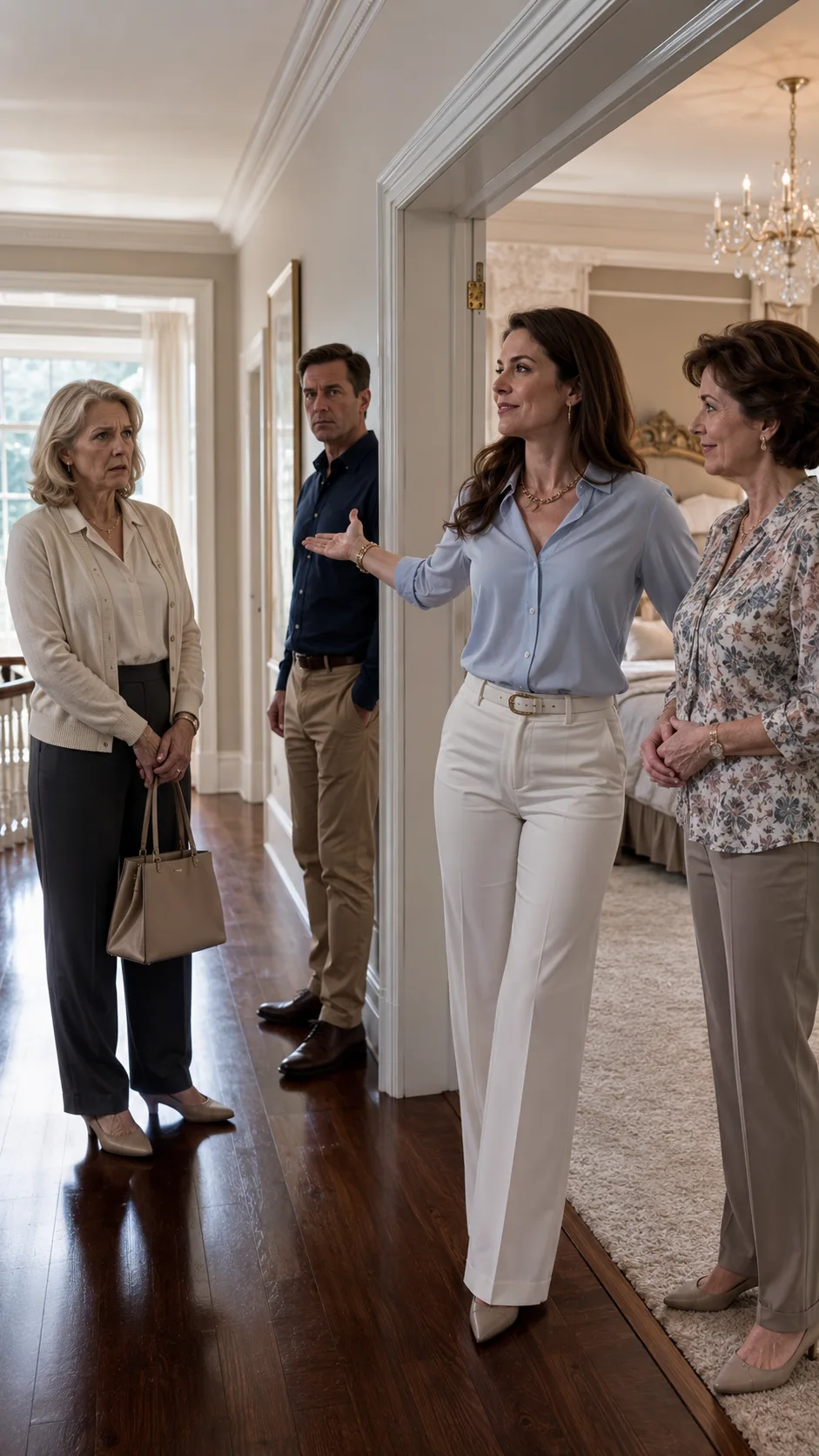
I BOUGHT A MANSION IN SECRET, THEN CAUGHT MY DAUGHTER-IN-LAW GIVING A TOUR LIKE SHE ALREADY OWNED IT
PART 3 — THE HOUSE I WAS ALLOWED TO KEEP AFTER THEY TRIED TO TAKE EVERYTHING
Six months later, I hosted my first dinner party in the mansion.
Chapter 3
I BOUGHT A MANSION IN SECRET, THEN CAUGHT MY DAUGHTER-IN-LAW GIVING A TOUR LIKE SHE ALREADY OWNED IT
PART 3 — THE HOUSE I WAS ALLOWED TO KEEP AFTER THEY TRIED TO TAKE EVERYTHING
Six months later, I hosted my first dinner party in the mansion.
Not for Kevin and Rebecca, who had moved into a two-bedroom apartment across town and were slowly rebuilding their relationship with honesty instead of manipulation.
Not for Rebecca’s parents, who had apparently found other living arrangements when their daughter’s grand plans fell through.
I hosted dinner for my neighbors.
The couple next door who had brought me flowers when I moved in.
The widow across the street who had invited me to her book club.
The young family at the end of the block whose children sometimes helped me carry groceries.
These people, who barely knew me, had shown me more genuine kindness in six months than my own family had in years.
We ate roast chicken that snapped at the skin, potatoes with rosemary, a salad scattered with jewel tomatoes.
The widow told a story about a cruise she took at sixty-nine.
The young father confessed he was afraid
of house centipedes.
We laughed until the chandelier chimed.
Kevin and I were slowly repairing our relationship. He had started calling every Sunday—conversations that were awkward but honest. He apologized without qualifiers. He insisted on family counseling. He kept a notebook, he said, where he wrote down the places he wanted to show his daughter and the lies he never wanted to tell her.
Rebecca and I maintained a polite distance.
She had given birth to a healthy baby girl, my granddaughter, whom I visited once a month under Kevin’s supervision.
Rebecca was civil during these visits, but I could see in her eyes that she still thought I had overreacted.
That I should have been grateful for her elaborate schemes to involve me in their lives.
But the real revelation came from my lawyer, who had done some digging into Rebecca’s background after I told him the full story.
“Mrs. Stevens,” he said, “I thought you should know this wasn’t Rebecca’s first time manipulating elderly family members. Her grandmother signed over her house to Rebecca’s parents five years ago under very similar circumstances. Fake concerns about property maintenance, suggestions about tax benefits, pressure to make decisions quickly for the family’s good.”
The pattern was clear.
Rebecca had not stumbled into elder abuse through desperation.
She had learned it.
Practiced it.
Perfected it as a family tradition.
“What happened to the grandmother?” I asked.
“She died in a state nursing home two years later. The family sold her house immediately after the funeral.”
I thought about how close I had come to the same fate.
If I had not kept the house purchase secret, if I had not installed security cameras, if I had been just a little more trusting or a little more isolated, I would have ended up
exactly like Rebecca’s grandmother.
Instead, I was sitting in my beautiful dining room, surrounded by friends who had chosen to know me rather than family who had chosen to use me.
My phone buzzed with a text from Kevin.
“Mom, Rebecca wanted me to ask if you’d consider being the baby’s guardian in our will in case something happens to us.”
I stared at the message for a long time, thinking about trust and responsibility and the difference between loving someone and enabling them.
I walked to the window and watched my hydrangeas inhale the dusk.
I texted back, “I’ll consider it if Rebecca completes a financial literacy course and commits to family therapy for at least a year.”
His response came quickly.
“She says that’s unnecessary. We just need a simple yes or no.”
I deleted the conversation and went back to planting my garden.
Some people never learn.
But some of us learn exactly enough to save ourselves.
I pressed my thumb into the soil and made room for roots.
After I put my phone away and brushed the soil from my palms, I stood very still and let the evening settle.
It is funny what a person hears when she finally stops apologizing—wind talking through the elm leaves, a chime catching its breath, the click of a beetle working under bark.
All the sounds of a life that had been waiting for me to show up to it.
I wished Henry could see the house, so I told him about it the way I used to: quietly, over chores.
I narrated the hydrangeas and the wainscoting and the drawer that won’t close unless you kiss it with your hip.
I told him about the cameras and the locksmith and the way my hands did not shake when Kevin confessed.
Somewhere between the kitchen and the porch, I realized I was smiling the kind of smile that belongs to a woman who knows what she owns—and more importantly, what she will no longer give away.
Before bed, I opened the cedar box where Henry kept stray screws and warranty cards and the letters we never mailed.
There was a sticky note in his handwriting—slanted, decisive:
Take care of the house, and it will take care of you.
He meant roofs and gutters.
I chose to include boundaries and bank policies.
The next morning, I put on my navy blazer—the one with the honest shoulders—and drove to the bank.
The lobby was cool, a hush of carpet and whispered pens. A young man in a blue tie offered me water. The manager, a woman with hair like spun steel, invited me into her office and closed the door as if confidentiality itself were a person who deserved a chair.
“I want to audit every note on my accounts,” I said. “And I want to set new controls.”
She nodded, ready with a keyboard.
“Name, date of birth, last four of your Social?”
I answered.
She typed.
“I’ll need to record a statement to attach to your profile. We can also enable a ‘No Third-Party Authorizations by Phone’ flag. That means even if someone claims to be your power of attorney, we require in-branch verification with ID—no exceptions.”
“Do it,” I said. “And add a verbal passphrase that only I would know.”
She slid a notepad across the desk.
I wrote something Henry used to say when the washing machine clanged itself sideways:
We fix what we can and we don’t panic about the rest.
“That’s a long passphrase,” she said, almost smiling.
“I’ve earned every word.”
We listened to the call logs.
On one recording, a cheerful rep asked for a callback authorization. Then a different voice—Rebecca’s, pitched sweet and businesslike—provided my address and incorrectly stated the expiration of a credit card I had not renewed.
It was not enough to move money.
But it was enough to tell a story: a person collecting scraps to sew into authority.
“We’ll annotate this,” the manager said. “I’m sorry this happened.”
“I’m not,” I said. “I’d rather have the map of what they were willing to do.”
When I left, my accounts wore new armor.
Outside, the flag over the post office snapped once in a clean breeze.
I stood there and felt the difference between fear and prevention.
Fear is a dark hallway.
Prevention is a light switch.
Kevin called that afternoon.
I let it ring to the last possible second, then I pressed accept.
“Mom,” he said, voice careful. “I found a therapist who specializes in financial boundaries. She has an opening Thursday. Will you come?”
“Will Rebecca?”
“She says she’s not ready.”
“I am.”
The therapist’s office smelled like orange peel and new books.
No heavy couches or performative tissues.
Just two chairs angled like a conversation one degree to the left of confrontation.
Kevin sat with his hands clasped, the way he used to at the pediatrician’s—tense but proud to be brave.
“I need to hear you say you know what you did,” I said after pleasantries ran out of road.
He stared at a plant that had learned to be glossy.
“I lied to you. I let Rebecca lie to you. I tried to pressure you into spending your money. I told myself it was for family, but that was just a clean word for a dirty thing.”
“What do you call it now?”
“Manipulation,” he said. “And theft. Even if I never touched a dollar.”
The therapist did not nod or murmur.
She watched the air between us thicken and then clear.
“What changes?” I asked.
“I separate my marriage from your wallet,” he said. “We make a budget. I get a weekend job until we have an emergency fund. I tell Rebecca we will not discuss your house again.”
“What about when your daughter is born?” I asked. “What story do you want to tell her about the month before she arrived?”
Kevin blinked, and his mouth trembled the way it had when he was five and realized the ocean keeps coming even when you tell it to stop.
“I want to tell her I learned something before she did.”
I surprised myself by reaching for his hand.
We held on—not because everything was fixed, but because the work had started on the right end of the board.
Over the next weeks, our conversations grew unglamorous in the best way.
We talked about APRs and meal plans and how to say no before resentment blooms.
Kevin sent me a screenshot of a spreadsheet titled We Don’t Touch Mom’s Money.
There were columns for income, rent caps, sinking funds for car repairs, and a bright red cell labeled:
IF WE CAN’T AFFORD IT, WE CAN’T AFFORD IT.
I printed the image and stuck it inside Henry’s cedar box like a medal.
I did my own work, too.
I sat with a lawyer and drafted language that read less like a threat and more like a fence. We added a clause about anyone seeking to influence my estate being automatically disinherited.
My attorney called it “deterrence.”
I called it sleeping through the night.
When Rebecca’s belly began to show, I dropped off a basket on their stoop—ginger tea, saltine crackers, a note that said simply:
I want a healthy mother for my granddaughter.
Boundaries did not cancel kindness.
They gave it a good address.
Spring reclined into summer.
The house learned me.
I learned which step creaked, which window wanted to be opened first, where the late light pooled on the banister like warm honey.
I hosted a book club and listened more than I spoke.
I learned the small mercies of neighbors: the couple who returned my trash cans to the curb when the wind bullied them, the widower who fixed a humming outlet and refused payment, accepting pie as currency.
One Sunday, Kevin arrived with an apology that was not a performance.
He came without Rebecca and without a plan.
He stood on my porch and studied the hydrangeas like they were a test he wanted to pass.
“I told Rebecca I’m not discussing your finances again,” he said. “I get it if you don’t believe me yet. But I’m going to be the kind of man my daughter can quote.”
“What does that sound like?” I asked.
He took a breath.
“We don’t build our future out of someone else’s past.”
I set out two glasses and poured lemonade like a communion for just us two.
We talked about sleep schedules and burp cloths and whether fathers ever stop being a little scared.
He laughed at himself, and the laugh was his childhood one—the one he did not know he still had.
The baby came on a thunder-wet night in August.
Kevin texted a photo of a squalling bundle with a bow the size of a promise.
I zoomed in to memorize her mouth.
She had Henry’s chin, which felt like a door opening in a house I thought I had mapped.
A week later, I went to see her.
Rebecca was pale and tired and, for the first time since this began, ungilded by intent.
She placed the baby in my arms with the gentleness of someone who has met the honest limits of her body.
“She’s perfect,” I said, because there was no other word that behaved as well.
Rebecca looked at me, hollowed out and human.
“I’m trying,” she whispered. “I know you can’t trust me yet. I can at least try.”
“Trying is a direction,” I said. “Keep your feet pointed.”
We managed twenty minutes of peace before the baby declared sovereignty.
I rocked her on the edge of their couch and thought about legacy as something more intricate than furniture or funds.
Maybe legacy is the rules we teach the air to keep:
We don’t lie.
We don’t take what isn’t ours.
We ask, and we accept the no like adults.
Autumn opinions arrived in the trees.
I roasted a chicken every Sunday because order sometimes tastes like thyme.
The neighbors came back with stories: college visits, a knee that behaved after surgery, a grandson who pronounced refrigerator with six syllables.
I listened and took seconds.
One afternoon, a thick envelope came from my lawyer.
Inside was a copy of a filed notice—language as crisp as linen:
Any attempt by Rebecca Whitaker Stevens or Kevin Stevens to obtain control, ownership, or access to the Elm Street property or related accounts through duress, deception, or undue influence shall trigger the following remedies…
I read all of it once and then set it in the cedar box with Henry’s note.
My house did not need to threaten anyone.
It only needed to be mine.
On the first cold night, I made cocoa and wrote a letter to my granddaughter.
Not a legal letter.
A human one.
When you are big enough to read this without closing one eye, you will already know my laugh. I want you to know what your grandmother did with courage once she found it. I did not become mean; I became clear. I learned the difference between a hand out and a hand up. I learned that love without honesty is a costume that starts to itch. If anyone ever tells you that you owe them your peace to prove your love, you can tell them you come from a long line of women who keep their keys.
I folded the letter and slid it into the cedar box.
I imagined her someday unfolding it with a huff about cursive and then reading every word because the paper smelled faintly of lemon oil and winter.
Kevin texted that night:
Mom, I paid off the credit card. We have three months of expenses saved. I’m sending you a photo of our budget board every month until you tell me to stop.
I stared at the message until the screen dimmed, then typed back:
Good work. Keep going. Proud of you.
The words fit just right—praise without a withdrawal slip attached.
Thanksgiving arrived with its old complications dressed as casseroles.
I hosted.
I made a table longer than our history and invited the people who had witnessed me becoming less afraid of myself.
Kevin came with the baby strapped to his chest like a solemn marsupial.
Rebecca came carrying rolls and a posture that said:
I will not ask for your house today.
We ate.
We laughed.
Once—only once—Rebecca glanced toward the upstairs hall, the direction of the master suite I had designed for myself.
The look lasted a single breath.
Then she blinked it away like a person remembering a fire alarm is a test.
After dessert, Kevin asked if he could go up and show the baby the view from the window seat.
“Just the view,” he said. “I want her to see what we mean when we say trees.”
“Just the view,” I said, and handed him the key like a ceremony with no backdrop of suspicion.
He brought the baby back down with cheeks pinked by window light, and we sat by the fireplace while the neighbors traded pie and gossip like currency in a cheerful country.
When they left, Rebecca lingered.
“I signed up for a budgeting course,” she said. “And therapy. Separate from Kevin. I don’t want to be the villain of my own child’s origin story.”
“Good,” I said. “Do it for her. And for yourself.”
She hesitated.
“Do you still think I planned it all?”
“I think you planned enough,” I said. “The rest, I’ll let the future decide.”
We stood there in the foyer where my new life puts on and takes off its shoes.
She did not apologize again.
I did not forgive her again.
We just nodded the way pedestrians do at a crosswalk—acknowledging the same rules were going to get both of us across.
Later, I went upstairs to the master suite and sat at the window seat.
The town was a snow globe someone had not yet shaken.
I could see the elm shouldering the moon.
On the glass, my reflection looked like a woman I would follow into any bank, any lawyer’s office, any hard conversation.
I pressed my palm to the pane and left a print that would fade by morning.
The house held its breath the way houses do when they are listening to you decide.
I spoke into the quiet, not to Henry this time, but to the girl who would one day climb these stairs and ask for a glass of water just to see my face again.
I told her a story about a woman who bought a house in secret and then remembered she was allowed to keep it.
Sleep came like a good agreement—clear terms, fair timelines, no hidden fees.
In the morning, the camera sent me an alert: a cat, pausing at the porch, considering the welcome mat as a philosophical question.
I laughed out loud and decided to let the mat mean what it always had:
Welcome, as long as you knock and tell the truth.
THE END.
Chapter complete
You have reached the end of this chapter.
Continue reading
A few more worlds to get lost in after this chapter.




