a meeting with the realtor for tomorrow. All three of us should be there to discuss terms.”
“Actually, Rebecca thinks it might be better if you wire the money first, then we handle the details.”
Of course she did.
The next morning, I received the most manipulative text message of my life.
“Mom, the sellers accepted another offer. We lost the house. Rebecca’s heartbroken. She was so excited about finally having space for her parents and maybe giving your grandchildren a real home. I’m sorry we couldn’t make it work.”
I stared at my phone in my kitchen, surrounded by moving boxes.
Because here’s what Kevin did not know: I had spent the previous evening packing—not to move into the mansion with them, but to move into it alone.
My suitcase yawned on the counter, full of T-shirts that smelled like dryer sheets and second chances.
I texted back, “That’s disappointing. I’m sure something else will come along.”
Within an hour, Rebecca called. Her voice was thick with tears that sounded remarkably fake to my newly skeptical ears.
“Margaret, I’m so sorry. I know how excited you were about the house, too. Kevin told me you were looking forward to the garden and the big kitchen for holiday dinners.”
Interesting.
I had never mentioned being excited about anything specific.
She was projecting what she thought I should feel.
“These things happen, Rebecca,” I said.
“The realtor said the other buyers might back out,” she continued. “Sometimes deals fall through at the last minute. If you’re still interested in helping us, we could stay in contact with the agent. See if it becomes available again.”
I almost admired the persistence.
Create false hope.
Keep me emotionally invested.
Maintain the possibility that my money could still buy their dream house.
“I’ll think about it,” I said.
That afternoon, I drove to the mansion one last time before moving in. I wanted to savor the moment when I walked through the front door as the rightful owner, not the elderly mother being granted permission to live in the smallest bedroom.
But as I turned onto Elm Street, I saw Rebecca’s car in the driveway.
I parked at the end of the block and watched.
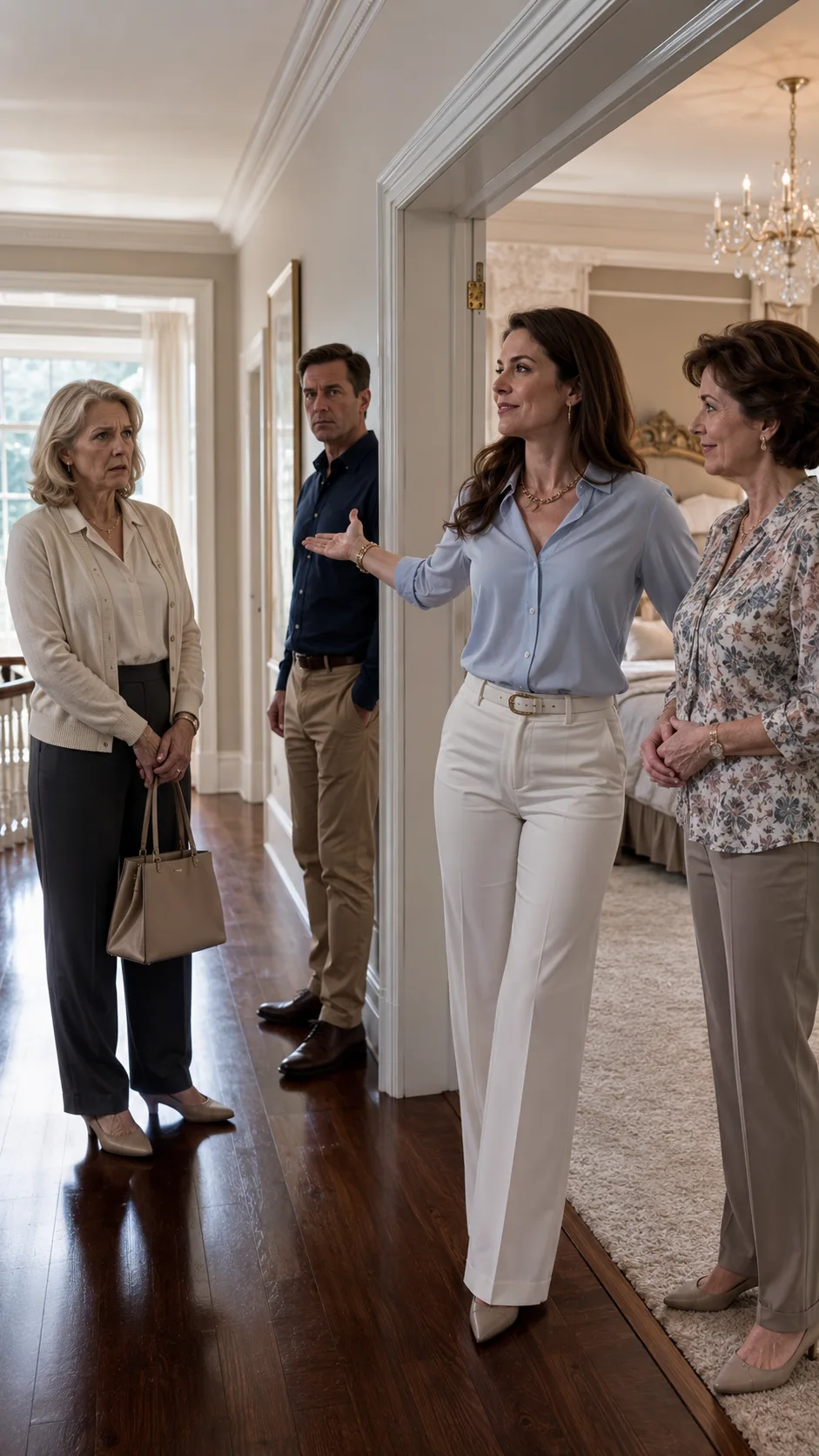
Rebecca was walking around the house with an older woman I did not recognize—sharp bob, expensive tote—pointing at windows, gesturing toward the garden areas, clearly giving some kind of tour.
They spent twenty minutes outside before Rebecca unlocked the front door with a key I definitely had not given her.
A key.
To a house she had just told me we had lost to other buyers.
I sat in my car, fury building with each passing minute.
Rebecca was showing my house to someone using a key she should not have had, barely hours after telling me we had lost our chance to buy it.
Then I watched her bring out a measuring tape.
They measured my living room.
My dining room.
My kitchen.
They were planning furniture arrangements for a house Rebecca thought belonged to someone else.
Unless she knew something I did not.
Unless this whole charade about other buyers and lost opportunities was covering up something much worse.
I called the property management company.
“Sarah, has anyone contacted you about accessing the Elm Street property?”
“No, Mrs. Stevens. You’re the only one with keys.”
“What about showing it to potential buyers?”
“The listing was taken down yesterday when you asked us to. No one else should have access.”
But someone did have access.
Someone was in my house right now, planning God knows what.
I made a decision that would change everything.
I drove home, called a locksmith, and had every lock on the mansion changed within two hours.
The locksmith, a man with forearms like old tree roots, whistled when he saw the brass.
“Victorian tumblers,” he said. “Pretty, but hungry for trouble.”
“Feed them new keys,” I said.
Then I called a security company and had cameras installed at every entrance, inside and out.
The technician showed me how to pinch and zoom, how to talk through the doorbell, how to bookmark clips.
“You can set alerts for faces you know,” he said. “Or, in your case, faces you’d prefer never to see again.”
If Rebecca wanted to play games with my property, she was going to discover I could play them better.
The locksmith was expensive.
The security system was expensive.
But watching Rebecca try to use her mysterious key on my front door the next morning?
Priceless.
I was sitting in the living room, boxes unpacked, coffee in hand, when I heard someone trying to unlock the front door.
The security app on my phone showed Rebecca on the porch, looking confused as her key failed to work.
She tried it several times.
Then she walked around to the back door.
Same result.
Then she called Kevin.
I could not hear the conversation, but I could see her gesturing angrily at the house, clearly frustrated that her secret access had been cut off.
Twenty minutes later, Kevin called me.
“Mom, the strangest thing happened. Rebecca drove by that house we were looking at, and she thinks someone might have changed the locks. She’s worried there might be squatters or vandalism.”
“Why would Rebecca be checking on a house we don’t own?”
A pause.
“She thought she saw broken windows from the street. She was just being a good neighbor.”
The lies were getting more elaborate, but they were still lies.
Rebecca had not seen broken windows because there were none.
She had been trying to access my house with a key she should not have had.
“Kevin, how did Rebecca get a key to that house?”
Another pause.
Longer this time.
“What key?”
“She tried to unlock the front door this morning. I saw her on the security cameras.”
Silence.
Then Kevin’s voice, carefully controlled.
“Mom, what security cameras?”
“The ones I had installed yesterday on my house. The house I own.”
The sound that came through the phone might have been Kevin choking on his coffee.
Or it might have been the sound of someone’s entire deception collapsing in real time.
“Your house,” he whispered.
“The house I bought six weeks ago with Henry’s life insurance money. The house I’ve been renovating while you and Rebecca planned to manipulate me into funding your dream home with my inheritance.”
The silence stretched so long I thought he had hung up.
Finally, he spoke.
“Mom, we need to talk.”
“Yes, Kevin, we certainly do. But first, I think you need to explain to your wife that trespassing on someone else’s property is illegal—even when you think you’re clever enough not to get caught.”
That evening, as I sat in my beautiful dining room eating takeout Chinese food off paper plates because I had not unpacked my dishes yet, I thought about how different this moment was from what I had originally planned.
I should have been hosting Kevin and Rebecca for a celebration dinner, toasting their new home and our bright future together.
Instead, I was alone in my house, watching security footage of my daughter-in-law trying to break in, while my son prepared to explain how they had planned to steal my inheritance through emotional manipulation.
But here’s the thing about rock bottom: the view from the top is so much better when you’ve earned it yourself.
Kevin arrived at eight o’clock sharp, looking like he had aged five years since our phone call.
Rebecca was not with him, which told me everything I needed to know about who was really driving their scheme.
“Mom, I don’t even know where to begin.”
“How about with how your wife got a key to my house?”
He sat heavily in my new living room chair, the one I had picked specifically because it was comfortable enough for elderly guests but sturdy enough to last decades.
The irony was not lost on me.
“She befriended the property manager’s assistant,” he said. “Told her she was your daughter-in-law, that you had asked her to check on the renovation progress while you were dealing with grief. Sarah’s assistant gave her a key for family access.”
I had to admire the audacity, even as it made my blood boil.
“So Rebecca has been monitoring my house purchase for weeks.”
He nodded miserably.
“She found out about it three days after you signed the papers. Your bank called to verify the wire transfer, and Rebecca answered your phone. She told them she was your financial power of attorney.”
The lies kept getting bigger.
“I never gave her power of attorney. She knows that.”
“But the bank representative didn’t ask for documentation over the phone. Rebecca got enough information to figure out what you had done.”
I poured myself a glass of wine, noting that my hands were perfectly steady.
Six months ago, this level of betrayal would have destroyed me.
Now it just felt like confirmation of what I had suspected.
“So instead of talking to me directly, you decided to manipulate me into funding your mortgage on a house I already owned.”
Kevin’s face crumpled.
“It was Rebecca’s idea. She said if we confronted you directly, you might get defensive about spending so much money. She thought if we could make you think it was our idea to buy the house, you’d feel better about helping us.”
“Help you buy a house from myself.”
“We didn’t think you’d actually want to live there alone. Rebecca figured you’d eventually want to downsize, maybe move into a senior community. We could buy it from you at fair market value. You’d get your money back, plus appreciation. Everyone would win.”
I stared at my son—this man I had raised to be honest and kind—and saw someone I barely recognized.
“Kevin, do you hear yourself? You planned to trick me into giving you money for a house I already owned, then convince me to sell it to you later?”
He rubbed his temples.
“When you say it like that, it sounds criminal.”
“Because it is criminal. It’s called fraud.”
He put his head in his hands.
“We never meant for it to go this far. Rebecca just got excited about the house, started planning, making lists. She thought if she could show you how perfect it would be for all of us—”
“All of us,” I said. “With me in the smallest bedroom.”
“That was never the plan.”
I pulled out my phone and showed him the security footage from that morning: Rebecca trying multiple keys, walking around the house, peering in windows, calling him in frustration.
“This was never the plan either, I suppose.”
The next morning, Rebecca called me directly for the first time in months.
Her voice had lost all pretense of sweetness.
“Margaret, Kevin told me about your little revelation. I think there’s been a misunderstanding.”
“Oh, I understand perfectly. You’ve been planning to defraud me for weeks.”
“That’s a very harsh way to put it. We were trying to find a solution that worked for everyone.”
I almost laughed.
“A solution where you get a mansion, I get a small bedroom, and the privilege of funding your mortgage.”
“You’re twisting our intentions. We never wanted to hurt you.”
“Rebecca, you answered my phone and impersonated someone with legal authority over my finances. You obtained keys to my property under false pretenses. You’ve been showing my house to other people without permission. What part of that was meant to help me?”
A long pause.
Then her voice changed completely, dropping the fake concern and revealing something much colder.
“Fine. You want to play hardball? You bought that house to manipulate us. You knew we were looking in that neighborhood. Knew we needed more space. You bought it specifically to dangle it in front of us, then snatch it away.”
The accusation was so ridiculous I actually laughed.
“Rebecca, I bought the house as a surprise gift for your family. I was planning to hand you the deed and tell you it was yours.”
“Right. That’s why you kept it secret for six weeks.”
“I kept it secret because I wanted it to be perfect before I surprised you. I had contractors working around the clock to make sure everything was exactly right for your family.”
Another pause.
“Prove it.”
“I’m sorry?”
“Prove you bought it as a gift. Show me the paperwork that says you intended to transfer ownership to Kevin.”
I realized then that Rebecca had never believed I might be generous.
In her mind, every action had an ulterior motive. Every kindness was manipulation.
She could not conceive of someone spending their inheritance on a gift for family members who had been taking her for granted.
“I don’t need to prove my intentions to you, Rebecca, but I can prove that you’ve been trespassing on my property.”
“Kevin’s your son. Family has a right to—”
“Family has a right to respect boundaries. You lost that right when you decided to lie and scheme instead of having an honest conversation.”
The conversation ended with Rebecca hanging up on me.
Twenty minutes later, Kevin called.
“Mom, Rebecca’s upset. She feels like you’re punishing her for caring about our family’s future.”
“Kevin, your wife committed multiple crimes. She’s not the victim here.”
“Couldn’t we all just sit down and talk this through? Find a way to make this work for everyone?”
I looked around my beautiful house, thinking about how many compromises I had made over the years.
How many times I had given in just to keep peace in the family.
“Kevin,” I said, “I’m done making things work for everyone else at my own expense.”
For two weeks, my phone rang constantly.
Kevin called every morning, Rebecca every afternoon, sometimes together in the evening.
The pattern was predictable: guilt, bargaining, anger, more guilt.
I started recognizing the scripts.
Guilt: “Your granddaughter needs stability.”
Bargain: “Just six months, then we refinance.”
Anger: “After all we’ve done for you.”
Then Kevin called one afternoon and said the sentence I knew was meant to break me.
“Mom, Rebecca’s pregnant.”
That stopped me cold.
“Pregnant?”
“She just found out. We weren’t going to tell anyone yet, but with everything going on—”
His voice carried a weight.
I recognized this was not just news.
It was ammunition.
“Congratulations,” I said carefully. “I’m happy for you both.”
“The thing is, with a baby coming, we really need more space. Rebecca’s morning sickness is already bad, and she’s worried about stress affecting the pregnancy.”
And there it was.
The pregnancy card, played exactly when I had started feeling strong enough to maintain my boundaries.
“Kevin, I understand you need more space. There are many lovely houses in your price range.”
“But Mom, this house is perfect. Rebecca’s already planned the nursery, picked out paint colors. She’s emotionally invested in—”
“My house,” I said. “The one she tried to steal from me.”
“She never tried to steal anything. She just got excited about the possibility.”
I hung up and called my lawyer.
If this was going to become a legal battle, I wanted to be prepared.
“Mrs. Stevens,” he said after I explained, “based on what you’ve told me, your daughter-in-law may have committed identity theft, fraud, and trespassing. Do you want to press charges?”
I thought about my grandchild growing up with a mother who thought manipulation was normal family behavior.
“Not yet,” I said. “But I want everything documented in case this escalates.”
That evening, Rebecca showed up at my door.
She looked genuinely terrible—pale and exhausted in a way that suggested the pregnancy news was real.
Her mascara had surrendered hours ago.
“Margaret, can we please talk? Just the two of us. No Kevin, no lawyers, no games.”
Against my better judgment, I let her in.
“I’m sorry,” she said, sitting on the edge of my sofa like she was ready to run. “I handled everything wrong. When I found out about the house, I panicked. Kevin and I have been struggling financially more than we’ve told you. His business has been slow. I haven’t worked since we got married, and we were behind on rent.”
It was the first honest thing she had said in months.
“Why didn’t you just ask for help?”
“Because you’ve already done so much—the down payment on our current place, the car repair last year, Christmas gifts for Kevin when he couldn’t afford them. I was embarrassed to ask for more.”
I understood that feeling.
The pride that makes you do stupid things rather than admit you need help.
“So instead of asking,” I said, “you decided to trick me.”
“I thought if I could make it seem like your idea to help us buy this house, you’d feel good about it instead of resentful. I thought I was protecting your feelings.”
Rebecca’s confession should have made me feel better, but it only made me angrier.
Because underneath her apology was the same condescending assumption that had driven everything else: that I was too fragile to handle the truth.
“Rebecca, I have been managing my own feelings for sixty-three years. I don’t need you to protect me from my own generosity.”
“I know that now. I made a mistake.”
“You made several mistakes—identity theft, fraud, trespassing, lying to my son about your actions.”
She flinched.
“Kevin doesn’t know about all of it.”
“What doesn’t he know?”
Rebecca looked around my living room at the furniture I had chosen, the photos I had hung, the life I had built without their input.
“He doesn’t know I’ve been planning to convince you to sign the house over to us as an early inheritance for tax purposes.”
I felt something cold settle in my stomach.
“Explain.”
“My uncle’s an accountant. He said if you give us the house now, instead of leaving it to Kevin in your will, it would save thousands in estate taxes. I thought after we were all living here together for a while, I could bring it up casually.”
The scheme was even more elaborate than I had realized.
Rebecca had not just wanted to manipulate me into funding their mortgage.
She had wanted to manipulate me into giving up ownership entirely.
“And if I refused?”
“I would have suggested that since you were getting older, it might be smart to transfer assets to family members to protect them from potential nursing home costs.”
Every word made it worse.
Rebecca had researched ways to separate me from my assets.
Planned conversations designed to make me feel like transferring ownership was my idea.
“Rebecca,” I said, “do you understand that what you’re describing is elder financial abuse?”
She went very still.
“That’s not what this was.”
“What else would you call systematically planning to trick an elderly family member into signing over valuable assets?”
“I was trying to help our family.”
“You were trying to help yourself at my expense.”
We sat in silence for several minutes.
Outside, I could hear children playing in the neighborhood park—normal sounds of normal families living normal lives without elaborate deception.
Somewhere, a dog barked at a mailman and then apologized with a wag.
“What happens now?” Rebecca asked finally.
“Now you and Kevin figure out your housing situation without involving my money or my property. You learn to budget, get second jobs if necessary, find a place you can actually afford. And the baby will grow up with parents who understand the difference between asking for help and committing fraud.”
Rebecca started crying then, the kind of exhausted sobbing that comes when someone finally understands they have lost everything through their own choices.
“Margaret, please. I know I messed up, but we could still make this work. You could live here. We could pay rent. Everyone could have what they need.”
I looked at this woman who had spent months planning to manipulate me out of my home and my money, who was now begging me to let her do exactly what she had originally schemed for.
“Rebecca,” I said quietly, “the fact that you think I should trust you with anything after what you’ve done tells me you still don’t understand how badly you’ve behaved.”
To be continued… Click “PART 3” to read the final part: 👉 PART 3 👈