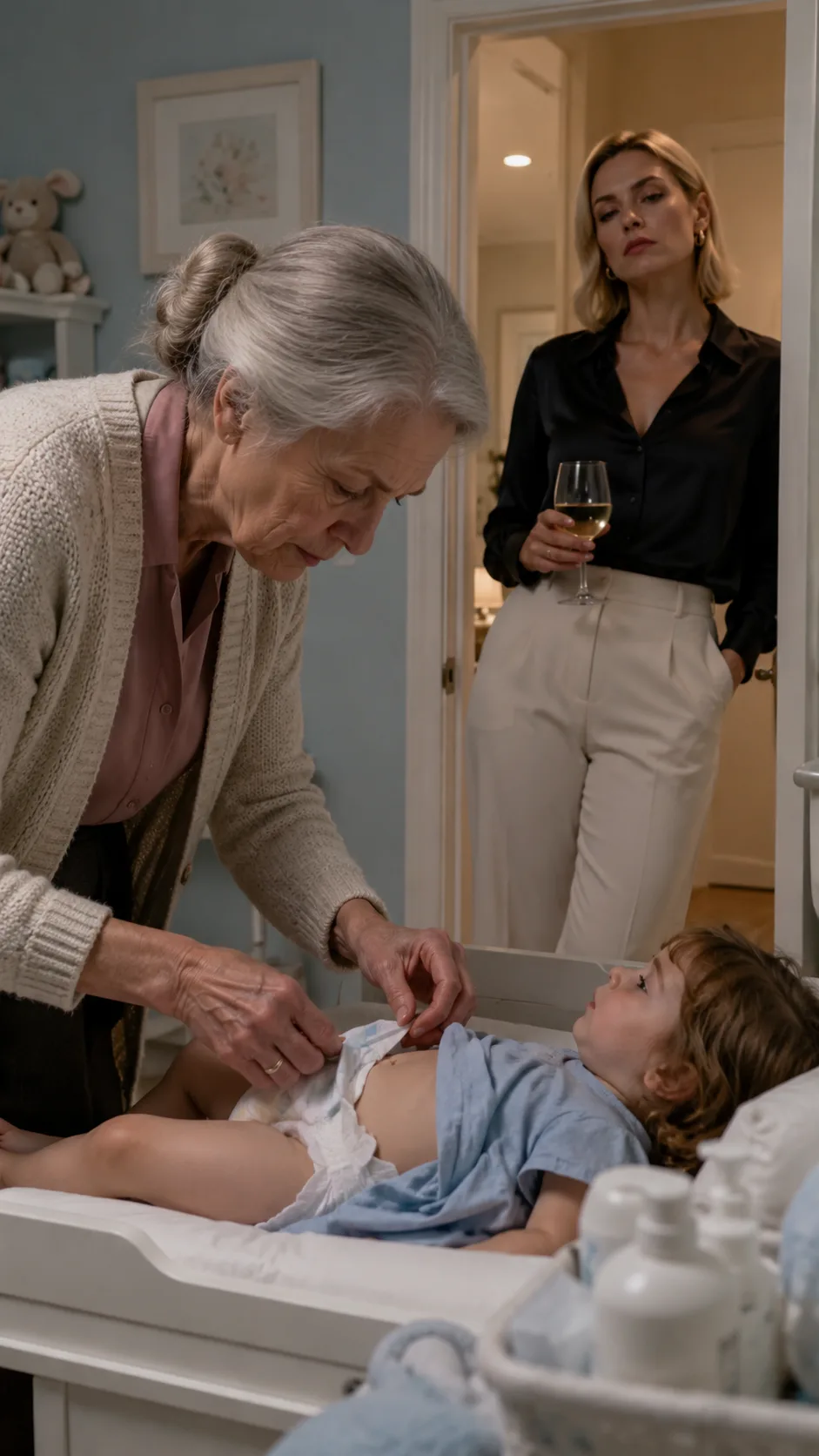
PART 3 — THE HOUSE THEY NEVER OWNED
A week later, I overheard my son on the phone while I scrubbed a high chair covered in mashed carrots.
Chapter 3
PART 3 — THE HOUSE THEY NEVER OWNED
A week later, I overheard my son on the phone while I scrubbed a high chair covered in mashed carrots.
He paced near the kitchen island, speaking in the clipped, confident voice he used when he wanted to sound like a man who could not lose.
“Yeah, we’ll flip the place next year. Easy. It’s worth at least 1.8 now. Mom is fine. She won’t be a problem. We’ll just shift the paperwork quietly. She probably thinks we’re still under the old arrangement.”
I rinsed the sponge. I dried my hands. I took the long way around the house, opened my filing cabinet, and placed one more copy of the updated deed into a labeled folder.
The label read: Emergency Exit.
Then came Sunday dinner.
I had made lemon-herb chicken the way my late husband liked it, with roasted carrots and potatoes crisped at the edges. My son barely looked at his plate before saying, “Too dry.”
My daughter-in-law did not sit right away. She was busy texting, sipping wine,
and whispering to a friend about spa reservations.
Halfway through dinner, my son looked up suddenly.
“Hey,” he said. “Where’s that envelope from Fidelity? The one with the deed copy? I had it in the drawer.”
He turned to me. His tone was casual, but his eyes were sharp.
I did not flinch.
“Oh,” I said, sipping my water. “I took it. I wanted to check something. I’ll return it after I’m done reviewing.”
There was a pause, the kind that lets silence do all the talking.
He nodded, but his throat moved. My daughter-in-law’s fork stopped midair. Across the table, their daughter looked at me, curious and confused.
I offered a small smile.
“I like to be thorough with paperwork,” I added.
Then I turned back to my plate.
They did not speak for the rest of the meal.
That night, I heard them whispering behind the hallway door.
Words slipped through the wood in fragments.
“Ownership.”
“Legal rights.”
“What if she changes something?”
The panic was not born from what I had said. It came from what I had not said.
They had built their arrogance on the assumption that I was weak. They were beginning to realize they had mistaken silence for surrender.
And that was only the beginning.
My son had a plan to sell the house and reinvest in a promising startup. He spoke about it the way some people discuss replacing an old lamp. He had placed me in the same category as dusty spoons, cracked picture frames, and broken chair legs.
He had lawyers lined up. A real estate consultant scheduled to tour the rooms. Photos prepared for promotional posts. He had even spoken about staging the house, as if my memories were clutter to be cleared away before strangers came through with
soft shoes and measuring tape.
All of this happened while I continued to knead biscuit dough in the kitchen, humming lullabies I used to sing to him.
I drank my tea and let him proceed because I had my own sources of leverage.
That afternoon, I composed a brief letter to his lawyer and another to the insurance company that held the file. In professional language, I thanked them for their attention and reminded them of the recorded clause stating clearly that the property could not be sold, transferred, or leveraged without my signature as the named owner.
I sent both letters by fax and certified mail. Quiet facts delivered to offices where facts still mattered.
The printer’s thin mechanical sound echoed in the unused office corner.
I did not need to yell. I needed them to stop.
It took two hours.
My son’s phone rang with a tone so sharp I could hear it beneath the hum of the stove fan. He answered in the den.
“Yeah,” he muttered. Then silence. “I understand. I’ll call you back.”
When he hung up, the usual smug confidence had drained from his posture.
Later that night, I saw him pacing near the fireplace, argument notes open on his tablet. His hand pressed against the marble mantel.
“They doubled my valuation,” he said to my daughter-in-law. “We’re going to miss the deadline.”
No one else knew it yet, but he had lost the deal.
Later, I heard him speaking to a potential investor.
“Look, I’m sorry. We hit a legal snag. The property apparently isn’t fully transferred. I know. I know. Thank you for your time.”
I did not gloat. I folded laundry in the silence.
The next morning arrived with tension thicker than August humidity. Raised voices came from the den. I pretended not to listen, but my name was tossed around like an accusation.
“Aunt Catherine has control.”
“She’s playing the long game.”
“What kind of mother does that?”
I remained invisible a little longer.
Then the real moment came.
My son called an impromptu meeting. Family only, no lawyers, just us at the large dining table that had once held warm casseroles, birthday candles, school projects, and Thanksgiving pies cooling under towels.
He was sweating. His wife sat beside him with her arms crossed. A cousin who had once given legal advice over cocktails looked suddenly very interested in the grain of the table.
My son cleared his throat.
“We need to talk about what’s happening with the house,” he said. “Who actually owns it legally?”
His eyes shifted toward me, then away, as if he expected me to fade into the chair.
I did not fade.
I sat upright with a linen napkin on my lap.
“I do,” I said.
Silence held for a heartbeat.
Then I outlined the facts. The deed had been reaffirmed legally. My signature was required for any sale. The title company had been consulted. The insurance had been amended to flag unauthorized transfers. The bank had copies. My lawyer had copies. I had copies.
“There is no sale without me,” I said. “There is no quiet transfer. There is no paperwork you can shift while I am in the kitchen.”
They stared.
The real estate consultant, who had been invited under the pretense of joining for coffee, shifted in his chair and looked toward the door. My son’s face turned pale. My daughter-in-law let out a small breath that almost sounded like a gasp.
I watched them crumble, not with joy, but with a steady resolve I had not felt in years.
It was not theatrical. No shouting. No grand speech. No slammed doors.
Only the tension in their throats and the sudden absence of answers.
One cousin whispered something to his wife and lowered his head. Another relative went white, rose from the table, and muttered about needing air.
I stood and walked from the room.
No applause followed. Only stunned silence.
Later, in my room, I closed the door and exhaled deeply. I did not weep. I simply released a breath I had been holding since the day they denied my worth.
I had not sought revenge. I had only claimed justice.
And in that dining room, beneath the chandelier they liked to boast about, they realized how dangerously confident they had been.
Some weeks later, I walked down the hallway and heard my son on the phone again.
“I’m sorry,” he said quietly. “I misunderstood everything.”
Those words were not meant for me. I did not step out to receive them. I let them echo through the rooms of the house, rooms that legally belonged to me, rooms full of proof that silence can build something stronger than any shouted confrontation.
Because justice delivered quietly carries a weight no denial can undo.
After that, I invited them with handwritten notes. No texts. No group chats. No casual messages passed through someone else. Just folded envelopes on the hallway table, each one addressed in my own script.
Family dinner. Sunday. No guests. 6:00 p.m. sharp.
They came, not because they wanted to, but because they were afraid not to.
The tension was thick before the salad reached the table. They knew something was coming. My son sat across from me, twisting his napkin. My daughter-in-law avoided eye contact. The cousins, siblings, and aunts sat stiffly, smiling the way people do in rooms where grief has not yet been named.
I waited until the soup bowls were cleared.
Then I stood.
“I want to speak,” I said, calm and clear. “Just for a few minutes.”
No one interrupted.
“I invited you here tonight not out of spite, but to restore balance. I am not here to embarrass anyone. But I will not protect what does not deserve protecting anymore.”
I placed the deed on the table. It was neatly folded, notarized, stamped, and filed. I did not slide it toward anyone. I simply let it sit there like a quiet truth.
“I am the legal owner of this house,” I said. “Fully, clearly, and without question. It has been filed, verified, and reinforced through every proper channel. There is nothing left to argue.”
My son’s hands trembled. His wife stared down at her shoes.
I continued.
“I am disappointed. Not only in how I have been treated, but in how easily you forgot who I was. You reduced me to a set of chores. A burden. A background figure. But I have lived more life than most people in this room. I raised you with everything I had. And when I stopped giving in the way you expected, you stopped seeing me.”
I looked my son in the eye.
“But I do not hate you.”
He blinked. His lower lip trembled.
“I do not seek punishment,” I said. “I seek respect. And now that the law recognizes my ownership, so will this family.”
He began to cry. Not dramatically. Not loudly. Silent sobs moved through his shoulders, the kind that come when a man realizes the fortress he built was made of sand.
He said nothing. He did not defend himself. He did not attack.
For once, he understood there was nothing he could say that would make the moment pass faster.
The relatives remained still. One aunt reached for her wineglass, then changed her mind halfway. A cousin whispered, “Jesus,” under his breath.
I sat back down.
“I will not evict you,” I added. “But I will not live here as a servant. From this day forward, I am not your maid, your babysitter, or your placeholder. I am the homeowner. I will live with dignity, or I will live alone. It is your choice whether you remain in this house under that truth.”
No one moved.
There were no arguments. I had not raised my voice. I had not brought a lawyer to the table. I had simply shifted the ground beneath their feet until they had nowhere left to stand.
After dinner, most of them left in silence.
My son stayed behind.
He did not ask for forgiveness. He knew it was not owed. But he did one thing.
He folded the deed slowly and handed it back to me.
“You’re right,” he said.
For that night, it was enough.
I signed the final documents one quiet afternoon, not with triumph, but with grace. My signature curved across the line, reaffirming the title fully in my name. I sent copies to the bank, the insurance company, my lawyer, and two people I trusted.
Each recipient confirmed in a polite, professional way that the house belonged to me, not only legally, but morally.
Then I wrote a short note to my son. I delivered it with a gentleness that spoke louder than any angry message could have.
“I no longer wish to carry burdens that do not belong to me,” I wrote. “Nor do I wish to weigh on your conscience. Please do not apologize because you feel cornered. I live now on my own terms.”
The next morning, I packed lightly.
A few dresses. My favorite shawl. Photo albums. The wooden box with the pearls. A stack of books I had always said I wanted to read but never had time for.
The movers took only the pieces I wanted: my small writing desk, my reading chair, my husband’s old bureau, and the dining table with its deep scratches from the carving knife he used every Thanksgiving.
No one asked why.
By then, it was understood.
I did not leave because they had won. I left because I finally could.
I moved into a small apartment not far away, but quiet enough to feel hidden. It sat on a gentle street lined with old oaks. From my window, I could see treetops, red-tiled roofs, and a church steeple in the distance. Mornings came in gold.
I chose the room with the biggest window and the least glare. I set my writing desk where the sunlight spilled across it. I placed a reading chair beside the bookshelf. I learned to make my coffee exactly the way I liked it, without anyone calling from another room before I had taken the first sip.
I woke when I chose to, not when I was needed.
Sometimes I caught myself smiling in the middle of an ordinary sentence, thinking about the simplicity of mornings when I read the New York Times and drank tea in my own quiet.
There is comfort in being judged by yourself again, in not having to prove your worth before breakfast, in not needing to justify the space your body occupies.
I was not alone. Every weekend, I walked through gardens, attended book readings, sat in café corners, and watched people pass by with grocery bags, dogs, strollers, and ordinary worries. I had rejoined myself.
I did not miss the drama. I did not yearn for an apology.
Apologies can be comforting, but they are often fleeting. What I needed most was not a pardon. I needed freedom from obligation disguised as affection.
That freedom, I claimed with care.
I was whole again.
So if someone is reading this, someone who has carried the weight of words that never matched the truth, someone who has stayed in rooms that dimmed their light because leaving felt unkind, hear me.
You can choose to stay, but not because someone allows you to. You stay because you choose to hold your space. Your presence is not a favor. It is your right.
You are not a guest in the life you built. You are not a burden because someone forgot what you gave. You are not less because your work was quiet.
You are home where your dignity is safe.
No matter who called you something smaller.
Now I wake before the sun. No alarm. Just dawn peeking through my curtains.
My apartment is quiet in a way the old house never was. There is no television running in the background, no silverware clattering beneath forced laughter, no footsteps coming toward my door with another request.
Instead, I hear the steady rhythm of my own breathing, the soft hum of the refrigerator, and the occasional flutter of wings outside the window.
Just yesterday, I found myself smiling when I caught my reflection in the hallway mirror. Not as Mother. Not as Grandma. Not as caretaker. Just Catherine.
My name is still written boldly on my driver’s license, but for a long time it had felt like it belonged to someone else. Now it belongs to me again.
I spent the afternoon making tea with jasmine petals. I arranged my bookshelf so old notebooks, military journals, and novels sat side by side, symbols of the past I carried and the future I now choose.
On the wall, I hung a small photograph of my younger self in uniform, hands steady in the ward, watching life return to someone who had nearly lost it. Next to it, I placed a photograph of the old house, quiet now, still mine, a testament not to money, but to endurance.
In the evening, I joined a local reading circle at the library. I listened more than I spoke, as I prefer now. An eighty-year-old poet read verses about spring buds breaking through cold ground, and I felt a deep solidarity in her words.
In her courage, I heard my own again.
This is not the life I imagined after all those years, but it is the life I earned by becoming true to myself.
A letter arrived two days ago, handwritten in shaky lines.
“Dear Mother,” my son wrote. “I am sorry for everything. I was wrong. I would like permission to visit when you feel ready.”
I stood in my kitchen with a pen hovering over a card. I thought of the years of silent dinners, of my truths being ignored, of footsteps I had followed as a child and footsteps my son should have learned to follow with care.
I wrote back simply.
“I live now by choice. I will invite you if the time comes when you are ready to listen first, not because I tell you to, but because you understand why listening matters.”
That is my peace.
I walk through my day by choice. I brew coffee by choice. I read by choice. I answer the phone by choice. I open my door by choice.
I remember the days when love felt conditional. Now love is a quiet flame I keep for myself first.
To anyone who has ever been told they are less, let that be your signal not to shrink, but to rise.
Let your absence teach them the value of your presence. Reclaim your story not for revenge, but for dignity. Build a home where your heart is heard.
It was not the house that made me whole again. It was knowing that I belong to myself first and always.
And so this is where it ends, not with triumph, but with steady resolve. A life rebuilt in stillness. A woman who spoke through silence and found home.
If you have ever felt overlooked, dismissed, or silenced, I hope you know now that you are not alone. Maybe they called you too sensitive, too stubborn, too slow. Maybe they rolled their eyes when you spoke, changed the subject when you remembered too much, or loved what you gave while forgetting who you were.
I know how that feels.
This story is mine, but the silence behind it belongs to too many of us. And the truth is, you do not have to shout to be heard. You do not have to slam a door or break anything to prove you exist.
Sometimes you only need to wait long enough for the world to realize what it lost when it stopped listening.
There are many quiet women who held families together with bare hands and tired hearts. Women who stayed kind even when no one applauded. Women who remember everything, especially the parts others tried to forget.
These are not just stories. They are testimonies. They are what happens when a quiet woman finally speaks, not to beg and not to punish, but to tell the truth.
And after seventy years, I have learned this: dignity has no expiration date. Wisdom does not rush. And when a grandmother finally remembers her own worth, the whole house feels it.
So stay a little longer in your own life. Pull up a chair. Listen, not only with your ears, but with the part of you that still remembers how it feels to be invisible.
Because what you hear in that silence might just be your own beginning.
THE END.
Chapter complete
You have reached the end of this chapter.
Continue reading
A few more worlds to get lost in after this chapter.




