PART 2 — THE PAPERS HIDDEN BEHIND THE TEA RECIPES
I could still feel the weight of my old medal resting against my chest, even though it had not touched my skin in years.
Chapter 2
PART 2 — THE PAPERS HIDDEN BEHIND THE TEA RECIPES
I could still feel the weight of my old medal resting against my chest, even though it had not touched my skin in years.
Decades earlier, I had earned it under the chaos of a military field hospital, far from the quiet lawns and two-car garages of the life I later built. As a head nurse, I held hands, steadied breathing, and helped mend wounds most people could not bear to look at.
I watched young men cling to life because someone refused to leave them alone. I learned that calm hands can be stronger than panic, and that a steady voice can hold a person together when the world around them is coming apart.
I was honored with a medal, an official acknowledgment from a government I served with everything I had. I never spoke of it much. I never placed it in a display case in the living room. I wore it only once, tucked under my blouse, when my husband took me to dinner and told me I looked like a
woman who had survived more than anyone would ever guess.
When my son was born, I placed that medal in a drawer and dedicated my life to raising him.
I exchanged field tents for a nursery. I exchanged hospital shifts for late-night feedings. I exchanged the disciplined rhythm of service for lullabies in a dim bedroom with a plastic mobile turning above a crib.
I left behind a career built on precision, courage, and responsibility. I gave up promotions. I gave up the respect of colleagues who wondered why I would step away when I was only beginning to be recognized. I gave it all up for bedtime stories, scraped knees, school plays, and peanut butter sandwiches cut diagonally because my son insisted they tasted better that way.
I still believed it was one of the finest decisions of my life.
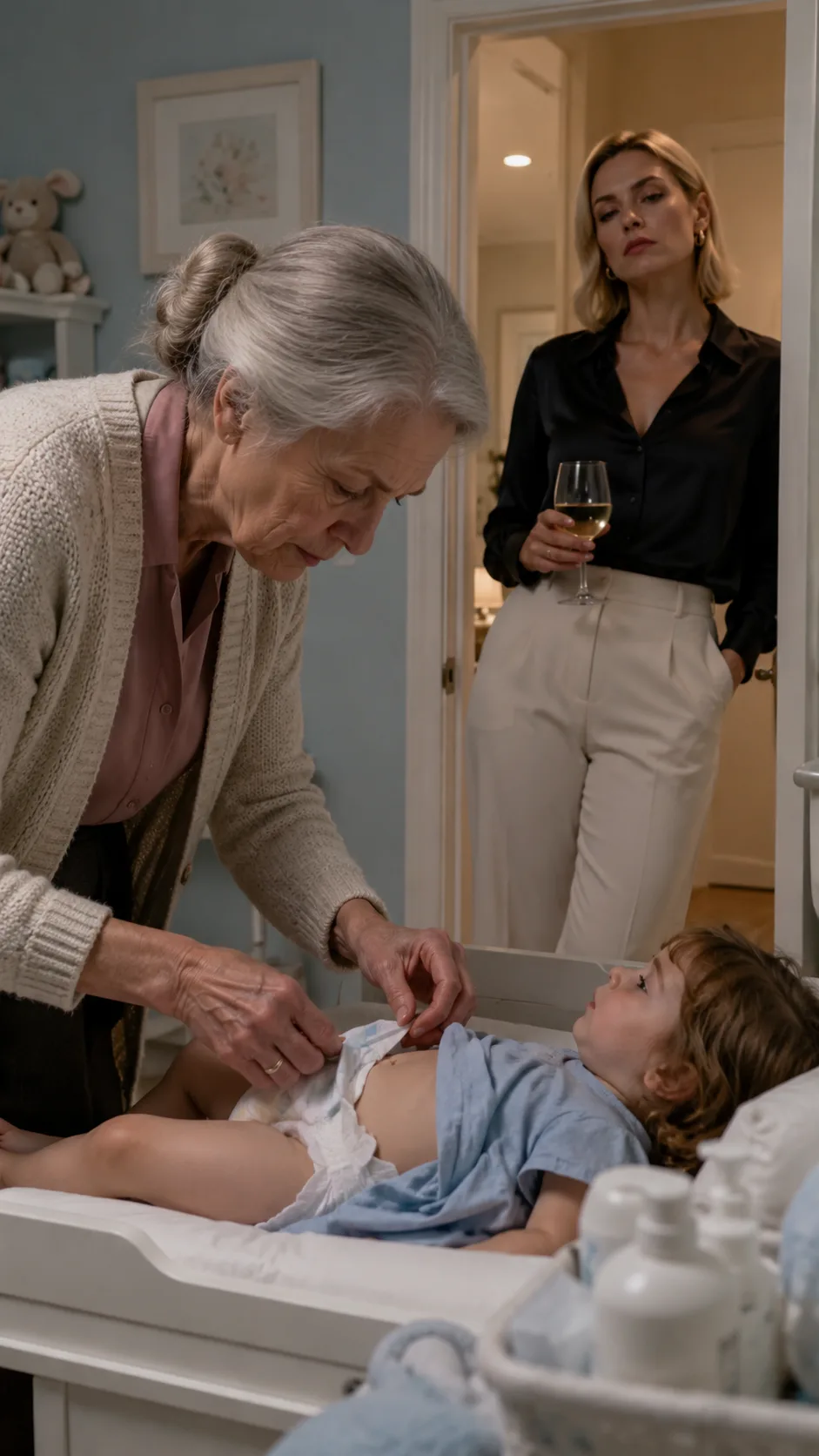
But now, as I bent over my granddaughter’s changing
table and lined her diaper just so, I heard the words that hollowed out every sacrifice I had made.
“You left your career because you were weak,” my son had said once, bluntly, with eyes colder than I had ever seen them. “Not because you sacrificed. You never made anything big.”
My daughter-in-law had added her own judgment without hesitation.
“If you were really that capable, you would have had your own place. You wouldn’t be here in my living room babysitting.”
It was the sort of cruelty delivered with casual indifference that leaves deeper marks than open anger. Anger can pass through a room and burn itself out. Indifference settles into the walls.
I stood among the crates of my son’s trophies, my daughter-in-law’s designer bags, and all the polished evidence of a life they believed they had built alone. They valued every award except the ones I had
earned. Every plate I washed, every bowl of oatmeal I stirred before sunrise, every whispered encouragement when my son doubted himself, every check I wrote, every time I stayed awake so he could rest, all of it had been erased.
My legacy, the home I helped shape, the child I raised, the love I poured into him until there was almost nothing left for myself, none of it mattered to them anymore.
They measured me only by my usefulness now. Was I convenient? Was I quiet? Could I watch the baby? Could I keep the kitchen clean? Could I be present when needed and disappear when company arrived?
It was a strange irony that a woman who had helped save lives was now called a liability in the house she had helped pay for.
I replayed old memories every morning. My son’s small hand wrapped around my index finger while I changed his diaper beneath the glow of a hospital nightlight after his first fever. The way I whispered, “You are brave enough to believe in love.”
I never imagined that same child would grow into a man who saw my love as something small enough to step over.
My daughter-in-law’s words festered in the corners of the house.
“You don’t deserve your own space. This little break we give you is charity.”
The meaning beneath it was clear. I was charity. I was something tolerated.
They never asked what it felt like to walk away from a life of service and climb into motherhood with both hands open. They never asked what it cost me, the education I paused, the leadership I left behind, the promotions I never took, the colleagues who looked at me with confusion when I said my son needed me more.
My son walked past old photographs on the mantel without seeing them anymore. In one, I stood in uniform, young and steady, my hands folded gently as I comforted a wounded soldier. In another, I was holding my son on the front steps of our first home, his little face pressed into my neck.
He did not glance at either one.
One afternoon, I asked him to pass me the milk from the refrigerator. He snapped before I could finish the sentence.
“I don’t pay for milk so you can stand around and complain about your old stories.”
He meant it.
My husband, rest his soul, used to say that history only keeps its worth when someone tells it honestly. In that house, they preferred forgetting. Forgetting made them comfortable. Forgetting allowed them to believe they had built everything alone.
So I learned to lean into silence. I learned to let dust gather on top of my sacrifices. I learned that if people are determined not to see you, standing directly in front of them will not change their minds.
But I never truly left my old strength behind.
I kept my diligence. I kept my care. I kept my principles burned into me. The same steady hands that once held chaos together now folded blankets and prepared baby bottles. The same voice that gave orders and comforted the frightened now read fairy tales in a soft whisper.
I adapted. I endured. But I never forgot.
Because when they pretended I existed only for their convenience, they made me more resolved to remember who I had been and who I still was.
Every morning, I woke before dawn. I carried my coffee into the kitchen and began the day washing dishes, wiping counters, stacking wood by the fireplace when winter came, and folding whatever laundry had been left in the machines overnight. By the time my son came downstairs, the house usually smelled like oatmeal, fresh bread, or coffee warming on the counter.
I was everywhere. Cooking. Cleaning. Folding. Guiding my granddaughter with wordless patience.
But I was never seen as myself.
I was treated as someone neutral. Someone ornamental. Someone assigned invisible labor.
They never asked what I thought. They redirected conversations with practiced ease, always keeping me behind the scenes. I wore aprons and soft shoes, not a seat at the table.
Once, I waited near the dining room to be invited to dinner while guests arrived in wool coats and polished boots, brushing snow from their shoulders. My son looked me up and down and said, “Mother, you should dress more tastefully when we have company.”
It was a polite way of saying, “We do not want you here as you are.”
I learned to choose long skirts over my old floral dresses, not because they were inappropriate, but because I had been made to feel that anything truly mine was embarrassing to them.
At a party for my daughter-in-law’s promotion, candles glowed bright on the dining table, champagne flowed into tall glasses, and guests asked to be introduced around the room. I stood beside the man I had taught to walk, the man I had taught to read, the man whose first apartment I had furnished with money I could have saved for myself.
One guest looked at me awkwardly and asked, “Is she the housekeeper, or…”
My daughter-in-law laughed before the question could finish.
“She’s just Mother,” she said. “She probably dressed that way because she only owns thrift-store clothes.”
No explanation. No correction. No hand on my shoulder. No “She’s the reason we have this house.” No “She served this country.” No “She raised him.”
Just Mother.
I responded with a gentle nod and a half smile. It is astonishing how silence can be sharper than words when a room knows something unkind has happened and chooses to pretend otherwise.
In that moment, something cracked. Not in their gratitude, because there had been so little left of it. Something cracked in mine.
I realized I had accepted their labels for too long. I had accepted small corners, half invitations, cold leftovers of respect.
I remembered that evening later as I folded my granddaughter’s pajamas. I remembered how I had stayed quiet when they asked me to help set the table but did not want me seated at it. I remembered how carefully they curated their image, and how my presence threatened to remind everyone there was a foundation beneath their success that they had not poured themselves.
I adored the life I had been given once. But now I had become a burden to the people who lived inside it.
One night, I sat in the hallway just outside the living room, where laughter echoed and glasses clinked a few feet away. Their party, their smiles, their easy confidence, all of it pressed against the years inside me. Years of brushing crumbs from floors. Years of bedtime stories no one remembered hearing. Years of holding up the ordinary scaffolding of their lives so invisibly they mistook it for air.
I counted the distance between what I had been and what they called me now. A retired nurse. A widow. A grandmother. A woman who loaded the dishwasher.
You can elevate a person or reduce her to dust with a shrug.
That thought came to me clearly. I could stop accepting crumbs of acknowledgment.
Their assumptions did not define my legacy.
I had kept papers. Documents. Deeds. Bank records. Insurance amendments. Mortgage files. All of them in a drawer hidden behind old tea recipes, because the people who thought I was simple never looked in places that smelled like chamomile and lemon.
I was never careless. I was only invisible until I decided not to be.
I did not want to be a burden. But I also refused to be unworthy.
I learned to let my silence accumulate strength. One day, the weight of everything ignored would become the force that moved my life back into my own hands.
Maybe then they would understand that respect is not granted once and kept forever. It is earned, even from a mother.
That night, as I folded the last towel and sipped a small cup of cold tea, I planned what would come next. I looked at the photo frames on the mantel, images of us as a family before love learned how to hurt, and I breathed in steadiness.
The years I had been overlooked were not empty years. They were years of saving quiet conviction. Invisible work done well is not lost. It grows. And when the hour is right, it becomes visible all at once.
When that hour came, I would not be seen as a caretaker, a grandmother, or an ornament. I would be seen as the woman who built the foundation they had been standing on.
A few days later, I carried a small wooden box to the table as if it held every memory I had ever saved.
Inside was an heirloom necklace passed down by my mother, and before her, by her mother. Pearls. Not especially modern, not flashy, but luminous in the way old things become when they have survived war, marriage, grief, and time.
The women in my family had worn those pearls on their wedding days. To me, they symbolized love strong enough to endure both peace and hardship.
I placed the necklace gently in my daughter-in-law’s hands.
“These were worn by women who came before us,” I said quietly. “I wore them after nights in the hospital wards, when I needed to remember that I came from strength. I want you to have them so you remember the strength that came before you, too.”
She glanced at the pearls, then at me. One eyebrow lifted.
She handed them back with casual cruelty.
“Look at your neck, Grandma,” she said. “That doesn’t match your outfit. You’re not at a gala. More like a museum exhibit, don’t you think?”
The pearls slipped through her fingers and fell against the table with a soft, scattered sound.
I did not pick them up immediately. I let them rest there, a reminder that heritage can be dismissed with one careless gesture by someone who has never had to protect it.
Later that evening, I sat beside my granddaughter at dinner, helping her scoop mashed potatoes onto her spoon. The dining room smelled of roast beef and rosemary. The chandelier threw neat little pools of light across the polished table.
I began to share a story.
“In the field hospital around midnight, after a terrible explosion nearby, we had to move quickly because—”
My daughter-in-law cut in before I could continue.
“Enough, Mother,” she said sharply. “We do not need those stories at the dining table. This is a family meal.”
She lifted her wineglass as if drinking could seal my silence.
I set my spoon down. The metal sounded louder than it should have.
Her smile was polite, thin, and practiced. In her eyes, I saw the same message I had seen for months.
You have nothing here.
I excused myself, leaving dinner half eaten. No one stopped me.
I retreated to what had become my room, a corner of the old home office behind stacks of paperwork and books I had bought decades ago. I closed the door and turned the lamp low. Then I reached beneath the folded quilts on the narrow bed and pulled out the gray folder I had kept hidden, even from the bank until the time was right.
Inside were the deed and mortgage records, all bearing the truth they had conveniently forgotten.
The house had been purchased with money my husband and I had saved. After he passed, I kept my name on the title. When my son married, I had allowed them to live there. When my daughter-in-law wanted to launch her business, I had taken on financial risk to help her begin. I expected gratitude then, or at least basic decency.
Instead, I was thanked with indifference.
The home had once been valued at $1.5 million, and because of my pension, careful payments, and a lifetime of frugality, it stood stronger than they knew. They talked about it as if it were already theirs. They forgot that signatures matter. Names matter. Records matter.
The folder snapped shut in my hands.
I exhaled the weight of decades. The years in which I allowed myself to be reduced to someone kind, useful, and invisible had ended.
I sat on the edge of the bed and laid one hand across the documents. I thought of nights spent whisper-reading to my son when thunder shook the windows. Mornings when I rose before dawn to pack his lunch. Winters when I shoveled snow from the driveway so he could reach the school bus warm and dry.
Those memories did not weaken me. They gave me focus.
I once saved lives with my hands. Now I would save myself with my mind.
The sentence fell from my lips so softly it seemed to move through the room like a draft. On the wall, a photograph of my younger self in uniform looked back at me, steady and unsmiling.
I tucked the documents into my purse the way I had once tucked bandages into a kit, with purpose and care. I left the empty wooden box on the bedside table, the pearls swallowed by shadow.
Then I walked back to the kitchen, breathing slow and controlled. I poured myself a cup of lemon tea, the kind my husband used to make for me when winter settled over the neighborhood. I held it like a chalice.
No tears came. Only a steady pulse of anticipation.
Later that night, I sat in the living room without calling for anyone. I opened old mail. I reviewed files I had prepared months earlier. The mortgage agreement contained fine print they had never bothered to ask about, language that protected me if anyone attempted a sale, transfer, eviction, or legal challenge without my consent.
I had signed carefully during a calm afternoon when everyone else assumed I was napping.
That was the thing about being underestimated. People leave you alone with their secrets.
I closed the file and felt the power of foresight. My smile was not cruel. It was restorative.
When I heard them go to bed, I stayed awake. At one point, I stepped into the hallway and looked toward my son’s door, where a strip of light showed beneath the frame. I walked barefoot across the carpet and stood there quietly.
I did not knock. I did not call his name.
I only placed a copy of one document beneath his door.
Quiet. Final.
Tomorrow, or maybe the day after, life would change. Not because of drama. Not because of anger. Because I had finally acted for myself.
If someone asked someday where the pearls went, I would smile and say, “They are safely stored, just like their worth.”
But I did not need to rush toward that day. That night, all I needed was to reclaim myself and what was mine.
And that, it turned out, was worth every unseen hour, every thankless chore, every denial of my worth.
It started with a phone call. Not a confrontation. Not a scream. Just the quiet beep of my old landline connecting to a law office I had known for years, the same office that had helped my husband and me buy the house my son now treated as his own.
The house where he said I could stay as long as I kept changing diapers and did not speak too much during dinner.
“Mrs. Graham,” the lawyer said, his voice warm and steady. “What can I help you with today?”
“I’d like to update and reaffirm the deed,” I said calmly, pressing the receiver closer to my ear. “And I’d also like to review the insurance and mortgage protections. Quietly.”
He did not ask why. He knew enough.
We made an appointment.
Over the next two weeks, while they lounged, laughed, and demanded extra tea with lemon, I signed legal documents in a quiet office downtown, across from a courthouse and a bakery that smelled of cinnamon rolls every morning.
The deed, still in my name, was reaffirmed. Additional protections were filed with the bank, ensuring that if anyone attempted to sell, refinance, or transfer the home without my approval, the action would be flagged immediately.
The house could not be touched without my notarized signature, and I kept that signature guarded more carefully than they could imagine.
I also restructured the property insurance, adding alerts for third-party real estate transactions and unusual private fund transfers tied to the property. The insurance team called it a quiet safeguard.
I called it survival.
They had assumed I was invisible. Soon they would learn I had simply been watching.
To be continued… Click “PART 3” to read the final part: 👉 PART 3 👈
Chapter complete
You have reached the end of this chapter.
Continue reading
A few more worlds to get lost in after this chapter.




