PART 3 — Ninety Days to Take Back My Home
She drafted a letter that afternoon.
Chapter 3
PART 3 — Ninety Days to Take Back My Home
She drafted a letter that afternoon.
It was not dramatic. That disappointed and comforted me at the same time.
There were no threats. No accusations. No emotional language. It stated that I was the owner of the property, that Daniel and Kristen had been allowed to stay temporarily, and that the arrangement would end ninety days from the date of the letter. It requested that they vacate the home by that date and return all areas of the property to my sole use and possession.
Ninety days.
A number.
A date.
A line on the calendar.
I printed the letter at the library because I did not want to use the printer at home. The young man at the desk showed me how to release the file from the computer station, and I felt foolish for nearly crying over three sheets of paper.
On the drive home, I passed the plazas and traffic lights I had
known for years. The pharmacy where Peter used to pick up prescriptions. The grocery store where Daniel once got lost for six terrifying minutes when he was four. The little diner where Carolyn and I sometimes met for breakfast after retirement.
Everything looked ordinary.
That was the strange thing about life-changing decisions. The world did not dim the lights. No music swelled. Nobody standing at the crosswalk knew that the envelope on my passenger seat felt heavier than a brick.
When I got home, Daniel was in the living room with Lily on his lap. A cartoon played on the television. My armchair had his work bag on it.
I stood in the doorway for a moment.
Then I walked over, picked up the bag, set it on the floor, and sat down.
Daniel looked surprised.
That should tell you how far things had gone. My sitting in my own
chair startled my son.
“Mom?” he said.
“I need to talk to you.”
Lily looked up at me.
“Grandma, want to watch?”
“In a little bit, sweetheart.”
Daniel shifted her onto the couch beside him and muted the television.
I had rehearsed a speech in the car, but the moment I saw his face, the speech disappeared. He was still my boy. Older, yes. Tired around the eyes. A little heavier in the face. But still Daniel.
That made it harder.
I handed him the envelope.
“What’s this?”
“A formal notice.”
His expression changed before he even opened it.
“What kind of notice?”
“I’ve spoken with a paralegal. You and Kristen need to find another place to live. I’m giving you ninety days.”
He stared at me.
For one full breath, he looked like a stranger.
Then he laughed once, not because anything was funny, but because he did not
know what else to do.
“You called a lawyer?”
“A paralegal.”
“Mom.”
He said it as if my name itself should have stopped me.
“I should have done it sooner,” I said.
His face reddened.
“This is a huge overreaction.”
“No, Daniel. It’s a delayed reaction.”
He looked down at the letter, then back at me.
“We were going to leave soon anyway.”
“When?”
He opened his mouth.
No answer came.
“When, Daniel?”
“We were figuring things out.”
“You’ve been figuring things out for ten months.”
“That’s not fair.”
“It is fair. It may not be comfortable, but it is fair.”
Kristen came in from the kitchen then. She saw the envelope in Daniel’s hand and stopped.
“What’s going on?”
Daniel did not answer.
I turned to her.
“I’ve given you both formal notice. The temporary living arrangement is ending. You have ninety days to find another place.”
Her face went still.
She was good at stillness. I had learned that about her. Some people yell when they are angry. Kristen arranged her face like a table setting, every piece polished and in place.
“You went to a lawyer?” she asked.
“A licensed paralegal.”
“Without discussing it with us first?”
“I have been discussing it with myself for months.”
“That’s not the same thing.”
“No,” I said. “It isn’t. And I should have been clearer from the beginning about what living here would look like. That was my mistake.”
Daniel looked at me then, maybe hearing what I was trying to do. I was not pretending I had handled everything well. I had not. I had let resentment grow in the dark because I was afraid to turn on the light.
“But I’m being clear now,” I continued. “This is my home. I will not live in one part of it while you make decisions about the rest.”
Kristen crossed her arms.
“No one said you couldn’t use the house.”
I looked at her.
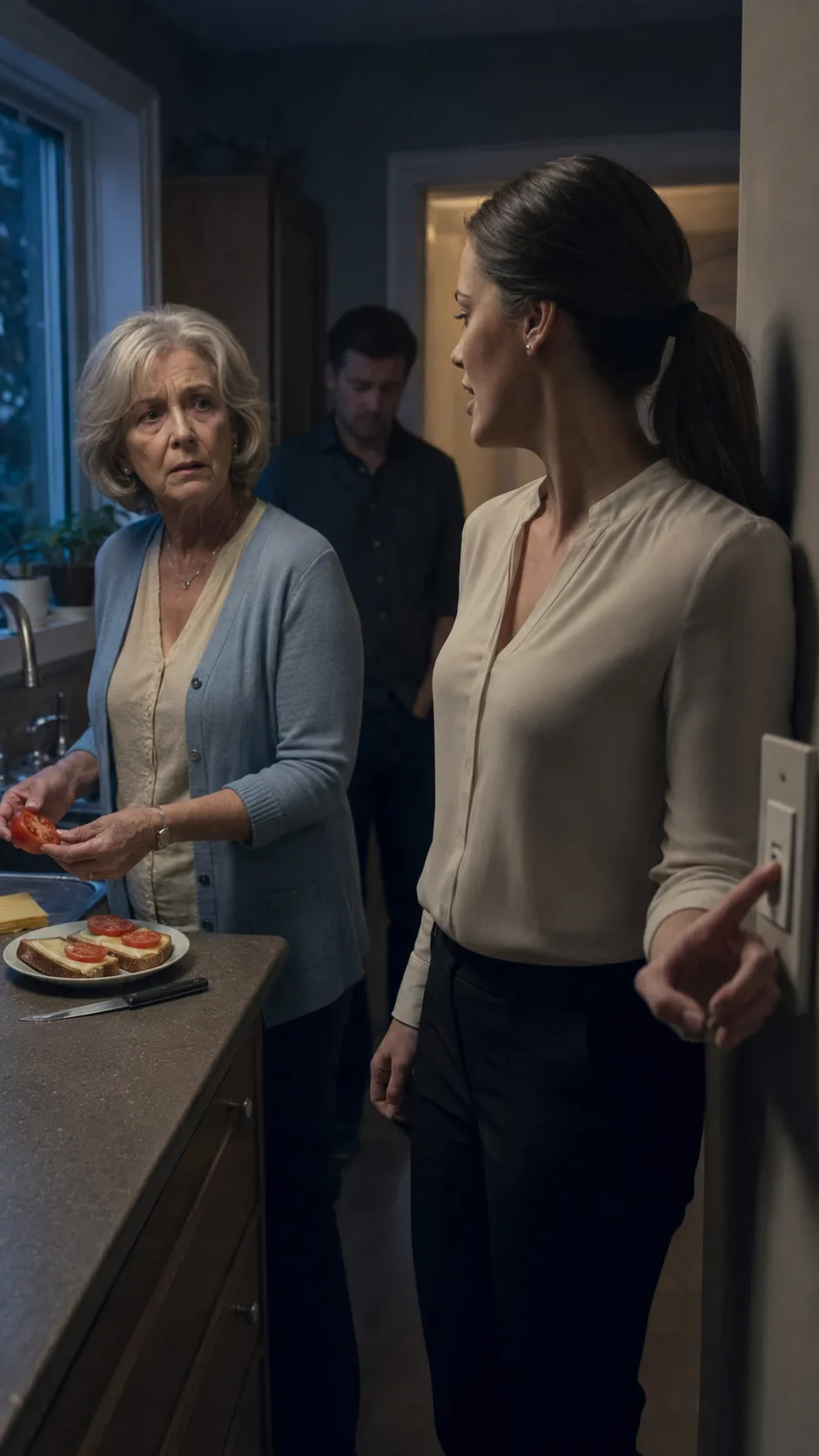
“You turned off the kitchen light while I was making dinner and told me to eat in my room.”
Her lips parted, then closed.
Daniel looked at her.
That was the first moment I saw something shift in his face.
Not enough.
But something.
Kristen recovered quickly.
“That was one night. We had a guest.”
“I was already making my dinner.”
“It was awkward.”
“Yes,” I said. “It was.”
Silence settled in the room.
Lily, sensing something, climbed off the couch and came to stand beside my chair. She put her hand on my knee.
“Grandma sad?”
I covered her little hand with mine.
“No, sweetheart. Grandma is all right.”
But I was not all right.
Not yet.
That evening was the beginning of the most uncomfortable season of my life.
People like to tell stories about taking back power as if one brave moment fixes everything. It does not. Sometimes the brave moment is only the door opening onto weeks of strained breakfasts, tight smiles, closed bedroom doors, and the heavy knowledge that every ordinary sound in the house now means something.
The next morning, Kristen did not come downstairs until after I had finished my coffee.
I made enough for myself.
Not because I was punishing her. Because I wanted coffee, and I was no longer organizing my movements around her comfort.
Daniel came down around seven, already dressed for work. He paused when he saw me at the kitchen table.
For months, I had taken my tea to the sitting room by that hour.
Now I was reading the newspaper beside the window.
“Morning,” he said.
“Good morning.”
He opened a cupboard, then closed it. He looked tired.
“Are we really doing this?” he asked quietly.
“Yes.”
He leaned against the counter.
“Mom, ninety days isn’t a lot of time.”
“It’s more than you gave me when the kitchen became yours.”
He flinched.
I did not enjoy that. I want that understood. There was no pleasure in hurting him.
But there was relief in finally telling the truth.
“I didn’t know you felt that way,” he said.
I folded the newspaper.
“Did you ask?”
He looked down.
“No.”
That one syllable contained more honesty than any speech he could have made.
Kristen entered a moment later, and the conversation ended.
That became the pattern for a while.
Almost-conversations.
Unfinished apologies.
Defensive remarks that died halfway through.
The house felt like weather before a thunderstorm, pressure building in the walls.
Kristen became polite in a way that made every sentence sharp.
“Do you need the kitchen right now, Margaret?”
“Would you prefer your mug back in this cupboard?”
“I wasn’t aware the living room arrangement was permanent.”
She never raised her voice. She did not need to. Polite cruelty can enter a room wearing clean shoes and still leave mud everywhere.
I answered calmly, even when my hands shook.
“Yes, I need the kitchen.”
“Yes, I prefer my mug where I kept it.”
“Yes, the photograph of my husband belongs on the mantel.”
The first time I moved Peter’s photograph back, Daniel watched from the hallway.
I dusted the frame with a soft cloth and placed it in the center of the mantel, where it had always been. Peter was smiling in the picture, one arm around me, the two of us standing near the lake on a windy day. My hair was shorter then. His jacket was unzipped. We looked younger than I remembered feeling at the time.
Daniel came closer.
“I didn’t know Kristen moved that,” he said.
“You didn’t notice?”
He looked at the photograph.
“No.”
I believed him.
That was part of the ache.
Daniel had not become cruel. He had become inattentive. He had allowed his wife’s preferences, his own stress, and my silence to build a version of the household where I faded naturally into the background.
Neglect is not always loud. Sometimes it is a son walking past his father’s photograph for months and not noticing it is gone.
The week after the notice, Kristen’s mother called me.
Her name was Elaine. I had met her several times, mostly at birthday parties and holidays. She was the sort of woman who wore perfume to casual lunches and spoke in a voice that suggested she was always one sentence away from being disappointed.
“Margaret,” she said, “I hear there’s been some trouble.”
I stood in the garden with my phone in one hand and a pair of pruning shears in the other.
“That depends on what you were told.”
“I was told you served Daniel and Kristen with some kind of legal notice.”
“I gave them formal notice that the temporary arrangement is ending.”
“They have a child.”
“I’m aware. I take care of her three afternoons a week.”
“They’re under tremendous pressure.”
“So am I.”
There was a pause.
Elaine was not used to that answer.
“I just think family should work these things out without paperwork.”
“I agree,” I said. “That would have been better.”
“Then why not withdraw it?”
“Because we didn’t work it out without paperwork.”
She exhaled.
“Kristen feels very unwelcome.”
I looked toward the kitchen window, where my mother’s bread bin should have been visible but was still in the garage because I had not yet gathered the heart to bring it back.
“Kristen told me to eat in my bedroom while she had a guest at my table,” I said. “Feeling unwelcome is not always evidence that you have been mistreated. Sometimes it means someone has finally stopped letting you mistreat them.”
Elaine did not call me again.
Daniel did not appreciate that conversation.
“You talked to Elaine?” he asked that night.
“She called me.”
“What did you say?”
“The truth.”
He rubbed his forehead.
“This is getting embarrassing.”
That word opened something in me.
Embarrassing.
I thought of the night I sat on my bed with a plate in my lap. I thought of my mother’s bread bin on the garage floor. I thought of the way I had learned to move quietly through my own hallway so I would not interrupt their evenings.
“Yes,” I said. “It is.”
He looked at me, startled by my agreement.
“It should have been embarrassing months ago,” I said. “Just not for me.”
He left the room.
But he did not slam the door.
That mattered.
Little by little, Daniel began to see.
I do not know what happened between him and Kristen privately. I never asked. Marriage is a room even mothers should not enter without invitation. But something changed after the second week.
He started making coffee in the morning, enough for both of us.
The first time, I came into the kitchen and found a mug waiting near the pot.
“I made extra,” he said, not looking directly at me.
“Thank you.”
It was not an apology.
It was something smaller, which sometimes is where apologies begin.
A few days later, I was pulling weeds in the garden when he came outside and sat on the back step. He did not bring his phone. That alone felt significant.
“Remember when Dad built those planter boxes?” he asked.
I looked at the raised beds.
“You mean when he built one straight and three crooked?”
Daniel smiled faintly.
“He said the tomatoes wouldn’t care.”
“They didn’t.”
We sat with the late afternoon light on the fence.
After a while, he said, “I’m sorry I didn’t notice.”
I kept my eyes on the garden.
“What didn’t you notice?”
He was quiet long enough that I almost thought he would retreat.
“Any of it,” he said. “How much space we were taking. How much you had given up. I told myself you liked being in your room because you didn’t complain.”
“That is a dangerous thing to assume about someone.”
“I know.”
“I should have spoken sooner.”
He shook his head.
“Maybe. But I should have looked.”
There it was.
Not enough to fix everything.
But enough to begin.
Kristen was harder.
I do not say that to make her a villain. She was not a villain. Life is rarely that convenient. She was a woman in her thirties who had discovered that adulthood was more expensive and less forgiving than she had expected. She was living in her mother-in-law’s house with a toddler, a strained marriage, bruised pride, and no clear exit plan. She felt dependent, and because that feeling humiliated her, she tried to create control wherever she could.
The kitchen.
The pantry.
The furniture.
The schedule.
Me.
Understanding that did not erase the harm. It only made the harm more human.
One evening, about a month after the notice, I found her in the garage.
She was standing near the shelves where some of my things had been pushed over the months. Canning jars. Christmas decorations. Peter’s old toolbox. A cardboard box of pantry items she had moved downstairs. And beside it, my mother’s bread bin.
Kristen had the lid in her hand.
I stopped at the doorway.
She turned.
“I was looking for the cooler,” she said.
“It’s on the top shelf.”
She glanced at the bread bin.
“I didn’t know it was your mother’s.”
“No,” I said. “You didn’t ask.”
Her face tightened.
“I thought it was just old.”
“It is old.”
“I mean, I didn’t think it mattered.”
“That was the problem.”
She set the lid down carefully.
For a moment, she looked younger than usual. Not innocent, exactly, but less armored.
“I’m not good at this,” she said.
“At what?”
“Living in someone else’s house.”
I almost said, “Then you should have remembered it was someone else’s house.”
But I did not.
Instead, I said, “I’m not good at disappearing in my own.”
She looked at me.
There was no dramatic apology. No tears. No embrace in the garage beside the snow shovel and old paint cans.
She only said, “I shouldn’t have turned off the light.”
“No,” I said. “You shouldn’t have.”
“I was embarrassed. My colleague was coming. I wanted things to seem normal.”
I waited.
She looked down.
“And I made you the thing that seemed abnormal.”
That was the closest she came to naming it.
I accepted it, not because it was complete, but because it was true.
The next morning, my bread bin was on the kitchen counter.
I did not ask who put it there.
I washed it carefully, dried it with a tea towel, and placed it beside the kettle, near the window.
The right place.
The right amount of space.
As the ninety-day date came closer, practical matters took over.
Daniel and Kristen looked at rentals in Hamilton, Burlington, Milton, and farther west. Everything was expensive. Every viewing had twenty applicants. Daniel came home discouraged more than once, and I had to fight the old instinct to soften the consequence for him.
A mother’s hand wants to reach out even when reaching out is what created the problem.
One night he sat at the table with his laptop open, rental listings reflected in his glasses.
“This is impossible,” he said.
“No,” I replied, rinsing a mug at the sink. “It’s difficult.”
He looked up.
“Is there a difference?”
“Yes. Impossible means there is nothing to do. Difficult means you keep doing what needs to be done.”
He smiled sadly.
“You sound like you did when I was failing chemistry.”
“You weren’t failing. You had a sixty-two.”
“That felt like failing.”
“And yet you survived.”
He returned to the listings.
The next week, they found a small rental house in Hamilton. Not perfect, but livable. Two bedrooms, a patch of yard, older kitchen, decent school catchment, close enough to Kristen’s work to manage. The rent was higher than they wanted, lower than they feared. Their credit union helped restructure some debt. Elaine helped with the deposit, though I only learned that later.
They were set to move out two weeks before the notice expired.
Once there was a date, the house changed again.
Boxes appeared.
Packing tape screeched across cardboard.
Lily asked why her books were going away.
Daniel carried bags to the car for donation.
Kristen moved through the rooms with a different energy, less ownership now, more urgency.
I expected to feel only relief.
I did feel relief.
But there was grief mixed into it.
That surprised me.
Not grief for the arrangement. I wanted my home back. I never doubted that.
But grief for what I had hoped the arrangement might become.
I had imagined Sunday dinners. Lily in the garden. Daniel fixing things around the house while I made coffee. Kristen and me finding some gentle rhythm, not mother and daughter, perhaps, but family. I had imagined being useful without being used.
Letting go of a bad situation sometimes means grieving the good version you kept waiting for.
Click the blue “PART 4” below to read the final part:
Chapter complete
You have reached the end of this chapter.
Continue reading
A few more worlds to get lost in after this chapter.




