PART 2 — The Phone Call That Drew a Line
Peter and I bought it in the late 1980s, when the paint on the shutters was peeling and the basement smelled like damp carpet.
Chapter 2
PART 2 — The Phone Call That Drew a Line
Peter and I bought it in the late 1980s, when the paint on the shutters was peeling and the basement smelled like damp carpet.
We could barely afford it then. The first winter, the furnace coughed like an old man. The upstairs bathroom had pink tile that Daniel once called “salmon wall disease.” The kitchen cabinets stuck in humid weather, and the front steps leaned slightly to the left.
We fixed it one piece at a time.
A new roof after Peter got a bonus.
A better furnace after a cold snap froze the pipes.
A kitchen update after years of saying, “Maybe next summer.”
When Peter passed, I paid off the last of the mortgage with insurance money and savings I had guarded like a woman protecting a flame in the wind. I still remember walking into the bank on a gray Thursday morning with the final paperwork in my purse. I had cried in the car afterward, not because I felt rich, but because the house was finally safe.
At least I
thought it was.
Daniel called me in October, two years before the night in the kitchen.
I remember it clearly because I was standing outside the grocery store with a bag of apples in one hand and a pharmacy receipt in the other. It had just started to drizzle, that thin Ontario rain that makes everything shine but never quite washes anything clean. His name appeared on my phone, and I smiled before I answered.
A mother’s heart is foolish that way. It remembers the child before it recognizes the man.
“Hi, Mom,” he said.
There was warmth in his voice, but it was too careful. Daniel had a tone he used when he wanted something and hoped I would make it easy for him.
“Everything all right?” I asked.
“Yeah. Yeah, everything’s fine. I just wanted to talk to you about something.”
I sat in the car before starting
the engine.
He told me he and Kristen were struggling. Their rent in Mississauga had gone up again. Daycare for Lily was more expensive than they had expected. Groceries, gas, car payments, insurance, everything had piled up. His hours at work had been cut for a while, then restored, but the damage was already done. Kristen was picking up extra clients where she could, but it still was not enough.
“We just need a few months,” he said. “Just to get back on our feet.”
I did not ask how much debt they had.
I did not ask why they had not told me sooner.
I did not ask what “a few months” meant.
I said yes before he finished explaining.
Because he was my son.
Because I remembered him at seven years old, sitting at my kitchen table with a hockey sticker on his lunchbox and jam on his
sleeve. Because I remembered driving him to practice before sunrise, both of us half asleep, the windows fogging while he balanced a travel mug of hot chocolate between his knees. Because I remembered him at thirteen, too proud to cry after Peter’s diagnosis, and at twenty-two, walking across the graduation stage at McMaster while I clapped until my hands hurt.
I said yes because love has a way of answering before wisdom gets a chance to speak.
They moved in on a Saturday.
A rented truck backed into my driveway just after ten in the morning. Daniel climbed out wearing a sweatshirt I had bought him three Christmases earlier. Kristen stepped down from the passenger side with a coffee cup in one hand and her sunglasses pushed up in her hair. Lily was two and a half then, bundled in a pink jacket, clutching a stuffed rabbit by one ear.
“Grandma!” she shouted when she saw me.
That one word softened every worry I might have had.
I had prepared the house as if I were welcoming guests for a holiday, not a family in trouble. I washed the sheets in the guest room and tucked a lavender sachet in the drawer. I cleared half the closet. I moved boxes out of the small second bedroom so Lily could have space for her crib and toys. I bought a step stool for the bathroom, extra towels, plastic bowls with little flowers on them, and a nightlight shaped like a moon.
Kristen hugged me at the front door.
“Thank you,” she said. “Really, Margaret. This is just for a little while.”
I believed her.
For the first few weeks, the house felt full in a way I had missed without admitting it.
There were little shoes by the door. Children’s songs floated down the hall. Daniel fixed the loose handle on the basement door without being asked. Kristen cooked twice the first week and insisted I sit while she made pasta with roasted vegetables. Lily followed me into the garden and helped pick the last cherry tomatoes, though she ate more than she carried inside.
At night, after they went upstairs, I would stand in the kitchen rinsing mugs and feel a kind of tired happiness.
The house had noise again.
The house had footsteps.
The house had family.
By the second month, small things began to change.
Not bad things, exactly. Not things a person could easily complain about without sounding petty.
The mugs moved.
Then the plates.
Then the coffee maker shifted from one side of the counter to the other because Kristen said it made more sense near the outlet.
One morning, I opened the cupboard where I had kept tea for twenty years and found protein powder, Lily’s snack containers, and Kristen’s vitamins.
My tea was in a lower drawer.
I bent to retrieve it and told myself it was fine.
Kristen was younger. She had her own way of doing things. She was trying to feel at home. I wanted her to feel comfortable. I wanted this arrangement to work.
Then she reorganized the pantry.
I came home from a routine dental appointment to find every shelf emptied and wiped down. Cans of beans, tomatoes, soup, peaches, and broth were stacked in cardboard boxes by the basement stairs.
“I hope you don’t mind,” Kristen said, standing in the pantry doorway. “There was a lot of expired stuff.”
“Expired?” I asked.
“Or just old-looking. I didn’t throw anything away. I just moved it downstairs. It was cluttering the shelves.”
The shelves now held clear plastic containers with labels, cereal decanted into tall bins, pasta lined up by shape, and snacks arranged in little baskets.
It looked like a magazine picture.
It did not look like my pantry.
I found my mother’s ceramic bread bin on the floor of the garage the following week.
It was cream-colored with a small painted bird on the lid. My mother had kept it on her own counter in Hamilton for as long as I could remember. After she died, it was one of the few things I asked for. Not jewelry. Not china. That bread bin.
I stood in the garage holding it against my hip, my throat tight with a feeling I did not want to name.
Later, I brought it up.
“Kristen, did you move the bread bin?”
She glanced up from wiping Lily’s hands.
“Oh, yes. I was trying to clear counter space. It’s sweet, but it doesn’t really go with the kitchen now.”
“The kitchen now,” I repeated.
She smiled, not unkindly, which somehow made it worse.
“I just mean with everything more open.”
Daniel was at the table, scrolling on his phone.
He did not look up.
I carried the bread bin back to the counter that afternoon. Two days later, it was in the garage again.
This time, I left it there.
That was how it happened.
Not all at once.
Not with shouting or threats or one dramatic moment where I could point and say, “This is when they crossed the line.”
It happened through a hundred small surrenders.
A shelf.
A lamp.
A chair.
A dinner time.
A silence.
By month four, the rhythm of the house belonged to them.
Daniel and Kristen ate late, usually around eight-thirty or nine. Kristen said that was when Lily finally settled, and cooking together was the only time she and Daniel had to talk. I began eating earlier. At first, I told myself it was practical. I had always preferred dinner around six anyway.
Then I began taking my plate to the small sitting room near my bedroom so they could have the kitchen.
Then I stopped watching television in the living room after seven because they liked to use the big screen.
Then Daniel’s work bag started appearing on my armchair.
Then Kristen’s throw pillows replaced the ones I had bought after Peter died.
Then the framed photograph of Peter and me at Niagara-on-the-Lake was moved from the mantel to the bookshelf in the hallway.
When I noticed, Kristen said, “It looked a little crowded in there.”
Crowded.
My husband’s photograph was crowded in the room where he had spent twenty-three years drinking coffee, reading the paper, and falling asleep during hockey games.
I said nothing.
That sentence is painful to write.
I said nothing.
I had reasons. At least I thought they were reasons.
Daniel was under pressure. Kristen felt embarrassed about needing help. Lily deserved stability. Housing was expensive. Families were supposed to make sacrifices. It was temporary. It was only a few months. It was not worth a fight.
But beneath all those reasons was something less noble.
I was afraid that if I pushed too hard, my son would pull away.
When you are a widow with one child, you learn to be careful with loneliness. You learn how quickly a quiet house can become a kind of weather. You tell yourself you are not clinging, only loving. You tell yourself you are not afraid of being left behind, only trying to be understanding.
So I made myself smaller and called it kindness.
By month seven, I was living in the back third of my own home.
My bedroom.
The little sitting room.
The garden.
That was my territory.
The rest of the house had become theirs in a way nobody officially declared but everyone obeyed.
In the mornings, Kristen’s laptop and planner took over the dining table. In the afternoons, Lily’s toys spread across the living room floor. In the evenings, Daniel and Kristen cooked, talked, laughed, watched television, and planned their life aloud in the rooms where I used to have one.
Sometimes I would hear them from my bedroom.
Kristen laughing.
Daniel answering in a low voice.
Lily protesting bath time.
Cabinets opening and closing.
The ordinary sounds of a young family at ease.
At first, I told myself I was grateful. The house was full of life again.
What I refused to admit was that it was full of their life.
Mine had been moved downstairs in boxes, placed in the garage, tucked into drawers, pushed to the edges.
Just like my mother’s bread bin.
The dinner incident happened in late August, on a warm evening after a day of gardening.
It was one of those perfect late-summer days when the sunlight seems to cling to everything, the fence, the patio stones, the leaves of the tomato plants. My garden had done beautifully that year. Beefsteak tomatoes, cherry tomatoes, basil, a few peppers, and one heritage variety I had bought from a nursery on a whim because the woman behind the counter said they were worth the trouble.
Around six, I came inside with a bowl of tomatoes balanced against my hip. I washed them at the sink. The kitchen window was open, and I could hear a lawn mower somewhere down the street. Someone’s dog barked twice. The house smelled faintly of dishwasher soap and basil.
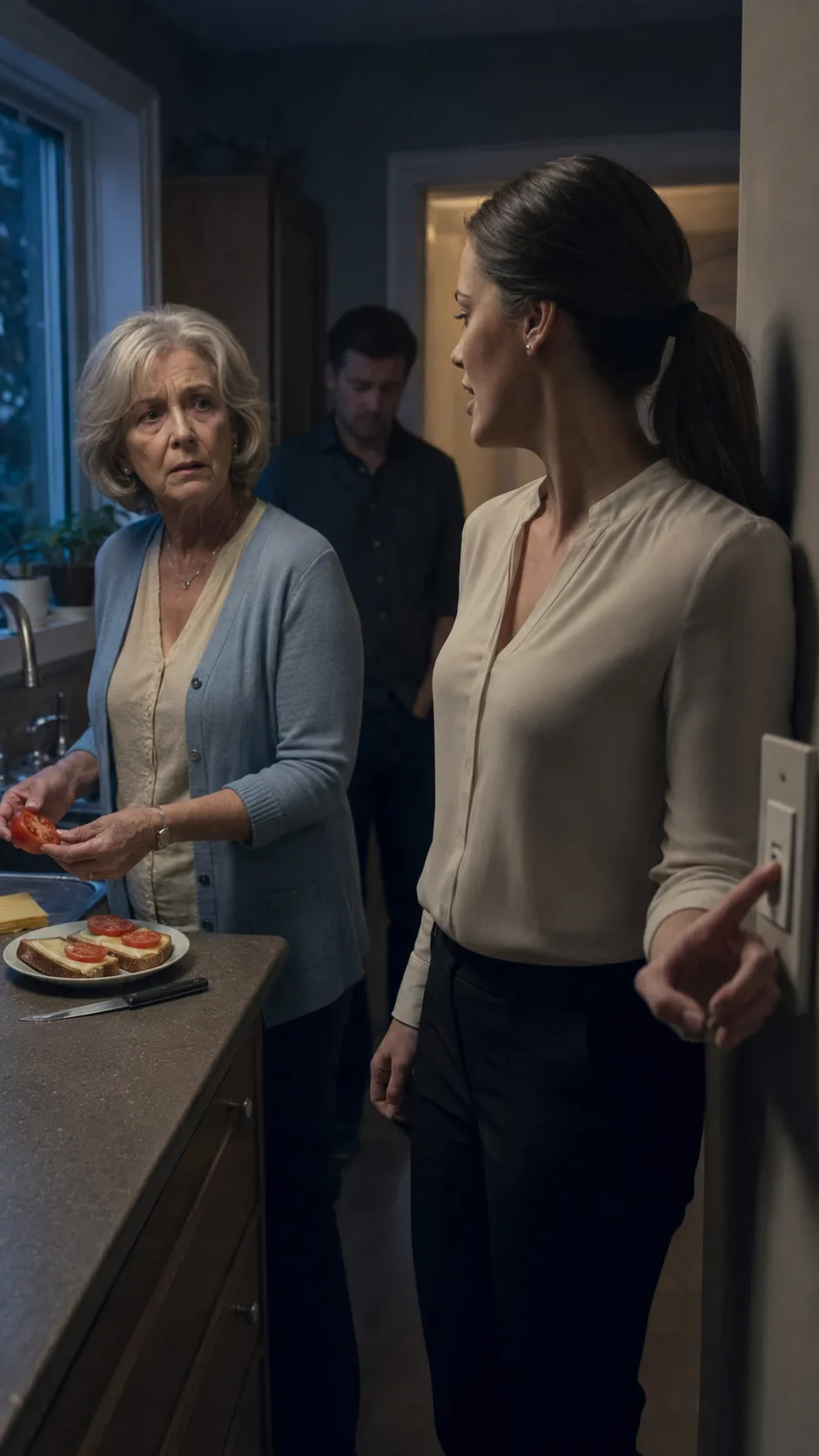
I sliced one tomato, sprinkled it with salt, toasted a piece of bread, and put a little cheddar on my plate.
Then Kristen walked in.
She was dressed better than usual, black pants, cream blouse, her hair pulled back. She looked at my plate, then at the counter, then at me.
“Oh,” she said. “You’re eating now?”
“Yes,” I said. “Just something small.”
She inhaled gently, as if preparing herself to be patient.
“Margaret, I meant to tell you. We have someone coming over tonight. A colleague of mine. It’s sort of a private dinner.”
I wiped my hands on a towel.
“All right.”
“So we’d prefer if you ate in your room.”
For a moment, I thought I had misheard her.
“My room?”
“Yes. Just tonight. It would be easier.”
Easier.
That word has excused more disrespect than anger ever could.
I looked toward the doorway and saw Daniel.
He had heard.
Of course he had heard.
He stood there with his phone in his hand, eyes lowered, as if he had discovered something interesting on the floor.
“Daniel?” I said.
He looked up, then away.
“Mom, it’s just dinner.”
Just dinner.
I have thought about those two words many times.
It is never “just dinner” when someone tells you where you are allowed to sit in your own house.
Kristen reached over and turned off the kitchen light.
That was the part that stayed with me.
Not the request.
Not Daniel’s silence.
The light.
The quiet click of the switch, the room going dim around me, the message so clear she did not need to raise her voice.
You are not needed here.
You are in the way.
Go.
I picked up my plate and left.
I did not sleep that night.
I lay in bed listening to the house settle after everyone went upstairs. Around midnight, a car passed outside, headlights slipping briefly across my ceiling. Somewhere in the distance, a train horn sounded. I stared into the dark and felt, for the first time in months, not confusion but clarity.
How did I get here?
How did a woman who had managed classrooms, cared for a sick husband, paid bills, signed mortgage papers, shoveled snow, planted every shrub in the yard, and rebuilt her life after grief end up eating alone in her bedroom while someone else entertained guests at her table?
The answer, when it finally came, was not flattering.
I had allowed it.
Not caused it. Not deserved it. Not invited cruelty.
But I had allowed the pattern to continue long after I knew it was wrong.
I had mistaken silence for peace.
I had mistaken flexibility for love.
I had mistaken my fear of conflict for generosity.
And worst of all, I had taught them, day after day, that there would be no consequence for treating my home as if I were lucky to occupy a corner of it.
By morning, I knew who to call.
Not Daniel.
Not Kristen.
Carolyn.
Carolyn and I had taught together for fifteen years. She retired two years before I did and had never once softened the truth just to make it prettier. She was the kind of friend who brought soup when your husband was sick, then told you plainly that your front tires were bald and you needed to stop pretending they would last until spring.
She answered on the third ring.
“Margaret? Everything all right?”
I opened my mouth to say yes, out of habit.
Instead, I said, “No.”
There was a pause.
“Tell me.”
I told her.
Not all of it at first. Just enough. The kitchen. The light. The plate. Daniel looking away.
Carolyn did not gasp. She did not say, “Oh, I’m sure she didn’t mean it that way.” She did not ask whether I had perhaps misunderstood. That is why everyone needs at least one friend who loves them more than they love politeness.
She said, “Call a lawyer.”
The word made my stomach tighten.
“I don’t want to make this into a legal situation.”
“Margaret,” she said, “it already is a legal situation. You’re just the only one pretending it isn’t.”
I sat at the small table by my bedroom window. Outside, the tomato plants leaned in the morning sun. My tea had gone cold.
“They’re family,” I said.
“Yes,” Carolyn replied. “And family can still take advantage of you. Sometimes they do it more easily because they know exactly which part of your heart to press.”
I did not answer.
She softened then, but only a little.
“You don’t have to throw them out this afternoon. You don’t have to be cruel. But you need to know your rights before they know them better than you do.”
That sentence landed in my chest.
Before they know them better than you do.
By noon, Carolyn had sent me the name of a licensed paralegal in Burlington who had helped a cousin of hers with a landlord issue years earlier. Her name was Patricia Morris. I stared at the number for almost twenty minutes before calling.
A receptionist answered, then transferred me.
Patricia’s voice was calm, practical, and older than I expected. Not elderly, but seasoned. The sort of woman who had heard people cry and ramble and apologize for taking up time, and had learned how to guide them back to the point.
I began poorly.
“I don’t know if this is really anything,” I said. “I may be overreacting.”
“Why don’t you tell me what happened,” she said.
So I did.
This time, I told more of it.
The move-in.
The pantry.
The bread bin.
The photograph.
The armchair.
The dinners alone.
The light switch.
The plate.
The quiet.
Patricia did not interrupt except to ask clear questions.
“Do you own the property?”
“Yes.”
“Is there a written lease?”
“No.”
“Do they pay rent?”
“No. They’ve helped with groceries sometimes, and Daniel paid the internet bill twice, I think.”
“How long have they lived there?”
“About ten months.”
“Do they receive mail there?”
“Yes.”
“Have they changed any locks?”
“No.”
“Have they ever told you that you could not enter certain rooms?”
I hesitated.
“Not exactly.”
“Tell me what ‘not exactly’ means.”
I looked toward the hallway.
“It’s more that I stopped using them.”
“Because you wanted to?”
“No.”
There was a small silence.
“Mrs. Ellis,” Patricia said, “I want to be very clear. You are not being silly. You are not wasting my time. These situations are more common than people think.”
I pressed my hand against my forehead.
She explained that I needed to approach things carefully. Even when people are family, once they have been living in a home for a period of time, receiving mail there, using it as their residence, removing them can require proper notice and a formal process if they refuse to leave. She did not frighten me. She did not exaggerate. She simply laid out the reality in plain language.
Then she said something I had not realized I needed to hear.
“You have the right to occupy your own home fully and freely.”
I closed my eyes.
Fully and freely.
Not the back bedroom.
Not the garden when no one else was using it.
Not the kitchen only when it was convenient.
My home.
Fully and freely.
Patricia asked, “What do you want?”
It should have been an easy question.
It was not.
For ten months, I had trained myself not to want too loudly.
I wanted Daniel not to be embarrassed. I wanted Kristen not to feel judged. I wanted Lily to be safe and happy. I wanted the house peaceful. I wanted to be a good mother. I wanted not to be one of those older women people whisper about, difficult, controlling, unable to let go.
But underneath all of that, there was a truer answer.
“I want my home back,” I said.
My voice shook when I said it.
“I want to cook in my kitchen. I want to sit at my table. I want to put my things where I want them. I want to stop feeling like I’m sneaking around in a house I paid for.”
Patricia’s voice remained steady.
“Then we start with documentation. A formal written notice. A clear timeline. Calm, lawful, and in writing.”
Click the blue “PART 3” below to read the next part:
Chapter complete
You have reached the end of this chapter.
Continue reading
A few more worlds to get lost in after this chapter.




