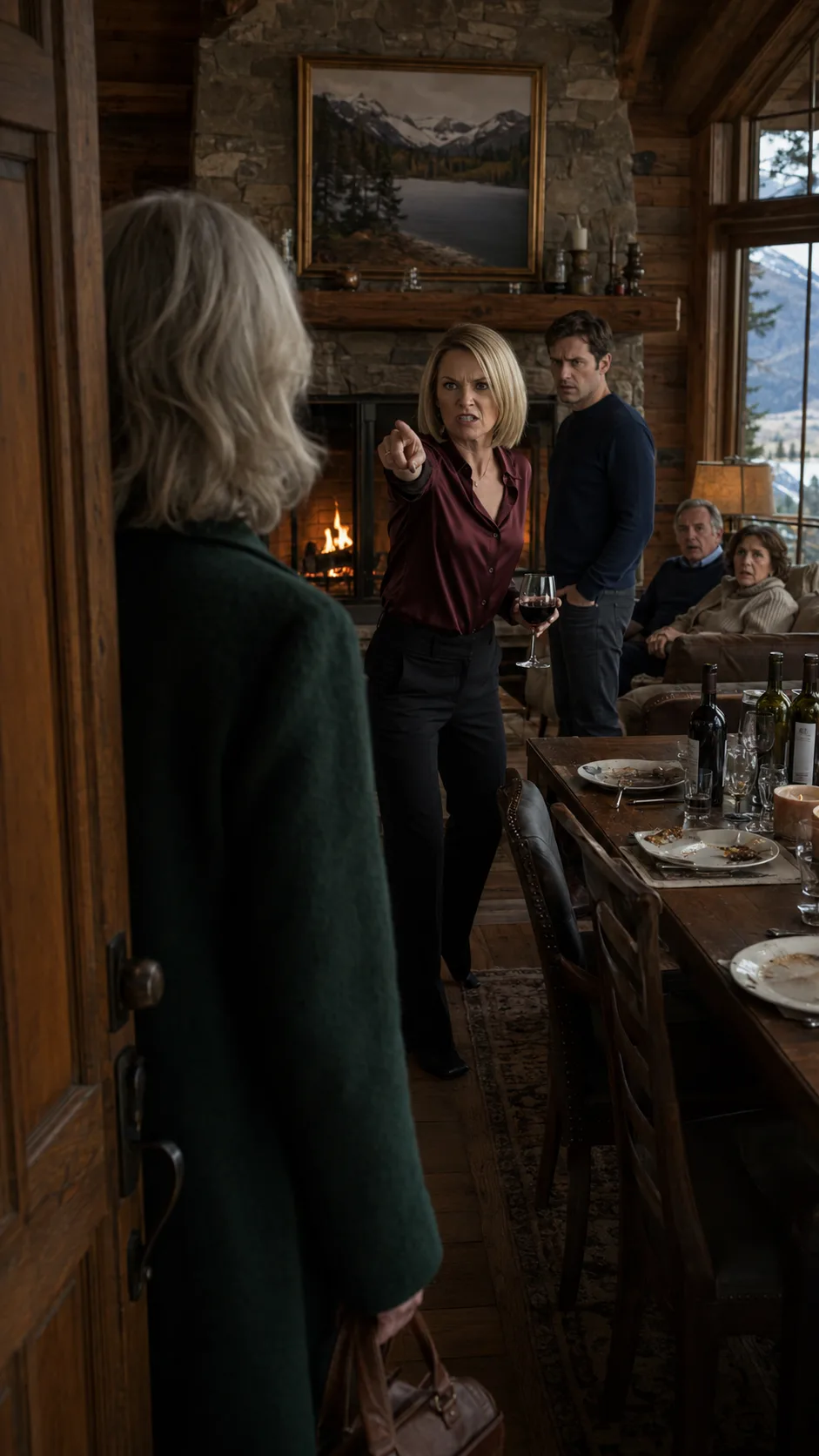
PART 3 — THE PRICE OF FINALLY SAYING NO
I went inside the house and locked the door.
Chapter 3
PART 3 — THE PRICE OF FINALLY SAYING NO
I went inside the house and locked the door.
My hands trembled slightly, not from fear, but from the rush of adrenaline finally beginning to leave my body.
I had done something I had been putting off for years.
I had said no.
I had set boundaries.
I had chosen my own dignity over maintaining a false family peace.
I walked through the living room, picking up the dirty glasses, the abandoned plates, cleaning up the remnants of the invasion. As I worked, my mind began to wander to the past, to the moments that had led me here, to this breaking point.
And I understood that this had not started today.
It had started many years ago, with small decisions that accumulated until they became a pattern of life.
I remembered when Robert was twenty-three years old and lost his first job. He came to me crying, saying he could not pay his rent, that he was going
to be evicted.
I had just received my first raise in years, a raise I had planned to use to finally take that trip to Europe I had always dreamed of.
But I looked into his eyes, saw his desperation, and gave him the money.
Two thousand dollars.
That meant my vacation, my rest, my moment of reprieve.
“It’s only this time, Mom,” he had promised me. “I’ll pay you back in two months when I get another job.”
He never gave me that money back.
And I never asked for it.
Six months later came another crisis, a credit card debt that had grown out of control.
Five thousand dollars.
I had just finished paying off the mortgage on my small apartment in the city. For the first time in my life, I did not have that financial pressure. I could breathe. I could save. I could live without
the constant weight of debt.
But Robert arrived at my door with bank papers, with threats of lawsuits, with that scared child’s face that always melted my defenses.
“Mom, I don’t know how it happened. I spent without realizing. If I don’t pay, they’ll ruin my credit history. I won’t be able to get anything in the future.”
And I paid five thousand dollars of my savings, of the money I had set aside for my retirement, for my future security.
“This is the last time,” I told him firmly. “You have to learn to manage your money.”
He nodded seriously. He promised he would change, that he would learn.
But a year later, he was back with another crisis, with another urgent need.
I sat on the couch hugging a cushion to my chest, and the tears finally came.
They were not tears of sadness.
They were tears of
liberation, of years of contained frustration finally finding an outlet. I cried for all the dreams I had postponed, for all the trips I never took, for all the times I denied myself something small so I could give something big to someone else.
I cried for the woman I had been, the one who always said yes, the one who confused love with infinite sacrifice.
And I also cried with relief because that woman had finally found her voice, her limit, her dignity.
I remembered when Robert met Sharon.
From the first moment, I knew there was something about her that unsettled me. It was not just her distant attitude or her way of talking as if the world owed her something. It was the way she looked at things, calculating values, measuring possibilities.
When they got engaged, Sharon insisted on a big, elegant, expensive wedding.
“It’s the most important day of my life,” she had said with those bright eyes. “I’m only getting married once.”
The wedding cost twenty-three thousand dollars. Robert and Sharon put in five thousand. Sharon’s father put in three thousand.
And I, who had promised to contribute five thousand to help, ended up paying fifteen thousand because unexpected expenses came up and they said they could not cancel the contracts.
Fifteen thousand dollars that represented two years of careful saving.
Fifteen thousand dollars I had planned to use to buy this cabin in the mountains.
I had to wait three more years, working overtime, denying myself basic pleasures to finally make the down payment on this property.
And here they were years later, occupying this place I had bought with so much sacrifice, treating it as if it meant nothing, as if it were simply another resource available for their use.
I got up and went upstairs to the master bedroom. I opened the closet where Robert had said they stored my photographs.
There they were, carelessly piled up in cardboard boxes.
I took them out one by one and placed them on the bed.
My mother smiling in her garden.
My father in his work uniform.
My grandparents on their fiftieth wedding anniversary.
And Robert, my little Robert at five years old, riding his first bicycle.
I held that photograph in my hands and looked at it for a long time.
He had been such a happy child then. So innocent.
At what point had he lost that sparkle in his eyes? At what point had he learned that he could take without giving? And how much of that was my fault for teaching him that I would always be there to rescue him?
The question hurt more than I expected because part of this, a part I did not want to admit, was my responsibility.
I had raised a son who did not know how to face consequences, who did not know the real value of money because he had never had to fight for it, who assumed love meant the infinite availability of resources.
But I also understood, sitting there in that quiet room, that it was not too late to teach him the most important lesson.
Not with words.
Not with sermons.
But with actions.
By letting him fall. By allowing him to face reality. By withdrawing the safety net I had so carefully woven all these years.
I went downstairs with the photographs and began to hang them back in their original places. Each frame I hung was an act of recovery—of my space, my history, my identity that I had allowed to be erased too easily.
When I finished, the living room looked as it should look.
Like my living room.
With my memories.
With my history imprinted on those walls.
It was no longer a generic space that anyone could occupy and transform.
It was my home.
I lit the fireplace and made myself a cup of tea. I sat down in front of the fire and let the warmth penetrate my tired bones.
It had been an exhausting day, emotional and devastating in many ways, but it had also been liberating.
I took out my phone and checked the confirmations of all the cancellations I had made.
Robert’s car insurance canceled.
The monthly contribution to his mortgage canceled.
Sharon’s gym payment canceled.
Each notification was a reminder that I had done it, that I had taken the step, that there was no turning back.
My phone vibrated with a message.
It was from Robert.
Mom, we made it home. Please reconsider. We can’t do this without your help. I beg you.
I looked at the message for a long time. My fingers moved over the keyboard, writing and deleting responses again and again.
Finally, I wrote something simple.
Robert, I love you. But love doesn’t mean allowing you to disrespect me. Learn to live within your means. Learn to value what you have. Learn to be responsible. When you do that, we can talk.
I sent the message and then, with a determined movement, blocked his number.
The first three days at the cabin were days of absolute silence.
I received no calls. I had no messages. There were no attempts at contact. It was as if I had cut a cord that connected me to a world of constant demands.
And now I simply floated in space, free but also strangely alone.
I spent the mornings walking in the woods around the property, watching the light filter through the pine trees, listening to the birds sing as if celebrating my presence.
In the afternoons, I read books I had bought years ago and never had time to open. I cooked simple food just for myself, without having to worry about anyone else’s tastes. I slept deeply, without sudden awakenings, without that nocturnal anxiety that had been my companion for so long.
It was peace.
It was freedom.
But there were also moments when doubt crept through the cracks in my determination.
On the fourth day, I decided to return to the city. I had things to resolve, promises to keep. I could not hide in the mountains forever, as tempting as it was.
As I drove back toward Denver, I mentally rehearsed the conversations I would have to have with the bank, with the insurance company, with lawyers if necessary.
I arrived at my apartment in the city at noon. The answering machine was blinking with fifteen new messages.
I listened to them all while making coffee.
Three were from Sharon, each one more desperate than the last. Four were from unknown numbers that were probably Joe and Lucy trying to communicate from other phones. Five were from family friends clearly contacted by Robert to intercede.
And three were from the bank.
I started with the bank.
I called the number they had left, and a representative answered.
“Mrs. Martin,” he said, “we’re calling because we noticed you canceled your monthly automatic transfer. We wanted to confirm if this was intentional or if there was an error in the system.”
“It was completely intentional,” I replied firmly. “I want to remove my monthly contribution to my son’s mortgage, and I also need to talk about removing my name as co-signer on his car loan.”
There was a pause on the other end of the line. I could hear rapid typing.
“I understand. Regarding the car, your son would have to refinance the loan without you as co-signer, which would require him to qualify on his own. Do you want us to send the necessary documentation?”
“Yes, please.”
“And regarding the mortgage, without your monthly contribution, the payment would increase by eight hundred dollars. Is your son aware of this change?”
“He is aware,” I said, although I did not know if he had truly processed the magnitude of what it meant. “He will have to find a way to cover the full amount.”
“Very well. We will process the changes. Just to inform you, if there are three consecutive missed payments, the bank would initiate foreclosure proceedings.”
“I understand. Thank you for the information.”
I hung up and stared at the phone.
Three months.
Robert had three months to find eight hundred extra dollars each month. It was possible if they reduced expenses, if Sharon worked more hours, if they stopped living beyond their means.
But it would require sacrifice.
Discipline.
Maturity.
The phone rang almost immediately. It was a number I did not recognize, but I decided to answer.
“Alice?”
It was Lucy’s voice, trembling, pleading.
“Please don’t hang up. I need to talk to you.”
I took a deep breath.
“What do you want, Lucy?”
“I came to the bank this morning with Robert. They told us you canceled everything. The car insurance, your part of the mortgage. Alice, we can’t afford all that. Robert earns eighteen hundred a month. The full mortgage is fourteen hundred. The car insurance is three hundred. The bills for electricity, water, and internet are another two hundred and fifty. How are we going to live on one hundred and fifty dollars a month?”
I did the math quickly in my head. The numbers did not add up.
“Lucy, if Robert earns eighteen hundred and the full mortgage is fourteen hundred, that leaves four hundred, not one hundred and fifty.”
“But the car insurance—”
“The car insurance that I was paying,” I interrupted. “If you can’t pay for it, then you can’t have the car. It’s that simple. Sell the car. Buy something cheaper that you can maintain. Use public transportation. Look for alternatives. But it is no longer my problem.”
“Sharon also works,” Lucy continued quickly. “She earns nine hundred a month.”
“That gives you twenty-seven hundred in total,” I said, calculating. “Fourteen hundred for the mortgage, three hundred for insurance if you decide to keep the car, two hundred and fifty for utilities. That’s nineteen hundred and fifty. That leaves you seven hundred and fifty for food, gas, and other expenses. It’s tight, but it’s possible.”
“But we also live there,” Lucy said, her voice going up an octave. “Joe and I need to eat. We need our medications. Joe has to go to the doctor every month. That costs one hundred and twenty dollars because we don’t have insurance.”
And there was the real reason the numbers were not working.
It was not just Robert and Sharon.
It was four adults living on the income of two, and one of them had significant medical expenses.
“Lucy, how old are you and Joe?”
“Sixty-seven. And neither of us works. Joe had a heart attack two years ago. He can’t work. And I take care of him.”
I felt a twinge of something akin to compassion, but I kept it at bay.
This was not cruelty on my part.
It was reality.
“Lucy, understand something. I am also close to seventy. I also have medical expenses. I also get tired. The difference is that I worked my whole life to secure my future. I saved. I invested. I prepared. And now that I could finally rest, I discovered I was supporting six people besides myself.”
“But we’re family.”
“Being family doesn’t mean I have to sacrifice my financial security for yours,” I said firmly. “Especially after how you treated me. You invaded my property. You disrespected me. You called me a trespasser. And now you want me to keep paying your bills.”
There was silence on the other side.
Then I heard sobbing.
“I don’t know what we’re going to do,” Lucy cried. “We have nowhere to go. We don’t have any savings. If Robert loses the house, we’ll be on the street.”
“Then Robert needs to find a second job,” I said without emotion. “Sharon, too. You need to apply for government medical assistance for Joe. You need to look for cheaper apartments, places you can afford with your real income. You need to live within your means, like millions of people do every day.”
“But—”
“There are no buts, Lucy. I made my decision. You now have to make yours. I sincerely wish you the best. But I am no longer your solution.”
I hung up before she could respond.
My hands were trembling, not from doubt, but from the intensity of maintaining my position against years of conditioning that screamed at me to give in, to help, to sacrifice myself one more time.
Two hours later, I received a text message from an unknown number.
It was from Sharon.
The insurance company called. They canceled the car policy. Now we can’t drive it legally. Robert can’t go to work. You’re going to be responsible when he loses his job because of you.
I replied briefly.
You can take the bus. You can look for alternatives. I am no longer responsible for the consequences of your decisions.
The next day, I personally went to the bank where they had the car loan. I filled out all the necessary forms to remove my name as co-signer.
The representative explained that Robert would have thirty days to refinance or return the vehicle.
“Are you sure about this?” the employee, a young man in his thirties, asked me. “It’s a process that cannot be easily reversed.”
“I am completely sure.”
I left the bank feeling lighter than I had in years.
Every document signed was a weight off my shoulders.
Two weeks passed.
Two weeks in which I remained firm in my silence, in my decision, in my newly established boundaries.
I had returned to the cabin after resolving all the matters in the city. I needed that sanctuary more than ever.
The mornings were cold now, with that late-October temperature that announced the arrival of winter. I woke up early, made coffee, and sat on the porch wrapped in a blanket, watching the sun paint the mountains in gold and pink.
I had managed not to check my phone obsessively. I kept it on silent most of the day, checking it only at night.
Messages kept coming, but less frequently.
Three from Robert, automatically blocked.
Two from unknown numbers that I deleted without reading.
One from a distant cousin asking if it was true that I had thrown Robert out on the street, clearly fueled by distorted versions of the facts.
But that Friday afternoon, when I checked the phone before making dinner, there were fifteen missed calls, all from the same unknown number, and three voicemails.
Something in my stomach tightened.
Fifteen calls in one day was not normal, not even in the middle of a family crisis.
I took a deep breath and listened to the first message.
It was Robert.
His voice sounded broken, barely recognizable through the sobs.
“Mom, please. Please answer. I need to talk to you. Everything is falling apart. Everything. Please.”
The second message was two hours later. This time his voice sounded different.
Not desperate.
Defeated.
“Mom, I lost my job. I was fired today. I was late three times this week because the bus doesn’t arrive on time, and my boss said he couldn’t tolerate it anymore. Without the car, I can’t be punctual. And now I have no way to pay for anything. Nothing.”
The third message was from only thirty minutes earlier.
And it was not Robert speaking.
“Mrs. Martin, this is Joe.”
His voice sounded tired, old.
“I need you to know what is happening here. Robert and Sharon have been fighting nonstop for three days. She blames him for losing his job. She blames him for the gym expenses and going out with friends. They both blame us for living here. Last night, Sharon yelled at him that she didn’t sign up to support his elderly in-laws. Robert replied that her parents don’t contribute anything either. We are destroying ourselves.”
He paused, and I heard his labored breathing.
“My wife hasn’t stopped crying in two days. I can’t sleep because of the chest pain. The shouting doesn’t stop. The bank called yesterday saying the first mortgage payment is overdue. Sharon is looking for cheap apartments for Lucy and me to move into, but with my condition, no one wants to rent to us. And now Robert is talking about declaring bankruptcy.”
I closed my eyes and let the phone fall onto my lap.
The image Joe painted was one of total collapse, of a system that had worked precariously thanks to my financial support and was now, without that support, falling apart in the most destructive way possible.
Part of me, the part that had been a mother for more than thirty years, wanted to grab the phone and call.
I wanted to say everything would be okay, that we would find a solution, that I would fix this as I had always fixed everything.
That part hurt me physically, as if claws were digging into my chest.
But there was another part, newer and stronger, that knew this was exactly what had to happen.
This pain, this chaos, was the price of years of irresponsibility. And if I intervened now, if I rescued the situation one more time, I would only be postponing this inevitable moment.
I would only be guaranteeing that in five years or ten, we would be in exactly the same place.
The phone vibrated in my hand.
Another text message.
Mom, it’s me. I know you blocked my number, but Sharon let me use hers. Please just listen to me. I’m not asking you for money. I just need advice. I don’t know what to do. The bank gave me fifteen days to pay or start foreclosure. I don’t have a job. Sharon is looking for a second job, but it takes time. Her parents have nowhere to go. And she told me this morning that if I don’t resolve this, she is going to divorce me.
I read the message three times.
I’m not asking you for money. I just need advice.
It was the closest to taking responsibility that I had seen from Robert in years.
But was it real?
Or was it just another manipulation? Another way to open the door to eventually ask for exactly what he said he was not asking for?
I did not answer.
I put the phone away and went for a walk in the woods while there was still light. I needed to clear my mind. I needed fresh air in my lungs. I needed to remember why I had made this decision.
When I returned, it had gotten completely dark. I lit the fireplace and made myself a simple dinner.
As I ate, the phone rang again.
This time, I answered without thinking.
“Hello?”
“Alice. Thank goodness.”
It was Sharon.
Her voice sounded completely different from the last time I had heard it. There was no arrogance, no contempt.
Only exhaustion and defeat.
“I know I don’t have the right to call you. I know I treated you horribly, but I need you to know something.”
I waited without saying anything.
“You were right,” Sharon continued, her voice breaking. “You were right about everything. We were living beyond our means. We spent without thinking because we knew you would always be there to rescue us. We used you. We disrespected you. And now we are paying the price.”
I remained silent.
“My parents are moving out in three days. We found a room in a shared house that agreed to rent to them despite my dad’s condition. It costs four hundred a month, and it’s horrible. Small, in a bad neighborhood, but it’s what we can afford. I got a second job cleaning houses at night. Robert is looking for anything—anything at all. And we submitted the application for government medical assistance for my dad.”
She paused, and I heard her breathe deeply.
“I’m not calling to ask you for money,” she finally said. “I’m calling because I need you to know that I understand. I understand why you did it. And even though it hurts, even though I’m terrified, I know it’s what we needed. A reality check.”
“And Robert?” I finally asked, my voice sounding strange after the long silence.
“He understands, too.”
Sharon let out a bitter laugh.
“Robert is devastated. He won’t stop crying. He says he failed you. That he failed as a son, as a husband, as a man. I think this is the first time in his life that he is really facing the consequences of his actions without having a safety net.”
“Are you going to lose the house?” I asked, though I already knew the answer.
“Probably. Unless Robert finds a job in the next few days and we can pay something to the bank to negotiate a payment plan. But even if we manage it, we are going to have to sell the car, cut expenses, live completely differently.”
There was a long silence.
Sharon was breathing on the other end of the line, waiting for me to say something, to offer something.
“Sharon,” I finally said, “do you know how much I’ve worked in my life?”
“No.”
“Since I was sixteen. Forty-five years working. Forty-five years getting up before dawn. Coming home after dark. Forty-five years postponing my dreams to build security. And in the last five years, I have given sixty-eight thousand dollars to support you. Sixty-eight thousand dollars that represent years of sacrifice.”
“I know,” she whispered.
“And still, you treated me like a trespasser in my own house. As if I didn’t matter.”
“I’m sorry. God, I am so sorry.”
“Sorry is not enough, Sharon,” I said with a voice that was firm but not cruel. “Sorry is just words. What I need to see are actions. Real changes. True responsibility. And that takes time. A lot of time.”
There was a heavy silence on the other end of the line. I could hear Sharon’s ragged breathing, the sound of someone trying not to completely fall apart.
“I understand,” she finally said. “I don’t expect your forgiveness. I don’t expect your help. I just wanted you to know that for the first time in my life, I am understanding what it means to really struggle. What it means to have no one to turn to. And it’s terrifying, but it’s also necessary.”
She hung up before I could reply.
I kept holding the phone, looking at the screen that now showed the call duration.
Eight minutes and forty seconds.
Eight minutes that had spoken more truth than years of previous conversations.
I did not feel triumph.
I did not feel satisfaction at seeing them suffer.
I felt something more complex, more nuanced.
Relief mixed with sadness.
Strength mixed with pain.
The certainty of having done the right thing, even though it hurt deeply.
The following days passed in a strange stillness. I kept receiving sporadic updates, unrequested but not rejected.
Joe and Lucy moved into the shared room.
Robert got a temporary job in a warehouse, working night shifts for eleven dollars an hour.
Sharon continued cleaning houses in addition to her regular job.
Between the two of them, they earned enough for food and basic utilities, but not for the mortgage. The bank initiated foreclosure proceedings. They had sixty days to vacate the property.
Sharon found a small one-bedroom apartment in a modest neighborhood. It cost six hundred dollars a month. It was all they could afford. They sold most of their furniture to gather the deposit.
Three weeks after that last conversation with Sharon, I received an unexpected call.
It was from a number I did not recognize, but this time I decided to answer.
“Mrs. Martin?”
It was a male voice, formal and professional.
“Yes, this is she.”
“My name is Marcus Flores. I am a financial counselor. Your son, Robert, came to see me this week, seeking help organizing his finances. During our session, he mentioned what had happened between you. He asked permission to give you my number in case you wanted to speak with someone neutral about the situation.”
I was surprised.
Robert had sought professional help.
That was something he had never done before.
“And why are you calling me?”
“Because part of my job is to help families rebuild not only their finances, but also their relationships,” he explained. “And because Robert authorized me to share something with you that I think you should know.”
I waited in silence.
“Your son cried throughout the first session, not because he had lost his house or his car. He cried because he understood, really understood for the first time, how much he had abused your generosity. He showed me the records of everything you had given him over the years. And he told me he had no idea it had been so much, that he had never added it up, that he had never seen the whole picture.”
I felt a knot form in my throat.
“We are working on a plan for him and Sharon to live within their real income. It’s tight, very tight, but it’s possible. And for the first time, he is committed to making it work without external help.”
“Are you asking me to help him?” I asked directly.
“No,” Marcus replied firmly. “In fact, I told Robert that the worst thing that could happen now would be for you to intervene and rescue the situation. I told him this moment, as painful as it is, is his opportunity to grow, to learn, to become the man he needs to be.”
“So why are you calling me?”
“Because I also work with parents who have had to make difficult decisions like yours. And I know that even though it is the right thing to do, it does not stop hurting. I wanted you to know that your son is taking this seriously, that he is changing, and that someday, when the time is right, he will probably want to talk to you—not to ask for help, but to thank you for forcing him to wake up.”
We hung up after a few more minutes of conversation.
I sat in front of the fireplace for a long time, processing what I had just heard.
There was a part of me that wanted to believe Robert was truly changing.
But there was another part, more cautious, that knew true change takes time. Words are easy. Actions are difficult.
Two more months passed. December arrived with its biting cold and short days. I stayed at the cabin practically the entire time, enjoying the solitude I had craved for so long.
I read.
I walked.
I cooked.
I slept.
I lived without the constant weight of other people’s demands.
And I discovered something surprising.
I was happy.
Genuinely happy in a way I could not remember being in years.
On Christmas Eve, as I prepared a simple dinner just for myself, the phone rang.
It was an unknown number, but something made me answer.
“Mom?”
It was Robert.
His voice sounded different.
More mature.
Calmer.
“Robert,” I said neutrally.
“I know you don’t want to talk to me, and I completely understand,” he said. “But it’s Christmas, and I needed to call you. Not to ask you for anything. Just to tell you something.”
I waited.
“Thank you,” he said simply. “Thank you for doing what none of us had the courage to do. Thank you for forcing me to grow. Thank you for loving me enough to let me fall.”
I felt tears start to roll down my cheeks.
“Sharon and I are in the new apartment. It’s small, but it’s ours. Paid for with our money. I’m working two jobs now. She is too. We are tired all the time. But we are okay. And for the first time, I understand what you lived through all those years. The sacrifice, the effort, everything.”
“I’m glad to hear that,” I said with a trembling voice.
“I’m not calling to ask you to come back into my life,” he continued. “Not yet. I know I need to show you that the change is real, that it’s not temporary. But I wanted you to know that I am trying. Really.”
“That’s all I ever wanted,” I said softly. “For you to learn to rely on yourself. For you to become a responsible man.”
“I know, Mom. And I’m going to achieve it, even if it takes years.”
After hanging up, I stared at the fire for a long time.
I did not know if Robert would really change.
I did not know if we could ever rebuild our relationship.
But for the first time in a long time, I had hope.
A cautious, protected hope.
But hope nonetheless.
Two days later, I received a final message.
It was from Sharon.
Merry Christmas, Alice. Robert doesn’t know I’m writing this to you. I just wanted to say that you were right about everything, and that if you can ever forgive us, we will be here working hard to deserve that forgiveness. But if you can’t, we understand that, too. We wish you peace and happiness. You deserve it more than anyone.
I read the message several times.
Then I put it away without responding.
Not because I was being cruel, but because I had nothing to say yet.
Forgiveness, if it came, would come with time, with sustained actions, not with pretty words.
I got up and walked to the window.
Snow had begun to fall softly, covering the forest with a white, silent mantle.
It was beautiful.
It was peace.
It was the world I had built for myself after decades of building worlds for others.
I took out my phone and opened the settings. I checked the list of blocked numbers.
Robert’s was still there.
My finger hovered over the option to unblock him.
But I did not do it.
Not yet.
Because true strength was not in unblocking the number. It was not in building bridges before they had proven themselves trustworthy again.
True strength was in maintaining my boundaries, in protecting my peace, in not confusing love with enabling, in not sacrificing my dignity for the temporary comfort of pretending everything was okay when it was not.
I put the phone away and returned to my chair by the fire. I picked up the book I had been reading and opened it to the marked page.
Outside, the snow kept falling.
Inside, the fire crackled with warmth and light.
And I, Alice Martin, sixty-one years old, was finally at peace.
I had learned the most important lesson of all.
Loving someone does not mean destroying yourself in the process.
Being a mother does not mean being a martyr.
Saying no, setting boundaries, protecting your space and your dignity is not selfishness.
It is survival.
It is self-respect.
It is true love.
The kind of love that teaches instead of enables, that strengthens instead of weakens.
And if Robert ever came to my door, not with words, but with years of sustained change behind him, maybe we could talk.
Maybe we could rebuild.
But it would be on my terms, with my limits clearly established, with my dignity intact.
Because this time, for the first time in my life, I was the priority.
And that was not selfishness.
That was justice.
That was liberation.
That was finally freedom.
THE END.
Chapter complete
You have reached the end of this chapter.
Continue reading
A few more worlds to get lost in after this chapter.




