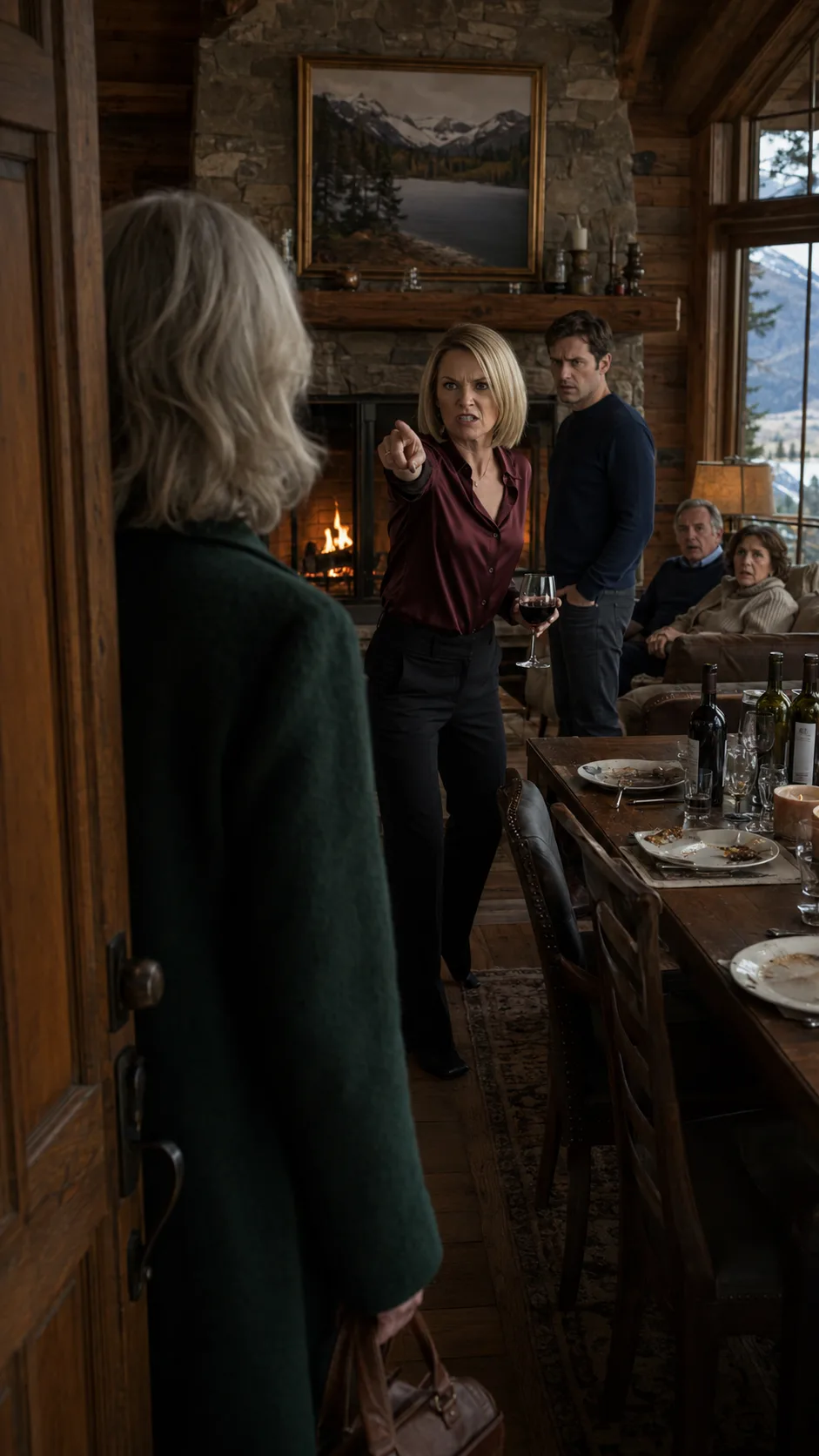
PART 2 — THE CALL THAT EXPOSED EVERYTHING
Then I walked slowly toward the couch opposite hers and sat down.
Chapter 2
PART 2 — THE CALL THAT EXPOSED EVERYTHING
Then I walked slowly toward the couch opposite hers and sat down.
I clasped my hands in my lap and looked at all of them one by one.
Robert avoided my gaze.
Joe and Lucy exchanged nervous glances.
Sharon was still standing, phone already in her hand, but her finger had stopped above the screen. Something in my attitude had thrown her off.
I sat there in my own house, surrounded by people who had invaded my space, lied, and acted as if I did not exist.
But I no longer felt fear.
I no longer felt doubt.
I only felt a cold, absolute determination.
I was going to reclaim what was mine. I was going to watch as each of them faced the consequences of their actions. And I was going to do it without raising my voice, without losing my composure.
Because true strength does not shout.
True strength waits.
And I had waited long enough.
Sharon was still standing
in front of me, phone in hand, but her fingers were not moving. I could see the confusion in her eyes, the thinly veiled anger of someone who had expected a different reaction.
She had bet that I would run out, ashamed, apologizing for interrupting their little celebration.
But I did not move.
I stayed seated, staring at her, waiting for her to do exactly what she had threatened to do.
“You’re not going to call?” I asked in a quiet, almost kind voice. “I told you to go ahead. I’m waiting.”
Robert stood up abruptly. His face was pale, almost gray. I knew that expression. It was the same one he had worn as a child when he knew he had done something very wrong.
He walked toward Sharon and put a hand on her shoulder, as if trying to stop her, but she roughly shook him off.
“I
don’t need your permission, Robert,” she said without taking her eyes off me. “Someone has to set some boundaries here.”
Joe, Sharon’s father, cleared his throat from his place on the couch. He was a heavyset man with a deep voice, accustomed to being listened to when he spoke. He got up slowly and walked to stand beside his daughter, as if reinforcing her position.
“Mrs. Martin,” he said in a condescending tone, as if speaking to a child. “I think there’s a misunderstanding here. Robert gave us permission to use the cabin this weekend. He told us you were traveling, that you weren’t coming, and that there would be no problem. In fact, he assured us that you had authorized this.”
I felt the blood rush to my head, but I kept my composure.
So that was the lie.
That was the story they had built to justify their
invasion.
Not only had they occupied my property without my consent, but they had used my name, invented an authorization I never gave, and manipulated the truth to make themselves look good in front of others.
“Robert told you that?” I asked, looking directly at my son. “You told them I authorized this?”
Robert opened his mouth, but no sound came out. His eyes darted from me to Sharon, from Sharon to her parents, looking for some way out, some way to escape this moment.
But there was no escape.
The truth was there, naked and cruel, waiting to be acknowledged.
Lucy, Sharon’s mother, spoke from her seat. She was a thin woman with a sharp voice and a perpetual expression of superiority that had bothered me from the first day I met her.
“We didn’t know you weren’t aware,” she said with false innocence. “Robert invited us. He said it would be a family weekend, that you would arrive tomorrow, and that we should get everything ready for when you came. We even cleaned the house. See? We went grocery shopping. We brought food, all so you would be comfortable.”
The lie was so elaborate, so carefully constructed, that it almost seemed credible.
Almost.
But I knew every corner of this house. I knew exactly how I had left it the last time I was there. And what I saw now was not a house prepared for my arrival.
It was an occupied house.
Transformed.
Stripped of my presence to make room for theirs.
“So Robert lied to you,” I said simply, letting the words drop like stones into still water. “Because I never gave any authorization. I never said I was traveling. I never knew you would be here.”
The silence fell over the room again.
But this time it was different.
This time there was discomfort.
Nervousness.
Joe and Lucy exchanged glances. Sharon squeezed the phone tighter. Robert still could not look me in the eye.
“That’s not true,” Sharon finally said, her voice rising in pitch again. “Robert wouldn’t lie about something like that. You must have forgotten. At your age, it’s normal for things to get confused, for memory to fail.”
There it was.
The first direct attack.
The strategy of making me look like a confused old woman, like someone who could not trust her own memories. It was a tactic I had seen before, one I had experienced in small doses over the years. But now I saw it in its rawest, most ruthless form.
I stood up slowly, not because I was going to leave, but because I wanted everyone to see me clearly when I said the next thing.
“My memory is perfectly fine, Sharon,” I said in a clear voice. “I remember every conversation I’ve had with Robert in the last few weeks. I remember him telling me he was busy with his job. I remember you stopped answering my calls two weeks ago. And I perfectly remember that this property is in my name, that I paid every dollar of the mortgage, that I maintained this place, and that no one—absolutely no one—has the right to be here without my explicit permission.”
I walked slowly toward the wall where my family photographs used to be. The empty frames were still there, but the pictures had been stored or discarded. I ran my hand over one of the frames and turned back to them.
“Where are my photographs?” I asked. “Where are the pictures of my parents, my grandparents, and my son when he was little?”
No one answered.
Sharon looked away.
Lucy sat down again, uncomfortable.
Joe cleared his throat but said nothing.
“We stored them,” Robert finally said, his voice barely a whisper. “We thought you wanted to refresh the decor. They’re in the upstairs closet.”
“You thought I wanted to refresh the decor?” I repeated, letting the question hang in the air. “Or did you decide that my presence here wasn’t necessary? That you could erase me from my own house and replace me with what you preferred?”
Sharon finally exploded.
Her control broke, and all the anger she had been suppressing surged to the surface.
“This is ridiculous. Robert is your son. He has a right to use this house. You’re always saying that what is yours is his, that you work to leave him something. And now it turns out we can’t even come for a weekend?”
“You have the right if I give permission,” I replied coldly. “You have the right if you ask me. You have the right if you respect the basic rules of coexistence. But sneaking in, lying about my authorization, removing my belongings, and then treating me like a trespasser when I show up on my own property? That is not a right. That is invasion.”
Sharon took a step toward me, her face red with fury.
“You know what? You’re right. I am going to call the police. I’m going to tell them there’s an agitated woman in our house, that she’s causing problems, that we need help.”
I smiled again.
That same calm smile that had unnerved her so much before.
“Go ahead,” I said again. “Please do it. In fact, I insist. I think it’s exactly what we need here—a third party who can see this situation clearly.”
And this time, Sharon dialed the number.
The sound of the phone dialing broke the tense silence of the room. Sharon had the speaker activated, probably so we could all hear, so I would know she was serious. Her hand trembled slightly, but her expression remained defiant.
Robert had sat down again, his head in his hands.
Joe and Lucy remained silent, watching the scene as if they were spectators in a theater.
A female voice answered on the other end of the line.
“Local police. What is your emergency?”
Sharon took a deep breath before speaking, composing her voice to sound scared and vulnerable.
“Yes, hello. I need help. There is a woman in our house causing a disturbance. She entered without permission and is threatening us. We are at the mountain cabin, mile marker eighteen off the county road.”
I felt my blood boil, but I stayed calm.
Every word that came out of her mouth was a calculated lie.
Our house.
Entered without permission.
Threatening us.
All designed to make me look like the aggressor, the troublemaker.
“Does the person represent an immediate danger?” the operator asked.
Sharon looked at me with barely contained hatred.
“I don’t know. She is very agitated. She is in her sixties, but she is acting irrationally. We are scared.”
“A unit is on the way. Stay in a safe place and do not confront the person. You can leave the house.”
“Yes, we can try,” Sharon replied, cutting the call with exaggerated drama.
She turned to the others with a triumphant expression.
“You heard them. The police are coming. You’d better leave before they arrive and this gets worse for you.”
I sat back down on the couch. I crossed my legs and placed my hands in my lap.
I was not going to move.
I was not going to give them the satisfaction of seeing me run away.
“I’m not going anywhere,” I said calmly. “In fact, I’m eager to speak with the authorities. I think they will find what I have to show them very interesting.”
The confidence on Sharon’s face wavered for a second. Just a second, but I saw it.
Robert lifted his head and looked at me with an expression I could not decipher. Was it fear? Guilt? Regret?
The next twenty minutes were the longest of my life.
No one spoke. Joe and Lucy whispered to each other occasionally. Sharon paced back and forth across the room, occasionally looking out the window. Robert remained motionless like a pillar of salt.
And I stayed seated, waiting with a calm that surprised even myself.
Finally, we heard the sound of an approaching engine. A patrol car from the local police department parked in front of the house. Two officers got out of the vehicle: an older man of robust build and a young woman carrying a notebook.
Sharon ran to the door before they could knock. She flung it open with an exaggerated expression of relief.
“Thank you for coming so fast. She’s inside. She came in without permission and won’t leave.”
The officers entered cautiously, assessing the situation with trained eyes.
The older officer looked at me and then at Sharon.
“Who is the owner of this property?” he asked in a neutral voice.
Sharon opened her mouth to answer, but I spoke first.
“I am,” I said, standing up. “My name is Alice Martin. This is my property.”
“That’s not true,” Sharon interrupted immediately. “She’s my husband’s mother. We have permission to be here. She’s the one who came in without warning and is causing trouble.”
The officer looked at me with an expression I had seen many times before.
It was the look of someone who had already decided to believe the version of the younger, more convincing person. It was the look that assumed the older woman was confused, that there were probably family misunderstandings, that this was an unimportant domestic issue.
“Ma’am,” he said condescendingly, “do you have any documents to prove this property is yours?”
I smiled.
It was the moment I had been waiting for.
“Yes, officer. I have all the necessary documents.”
I walked to my purse, which I had left by the door when I entered. I opened it calmly and took out a folder I always carried with me when I traveled between my apartment and the cabin.
Inside were the property deed, the latest property tax payment, the utility bills in my name, and a letter from the bank confirming that the mortgage was completely paid off.
I handed the documents to the officer.
He reviewed them carefully, flipping through each page, verifying dates and names. His expression began to change. The young female officer came closer to look as well, and they exchanged a significant glance.
“Everything is in your name,” the older officer finally confirmed, looking at Sharon with a completely different expression. “Mrs. Alice Martin is the sole registered owner of this property.”
Color drained from Sharon’s face.
Joe stood up abruptly.
Lucy let out a small gasp.
Robert closed his eyes as if he wanted to disappear.
“But Robert is her son,” Sharon stammered. “He told us we could be here, that she had given permission.”
The young officer spoke this time, her voice firm but professional.
“Ma’am, the fact that he is the owner’s son does not give him an automatic right to use the property without her consent. And Mrs. Martin says she never gave that permission.”
“I never gave it,” I said in a clear, strong voice. “I arrived here expecting to find my house empty, and I found all of them occupying it as if it were theirs. They removed my photographs, brought their things, lied to other relatives by saying I had authorized this. And when I showed up, they called me a trespasser and threatened to call the police. Well, here are the police, and here are the documents that prove I am the one with the right to be here.”
The older officer turned to Sharon with a serious expression.
“It is clear that Mrs. Martin did not give permission for you to be here.”
Sharon looked at Robert desperately, seeking help, but he still could not speak.
Finally, it was Joe who replied.
“There was a misunderstanding,” he said in a tense voice. “Robert invited us. We thought everything was in order.”
“It was not a misunderstanding,” I intervened. “It was a deliberate lie, and now I want all of you off my property immediately.”
The young officer took notes in her notebook. The older officer looked at me with an expression that was now respectful.
“Mrs. Martin, you are within your rights to ask them to vacate your property. Do you wish to file a formal complaint?”
I looked at each of them. At Sharon with her mixed rage and fear, at Joe and Lucy trying to look innocent, and at Robert destroyed by shame.
And I felt something break inside me.
It was not sadness.
It was liberation.
“I want them to leave,” I said simply. “Now.”
The older officer nodded gravely and turned to Sharon and the others.
“You must vacate the property immediately. Mrs. Martin has proven to be the sole legal owner and has requested that you leave. If you do not do so voluntarily, we will have to proceed with a forced removal.”
Sharon opened her mouth to protest, but the young officer interrupted her firmly.
“You can gather your personal belongings now, but you must leave the premises within the next thirty minutes.”
I saw how reality began to settle on their faces—the public humiliation of being exposed in front of the authorities, of having their lie unmasked so completely.
But that was only the beginning.
There was something else I needed to do, something I had been putting off for years out of fear, out of misplaced love, out of that horrible habit of sacrificing myself for those who never valued me.
“Officer,” I said calmly. “Before they go, there’s something else I need to clarify in front of witnesses.”
Everyone looked at me.
Robert lifted his head, his eyes full of a silent plea.
He knew what was coming.
After all these years, he knew.
I went back to my purse and pulled out another folder. This one was thicker, heavier. It contained years of documents, receipts, bank transfers, and contracts.
I opened it on the dining room table, clearing the glasses and plates that were still there.
“Robert,” I said, looking directly at him. “How much money have I given you in the last five years?”
He turned even paler, if that was possible.
“Mom, please.”
“Answer the question.”
The silence was deafening.
Sharon was looking at him, not understanding what was happening. The officers remained attentive, not intervening, but clearly interested.
“I don’t know exactly,” Robert murmured.
“I do know,” I said, pulling out a document. “Forty-two thousand dollars. In the last five years, I have transferred forty-two thousand dollars to you for the down payment on your house, for your car, for your credit card debts, for the wedding party Sharon wanted, and for the trip to Europe you took last year.”
Sharon took a step back as if I had slapped her.
Joe and Lucy exchanged uncomfortable glances.
“Furthermore,” I continued, pulling out more papers, “I pay for your car insurance. That is three hundred dollars monthly. I also pay Sharon’s gym membership, one hundred and fifty dollars a month. And for the past two years, I have been covering twenty percent of your mortgage because you could not handle the full payments. That is another eight hundred dollars monthly.”
I placed each document on the table with surgical precision.
Receipts.
Bank statements.
Emails where Robert had asked me for help again and again.
Everything was there, black and white, impossible to deny.
“In total,” I said, doing the final calculation, “in the last five years, I have invested sixty-eight thousand dollars in keeping you afloat. And I am not counting the gifts, the dinners, the clothes, or the appliances I bought you when you moved in.”
My voice was trembling now, not from weakness, but from years of contained frustration finally finding an outlet.
“And this is how you repay me. Invading my home. Lying about me. Removing my photographs as if I no longer existed, as if I didn’t matter anymore.”
Robert had tears in his eyes. He stood up and tried to approach me.
“Mom, I didn’t know Sharon was going to—”
“No.”
I stopped him with one hand.
“Don’t blame only Sharon. You allowed this. You lied about my authorization. You brought all these people onto my property without asking me. You removed my photographs. You decided my space didn’t matter.”
I turned to the officers, who were now looking at me with a mixture of respect and pity.
“I want you to be witnesses to what I am about to say.”
I took out my phone and opened my banking application. My hands were not shaking. They were steady, sure, determined.
“As of this moment, I am canceling all automatic transfers in the name of Robert Martin. I am canceling the payment for his car insurance. I am canceling the monthly contribution to your mortgage. I am canceling Sharon’s gym payment.”
I pressed button after button, confirming each cancellation.
Sharon watched the scene with growing horror. Joe had stood up, trying to comprehend the magnitude of what he was witnessing.
“Mom, wait,” Robert pleaded. “We can talk about this. We can fix it.”
“There’s nothing to fix,” I replied without looking up from the phone. “For years, I have fixed your problems. I have paid your debts. I have covered your mistakes. And I did it because I loved you, because you were my son, because I thought it was my duty to support you. But I confused support with enabling. I confused love with being used.”
I finished the cancellations and put the phone away. Then I took another document from the folder.
“The car you drive, Robert, is in my name because I put down the deposit and I am the co-signer on the loan. If you stop paying, they come after me. So I am also going to speak with the bank this very week to remove my name from that contract. If you cannot assume the full payment, you will have to return it.”
“You can’t do that,” Sharon finally screamed. “That’s our car. We need it for work.”
“You should have thought about that before,” I said coldly. “Before you invaded my house. Before you disrespected me. Before you assumed I would always be there to bail you out, regardless of how you treated me.”
Lucy spoke for the first time in several minutes, her sharp voice full of indignation.
“This is cruelty. They are your family. How can you be so hard on your own son?”
I turned to her with a calm that surprised even myself.
“Hard? You want to know what’s hard, Lucy? Working sixty hours a week for thirty years to give my son a better life. Sacrificing my own dreams to pay for his studies. Going without vacations because every extra dollar went to him. And then discovering that they see me as a bank, as a resource to be exploited, not as a human being who deserves respect and consideration.”
My voice rose for the first time, charged with years of accumulated pain.
“You arrived here three months ago when Robert and Sharon invited you to live with them because you couldn’t afford your rent. And do you know who is subsidizing that generosity? I am, with the eight hundred dollars monthly I put toward the mortgage. I am paying for you to have a roof over your heads while you treat me like a trespasser in my own property.”
Joe opened his mouth, but no sound came out.
The truth was too obvious, too brutal to deny.
I took the last document from the folder. It was the contract for the house where Robert and Sharon lived.
“This is the copy of the mortgage agreement. Tomorrow morning, I am going to contact the bank and request to remove my monthly contribution. You will have to cover the full payment yourselves. If you can’t, the bank will begin foreclosure proceedings in ninety days.”
The silence that followed my words was absolute.
Even the officers seemed uncomfortable with the tension filling the room.
Sharon had her hands over her mouth, her eyes wide, as the magnitude of what had just happened began to sink in. Joe and Lucy were pale, motionless as statues.
And Robert simply wept in silence, tears running down his cheeks, making no effort to stop them.
I put all the documents back into the folder with slow, deliberate movements.
Each paper I folded was a chapter closed.
A tie cut.
A chain broken.
“You have thirty minutes to collect your things and leave,” I said, looking at the older officer.
“That is correct,” he nodded, consulting his watch. “That’s right, Mrs. Martin. We will wait outside to ensure the removal is carried out without incident.”
The two officers stepped out onto the porch, leaving us a moment of privacy I had not asked for but which they probably deemed necessary.
It was the last chance for the family to say what they had to say, to try one final emotional plea.
Robert was the first to move. He approached me with slow, hesitant steps, like a child who knew he had made a terrible mistake and did not know how to fix it.
“Mom.”
His voice broke.
“Mom, I’m sorry. I am so sorry. I didn’t want things to come to this. I thought… I thought you wouldn’t mind us coming up for a few days.”
“A few days,” I repeated without emotion. “And the photographs? And the lie that I had given permission? And treating me like a trespasser when I showed up?”
“That was Sharon,” he said quickly. “She was nervous. She didn’t think.”
“No,” I interrupted him firmly. “Don’t blame only her. You were here. You saw how she treated me. You didn’t say anything. You didn’t defend me. You allowed your wife to call me an old trespasser in my own house, and you sat there without saying a word.”
He lowered his head, unable to deny the truth of my words.
Sharon finally found her voice, but now it sounded different. There was no longer arrogance, no contempt.
There was pure panic.
“Alice, please. You can’t leave us like this. How are we going to pay the mortgage? How are we going to keep the car? Robert has to go to work. I have my job. Without the car, we can’t—”
“You should have thought about that before,” I said with a calm that surprised even me. “Before you played with fire. Before you assumed I would always be there to clean up your messes, regardless of how you treated me.”
Joe attempted a different approach, his voice now soft, almost pleading.
“Mrs. Martin, I understand you’re upset. You have every right. But think about this with a cool head. They are your family. It’s Christmas in a few weeks. Do you really want them to spend the holidays on the street?”
“They won’t be on the street,” I replied. “They will be in the house I’ve been helping to pay for. The house where you live for free thanks to my money. Only now they’ll have to pay the full amount of the mortgage. They will have to adjust, make sacrifices, tighten their belts, just like I did for decades.”
Lucy approached with tears in her eyes, adopting the victim role that had probably worked for her all her life.
“We are elderly. We are sixty-seven years old. We can’t go back to working full-time. We depend on Robert and Sharon. If they lose the house, we have nowhere to go.”
I felt a pang of something in my chest.
It was not guilt.
It was not exactly pity.
It was the recognition that these people were genuinely scared.
But that fear was a consequence of their own decisions, of years of living beyond their means, of assuming someone would always be there to rescue them.
“Lucy,” I said, looking directly at her, “I’m also elderly. I am sixty-one years old, and no one rescues me. No one pays my bills. No one supports me when I’m tired. Everything I have, I built alone, with my own hands, with my own effort. And you came here to my sanctuary and turned it into your own without asking me, without respecting me, without even considering that I also deserve peace.”
I walked to the window and looked outside, where the two officers waited beside their patrol car. The sun was beginning to set behind the mountains.
Soon it would be night.
Soon they would be on the road driving back to the city in the cold evening.
“You have twenty minutes,” I said without turning around. “Start packing.”
For the next few minutes, I heard the chaos of people hurriedly gathering their things, suitcases being zipped, objects being stuffed into bags, quick footsteps going up and down the stairs.
No one spoke.
Only the sound of urgency, of contained panic, of a world crumbling.
Sharon walked past me carrying a large bag. She stopped for a second as if to say something, but finally just kept walking.
Joe and Lucy came down with their belongings, avoiding my gaze.
Robert was the last to come down. He carried two suitcases, and his face was swollen from crying. He stopped in front of me. He opened his mouth. He closed it. He opened it again.
“Mom, is there any way to fix this? Any way you can forgive us?”
I looked at him for a long moment.
I saw the child he had been, the son I had loved more than my own life.
But I also saw the man he had become.
A man who had learned to take without giving.
A man who had confused my love with weakness.
“Robert,” I said softly, “forgiveness doesn’t come with an attached check. If I can ever forgive you, it will be because you have learned to be responsible for your own life. Because you have understood that loving someone doesn’t mean using them. Because you have grown.”
“But without your help—”
“Without my help,” I interrupted him. “You will learn what I had to learn alone. That life is hard. That nobody owes you anything. That respect is earned and dignity is protected. You will learn, or you won’t learn. But it is no longer my responsibility to teach you.”
The older officer appeared at the door.
“Mrs. Martin, are they ready to go? Is there anything else you need?”
“No, officer. Thank you for your help.”
One by one, they left.
Joe and Lucy first, carrying their suitcases toward one of the cars. Sharon followed, head down, defeated. Finally Robert walked out, slowly, as if his feet weighed tons.
Before getting into the car, he turned back one last time toward the house.
Our gazes met through the window.
I raised my hand in a gesture that was neither a wave nor a goodbye. It was simply acknowledgment that this was happening, that there was no turning back.
The engines started. The taillights came on. Slowly, the three vehicles began to drive away along the dirt road, kicking up dust in the growing darkness.
The officers approached one last time.
“Are you going to be okay, ma’am?” the young officer asked with genuine concern.
I smiled, and for the first time in a long time, it was a real smile.
“Yes,” I said. “I’ll be fine.”
After the officers left, I stood on the porch for a long time, watching the last lights of the vehicles disappear in the distance.
The silence of the mountain enveloped me like a warm blanket.
It was not an empty silence.
It was a silence filled with peace, liberation, and possibilities.
For the first time in years, I could hear my own thoughts without the constant noise of other people’s demands.
To be continued… Click “PART 3” to read the final part: 👉 PART 3 👈
Chapter complete
You have reached the end of this chapter.
Continue reading
A few more worlds to get lost in after this chapter.




