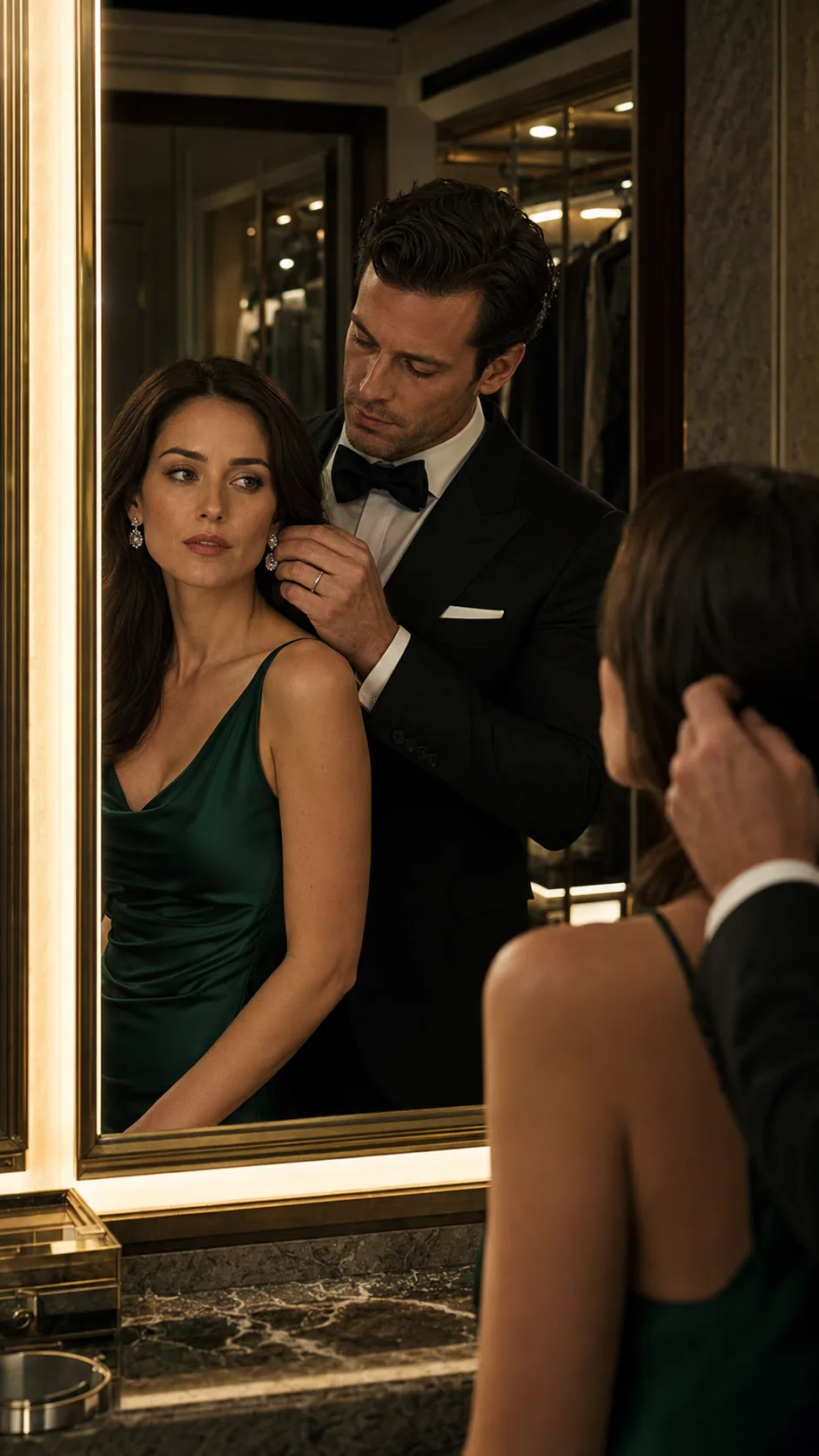
PART 3 — I TURNED HIS SURVEILLANCE SYSTEM AGAINST HIS SECRET MISTRESS
I spotted her the moment I stepped onto the terrace.
Chapter 3
PART 3 — I TURNED HIS SURVEILLANCE SYSTEM AGAINST HIS SECRET MISTRESS
I spotted her the moment I stepped onto the terrace.
Twenty-six years old. Red dress. Designer handbag worth more than most assistants earned in months. Ronan’s executive assistant. His private secret. And, according to five days of metadata review, his professional problem.
I circulated with a champagne flute I never drank from.
Playing the role I had perfected.
Corporate wife.
Soft smile.
Appropriate laughter.
My right earring transmitted a steady sixty-two beats per minute to Ronan’s dashboard.
Perfect compliance.
Perfect control.
Otilia stood near the marble bar, phone in hand, texting with the screen angled carefully away from the crowd. I had watched her do this repeatedly over the past week.
Always the same angle.
Always shielding the screen.
The evidence suggested Ronan either did not know or chose not to know.
His assistant was not simply involved with him.
She was selling him out.
Internal emails. Strategy briefs. Client acquisition targets. Documents quietly forwarded to a secure domain connected
to his fiercest competitor.
The metadata did not lie.
Neither did Otilia’s lifestyle.
Designer restaurants. Resort weekends. Rotating handbags.
The math was simple.
The betrayal was layered.
At 8:45, the jazz ensemble increased volume for its signature number. The crowd near the bar thickened as guests refreshed drinks.
I positioned myself seven feet from Otilia.
Her bag hung open on her left arm. Phone visible in the interior pocket. Keys. Lipstick. Wallet. The disorganized confidence of someone who did not expect surveillance.
I moved.
The collision looked entirely accidental.
My heel caught the slight elevation between terrace sections. My shoulder brushed hers as I stumbled forward. She steadied me with one hand. I caught myself against the marble bar.
“I’m so sorry,” I said, straightening. “Caught my heel on the step. Are you all right?”
“Completely fine,” Otilia said, smoothing her dress. “No worries at all.”
The entire interaction lasted
two seconds.
Exactly the length Ronan had taught me during a first-year vacation party trick.
Sleight of hand.
Watch me make this card disappear.
The student had become the master.
My left diamond earring now sat inside Otilia’s handbag, pressed between her leather wallet and phone case.
I adjusted the right earring, the biometric sensor still transmitting to Ronan, and apologized again.
Otilia smiled and returned to her phone.
My left earlobe felt light, empty, exposed.
Only I would notice.
And Ronan, if he looked closely.
I moved to the perimeter balcony, putting distance between myself and the crowded bar. Manhattan stretched below in grids of light and glass. Millions of ordinary lives moved beneath me while I executed quiet warfare above them.
My breathing held.
Four counts.
Four counts.
Four counts.
Four counts.
The monitor would show sixty-two beats per minute.
Relaxed socializing.
Nothing unusual.
Some women would have
confronted the assistant.
Some would have exposed her immediately, using the betrayal for leverage, anger, or public humiliation.
I did something more elegant.
I made her useful.
Inside Otilia’s designer bag, microscopic hardware waited patiently.
The transmitter would capture every conversation she had with competitor contacts. Every whispered call. Every handoff she believed was private.
And when Ronan eventually checked his dashboard, when he noticed the split between my location and the earring’s location inside Otilia’s bag, his paranoia would trigger exactly as designed.
He would access the audio stream expecting to catch me.
Instead, he would hear his assistant selling his secrets.
The trap was not for her.
She was bait.
Ronan had built a surveillance system to control me, to ensure I never discovered what he had done to my father.
I had just transformed that system into the weapon that would make him destroy his own architecture.
I had less than twenty-four hours before the detonation.
It took twenty minutes.
Across the rooftop, Ronan pulled out his phone.
I knew the moment he saw the coordinate split because his entire body went rigid. He stood near the jazz ensemble with a martini in hand, speaking to board members. Then his eyes dropped to the screen.
His shoulders locked.
His jaw tightened.
He scanned the crowd until his gaze found me near the glass doors.
Then he started walking.
My heart rate, which had held steady at sixty-two, began to climb.
Sixty-five.
Sixty-eight.
Seventy-two.
I deployed the breathing pattern.
Four counts.
Four counts.
Four counts.
Four counts.
Seventy-six.
Eighty.
Eighty-four.
If he was monitoring the biometric dashboard actively, if he looked at the number now, he would know.
“Is everything all right?” Ronan asked, voice tight.
“I caught my heel near the terrace,” I said, gesturing toward the bar. “I think the leather is loose. Why?”
My voice sounded casual.
My heart hammered against my ribs.
He studied me for three seconds.
Three seconds where I focused every trained instinct on keeping my face neutral.
Then he nodded slowly.
“Nothing,” he said. “Just checking in.”
He turned and walked back toward the board members, phone still in hand.
I excused myself and moved to the ladies’ room, locking myself in a stall until my pulse descended.
When I emerged seven minutes later, Ronan stood across the terrace with his phone tucked away.
The crisis had passed by milliseconds.
Saturday evening at ten, I sat in the dark Tribeca living room while Ronan worked in his locked home office.
My secondary phone, the encrypted device Rhett configured, vibrated once.
Ronan had opened the left earring’s audio stream.
He was listening.
But the transmitter was not with me.
It was in Otilia Cooper’s apartment across town, capturing whatever conversation she was having at that exact moment.
I waited.
Four minutes later, through the shared office wall, I heard a heavy object strike the floor.
Then Ronan’s voice, muffled but sharp.
“Terminate Cooper tonight. Full NDA enforcement. No severance. Silence.”
A pause.
“I don’t care where she is. Revoke credentials and have her escorted out within thirty minutes.”
The line cut.
Dead silence followed.
I sat in the dark, monitoring the passive alert that confirmed Ronan had accessed the audio stream for four minutes and seventeen seconds.
He had stepped directly into his own trap.
The architect undone by his own blueprint.
Monday afternoon, I returned to Rhett’s Brooklyn lab.
He looked like he had not slept in forty-eight hours. Coffee mugs stacked beside his workstation. Blue monitor glow reflected off exhausted eyes.
“Show me,” I said.
He pulled up a file tree full of interconnected nodes.
“This is Henderson Financial’s dual-ledger system,” he said. “I didn’t break into anything. I followed metadata. Headers, timestamps, access logs. Digital footprints.”
The display showed offshore structures, holding companies, routing pathways, concealed assets.
“This is forensic metadata reconstruction,” Rhett said. “Your attorney can use it to file a discovery demand. Completely legal. Completely admissible. Completely devastating.”
“How soon can Desmond file?”
“He has enough by morning.”
I tucked the analysis drive into my coat.
Tomorrow, Desmond Foster would walk that forensic map into court and file the motion that cracked Ronan’s financial architecture like granite under pressure.
But first, I had one more stop.
A weekly obligation I had never missed in three years.
My father was waiting at NewYork-Presbyterian, and I needed to tell him the war had officially begun.
Tuesday afternoon, Desmond slid a manila envelope across his conference table.
Inside were the first three pages that would end Ronan’s freedom.
Court-ordered discovery revealed years of systematic offshore asset movement, improper reporting, and carefully hidden accounts.
Desmond Foster, my former law school classmate and now managing partner of a Midtown boutique firm, sat across from me with the composure of a man holding the legal equivalent of a loaded vault key.
“What we’re looking at is not creative accounting,” he said. “It’s a blueprint.”
I pulled the first page from the envelope.
Wire records. Entity formations. Beneficial ownership structures. Offshore registrations mapped across jurisdictions.
“Not a marital dispute,” I said.
“No,” Desmond confirmed. “This is institutional exposure.”
I slid the pages back into the envelope.
“Finalize the whistleblower filing this week. I want federal protection secured before he understands what is coming.”
“Seventy-two hours,” Desmond said. “I can have it submitted by Friday.”
I looked down at the papers.
Court-stamped bond paper.
Black ink.
Wire numbers.
Shell company certificates.
A man who believed surveillance made him untouchable had been undone by documents.
“This strips him of everything,” Desmond said quietly.
“Not everything,” I said, standing with the envelope in my bag. “Only his freedom, his assets, his reputation, and the empire he built on my father’s work.”
“Where are you going?”
“To tell my father the cage is closing.”
At three that afternoon, I sat in the same hospital chair I had occupied every Tuesday for three years.
Vernon Vance lay motionless in the private room, chest rising and falling with machine-assisted rhythm. The steady hiss of the ventilator was the only sound in a room where time had stopped but bills had not.
Three years.
One hundred fifty-six Tuesdays.
One hundred fifty-six visits where I sat beside him and told him what I was building.
Today, I pulled a folded slip of paper from my coat pocket and wrote two names.
Ronan Henderson.
Elodie Vance.
The man who took.
The daughter who remembered.
I folded the paper and tucked it into the pocket of his hospital gown.
“I am halfway through, Dad,” I whispered. “The discovery is filed. The federal protection is coming. He doesn’t know yet that the cage is closing.”
His hand lay motionless on the sheets.
The monitor continued its rhythm.
Every day he spent in that bed was a second ticking off the clock I had built for Ronan Henderson.
And that clock was about to strike.
Three days later, I met Clarice Rivera in a secluded Upper East Side café.
She was forty years old, wearing clothes a decade out of fashion, holding her coffee cup with hands that had not stopped trembling since she sat down.
Clarice was Chester Rivera’s wife.
Chester, Ronan’s attorney, had helped build the legal maze that hid my father’s stolen work and Ronan’s assets. He had also built a smaller cage at home.
No independent accounts.
No friends.
No easy exit.
Every dollar monitored.
Every schedule controlled.
I slid a thick dossier across the marble table.
“This is your asset assessment under New York domestic law,” I said. “My firm’s resources will handle your exit. No compensation required.”
She looked at the dossier but did not touch it.
“Why?”
“Because your husband helped destroy my father,” I said. “And because no one should live in a cage.”
She studied my face, then opened the folder.
Her breathing changed as she read.
Freedom quantified in legal prose.
“You’re the woman destroying Ronan Henderson,” she said softly.
“I am.”
“Chester talks about you when he thinks I’m not paying attention. He thinks I’m furniture in the house.” She looked up. “But furniture hears everything.”
“What does Chester say?”
“That you’re dangerous. That you filed discovery revealing offshore structures. That Ronan is panicking.”
“He’s correct.”
She closed the dossier.
“I know where Chester keeps the corporate seals.”
I leaned forward.
“Home safe. Second bedroom office. Combination is our wedding date backward. The one date he assumes I would never use because he knows how much I regret it.”
“Why are you telling me this?”
“Because I want out,” she said. “And because men like Chester and Ronan only understand one language: consequence.”
That night, Clarice gave me access to the seal Ronan believed only Chester could authorize.
The same afternoon, Rhett confirmed something I had suspected for weeks.
Ronan’s corporate security system had a fatal flaw.
Sentinel Security firmware version 3.2.
Rhett had worked on the core testing team years earlier. He had documented a critical flaw that management buried to protect lucrative corporate contracts.
“Your husband hired the company that dismissed me for being too thorough,” Rhett said. “And installed the exact system I know how to navigate.”
Ronan thought he had built a fortress.
He had purchased a door Rhett already knew how to open.
Five days later, Desmond and I filed the divorce complaint and whistleblower submission.
Click the blue “PART 4” below to read the final part: 👉 PART 4 👈
Chapter complete
You have reached the end of this chapter.
Continue reading
A few more worlds to get lost in after this chapter.




