PART 2 — I LEARNED TO CONTROL EXACTLY WHAT MY HUSBAND HEARD
“Darling, we should leave soon,” Ronan said, checking his watch.
Chapter 2
PART 2 — I LEARNED TO CONTROL EXACTLY WHAT MY HUSBAND HEARD
“Darling, we should leave soon,” Ronan said, checking his watch.
“The car is waiting.”
“Of course. Just one moment.”
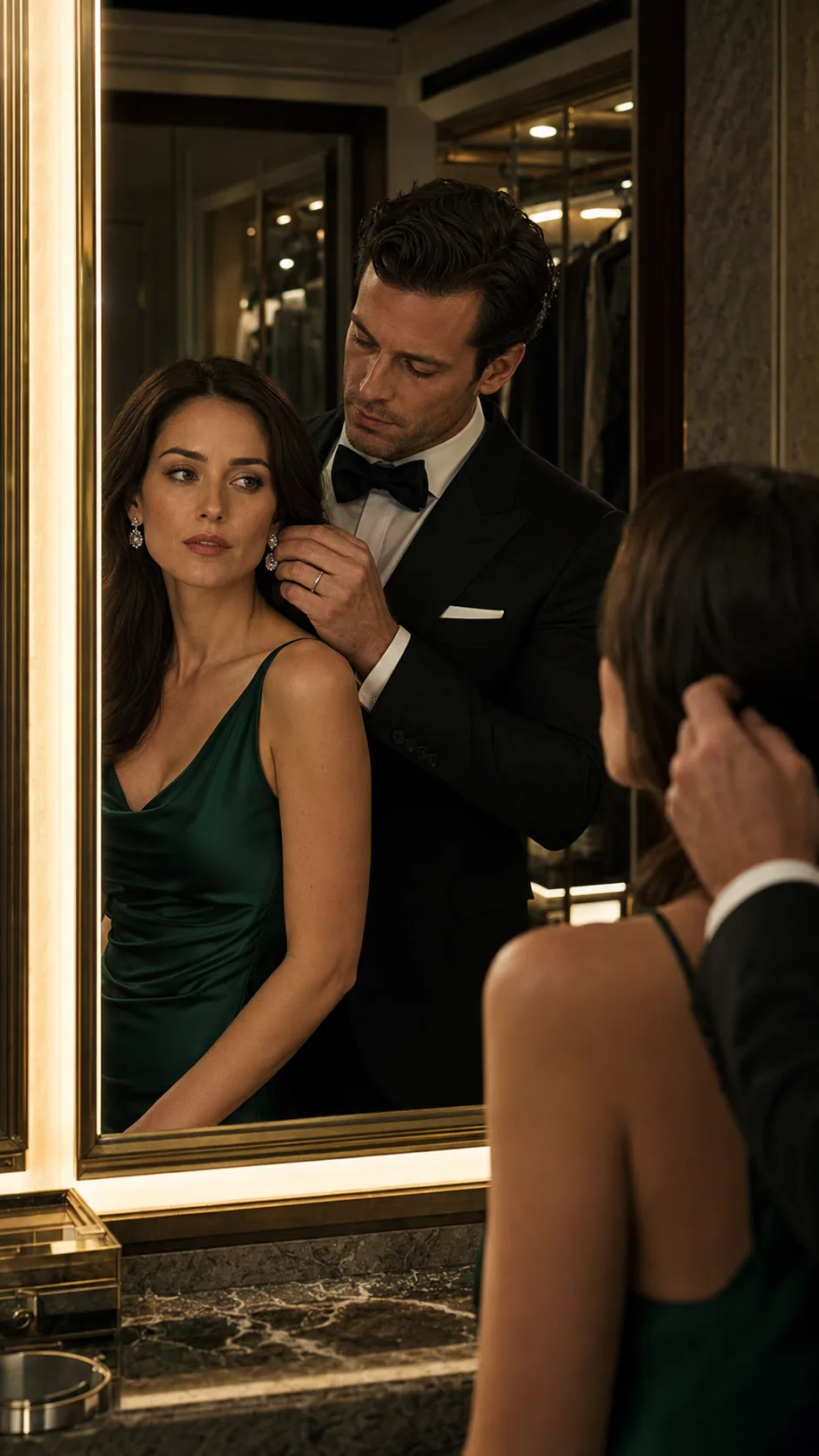
I touched the earrings, feeling their unnatural weight. The way they seemed to pull not only down, but inward, as if the metal carried something denser than platinum.
Ronan stood behind me, adjusting his cuff links and watching my reflection with that calculating expression.
Three years of marriage had taught me to read him the way a sailor reads weather. Small signs. Coming storms.
The tightness in his jaw meant he was planning something.
The way his hand touched my shoulder, possessive and proprietary, meant he believed he had already won.
The earrings were not just jewelry.
They were a message I had not yet learned to read.
I turned from the mirror to face him, offering the flawless smile I had perfected through charity galas, board dinners, and carefully staged public appearances.
The smile said I was grateful.
Compliant.
His.
“They’re perfect,” I said.
He leaned down and kissed my cheek. Dry lips. Brief contact. The kind of affection that photographed well but felt like paperwork.
“Nothing but perfection for my wife.”
I accepted his arm as we walked toward the private elevator. My heels clicked against Italian marble. The diamonds felt cold against my ears, heavier than they should have been, as if they carried more than precious stones.
I had learned that when Ronan gave me something beautiful, he was already calculating what he would take in return.
The postnuptial agreement cost me asset protection.
Quitting the firm cost me professional identity.
Every gift had an invisible price tag.
I simply had not yet seen the bill.
The elevator doors slid shut, sealing us inside mirrored walls and soft lighting. I watched our reflection. The perfect couple dressed for Manhattan’s elite. Diamonds catching light. His hand secure at
my waist.
I smiled at him.
He smiled back.
Neither smile reached our eyes.
By morning, I would understand exactly what my anniversary gift had been designed to steal.
The gala ended at 10:43 p.m.
By 11:14, I learned exactly how my father’s life had been broken.
Ronan’s phone lit up on the nightstand while water ran in the master bathroom shower. I had maybe ninety seconds, the length of his standard post-event routine, before he came out toweling his hair and asking if I enjoyed the evening.
I crossed the bedroom in bare feet, emerald dress already unzipped, and lifted his phone.
No passcode.
He had never needed one.
His wife was contained. Controlled. No threat at all.
The email sat at the top of his inbox. Sent at 10:47 p.m. while we had been in the car returning home.
From Chester Rivera.
Subject line: Vernon Vance final confirmation.
I tapped it open.
The words were clinical.
Vernon Vance intellectual property acquisition complete per 2020 directive. Source code transferred through shell entities. Trail cold. Exposure risk negligible. Marriage containment successful.
Congratulations on three years.
The shower water continued its steady rhythm.
I read the email twice more, memorizing every word, then scrolled through the thread history.
March 2020.
Hire the necessary specialists. I want his entire patent portfolio, and I want it untraceable.
August 2020.
Morgan’s bankruptcy filing confirmed. Recommendation: pursue the daughter. Active bar license. Litigation background. Potential risk if she investigates independently. Suggest direct neutralization through marriage.
November 2020.
Engagement secured. Wedding scheduled March 2021.
My father’s collapse happened in September 2022, weeks after his company folded under circumstances no one could explain.
Intellectual property theft, they said.
Corporate misconduct, they said.
No proof. No leads.
Just Vernon Vance’s life’s work vanishing into offshore structures while his bank accounts went negative and stress took what was left of his body.
I had spent three years believing it was random.
Market forces.
Bad timing.
A tragedy with no face.
But Ronan Henderson had orchestrated every second of it, then married me to make sure I never discovered the truth.
The shower kept running.
I kept the diamond earrings firmly on my ears and focused on my breathing. The biometric sensor, if that was what I now suspected, would show him exactly what he expected: a tired wife preparing for bed, pulse slightly elevated from the evening, completely unaware.
I returned the phone to its exact place on the nightstand.
Seventeen centimeters from the lamp base.
Parallel to the table edge.
Then I walked to the closet just as the shower stopped.
“Are you tired, honey?” Ronan called from the bathroom.
“Not at all,” I said. “The night is just beginning.”
Three years.
Three years I had been married to the man who put my father in that hospital bed.
Three years sleeping beside the architect of my family’s ruin, smiling at his business partners, wearing the jewelry he selected, living inside the prison he had built specifically for me.
The earrings felt different now.
Not heavy.
Not suspicious.
Dangerous.
I waited until Ronan fell asleep, his breathing evening out at 11:52 p.m. Then I moved to the study and opened the encrypted laptop I had purchased three weeks earlier with cash.
The laptop Ronan did not know existed.
I typed a single message to a Miami number I had researched for the past month.
Initial assessment correct. Proceeding to phase one.
The response arrived within ninety seconds.
Confirmed. Saturday, 9:00. Usual location.
I closed the laptop, returned to bed, and lay beside my husband in the dark, listening to him breathe.
The earrings pressed cold against my skin.
His surveillance system.
His control mechanism.
His mistake.
By Saturday morning, I was stepping out of an Uber in Brooklyn Heights, twenty-five minutes and a world away from the Tribeca penthouse.
Rhett Ward answered his door in a faded MIT T-shirt with diagnostic magnification goggles pushed up on his forehead.
Twenty-nine years old. White-hat security consultant. The only person I trusted with my life.
His basement apartment smelled like solder, coffee, and burnt resin. Blue monitor light turned everything metallic.
“You wore them?” he said, looking at the earrings.
“I needed to know what I was dealing with.”
He gestured toward a workstation covered with precision tools and circuit board fragments.
“Sit. Don’t move your head too much. If they’re transmitting, sudden movement might trigger alerts.”
I sat.
Rhett wheeled his chair close and adjusted a stereo microscope until its twin lenses focused on my right ear. His hands moved with surgical precision as he worked the clasp free.
“Acoustic transmitter,” he said, placing the diamond under magnification. “Live signal. Active range approximately fifty meters. Commercial-grade surveillance tech. The kind corporate security uses for executive protection or monitoring.”
He reached for the left earring.
“And this one is the prize.”
He removed it carefully, then went silent.
“Biometric sensor,” he said. “Heart rate. Skin temperature. Possibly stress response if it’s sophisticated enough. Real-time physiological monitoring.”
He looked up from the microscope.
“You know it’s actively transmitting right now, don’t you?”
“I do.”
“He’s watching your vital signs. Every heartbeat. Every temperature shift. Any spike in your pulse, he’ll know you’re stressed. Any drop, he’ll know you’re afraid.”
Some women would have thrown the earrings into the East River.
Some would have confronted him immediately, demanded answers, called lawyers, made a public scene.
I did neither.
“Put them back in,” I said.
Rhett stared at me.
“You’re serious?”
“Completely.”
He refastened the first earring with careful hands, then the second.
I stood and walked to the small bathroom mirror, adjusting each diamond until it caught the fluorescent light perfectly.
The acoustic chip was live.
The biometric sensor was feeding Ronan my pulse, my temperature, every physiological tell that might reveal fear or discovery.
Let him watch.
Let him listen.
Because the woman whose vital signs he monitored was no longer just his wife.
She was the one deciding what he would hear next.
“From this moment forward,” I said, watching my reflection, “I decide exactly what he hears.”
The next phase required learning to control what those sensors could and could not detect.
Three days later, I sat in Rhett’s lab with electrodes taped to my wrist and chest, staring at a monitor that displayed my heartbeat in real-time green waves.
The first time Rhett read the email aloud—the one confirming my husband had orchestrated my father’s downfall—my heart rate spiked from sixty-two to eighty-four in less than three seconds.
“Twenty-two beats,” Rhett said, tapping the jagged mountain on the monitor. “If Ronan sees that through the biometric sensor, he’ll know.”
I stared at the screen, watching the pulse gradually settle.
A perfect physiological confession.
“How long do I have?” I asked.
“Before what?”
“Before I need to wear them again. Before he starts asking questions.”
Rhett checked his watch.
“You removed them Saturday morning. Today is Tuesday. Three days of professional cleaning is reasonable. Five days, he’ll know something is wrong.”
Five days.
I had five days to learn what trained operatives spent months mastering.
“Show me how,” I said.
He pulled up tactical breathing techniques on his monitor.
“Four-count inhale. Four-count hold. Four-count exhale. Four-count hold. Your autonomic system can be trained. The goal is not to erase emotion. That’s impossible. The goal is to prevent spikes beyond normal variance.”
We ran the test again.
He read the email.
The rage arrived like fire through my chest, jaw, and hands.
But I held the rhythm.
Four counts in.
Four counts held.
Four counts out.
Four counts held.
The monitor climbed from sixty-two to seventy-three.
“Better,” Rhett said. “Again.”
We ran it seventeen times over two hours.
Seventeen times, I heard the words confirming my husband had broken my father’s company and married me to contain the daughter.
Seventeen times, I forced my nervous system to comply with a rhythm that had nothing to do with what I felt and everything to do with survival.
At 11:30, Rhett ran the test again.
This time, I did not focus on the breathing alone. I focused on the rhythm of my father’s ventilator. The steady mechanical inhale and exhale I had memorized during hospital visits.
The sound that meant he was still alive.
Rhett read the email.
The monitor climbed from sixty-two to sixty-six, then settled.
“That’s it,” he said quietly. “Four-beat variance. Normal stress response. Nothing unusual.”
I opened my eyes and looked at the green line.
Barely trembling.
During a short rest, I pulled the encrypted laptop from my bag and opened a dashboard Rhett was not meant to see.
Kensington Capital.
The shell company I had established with my father’s trust.
Current holdings: forty percent of Ronan’s outstanding convertible bonds, acquired over twelve months through small transactions below institutional radar.
Every share purchased through layered entities.
I closed the laptop before Rhett could see the full scope.
“One more test,” he said. “The hardest one.”
He positioned a webcam at eye level.
“Smile. Smile while keeping your pulse locked. Anyone can maintain baseline in a neutral state. You need to perform affection while your physiology stays controlled. Look into that camera like it’s him. Smile like you love him. Don’t let your heart betray you.”
I established the breathing pattern.
The monitor showed sixty-two.
I looked into the lens and imagined Ronan’s face, the cold smile he wore while fastening the monitored earrings to my ears.
Then I smiled.
Warm.
Genuine.
Loving.
The monitor did not move.
“Perfect,” Rhett whispered. “That’s perfect.”
He thought this training was about surviving my marriage.
He did not know I had been preparing for this war since the day I signed my maiden name on the Kensington Capital papers, before I ever said I do.
The question was never whether I could deceive Ronan’s surveillance.
The question was how long I would let him believe he was watching me when I had already positioned myself to watch everything he owned come apart.
The corporate gala was five days away.
I needed one more asset before the first strike.
Her name was Otilia Cooper.
I acquired her five nights later on a Manhattan rooftop.
Click the blue “PART 3” below to read the next part: 👉 PART 3 👈
Chapter complete
You have reached the end of this chapter.
Continue reading
A few more worlds to get lost in after this chapter.




