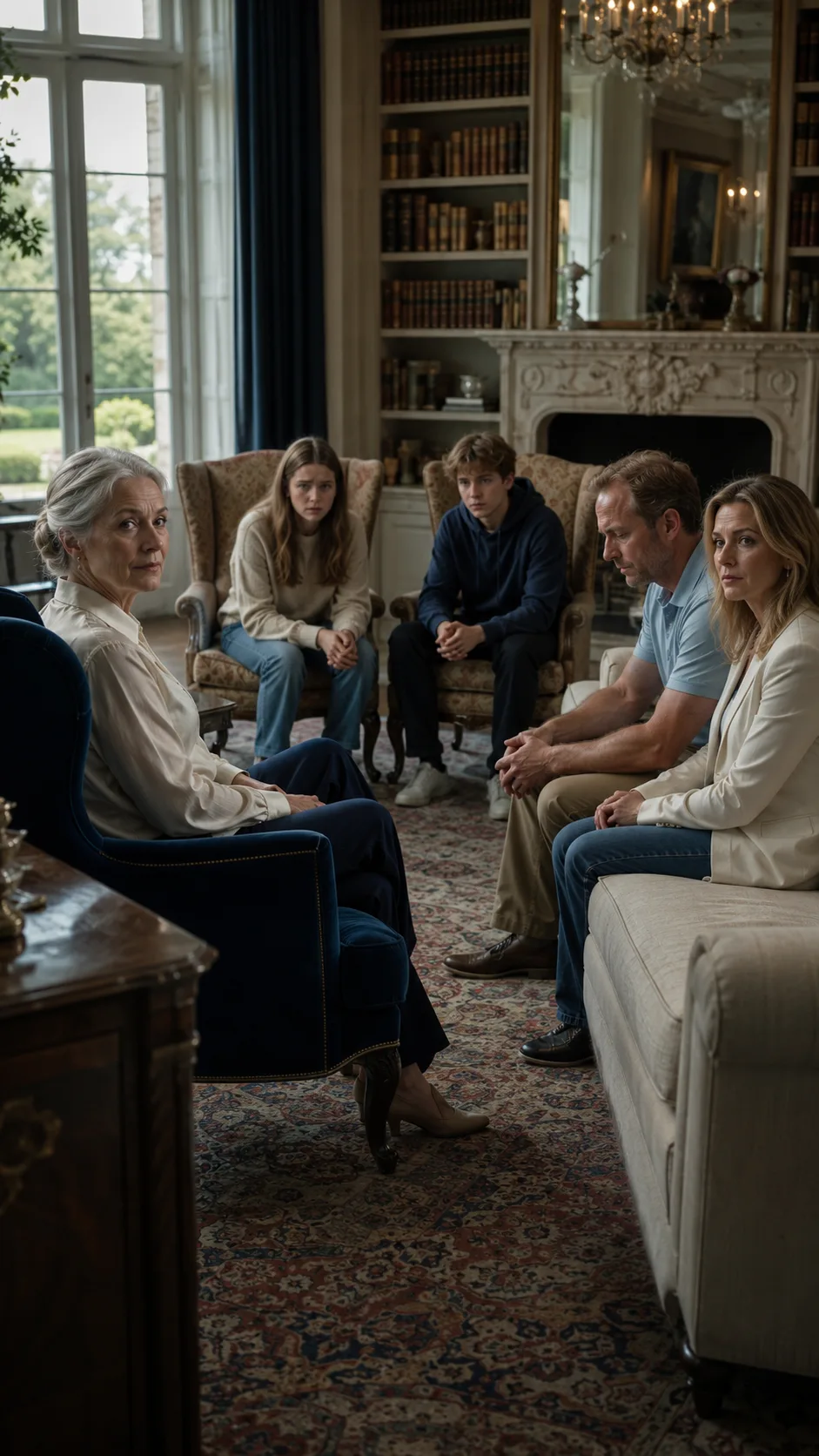
PART 2 — THE WOMAN THEY THREW AWAY FINALLY DECIDED WHO COULD ENTER HER HOME
Jessica laughed once, sharp and unbelieving.
Chapter 2
PART 2 — THE WOMAN THEY THREW AWAY FINALLY DECIDED WHO COULD ENTER HER HOME
Jessica laughed once, sharp and unbelieving.
“Maggie, be serious.”
“I am being serious.”
James leaned forward.
“Mom, please. We are in a terrible spot.”
“And I was not?”
“That was different.”
“Because you preferred your own suffering to mine?”
His mouth opened and closed.
Jessica stood again, anger making her careless.
“You know what? Fine. You want to punish us forever over one bad decision? Fine. But don’t sit there and pretend you’re so morally superior just because you got lucky.”
That word did it.
Lucky.
I stood.
The room shifted with me.
People are used to old women managing pain from a seated position.
Standing changes the weather.
“Lucky,” I repeated.
“Jessica, I lived in a motel that smelled like bleach and cigarettes. I walked to the library every morning because it had free heat in winter and free air conditioning in summer. I took a part-time bookkeeping job at a garden center for fifteen
dollars an hour because no one else wanted to hire a sixty-year-old widow. I spent nights in a studio apartment over Giuseppe’s Pizza reviving clearance plants everyone else thought were dead. I built a business by seeing value in what people were willing to throw away. Then I built another, and another. I learned contracts. I learned supply chains. I learned licensing. I learned how to sit across from bankers and loan officers and men in custom ties who assumed I was a hobbyist in orthopedic shoes and make them understand I was the smartest person in the room.”
My voice never rose.
It did not need to.
“There is not one square foot in this house luck bought. There is not one check with my name on it that did not come through work. And there is certainly not one room here intended for the convenience of the two
people who told me figuring out my life was not their problem.”
That shut her up.
James looked smaller by the minute.
I felt a strange, late wave of pity for him then.
Not enough to soften.
Enough to see clearly.
He had spent twelve years building a marriage around avoidance, and avoidance always sends the bill eventually.
Emma wiped her face and said, “Can we still know you?”
That question broke me a little.
Not outwardly.
Years and years of survival had built good walls.
But inside, something tender and old gave way.
I looked at her.
At Tony.
At the children I had once packed lunches for and then lost to someone else’s shame.
“Yes,” I said. “You can.”
Jessica made an outraged noise.
“You cannot go around us.”
I turned to her.
“I can go around anyone I choose in my own family if the obstacle is
dishonesty.”
“You don’t get to decide that.”
“I already did.”
Tony spoke before she could reload.
“I want to come back.”
Jessica swung toward him.
“Tony.”
He held his ground.
“No. I want to come back. I want to know her. I want to know what else you lied about.”
Emma nodded through tears.
“Me too.”
I had not planned for that.
People imagine revenge stories hinge on the one perfect speech, the slammed door, the security guard, the immaculate final line.
Real life is messier and, when you are lucky, kinder than that.
The true shock is often not what you say to the people who hurt you.
It is what you do with the ones who were lied to on the way.
Jessica looked at James with pure fury.
“Say something to them.”
He looked at his children, then at me, and for one brief second I saw the boy who used to cry if he thought I was mad at him.
“I think,” he said slowly, “they should hear whatever they want to hear.”
Jessica stared at him.
“You are unbelievable.”
No, I thought.
Just late.
I crossed to the sideboard and took out two leather-bound guest key folders I had bought mostly because the house came with them and I enjoyed the absurdity.
I handed one to Emma and one to Tony.
“These are not room keys,” I said. “They’re gate codes and my number written inside where you won’t lose it. If you want to come here, you text first. If I say yes, you come. If I say no, you don’t argue. This is not a hotel and it is not a rebellion headquarters. Is that understood?”
They both nodded so quickly it hurt to watch.
Jessica looked ready to shatter something.
“You are undermining us in front of our own children.”
I met her eyes.
“You mistook that for a new behavior.”
The silence that followed carried more truth than sound ever does.
Finally James stood.
He looked exhausted.
Older than his years.
Like a man who had spent so much time being managed by the strongest emotion in the room that he had forgotten how to produce one of his own.
“We should go,” he said.
Jessica stared at him.
Then at the children.
Then at me.
“You think you’ve won.”
I smiled.
“No,” I said. “I think I’m home.”
That landed harder than anything else I could have said.
Because she understood what I meant.
Not just the house.
Not just the money.
Not the view across eight acres and the formal garden and the pool house and the library she had already mentally divided into possible bedrooms.
I was home in myself.
That was what she had not counted on.
She came expecting the old Maggie—the apologetic widow, the woman grateful for crumbs, the mother who would trade dignity for a place at the table.
That woman no longer lived there.
James moved toward the door.
Jessica followed after the shortest possible hesitation, heels sharp against my hardwood floors.
Emma and Tony lingered.
I walked them to the foyer myself.
At the door, Emma turned to me and said, “Did you really live over a pizza place?”
I laughed softly.
“For almost three years.”
“What was it like?”
“Loud. Greasy. Drafty in winter. And the best thing that ever happened to me for a while.”
Tony looked around the foyer.
“Did you always want a house like this?”
I considered it.
“No,” I said. “I wanted safety. The house came later.”
That seemed to matter to him.
Then I kissed Emma’s cheek, squeezed Tony’s shoulder, and watched them walk down the front steps behind parents they no longer looked at quite the same way.
When the door closed, the house went very quiet.
Not triumphant.
Not empty.
Just still.
I stood in the foyer with one hand on the brass handle and let myself feel all of it at once.
The sting.
The satisfaction.
The grief.
The absurdity of having survived long enough to watch the same people who once found me inconvenient now study my crown molding for storage possibilities.
Then I did what women like me always do after war has passed through a room.
I straightened the sofa pillows.
I carried four untouched water glasses back to the kitchen.
I washed my hands.
And then I called Eleanor.
She answered on the second ring.
“Well?”
I laughed.
“They came.”
“Of course they did.”
“With the children.”
“Oh, that’s bold.”
“They wanted to move in.”
A long pause.
Then Eleanor let out the kind of rich, delighted laugh only women over sixty can produce when another woman has just been proven magnificently right about human nature.
“And?”
“I said no.”
“Only no?”
I looked out through the conservatory glass at the clipped hedges and winter-dormant beds that would be blazing by May.
“No,” I said. “I said much more than that.”
Eleanor made a satisfied sound.
“Good. How do you feel?”
I thought about the motel room with the broken air unit.
The library computers.
Sarah Mitchell at the garden center.
Dirt under my fingernails.
Eleanor helping me through that first impossible SBA packet.
The warehouse.
The first licensing agreement.
The first time Phoenix Plant Recovery cleared enough profit that I cried over a spreadsheet alone in my office because the numbers felt like oxygen.
Then I thought about James’s face on my porch that morning.
“I feel,” I said, “like twelve years of silence just paid compound interest.”
Eleanor laughed again.
“Come to dinner tomorrow. I’ll open the good wine.”
After we hung up, I went upstairs to the conservatory suite that had once sold me on the house in the first place.
Not the ballroom foyer.
Not the library.
Not the primary bedroom with its double fireplace and view over the valley.
The conservatory.
Glass roof.
Slate floor.
Sun even in winter.
Enough room for two hundred plants and still space for a round table in the middle where people could sit with tea and tell the truth or not, but either way under good light.
I had filled it carefully over the past year.
Lemon trees.
Camellias.
Wintered geraniums.
Rare philodendrons.
A row of rescue orchids I got from a hotel lobby renovation in Charleston.
Plants other people had written off and I had taught, once again, that neglect is not always the same thing as death.
I stood there with my hands wrapped around a fresh cup of coffee and looked out at the grounds.
At noon, Emma texted.
Can I come back next weekend? Alone? I want to hear everything.
I wrote back:
Yes. Saturday at 11. I’ll make cookies.
Three dots appeared.
Then:
Mom says you’re manipulating us.
I looked at the screen a long time before answering.
Then I typed:
Wanting the truth is not manipulation.
She wrote back almost immediately.
I know.
That was how it began.
Not with grand declarations.
Not with family therapy.
Not with James arriving in tears or Jessica having a moral awakening in the frozen-food aisle.
It began with Saturdays.
Emma first.
Then Tony.
Then sometimes both.
We started careful.
Cookies.
Tea.
Photo albums.
Stories they should have known years earlier.
Their father at eight in a Little League uniform too big through the shoulders.
The time he brought home a stray dog and hid it in the garage for two days.
The Christmas he wanted a bike so badly he cried into the mashed potatoes because he knew I couldn’t afford it and got one anyway because I took on extra ironing that month and ate toast for dinner for a week.
Children do not only inherit a family’s wounds.
They inherit its missing stories too.
Tony asked practical questions.
“How much was the motel?”
“How did you get from there to the apartment?”
“What does plant rehabilitation actually mean?”
“How do loans like that work?”
Emma asked the questions girls ask when they are closer to pain.
“Were you ashamed?”
“Did you hate Dad?”
“Did you ever think about just disappearing?”
“Did you want to see us all that time?”
That last one nearly finished me.
“Yes,” I said. “Every birthday.”
They came often enough that I set up two bedrooms on the second floor properly.
Not lavishly.
Thoughtfully.
Emma got the blue room at the back because she liked the morning light and read late.
Tony got the room over the garage because he liked the small sitting nook and the view of the pool.
I put fresh towels in both, bought extra phone chargers, and left little bowls of mints on the bedside tables because hospitality is muscle memory where I come from.
I did not tell James or Jessica when the children were there.
The children were old enough to make the moral decision of whom to see, and I was done treating adulthood as something parents could claim on behalf of children while lying to them.
James called once about a month in.
Not from a place of authority.
From that old, uncertain place where guilt and need sound too similar.
“Mom.”
“Yes.”
“They’ve been spending time with you.”
“They have.”
He was quiet.
“I’m glad,” he said finally.
I believed him.
Not because I trusted him fully.
Because fathers are different when children stop looking at them with automatic faith.
They become more honest or more defensive, and weakness had finally made honesty cheaper for him.
“Jessica isn’t,” he added.
“That is not my burden.”
“I know.”
Another silence.
Then, quietly, “I am sorry.”
There are apologies that want to be received and apologies that have finally given up on controlling the outcome.
His sounded closer to the second kind.
“I know,” I said.
This time I meant something gentler than I had the day of the visit.
He started calling every few weeks after that.
Never asking for money.
Never asking for anything, in fact.
Sometimes to check whether Emma had left her school bag at my place.
Sometimes to say Tony made varsity and I might want to know.
Sometimes just because old people and estranged sons both discover, at inconvenient ages, that silence is not the same thing as peace.
Jessica never called.
Which was fine.
Then, in late October, the county posted the foreclosure sale date.
I found out the same way everybody in Millbrook finds out things that should embarrass somebody—through quiet talk at the diner, legal notices taped to courthouse bulletin boards, and women in the pharmacy line lowering their voices only after the most important part of the sentence has already been heard.
I did not go looking for it.
At my age, trouble often arrives stapled to public record without needing an invitation.
Three days later, James showed up at my office downtown.
Not the conservatory office at the house.
The real office in the historic district above our flagship design showroom, where Phoenix Plant Recovery ran its consulting arm and sustainability partnerships and where I sat behind a walnut desk looking over contracts bigger than the mortgage on the house he was about to lose.
My assistant buzzed me.
“Your son is here. Says he doesn’t need much time.”
I stared through the office window at the courthouse dome across the square, at the lunch traffic, at the women carrying yoga mats and dry cleaning and iced coffees as if adulthood were a series of errands and not a long legal argument with your own history.
Then I said, “Send him in.”
He came into the room carrying none of the theater of the mansion visit.
No wife.
No children.
No rehearsed family language.
Just James, grayer and thinner than he had been in the summer, hands rougher than before, shame stripped down into something nearly decent.
He sat when I told him to.
Neither of us spoke for a moment.
Then he said, “We’re going to lose the house.”
I folded my hands on the desk.
“I know.”
He nodded as if he had expected nothing else.
“I’m not here to ask to move in.”
“That’s wise.”
He gave the ghost of a smile at that, then lost it.
“I’m here because the kids know everything now, or enough. Emma barely speaks to Jessica. Tony does when he has to. They still come see you and I’m glad they do. And I…” He stopped, looked down, and tried again. “I need to know if there’s any version of this where I’m still your son.”
I did not answer immediately.
Because that is not a financial question.
That is not even a forgiveness question.
That is a soul question, and if you answer it too fast you do everyone involved a disservice.
“You are my son,” I said at last. “That is biology. History. Fact.”
He swallowed.
“But?”
“But being my son is not the same as having access to me on your terms. You learned that too late.”
Tears came into his eyes then, and I admit it hurt to see.
Not because I enjoyed it.
Because I am still his mother and some wounds never become clean, no matter how justified they are.
“I know,” he said.
“I think you do.”
He sat there another moment, then said the thing I had waited twelve years to hear.
“I chose comfort over character.”
There it was.
Not Jessica made me.
Not we were stressed.
Not you know how marriage gets.
I chose.
Comfort.
Character.
At sixty, I would have rushed to soothe that confession.
Told him not to be too hard on himself.
Softened the edges.
Mothers are trained toward mercy so aggressively that it can become a vice.
At seventy-two, I knew better.
“Yes,” I said.
He nodded once, as if the confirmation cost him and he deserved the bill.
“I’m trying not to do that anymore.”
“Good.”
He looked around my office then.
At the built-in shelves.
The framed licensing maps.
The awards from sustainability groups and industry journals and women’s entrepreneurship panels I had once hated attending and later learned to enjoy out of spite.
“I used to tell myself you just got lucky,” he said quietly. “That if things had gone differently, you would’ve ended up all right because you’re tough and the world rewards people like that.”
I raised an eyebrow.
“The world does not reward people like me, James. People like me invoice it.”
That actually made him laugh through the tears, and I was grateful for it because grief without humor curdles into self-importance if left unattended.
Then I said the thing he had really come for.
“I am not paying off your mortgage.”
He nodded immediately.
“I know.”
“I am not writing a quiet rescue check. I am not becoming your emergency line of credit in old age because you have now remembered my humanity.”
“I know.”
“But.”
This time he looked up the way children do when they know there might still be a door somewhere in the room.
“I will not let Emma and Tony pay for choices they did not make.”
He stared.
I opened the file drawer at my right hand and took out two folders.
He blinked.
“I set up education trusts for them six months ago,” I said. “Directly. With strict controls. Tuition, books, housing stipends, reasonable living expenses. No parent access. They don’t know the details yet because I wanted the timing right. You can tell them today if you choose.”
He looked at the folders as if they might disappear.
“You did that?”
“Yes.”
“Why?”
That question almost offended me.
“Because they are my grandchildren,” I said. “And because the adults in this family have already wasted enough years confusing injury with inheritance.”
He covered his eyes with one hand then, breathing unevenly.
“I don’t deserve you,” he said.
That was probably true.
But deserving has never had much to do with family, only with what you do once grace embarrasses you.
“Go rent something smaller,” I said. “Tell the truth to your children every day for the next ten years until it becomes natural. Get a job, any honest one, before you wait for the right title. And do not bring me your wife’s anger and call it a moral dilemma.”
He dropped his hand and nodded.
When he left my office, he took the education folders for Emma and Tony with both hands, like something fragile.
I did not stop him.
Jessica filed for divorce seven months later.
That surprised no one but James.
I am not proud of the small grim satisfaction I felt when Emma told me over soup in my kitchen, “Mom says she can’t be married to someone who keeps making her feel insecure.”
The old Maggie would have bit her tongue.
The woman I am now said, “That is a sentence often used by people who mistake accountability for instability.”
Emma nearly inhaled a crouton laughing.
That was another kind of healing.
Not grand.
Not cinematic.
Just two women at a kitchen island in a house big enough for the truth.
Jessica moved into a luxury rental she could not really afford and then into a townhome she could.
James rented a small place across town near the high school and started doing commercial landscaping for a company owned by a man I happened to know from my early garden-center years.
The pay was not glamorous.
The work was hard.
His back hurt.
His pride hurt more.
Good.
Some kinds of repair require blistered hands.
Over time, the children became less like visitors and more like family.
Emma studied at my dining room table and raided my refrigerator as if she’d been doing it forever.
Tony discovered he liked pruning and irrigation systems and came to work summers with one of my regional greenhouse managers, who promptly informed me the boy had “an eye for stressed inventory and a mouth that still remembers how to say yes ma’am,” which I took as the highest available compliment.
When Emma got into college, we celebrated with Chinese takeout in the breakfast room and a Costco sheet cake because no triumph worth respecting should be too elegant for buttercream.
Tony started talking about business school one week and landscape architecture the next, which is exactly how a seventeen-year-old ought to sound if life has finally given him room to imagine more than survival.
James came to Thanksgiving three years after the mansion visit.
Not Jessica.
Just James.
He brought a pecan pie from the good bakery, stood awkwardly in my mudroom holding it like a peace offering from a war no one knew how to memorialize, and said, “I know I don’t deserve to be here.”
“No,” I said. “But you were invited. Those are different things.”
That dinner was not magical.
I want to be honest about that.
There was no sweeping reconciliation.
No toast.
No one cried into the mashed potatoes and thanked God for family.
Emma still watched him carefully.
Tony kept conversation on football and classes and the new greenhouse ventilation system.
James helped carry dishes without being asked, and when I caught him at the sink later staring out into the dark over the back lawn, he said, “I used to think success was getting into a house like this.”
“And now?”
“Now I think success is getting invited back after you’ve behaved like a fool.”
That was closer to wisdom than he had ever sounded in his life.
These days, when people in town talk about me—and in a place like Millbrook, people always talk—they do it with a kind of careful respect that still makes me smile.
I am not “poor Maggie” anymore.
Not “James’s mother.”
Not “the widow who had that rough spell after Harold died.”
I am Maggie Williams of Phoenix Plant Recovery.
The woman with the big house on the ridge.
The one who turned dead inventory into a national business.
The one who bought the Harrison estate in cash and put a greenhouse where the former owner kept a card room.
The one who serves roast chicken and hard truths with equal calm.
I do not say any of that with bitterness anymore.
Bitterness is heavy.
Success is lighter.
Especially when earned late.
Sometimes, on clear mornings, I take my coffee to the upstairs balcony and look over the town below.
The old neighborhoods.
The church steeples.
The courthouse.
The subdivisions with their matching roofs and HOA mailboxes lined up like obedient little promises.
Somewhere down there is the life I once thought I needed to be invited back into in order to matter.
Now I know better.
I mattered in the motel room.
I mattered in the studio above the pizza shop.
I mattered with dirt under my nails and a bookkeeping ledger on my lap and a tray of nearly dead geraniums by the window.
The mansion did not create my value.
It just gave other people a backdrop large enough to notice it.
And that, maybe, is the final lesson.
People like James and Jessica always think power lives in the house, the title, the visible proof.
They think the person who ends up with the bigger gate and the better address must somehow have won.
But winning had happened long before the Harrison house.
It happened the first morning I walked into the public library instead of lying down in that motel bed and letting humiliation finish its work.
It happened the day I took home three truckloads of “dead” plants and saw possibility where other people saw trash.
It happened when I signed the SBA papers with my hands shaking and did it anyway.
It happened when I learned that being thrown away and being worthless are not remotely the same thing.
By the time James and Jessica rang the bell here and told me, in all but exact words, that they intended to move into my extra room and call it reconciliation, I had already won a thousand quieter victories they would never fully understand.
What shocked them was not that I said no.
It was that I said no without anger.
Without pleading.
Without the old hunger to be chosen.
I said no like a woman who had built her own front door and finally understood she was allowed to decide who crossed it.
That kind of no changes everything.
THE END.
Chapter complete
You have reached the end of this chapter.
Continue reading
A few more worlds to get lost in after this chapter.




