He Spent Twelve Years Lying — She Opened One Door And Changed Everything
PART 1 — AFTER TWELVE YEARS, THEY CAME BACK TO THE DOOR THEY ONCE CLOSED ON ME
My daughter-in-law turned my son against me, and together they shut me out for twelve years.
Chapter 1
He Spent Twelve Years Lying — She Opened One Door And Changed Everything
PART 1 — AFTER TWELVE YEARS, THEY CAME BACK TO THE DOOR THEY ONCE CLOSED ON ME
My daughter-in-law turned my son against me, and together they shut me out for twelve years.
Then my small business took off, I bought a mansion, and suddenly they came back smiling like nothing had happened.
The next day, they showed up at my door and said, “Hey Mom, we’re moving in since you have all this extra room.”
They had no idea they were about to hear the one answer they never expected.
By the time my son rang the bell at the Harrison house, I had already lived long enough to know that regret rarely travels alone.
It usually arrives with a spouse, two nearly grown children, and a housing problem.
The front door camera gave me a clean, bright view of all four of them standing on my stone porch as if they belonged there.
James in pressed khakis and a pale polo shirt that tried too hard to look relaxed.
Jessica in designer jeans and a cream blazer, hair blown smooth, lips
glossy, posture perfect in that brittle suburban way women wear when they have spent years trying to look richer than they feel.
Behind them stood Emma and Tony.
No longer the little children I had once bathed and fed and rocked to sleep, but teenagers now—long-legged, uncertain, watchful.
My coffee was still hot.
The kitchen behind me still smelled like lemon oil, new cabinets, and rosemary focaccia cooling on the island.
Morning light came through the conservatory windows in long pale strips, catching on the glass, the wrought iron, and the broad green leaves of the lemon tree I had moved in before I unpacked half my dishes.
The newspaper had printed the real estate transfer the day before.
Of course they had come.
I let them stand there for another ten seconds.
Not to be cruel.
To let myself feel the full shape of the moment.
Twelve years earlier,
James had carried my suitcase to a front porch in the rain and set it down as if he were moving out old patio cushions.
Now he was standing outside my door in a neighborhood he used to drive through on Sunday afternoons, hoping for entry.
There are times when life is so exact it feels written.
I smoothed the front of my blouse, crossed the marble foyer, and opened the door just wide enough to keep the screen between us.
“Well,” I said. “This is a surprise.”
James tried a smile and failed somewhere around the eyes.
“Mom.”
His voice caught slightly on the word, and I would be lying if I said that did not land somewhere in me.
Mothers are built badly for this kind of thing.
The child can be forty-five, balding, soft around the middle, carrying his own failures in a leather weekender, and some
humiliating part of your heart will still remember the little boy who had croup and wanted you to sit on the edge of the bed until he fell asleep.
Jessica leaned in half a step.
“Maggie,” she said brightly. “We saw the house transfer in the paper and thought, well, we have to come congratulate you.”
How thoughtful, I almost said.
Instead I looked past her to Emma and Tony.
Emma was sixteen now. Tall, fine-boned, with Jessica’s sharp cheekbones but none of that meanness around the mouth.
Tony was fourteen, broadening through the shoulders, with James’s cowlick and the same uneasy kindness James used to wear as a child before life and marriage turned him into someone I no longer recognized.
I had not seen either of them in person in almost twelve years.
That fact sat in my throat like a stone.
“Congratulations delivered,” I said. “Anything else?”
Jessica’s smile thinned.
James shoved his hands into his pockets, then took them back out. He had always done that when nervous, even as a boy.
“Mom, can we come in? We need to talk.”
There it was.
Not hello.
Not I’m sorry.
Not You look well.
We need to talk.
I thought of October 2012.
I thought of two suitcases, a cardboard box, and my own son looking at me as if eye contact might make what he was doing harder.
I stepped back.
“Come in,” I said. “Since we’re suddenly so interested in family conversations.”
They followed me through the foyer with the same careful awe people wear in expensive homes when they are trying not to look impressed.
The Harrison house had once belonged to a steel widow who hosted charity luncheons and kept peacocks before the city made her stop.
Twelve thousand square feet, eight acres, brick and limestone, a sweeping staircase no one really needed, and a conservatory bigger than the apartment where I had once revived dying ferns for grocery money.
I had not bought it only because it was beautiful.
I had bought it because it had room.
Room for my business records.
Room for my winter greenhouse.
Room for Eleanor and my book club and women who brought casseroles without pity in them.
Room, if life ever softened enough, for grandchildren who had been kept from me.
What I had not bought was a place for James and Jessica to stage a rescue fantasy in reverse.
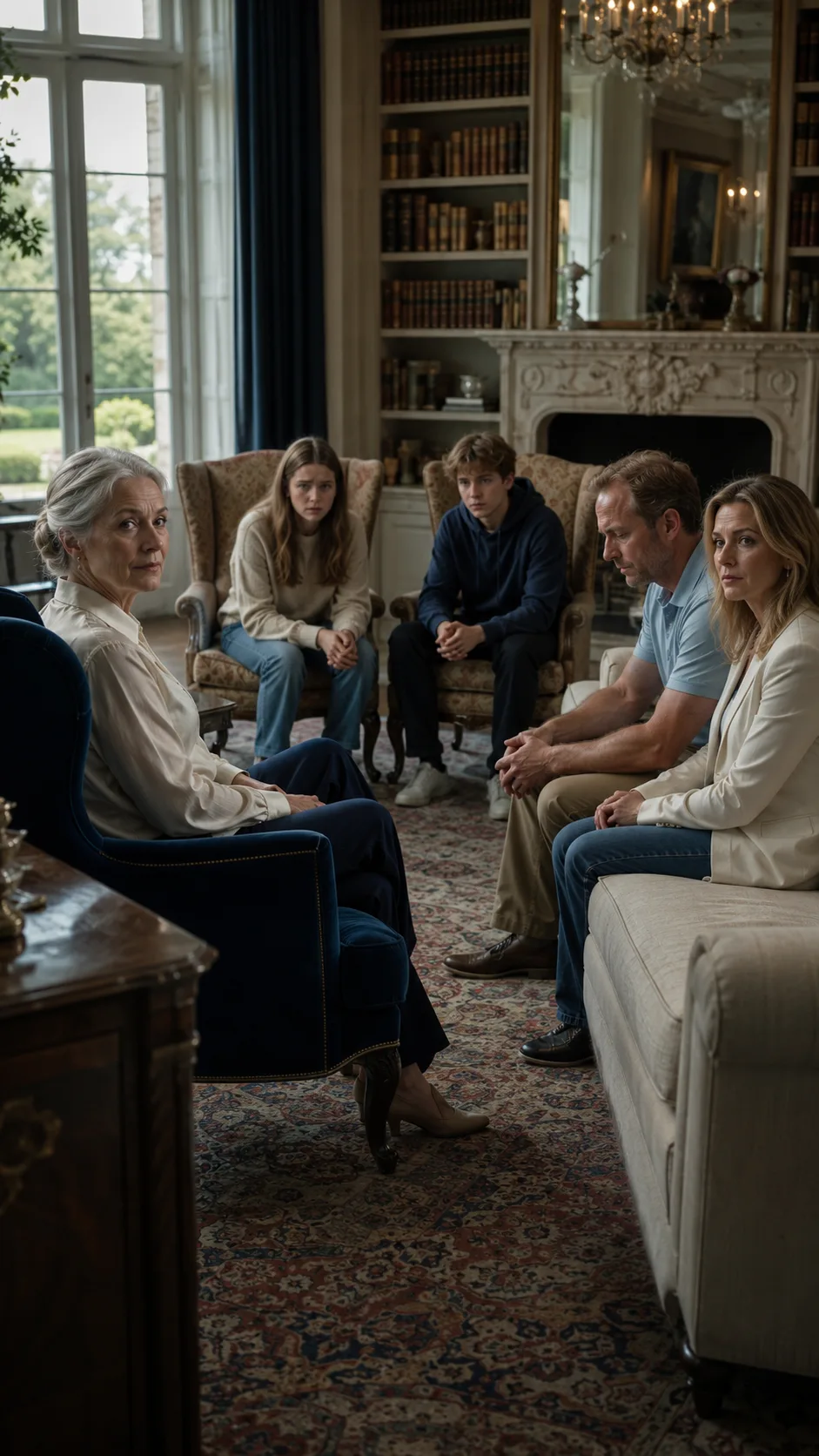
I led them into the living room and took my chair by the windows.
It was a high-backed navy velvet chair I had chosen because it made me feel settled the minute I sat in it.
James and Jessica lowered themselves onto the sofa.
Emma and Tony remained standing for a moment, taking in the room.
The antique rug.
The wall of books.
The carved stone mantel.
The wide lawn beyond the windows falling away toward the lower end of town.
From the upstairs back bedrooms you could see almost all of Millbrook spread out below, including the modest subdivision where James and Jessica still lived in the colonial they once needed me to leave in order to “have breathing room.”
Tony looked toward the pool.
“This place is huge,” he said softly.
“It is,” I said.
Jessica folded her hands in her lap with visible discipline.
“It’s certainly a lot of house for one person.”
There are women who can insult you using only square footage.
I have always admired the skill, even when I disliked the woman.
“I find I quite enjoy the space,” I said. “Now. You said you needed to talk.”
James glanced at Jessica.
Jessica glanced at James.
Already, I thought. They haven’t even made it to the lie they agreed on.
At sixty, when they put me out, I still believed hesitation meant guilt and guilt could be reasoned with.
At seventy-two, I understood hesitation usually means the people in front of you are deciding which version of themselves they want to perform.
James cleared his throat.
“Things have been… difficult.”
“Have they.”
Jessica took over, just as she always had.
“We know things ended badly between us years ago. We’ve had time to reflect, and we realize we handled that period very poorly.”
That almost made me laugh.
Handled that period very poorly.
As if they had misfiled a school form or forgotten a dental appointment.
I crossed one ankle over the other and let her continue.
“James has had some job instability,” she said carefully. “The market has been rough. The kids are older, expenses are higher, and we’re trying to make smart decisions as a family.”
“Mm-hm.”
“And,” James said, jumping in too quickly, “we saw the paper about the house and… well…”
He looked around the room in a way he probably thought was discreet and absolutely was not.
“It just seems like,” he finished weakly, “you’ve got more room than one person could ever need.”
There it was.
Not even artful.
Not even dressed up.
Just greed in khakis.
I folded my hands in my lap.
“You want to move in.”
Jessica lifted her chin.
“Temporarily.”
“For how long?”
She gave a delicate shrug.
“Six months. A year at the outside. Just until James is back on his feet and we can sort some things out.”
I looked at James.
He still couldn’t quite hold my eyes.
It occurred to me then that weakness ages worse than cruelty.
Cruelty at least has the courage of its appetite.
Weakness just sours and spreads.
“You want to move your whole family into my house,” I said, “because your finances are in trouble.”
“We’re family,” James said. “Family helps each other.”
The sentence hung in the room a moment.
Emma frowned slightly.
Tony looked from his father to me, trying to find the shape of something he did not yet understand.
I smiled.
Not warmly.
“Family,” I repeated. “Is that what you called it when you locked me out of your house with two suitcases and a cardboard box?”
The room went still.
Jessica’s expression hardened by one degree.
James went pale under the tan he had probably tried to maintain to look like a man still in control of his life.
Emma spoke first.
“What is she talking about?”
No one answered her.
That, more than anything, made my mind up.
There are lies adults tell each other in marriages, over mortgages, in courtrooms, and around inheritance.
I have lived long enough to know some of them are cowardly, some are strategic, and some are just the weak scaffolding people build around shame.
But when you make children live inside a lie for years because you are too proud to name what you did, you lose the right to manage how the truth arrives.
“Sit down,” I told Emma and Tony.
Neither moved at first.
“Both of you,” I said. “If your parents are here asking me for help, then you are old enough to understand what kind of help they’re asking from.”
Emma and Tony sat in the two wing chairs opposite me.
Jessica straightened.
“Maggie, this really isn’t necessary.”
“It became necessary the day you taught them a story with me missing from it.”
James rubbed a hand across his mouth.
“Mom…”
“No,” I said. “You’ve had twelve years of ‘Mom.’ You can listen now.”
I looked at Emma first because she was the one trying hardest not to cry, which usually means a girl is already making room for everyone else’s discomfort.
“Twelve years ago,” I said, “your grandfather had recently died. I was sixty. I had been married for forty-one years, and then suddenly I wasn’t. The life insurance was modest. Your father and mother asked me to stay with them for a while until I figured out what came next.”
I kept my voice calm and flat.
Facts first.
Emotion later, if at all.
“I watched you both while your parents worked. I cooked. I helped with laundry. I contributed most of my Social Security check to groceries and the electric bill because your father said things were tight. I tried very hard to make myself small in someone else’s house.”
Tony blinked.
“You lived with us?”
“For three months.”
Emma looked at her parents.
“You never said that.”
Jessica shifted.
“Maggie has always preferred the dramatic version of things.”
I didn’t even look at her.
“Then one morning,” I continued, “your father came into the kitchen and said they needed to talk. Your mother stood behind him with her arms folded. I still remember the countertop. Gray granite. I had just set down my coffee cup. Your mother said the arrangement wasn’t working. She said I was too set in my ways, that the children were confused about who was in charge, and that it was time for me to go.”
Emma’s mouth parted.
“What?”
I nodded once.
“I asked where I was supposed to go. Your mother said that was not their problem anymore.”
Tony stared at James.
“Dad?”
James looked at the floor.
“He took my two suitcases and a cardboard box to the porch,” I said. “He put them outside. I got into a taxi with eight hundred and forty-seven dollars in my purse and nowhere to live.”
“That is not the whole story,” Jessica snapped.
I turned to her then.
“No? By all means. Please improve it.”
Her color rose.
“You were interfering. You made comments in front of the children. You questioned our parenting. You acted like the house was yours.”
“I made breakfast,” I said. “And I asked that the children say please and thank you.”
Emma looked at Tony.
He looked sick.
The quiet stretched.
Then Tony asked the only question that mattered.
“Where did you go?”
There are certain questions children ask in voices so gentle you want to lie just to spare them the image.
But they had already lost too much to somebody else’s narrative.
I was not going to become another adult who protected myself with softness.
“I lived at the Sunset Motel on Route 9 for six weeks,” I said. “Then I moved into a studio apartment above a pizza place.”
Tony stared.
Emma’s eyes filled.
“You were homeless?”
“For a while, yes.”
James leaned forward suddenly, panicked.
“Mom, please, you’re making it sound—”
“I don’t need to make it sound like anything,” I said. “You already did the work.”
The silence after that was so complete I could hear the grandfather clock in the foyer and the soft hum of the climate system somewhere behind the walls.
Jessica inhaled sharply through her nose.
“We were under pressure,” she said. “You make it sound like we were monsters. We were drowning. James’s hours had been cut. The kids were little. I was trying to hold everything together and you—”
“And I became the easiest piece to remove,” I said.
That hit because it was true.
There is a point in every family betrayal where everybody hears the real sentence at the same time and no one can pretend it was phrased differently.
Emma wiped under one eye with the heel of her hand.
“Mom,” she said, not taking her gaze off Jessica, “you told us Grandma Maggie moved to Florida after Grandpa died.”
Jessica’s face changed.
Not guilt.
Calculation.
“She did move away from us,” she said carefully.
Tony sat forward.
“No. That’s not what you said. You said she didn’t want to be part of the family anymore.”
James closed his eyes.
There it was.
I had wondered for years what story they told.
Whether I was selfish or unstable or dramatic or difficult.
Whether I had died by narrative in some polite suburban way no one discussed at church lunch.
Now I knew.
Jessica heard the tremor in the room and moved to retake control.
“This is ancient history,” she said briskly. “Whatever happened back then, we’re here now trying to fix it.”
I smiled at that.
Not because it was funny.
Because there are sentences so indecent they deserve to be appreciated as craftsmanship.
“Are you,” I said, “trying to fix it? Or are you trying to avoid foreclosure?”
James jerked his head up.
Jessica went completely still.
Emma frowned.
“Foreclosure?”
No one answered.
I looked at the teenagers.
“Your parents are not here because they had a sudden moral awakening. They’re here because their mortgage is behind, your father lost his job six months ago, and the county filing is public record.”
Jessica stood up.
“You had no right—”
“I had every right to read documents filed at the courthouse under my own last name when the same house that once required my removal suddenly needed rescuing.”
James looked ashamed enough now that I could almost see the younger man buried under the choices.
Emma turned to him fully.
“You lost your job?”
He nodded once.
“For what reason?” I asked gently, because some humiliations are better answered by their owner than their witness.
He swallowed.
“Expense report issues.”
That was cleaner than the truth and we all knew it.
I tilted my head.
“The company called it falsification. But I appreciate the instinct toward euphemism.”
Tony stared at his father as if he had never seen him before.
Jessica made a harsh sound.
“So you’ve been spying on us now?”
“No,” I said. “I’ve been living in a small town where legal notices, real estate transfers, and whispered reputations still travel faster than kindness. There is a difference.”
Then I stood up and crossed to the console table behind the sofa.
From the top drawer, I took out a folded sheet of legal pad paper inside a plastic sleeve.
James saw it and went white.
That satisfied something in me I am not especially proud of.
Six months after they threw me out, James had come to see me once.
Tuesday evening.
Rain on the motel windows.
He had been drinking and crying in that embarrassed male way, as though grief itself were an indignity he wanted credit for enduring.
He told me the house felt wrong without me.
He said the children asked where I was.
He said Jessica did not understand what he had done because Jessica did not understand that mothers are not spare furniture.
Then he gave me a letter.
Three pages.
Legal pad.
Apology in a hand so shaky I barely recognized the boy I raised in it.
He begged me not to tell Jessica he had come.
Because, he wrote, she had already said if he brought me back she would leave him.
I had kept the letter for twelve years.
Not as revenge.
As documentation.
Because experience had already taught me that weak men almost always return to the story that protects them.
I held up the sleeve.
“Would anyone like to hear what your father wrote me six months after he put my suitcase on the porch?”
Jessica snapped toward James.
“What?”
He said nothing.
That was answer enough.
“I was drunk,” he muttered finally.
“No,” I said. “You were honest. Which is much rarer.”
Emma stood up.
“You went to see her?”
James rubbed his forehead.
“Yes.”
“And you didn’t tell us.”
“No.”
“You told Mom she was lying about all of this.”
Jessica rounded on him.
“You told her she wrote that letter? You went behind my back and played martyr?”
“There it is,” I said quietly, mostly to myself.
Jessica looked at me with something very close to hate.
“You think this proves what, exactly? That he felt bad afterward? Fine. He felt bad. We were under stress. We were drowning. We were trying to keep our own family together.”
“At my expense,” I said.
“At the time,” she shot back, “you were one more problem.”
There are moments when people tell the truth so cleanly they almost become dignified.
No polish.
No moral cover.
Just appetite.
I think that was the moment Emma stopped being a child.
Not because of anything I said.
Because she heard her mother use the word problem to describe a widowed grandmother with two suitcases and nowhere to sleep.
Emma stared at Jessica and said, very quietly, “That’s awful.”
Jessica stiffened.
“You don’t understand adult pressure.”
“No,” Emma said, and tears slipped down her face now though her voice stayed steady, “but I understand cruelty.”
Tony stood too, red in the face, furious in the straightforward way boys are before adulthood teaches them to disguise it as sarcasm.
“You lied to us,” he said to both of them. “You made it sound like she walked away.”
Nobody answered him.
I crossed back to my chair and sat down again because my knees had begun to shake and I refused to let anyone in that room see it.
“Twelve years is a long time,” I said into the quiet. “Long enough to build a company. Long enough to buy a house. Long enough to become someone who no longer needs scraps from the people who threw her away. But it is also long enough to miss a girl’s first dance recital and a boy’s seventh-grade band concert. Long enough to miss braces and first heartbreaks and learner’s permits and every ordinary little thing that actually makes up a life.”
Emma sat slowly, crying without drama now.
Tony stayed standing.
“I would have baked you birthday cakes,” I told them both. “I would have sent cookies home after school. I would have taught you how to keep basil alive on a kitchen windowsill and how to read a seed packet and how to tell when a person is being polite and when they’re being mean in a prettier accent. I would have loved you the whole time, and I was not given the chance.”
That undid Emma completely.
She covered her mouth and cried the way girls do when the grief is not only theirs but the grief of all the wasted years landing at once.
Jessica turned to James in disbelief.
“Say something.”
He did.
Just not to her.
“I’m sorry,” he said to me.
That could have meant many things.
Sorry for the porch.
Sorry for the letter.
Sorry for the silence.
Sorry for standing in my marble living room asking for square footage after twelve years of moral vacancy.
I looked at him.
“I know you are,” I said. “That does not change what happened.”
Because that is the terrible thing about remorse.
It can be real and still arrive years too late to alter the damage.
Nobody spoke for a while.
Then Tony asked, “So what now?”
Children, I have found, are better than adults at getting to the sentence that matters.
Now.
Not the story.
Not the excuse.
Not who was worse.
Now.
I folded the plastic sleeve with James’s letter and set it on the table beside me.
“Now,” I said, “your parents are not moving into this house.”
To be continued, Part 2 now.
Chapter complete
You have reached the end of this chapter.
Continue reading
A few more worlds to get lost in after this chapter.




