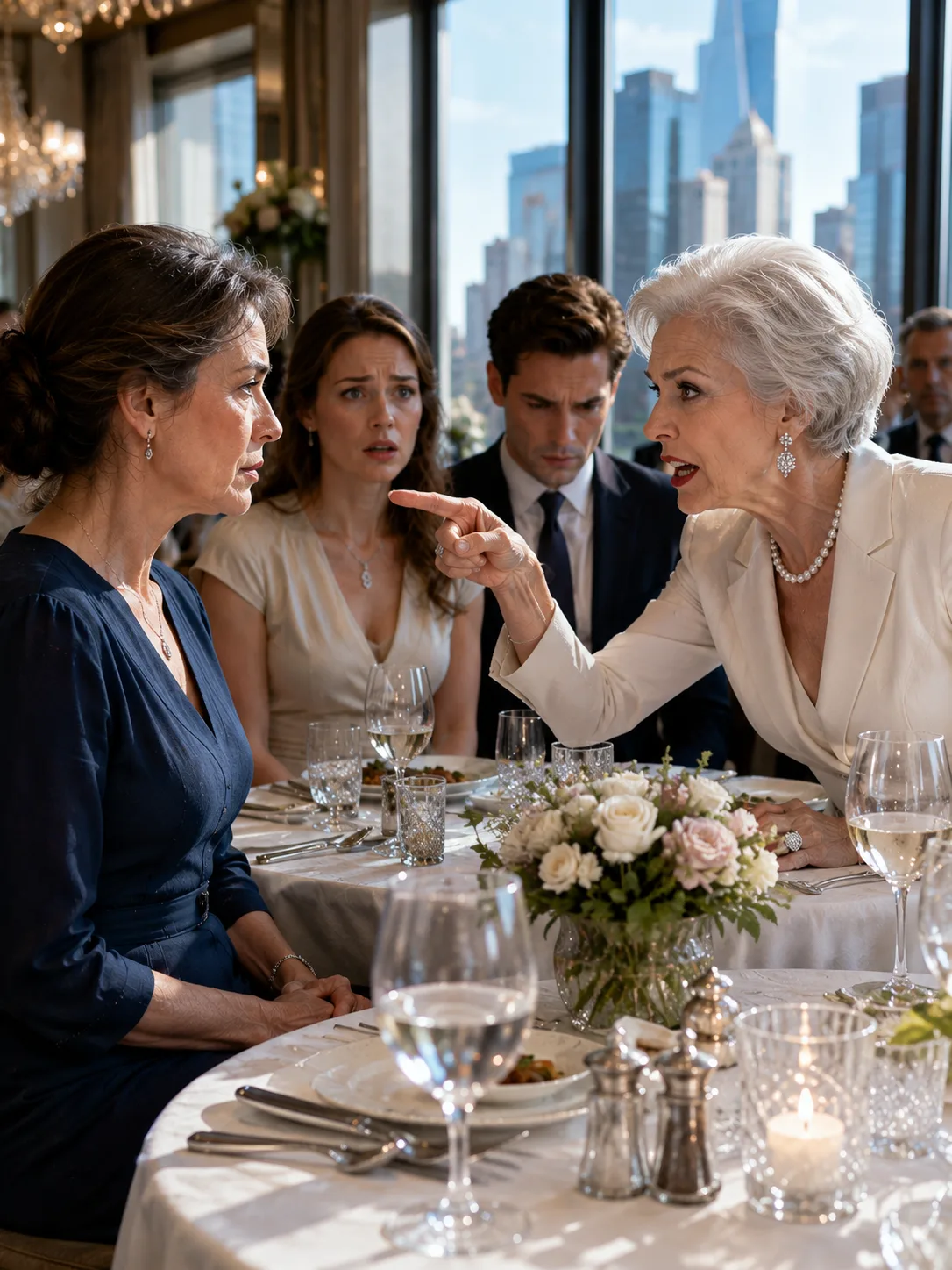
My future mother-in-law looked at my mother like she was something that had been delivered to the wrong table.
Chapter 1
My future mother-in-law looked at my mother like she was something that had been delivered to the wrong table.
Not a person.
Not a guest.
Not the mother of the woman her only son loved.
Just a mistake.
That was the first thing I noticed when Grace Carter walked into Le Valmont, one of the most expensive restaurants in downtown Chicago, wearing the same navy-blue dress she had worn to my college graduation.
It was clean.
Pressed.
Simple.
My mother had even sewn the loose hem herself the night before.
But Victoria Monroe noticed none of that.
She noticed the lack of diamonds.
The plain black shoes.
The small leather purse that had clearly been used for years.
And I watched, with my hands folded tightly in my lap, as Victoria’s perfect smile sharpened into something cruel.
Victoria Monroe was the kind of woman people recognized before she introduced herself.
She owned half a dozen luxury property companies, appeared on magazine covers, chaired charity galas, and somehow made every
waiter, banker, attorney, and socialite in Chicago remember her name. She had built a reputation on elegance and control. Her silver-white hair was always sculpted into a flawless wave. Her suits looked custom-made because they were. Her jewelry never sparkled too loudly, but always enough to remind people she could afford louder.
She believed in legacy.
She believed in bloodlines.
She believed money didn’t buy class, but she also believed people without money almost never had it.
That was why she hated the idea of me marrying her son.
Not because I had done anything wrong.
I was thirty years old, an elementary school teacher, quiet when I needed to be, stubborn when I had to be, and completely in love with Ryan Monroe.
Ryan was nothing like his mother.
He was warm.
Gentle.
The kind of man who remembered how children took their coffee orders when they played pretend
café in my classroom. The kind of man who once drove forty minutes back to a grocery store because the cashier had given him too much change. The kind of man who listened when my mother talked about her garden as if tomato plants were just as important as board meetings.
But to Victoria, love was not enough.
Love, in her mind, did not protect wealth.
Love did not preserve reputation.
Love did not stop a family from “climbing.”
That was the word she used once when she thought I couldn’t hear.
Climbing.
As if my mother and I had been standing at the bottom of a wall, waiting for Ryan to lower a rope.
When Victoria invited us to dinner, Ryan tried to sound hopeful.
“She wants to start over,” he said, adjusting his tie in the mirror of our apartment.
I stared at him from the edge of
the bed.
“Do you believe that?”
He paused.
That pause told me everything.
“No,” he admitted. “But I want to.”
So did I.
More than anything, I wanted that dinner to go well. I wanted our families to sit together without tension. I wanted Victoria to see what Ryan saw in me. More than that, I wanted her to see what everyone who truly knew my mother already understood.
That Grace Carter was not small.
She was quiet.
There was a difference.
My mother arrived ten minutes after us because she had insisted on taking the train instead of letting Ryan send a car.
“I still know how to get around Chicago,” she had said, laughing over the phone. “I did it before any of you had smartphones.”
When she walked through the restaurant doors, every chandelier seemed to glow around her. Not because she looked rich. She didn’t. She looked exactly like herself. Soft gray-brown hair pinned at the back of her neck. Navy dress. Small pearl earrings my father had given her before he died. A face with lines earned from work, grief, laughter, and years of saying yes to people who needed help.
I stood immediately.
“Mom.”
She smiled at me, then at Ryan.
Victoria remained seated for one extra second.
Just long enough for all of us to notice.
Then she rose with the polished grace of a woman who knew how to make disrespect look like etiquette.
“Grace,” she said. “How nice of you to join us.”
“Thank you for inviting me,” my mother replied.
Her voice was calm.
It always was.
We sat around a round table near the windows, where the Chicago skyline glittered in afternoon sunlight. White tablecloth. Crystal glasses. Silverware lined up like surgical instruments. A flower arrangement so perfect it seemed afraid to breathe.
Victoria sat on my right.
Ryan beside her.
My mother across from Victoria.
I sat between Ryan and Grace, feeling like a bridge someone had already decided to burn.
For the first few minutes, Victoria behaved.
She asked about my classroom.
She asked Ryan about work.
She commented on the menu.
Then the waiter poured wine, and something in her changed.
Her eyes drifted back to my mother’s dress.
“So, Grace,” Victoria said, lifting her glass, “I hear you’re still working.”
My mother smiled.
“I am.”
“At your age?”
Ryan’s hand tightened around his fork.
My mother didn’t react.
“I enjoy it.”
Victoria let out a small laugh.
Not loud enough to be called rude.
Just sharp enough to cut.
“Or perhaps retirement isn’t affordable.”
The table went still.
I felt my face burn.
“Victoria,” Ryan said quietly.
His mother did not look at him.
She kept her eyes on Grace.
“I’m only making conversation.”
“No,” I said before I could stop myself. “You’re not.”
My mother’s hand found mine beneath the table and squeezed once.
A warning.
A plea.
Don’t.
So I swallowed the rest of my anger.
Victoria noticed.
Of course she did.
Her smile returned.
“I simply think it’s important for families to be honest with one another before a marriage,” she said. “Different backgrounds bring different expectations.”
Grace folded her hands in her lap.
“That’s true.”
Victoria leaned slightly forward.
“And sometimes people see marriage as an opportunity.”
Ryan’s face hardened.
“Mom.”
But Victoria was not finished.
Her voice lowered, though every word seemed to travel farther than the last.
“I have spent my life around people who want access to what they did not build.”
I looked at her.
“Are you talking about us?”
She tilted her head.
“I’m saying your family may see my son as a doorway.”
My mother’s expression did not change.
Victoria smiled with her beautiful red mouth.
“After all, Grace, your family seems to have very little. No offense.”
“No offense?” Ryan repeated, stunned.
Victoria ignored him.
Then she said the sentence that made my stomach drop.
“Your family is trying to climb up through this marriage.”
For a moment, nobody moved.
The restaurant did not go silent, not really. Forks still touched plates. Waiters still moved between tables. Someone laughed near the bar. But at our table, everything froze.
I looked at my mother.
She was still smiling.
But now I saw the small change in her eyes.
Not pain.
Recognition.
As if Victoria had finally said aloud what Grace had known all along.
I started to stand.
My mother shook her head once.
It was barely visible.
But I sat back down.
Victoria took my obedience as victory.
She leaned back in her chair and lifted her wine glass again.
That was the moment the first twist arrived.
The main course had just been placed in front of us when a tall man in a charcoal suit stepped out from behind the private dining corridor. He was in his sixties, with silver hair and the calm confidence of someone who did not need to prove he belonged anywhere.
The restaurant manager straightened as he passed.
Two servers stepped aside.
Victoria immediately adjusted her posture.
I recognized the look on her face.
Expectation.
She thought he was coming to greet her.
And why wouldn’t she?
Victoria Monroe expected doors to open, hands to extend, names to be remembered.
The man approached our table.
Victoria smiled before he even arrived.
But he walked right past her.
Past Ryan.
Past me.
And stopped beside my mother.
His face changed completely.
“Grace Carter,” he said warmly. “Welcome back.”
My mother stood.
“Hello, David.”
Then he hugged her.
Victoria’s hand froze around her wine glass.
Ryan blinked.
I stared at my mother.
David stepped back and held both her hands.
“It has been too long.”
“It has,” Grace said. “You look well.”
“Because of you.”
The words landed heavily.
Victoria cleared her throat.
“I’m sorry,” she said, though she did not sound sorry at all. “You two know each other?”
David turned to her with polite surprise.
“Of course.”
Victoria gave a small laugh.
“I didn’t realize Grace was a regular here.”
David looked at my mother again, and something almost amused crossed his face.
“A regular?”
He shook his head.
“Mrs. Carter is the reason this restaurant exists.”
The table went quiet again, but this silence was different.
Victoria’s smile flickered.
“I beg your pardon?”
David rested a hand on the back of Grace’s chair.
“Twenty-five years ago, I was an unemployed chef with a business plan nobody wanted to read. Banks refused me. Investors laughed. I was days away from giving up.”
Grace lowered her eyes.
“David.”
“No,” he said softly. “People should know.”
Then he looked directly at Victoria.
“Grace was the first person who believed in me.”
Victoria recovered quickly.
“That’s very kind,” she said. “A small loan can change a young man’s confidence.”
David laughed.
It was not cruel.
That made it worse.
“No, Mrs. Monroe. Not a small loan.”
Victoria’s smile disappeared.
“Then what exactly was it?”
David’s voice remained pleasant.
“Seed investment. Business guidance. Vendor introductions. And when our first location nearly collapsed after the fire damage, she put in more capital and refused to let me sell.”
My mother sighed.
“David, this is not necessary.”
“It is.”
He turned back to us.
“Grace still owns eighteen percent of the entire restaurant group.”
My fork slipped from my hand and struck the plate.
Ryan stared at my mother.
Victoria did not blink.
David continued, unaware or perhaps fully aware of the bomb he had just dropped.
“At current valuation, that stake is worth somewhere north of thirty million.”
The flower arrangement between us suddenly looked absurd.
Thirty million.
My mother, who clipped coupons.
My mother, who drove a used sedan.
My mother, who still mended socks because she hated waste.
Victoria’s face had gone pale beneath her makeup.
“You own part of this company?” she asked.
Grace answered quietly.
“Yes.”
“For how long?”
“Since the beginning.”
David smiled.
“And starting next month, after our board vote, she will also become honorary chair of the foundation arm.”
Victoria looked like someone had rearranged the room while she was sitting in it.
David excused himself after a few more words, promising dessert on the house. When he left, nobody touched the food.
Ryan was the first to speak.
“Grace… why didn’t you ever tell us?”
My mother gave a tiny shrug.
“It never came up.”
I almost laughed.
Not because it was funny.
Because that was exactly something she would say.
Victoria set her glass down with great care.
The glass trembled anyway.
“I don’t understand,” she said.
Grace looked at her.
“What part?”
Victoria’s jaw tightened.
“You live in that little house.”
“I like my house.”
“You still work.”
“I like working.”
“You let people think—”
My mother gently interrupted.
“People are free to think what they want.”
The words were soft.
But Victoria flinched as if they had been slapped across the table.
I thought that was the moment the balance shifted.
But Ryan had gone quiet in a way I recognized.
He was about to say something he had been carrying for too long.
“Mom,” he said.
Victoria turned sharply.
“What?”
“There’s something you don’t know.”
“Ryan, not now.”
“Yes. Now.”
His voice shook, but he stood.
That alone startled her.
Ryan rarely challenged Victoria in public. Not because he was weak, but because he had spent his whole life trying not to embarrass a woman who considered embarrassment a form of death.
He reached into the inside pocket of his suit jacket and pulled out a folded paper.
Not a legal document.
Not something dramatic.
Just a worn, creased bank letter.
I recognized it instantly.
My heart sank.
“Four years ago,” he began, “I lost everything.”
Victoria frowned.
“What are you talking about?”
“My development project collapsed. The one in Fulton Market.”
“That project did well.”
“No. It didn’t.”
Victoria looked confused.
“I saw the press release.”
Ryan laughed once, without humor.
“You saw the version I wanted you to see.”
He unfolded the letter and placed it on the table.
“I was almost a million dollars in debt.”
Victoria stared at him.
“No.”
“Yes.”
“You would have told me.”
“I couldn’t.”
“Why?”
Ryan’s eyes reddened.
“Because I spent my entire life trying to be the son you could show off.”
Victoria recoiled.
The words hurt her.
Good, I thought.
Then felt guilty for thinking it.
Ryan continued.
“I had creditors calling every day. I couldn’t sleep. I couldn’t eat. I was going to lose my apartment, my company, everything.”
Victoria’s voice dropped.
“Who helped you?”
Ryan looked at Grace.
My mother closed her eyes for one second.
Victoria followed his gaze.
“No.”
Ryan nodded.
“Grace did.”
Victoria’s lips parted.
“She paid the debt?”
“Most of it. She negotiated the rest.”
I watched Victoria’s world crack again.
“And you knew?” she asked me.
I nodded.
“Eventually.”
Ryan’s voice softened.
“She made me promise not to tell you.”
Victoria turned to Grace.
“Why?”
My mother looked almost embarrassed.
“Because he asked me not to.”
“That is not an answer.”
Grace sighed.
“Because he was ashamed. And shame grows when people keep shining lights on it.”
Ryan wiped at his face.
“She saved me, Mom.”
Victoria gripped the edge of the table.
The same woman she had accused of chasing wealth had quietly protected her son from ruin and never claimed credit.
For a while, the only sound at our table was the low murmur of the restaurant around us.
Then Victoria whispered, “Why would you do that?”
Grace looked at Ryan like he was her own child.
“Because he needed help.”
Victoria shook her head.
“No one does that for no reason.”
Grace did not answer immediately.
When she did, her voice was different.
Older somehow.
“There was a reason.”
That was when she opened her purse.
The purse Victoria had judged the moment she saw it.
From inside, Grace removed a small wooden box.
It was scratched at the corners, the kind of thing kept not because it was valuable, but because throwing it away would feel like betrayal.
She placed it on the table between the wine glasses.
Victoria stared at it.
“What is that?”
“My father’s keepsake box.”
Grace opened it.
Inside were photographs.
Old ones.
Black-and-white.
Faded color.
Edges curled from age.
She selected one and slid it across the table.
Victoria picked it up impatiently.
Then all color left her face.
Her hand began to tremble.
Ryan leaned closer.
I did too.
The photograph showed a much younger Victoria standing in front of a warehouse beside her late husband, Thomas Monroe.
I had seen photos of Thomas before in Ryan’s family home.
Handsome.
Serious.
The kind of man whose portrait hung over fireplaces.
But he was not alone in the picture.
Beside him stood a younger Grace.
And beside Grace stood an older man I recognized from my mother’s albums.
My grandfather.
Victoria’s voice was barely audible.
“Where did you get this?”
Grace answered, “My father kept it.”
Victoria looked at her.
“Why is my husband standing with your father?”
Grace folded her hands.
“Because before there was Monroe Development, there was Carter and Monroe.”
Ryan slowly sat back down.
“What does that mean?”
My mother took a breath.
“Your grandfather and my father started a company together forty years ago.”
Victoria shook her head immediately.
“No.”
Grace did not raise her voice.
“They were partners.”
“No. My father-in-law built that company.”
“They both did.”
Victoria’s fingers tightened around the photograph.
“You’re lying.”
Ryan said, “Mom.”
But Victoria snapped, “No. I would know.”
Grace looked at her with such sadness that my chest hurt.
“Would you?”
That silenced her.
My mother continued.
“They started with one warehouse. Two desks. One secretary they could barely afford. My father handled suppliers and labor. Your father-in-law handled financing and client relationships. They were good together.”
Victoria stared at the photo like it might change if she looked long enough.
“Then what happened?”
“The recession hit. They nearly lost everything. My family sold our land, our house, my mother’s jewelry, every savings account we had. The money kept the company alive.”
Ryan looked at me, horrified.
I had never heard this part.
Grace’s voice stayed steady, but her fingers tightened in her lap.
“Then my brother got sick. Medical bills came. My father became desperate. Your father-in-law offered to buy our share temporarily until we recovered.”
“Temporarily?” Victoria whispered.
Grace nodded.
“But my brother died. My mother broke. My father never recovered emotionally. By the time he tried to revisit the agreement, your father-in-law had passed too. The paperwork showed a sale. Not a loan. Not temporary. A sale.”
Victoria said nothing.
Grace looked down at the table.
“My family lost everything. Yours became one of the wealthiest development families in Chicago.”
The words were not accusing.
That somehow made them more devastating.
Victoria seemed to shrink.
“I didn’t know.”
“I believe you.”
“You believe me?”
“Yes.”
Grace’s answer came too quickly.
Like she had decided long ago.
Victoria looked up.
“Why?”
“Because your husband did.”
The next silence was the deepest yet.
Victoria’s eyes flickered.
“What are you saying?”
Grace reached back into the wooden box and removed a bundle of letters tied with a faded blue ribbon.
Victoria stared at them as if they were alive.
“Thomas found out,” Grace said.
Ryan whispered, “Dad?”
Grace nodded.
“Years later. After your father-in-law died. Thomas came to see my father. He wanted to understand what had happened.”
Victoria’s lips parted.
“He never told me.”
“He tried.”
Grace untied the ribbon.
The letters spread across the table like ghosts.
“He wrote these to you.”
Victoria did not reach for them.
Ryan did.
He took the first letter and unfolded it carefully.
His father’s handwriting filled the page.
I watched his eyes move.
Then his face collapsed.
“Ryan,” Victoria said.
He swallowed hard.
“It’s Dad.”
Victoria’s hand flew to her mouth.
Ryan read aloud, voice breaking.
“Victoria, if anything happens before I can make this right, you need to find Grace Carter. Her family gave us the foundation we built our life on, and I have carried that knowledge like a stone in my chest.”
Nobody moved.
Ryan picked up another.
“Grace did not ask for repayment. That is what makes it worse. Her father only asked that the truth not die with him.”
Victoria’s eyes filled.
“No.”
Ryan read another.
“I have begun setting aside money. Not enough yet. Never enough. But I want our family to restore what was lost, even if Grace refuses to take it.”
Victoria pushed back from the table.
The chair scraped loudly.
“No.”
Grace’s eyes softened.
“He loved you. He was afraid the truth would destroy the image you had of his family.”
Victoria shook her head violently.
“No. He would have told me.”
“He was going to.”
Grace took out one final letter.
“This one was dated three days before his heart attack.”
Victoria reached for it with shaking fingers.
This time she read silently.
I watched the words move through her body.
Her shoulders stiffened.
Her mouth opened.
Then closed.
Then opened again without sound.
When she finished, she lowered the page to the table.
For the first time since I had known her, Victoria Monroe looked lost.
Not angry.
Not proud.
Lost.
Then she looked at Grace.
And something ugly came back, not because she believed it, but because she needed somewhere to put the pain.
“So that’s why you helped Ryan.”
Ryan stood.
“Mom, don’t.”
Victoria’s voice rose.
“You knew who he was.”
Grace remained seated.
Victoria pointed at my mother.
“You knew he was Thomas Monroe’s son.”
“Yes.”
“And you got close to him anyway.”
“I didn’t get close to him. He came to Emily’s school fundraiser.”
Victoria laughed bitterly.
“You expect me to believe this is all coincidence?”
I stood.
“That is enough.”
But Victoria was beyond restraint now.
Her hand slammed onto the table so hard the crystal glasses shook.
Several nearby guests turned.
“You waited forty years,” she said, voice cracking, “and then you sent your daughter into my family.”
Ryan’s face changed completely.
“Apologize.”
Victoria ignored him.
“To punish us,” she said. “To make us pay.”
Grace slowly stood.
The entire table seemed to draw breath.
My mother had been calm all evening.
Patient.
Still.
But now she stood with the kind of quiet authority that made even Victoria stop speaking.
Grace picked up the photograph of Thomas and my grandfather.
She held it between them.
“If I wanted revenge,” she said, “I had forty years to take it.”
Victoria’s nostrils flared.
Grace placed the photograph down.
Then she took something else from the wooden box.
A small program.
Cream-colored.
Embossed.
Victoria recognized it immediately.
I could see it in her face.
Ryan did too.
“Mom,” he said slowly. “Isn’t that from the Monroe Scholarship Gala?”
Victoria stared at the program.
Grace nodded.
“The first one.”
Victoria reached for it.
Grace let her take it.
On the front were two names.
Thomas Monroe Memorial Scholarship.
Victoria whispered, “Why do you have this?”
Grace looked at her directly.
“Because I created it.”
The words struck harder than any shout.
Victoria’s face went blank.
“No.”
Grace opened the program and turned it around.
Inside was an old photograph.
Thomas Monroe standing beside Grace.
In front of a banner for the first scholarship ceremony.
Ryan took the program from his mother’s hand.
His eyes widened.
“Dad was there?”
“Yes.”
Victoria looked like she might fall.
“But the scholarship was his idea.”
Grace nodded.
“It was.”
“I funded it after he died.”
No one spoke.
Grace continued, and now her voice shook for the first time.
“Thomas wanted to repair what had been broken. But he died before he could. The first year after his passing, I received a call from a school counselor. A student had lost his father and could not afford tuition. Thomas had already promised help.”
She looked down.
“I paid it.”
Victoria’s tears spilled.
“Then another student came. And another. Eventually I formed the scholarship officially.”
Ryan’s voice was barely a whisper.
“All those galas.”
Grace nodded.
“All those students.”
“All those awards in Dad’s name.”
“Yes.”
Ryan covered his mouth.
My eyes burned.
Victoria had spent years attending ceremonies, standing beneath portraits of her late husband, accepting applause for a legacy she thought her family had preserved.
But the legacy had been carried by the woman she had just insulted.
Grace had not taken Thomas’s reputation.
She had protected it.
For twenty-three years.
Victoria’s hand shook around the program.
“Why didn’t you tell me?”
Grace looked at her gently.
“Because it would have hurt you.”
Victoria let out a broken laugh.
“It hurts now.”
“Yes,” Grace said. “Truth often does when it arrives late.”
Victoria sank back into her chair.
The entire restaurant seemed aware now, but no one dared approach.
Ryan sat beside his mother, but he did not touch her.
Not yet.
He was looking at Grace like he was seeing her for the first time.
So was I.
I had known my mother was generous.
I had known she gave quietly.
But this was something else.
This was not generosity.
This was grace in the literal sense.
The kind of mercy that costs a person something.
Victoria looked at the letters.
The photograph.
The gala program.
Then finally at Grace.
“You let me praise him every year,” she whispered.
Grace nodded.
“You let me stand on stages.”
“Yes.”
“You let people think we were the donors.”
“I let people remember Thomas as he wanted to be.”
Victoria started crying harder.
“After what my family did to yours?”
Grace’s face tightened.
“What happened between our fathers was complicated.”
“No,” Victoria said, shaking her head. “Don’t make it gentle.”
Grace fell silent.
Victoria looked around the table, and I saw the exact moment she understood the shape of herself.
Every cruel word she had said that night returned to her.
Retirement.
Money.
Climbing.
Access.
Opportunity.
She had accused Grace of wanting a place in her world without knowing Grace had been quietly holding up pieces of that world for decades.
Victoria pressed both hands over her mouth.
A sob escaped anyway.
Ryan finally reached for her shoulder.
She flinched, then leaned into his hand like a child.
“I’m sorry,” she whispered.
At first I thought she meant Ryan.
Then she looked at my mother.
“No,” Victoria said, forcing herself to stand.
Her legs were unsteady.
“I need to say it correctly.”
Grace did not move.
Victoria stepped around the table.
Not dramatically.
Not proudly.
Slowly.
Every step seemed to cost her.
When she reached my mother, Victoria stopped an arm’s length away.
The two women stood in the sunlight.
One in navy.
One in white silk and pearls.
One who had been judged.
One who had done the judging.
Victoria’s voice broke.
“I spent this entire dinner trying to make you feel small.”
Grace’s eyes shone.
Victoria swallowed.
“And the truth is, I have never felt smaller in my life.”
My mother’s face softened.
Victoria continued.
“I was afraid.”
That surprised all of us.
Even her.
She wiped her cheek quickly, embarrassed by her own honesty.
“When Ryan said he wanted to marry Emily, I saw myself losing control of the only family I had left. I told myself I was protecting him. I told myself I was protecting our name.”
She looked at me.
“But I was protecting my pride.”
Then she looked back at Grace.
“And I used that pride to wound you.”
Grace did not rush to comfort her.
She let the apology stand on its own.
Victoria took a shaky breath.
“I don’t deserve your forgiveness.”
My mother smiled faintly.
“Forgiveness is not usually given because someone deserves it.”
Victoria’s face crumpled.
Grace stepped closer.
“I forgave you before tonight.”
Victoria shook her head.
“How?”
“Because bitterness would have kept me tied to a past I could not change.”
Victoria whispered, “And what am I supposed to do with this?”
Grace looked at the letters.
Then at Ryan.
Then at me.
“You start telling the truth.”
The aftermath of that dinner did not look like a movie.
No one clapped.
No one gave a speech.
No waiter announced dessert.
Victoria did not suddenly become a different person in ten minutes.
She sat back down with ruined makeup and trembling hands while Ryan gathered his father’s letters as carefully as if they were bones.
David returned once, saw the table, and quietly left again without a word.
Emily Carter, that is me, did not know whether to cry, scream, or laugh at the absurdity of it all.
My mother ordered tea.
Of course she did.
“Mom,” I whispered, still stunned. “How could you never tell me?”
She looked at me with tired eyes.
“Because I didn’t want you to inherit my grief.”
“But I inherited the silence.”
That hurt her.
I saw it.
She reached for my hand.
“You’re right.”
It was the first time all night she looked truly wounded.
Not by Victoria.
By me.
“I should have told you more,” she said.
I squeezed her fingers.
“Yes.”
Ryan leaned forward.
“And I should have told my mother about the debt.”
Victoria looked at him.
“Yes,” she said quietly. “You should have.”
He blinked, surprised.
Then she added, “But I should have been the kind of mother you could tell.”
That broke something open between them.
Ryan’s eyes filled again.
For years, I had watched him shrink around Victoria. Not because she didn’t love him, but because her love came wrapped in expectation. He had been her success story, her heir, her proof that every sacrifice and every ambition had been worth it.
That night, for the first time, he became her son instead of her reflection.
When we finally left Le Valmont, the sun had begun to dip between the buildings. Victoria stood on the sidewalk clutching the wooden box Grace had insisted she take home.
“No,” Victoria had said. “These are yours.”
Grace shook her head.
“They belong to both families now.”
Victoria looked at her.
“I don’t know how to carry them.”
Grace answered, “Carefully.”
For several weeks after that dinner, everything changed slowly.
Painfully.
Victoria called off three charity appearances.
The society pages speculated she was ill.
In a way, maybe she was.
She spent days reading Thomas’s letters, then rereading them, then calling Ryan late at night to ask questions he could not answer.
Did your father ever mention Grace?
Did he ever seem sad after the gala?
Did he keep a blue ribbon in his desk?
Ryan answered what he could.
Sometimes he simply listened while his mother cried.
One Sunday afternoon, Victoria came to my mother’s house.
No driver.
No assistant.
No pearls.
Just a white blouse, gray slacks, and her silver-white hair tucked behind one ear.
She stood on the porch holding a bakery box.
My mother opened the door and stared.
Victoria lifted the box awkwardly.
“I brought lemon cake.”
Grace looked amused.
“You bake?”
“No. I panicked.”
My mother laughed.
And somehow, that was the beginning.
Not of friendship.
Not yet.
But of something honest.
They sat at my mother’s kitchen table for four hours. Ryan and I stayed in the living room pretending not to listen, but their voices carried.
Victoria asked about Grace’s father.
Grace asked about Thomas.
Victoria cried when Grace described the day her family sold their house.
Grace cried when Victoria described Thomas’s last morning, how he had kissed her forehead before leaving for a meeting and never came home.
Two women grieving different versions of the same history.
Two women who had been shaped by men they loved and secrets they never asked to inherit.
A month later, Victoria attended the scholarship ceremony again.
But this time, when she stepped onto the stage, she did not accept the applause.
She raised a hand.
“Before we begin,” she said, voice shaking, “there is someone I need to acknowledge.”
My mother sat in the third row beside me.
She stiffened.
Victoria looked directly at her.
“For years, I believed this foundation existed because of my husband’s generosity. That is partly true. Thomas Monroe had the dream. But the woman who carried that dream, protected it, funded it, and never asked for recognition is Grace Carter.”
The room turned.
My mother closed her eyes.
Victoria continued.
“My family owes hers a truth that arrived too late. Tonight, I will not correct the past. I cannot. But I can stop benefiting from silence.”
Then she stepped away from the podium and held out her hand.
My mother did not move at first.
Then I nudged her.
“Go.”
She stood.
The room rose with her.
Not because she looked wealthy.
Not because anyone had measured her status.
Because truth has a sound when it finally enters a room.
It sounds like people standing.
The wedding happened six months later.
Not at a mansion.
Not at a country club.
In my mother’s garden.
Victoria offered to pay for anything we wanted.
My mother offered to make the centerpieces herself.
They argued about it for two weeks, then compromised in the most ridiculous way possible: Victoria paid for the tent and chairs, my mother grew the flowers, and Ryan and I were forbidden from interfering.
On the morning of the wedding, I found Victoria and Grace standing together near the rose bushes.
Victoria wore pale blue.
Grace wore navy again, but this time with a delicate silver brooch Victoria had given her.
“You look beautiful,” Victoria told her.
Grace smiled.
“So do you.”
Victoria touched her white hair nervously.
“I almost wore black.”
Grace raised an eyebrow.
“To your son’s wedding?”
“I was told it was slimming.”
Grace laughed.
I stood hidden near the back door, watching them.
Two women who should have remained enemies, if life were as simple as pride wanted it to be.
But life is rarely simple.
Pride breaks.
Truth leaks out.
Old letters survive.
And sometimes the woman you judge across a dinner table turns out to be the one who kept your family’s best memory alive.
Before the ceremony, Victoria came to see me.
I was standing in my childhood bedroom, trying not to cry over my veil.
She knocked softly.
“May I come in?”
I turned.
For a second, I saw the old Victoria in the doorway.
Elegant.
Controlled.
Untouchable.
Then she stepped inside and her eyes filled.
“You look lovely,” she said.
“Thank you.”
She hesitated.
“I owe you an apology too.”
“You already apologized.”
“Not enough.”
I waited.
She clasped her hands in front of her.
“I made you feel like you had to prove you were worthy of my son.”
I swallowed.
“Yes.”
Her eyes lowered.
“You never did.”
I almost cried then.
Not because her apology fixed everything.
It didn’t.
But because she finally understood what she had done.
Victoria looked toward the window, where my mother was helping Ryan pin his boutonniere.
“Your mother has more dignity in one quiet breath than I had in years of speeches.”
I smiled through tears.
“She would hate hearing that.”
“I know,” Victoria said. “That’s how I know it’s true.”
Years later, people still asked about our wedding.
They wanted to know if it was awkward, having both families there after everything.
It wasn’t.
It was tender.
Messy.
Human.
Victoria cried during the vows louder than my mother did.
Grace handed her a tissue without looking.
Ryan whispered, “That feels about right.”
After we were married, the two families did not merge perfectly.
Nothing real does.
There were uncomfortable dinners.
Misunderstandings.
Old habits.
Victoria still occasionally said something sharp, then caught herself and apologized before my mother could raise an eyebrow.
Grace still avoided praise so aggressively that accepting gratitude looked physically painful.
Ryan learned to tell the truth before it became a secret.
I learned that silence is not always strength.
Sometimes silence is protection.
Sometimes it is fear.
Sometimes it is both.
The Monroe Scholarship Foundation was renamed the Carter-Monroe Promise.
Victoria insisted.
Grace resisted.
Victoria won that argument by threatening to name the new library wing after Grace’s tomato plants.
My mother called her ridiculous.
Victoria said, “Yes, but wealthy ridiculous, which means people listen.”
They both laughed.
Every year, at the scholarship dinner, Victoria told a shorter version of the story.
Not all of it.
Some wounds deserved privacy.
But she always ended the same way.
“I once believed class was something you inherited,” she would say, standing under warm lights with her silver-white hair shining. “Then I met a woman who taught me class is what you give when no one is watching.”
My mother always looked down when the applause came.
And every year, Ryan took her hand.
The last time I thought about that first dinner was on our fifth anniversary.
Ryan and I returned to Le Valmont with both mothers.
David gave us the same table.
The same windows.
The same view of Chicago glowing in the afternoon sun.
Victoria arrived first.
Still elegant.
Still impossible not to notice.
But softer now.
She wore cream instead of black, pearls instead of diamonds, and when my mother walked in wearing that same navy-blue dress, Victoria stood immediately.
No pause.
No inspection.
She walked across the restaurant and embraced her.
“You kept the dress,” Victoria said.
Grace smiled.
“I like this dress.”
Victoria laughed.
“I know.”
We sat together.
Ordered dinner.
Talked about ordinary things.
My classroom.
Ryan’s new project.
My mother’s garden.
Victoria’s attempt to learn how to bake, which had apparently ended with smoke, profanity, and one ruined pan.
Halfway through the meal, Victoria looked around the restaurant and grew quiet.
I knew she was remembering.
We all were.
Finally, she lifted her glass.
“I came to this table once to prove I was above someone,” she said.
No one interrupted.
She looked at Grace.
“And I left understanding I had been standing beneath her the entire time.”
My mother shook her head.
“Victoria.”
“No,” Victoria said gently. “Let me have my dramatic moment. I’ve reduced them significantly.”
Ryan laughed.
So did I.
Even Grace smiled.
Victoria raised her glass higher.
“To truth,” she said.
Grace lifted hers.
“To mercy.”
Ryan lifted his.
“To fewer family dinners that feel like emotional warfare.”
I lifted mine.
“To both of our mothers.”
We drank.
Outside, Chicago moved like nothing had changed.
Cars slid between glass towers.
People rushed along sidewalks.
The city kept its secrets, as all cities do.
But at our table, there were fewer secrets than before.
That was enough.
Because the night Victoria Monroe tried to make my mother disappear, she accidentally revealed the woman Grace Carter had always been.
Not poor.
Not small.
Not someone climbing.
A woman who had carried grief without weaponizing it.
A woman who had protected a dead man’s promise.
A woman who had saved a son who was not hers.
A woman who had every reason to demand repayment and chose instead to build scholarships.
Victoria once thought my mother wanted access to her family’s world.
The truth was far more devastating.
Grace had been quietly holding the door open for that family long before Victoria ever knew her name.
And when Victoria finally stood up from that dinner table, she did not leave as the most powerful woman in the room.
She left as the only one who understood how small pride looks when it is placed beside grace.
THE END.
Chapter complete
You have reached the end of this chapter.
Continue reading
A few more worlds to get lost in after this chapter.




