PART 3 — THE PRICE OF EXILE
Beatrice stepped forward.
Chapter 3
PART 3 — THE PRICE OF EXILE
Beatrice stepped forward.
“Raymond, that is absurd. He was following instructions.”
“Then he chose poorly.”
Mr. Albright’s face flushed dark but he understood the room. He placed his badge on a side table and left. The door closed behind him with a soft, final click.
Beatrice stared at me.
“You’re embarrassing yourself.”
“I doubt it.”
“You come in here after an overnight flight, led by a young woman who has spent a year managing your guilt, and now you’re punishing staff for trying to maintain order?”
“My grief does not make me foolish.”
“No,” she said. “Your guilt does.”
That one landed. Beatrice has always known exactly where to cut.
Liam and I had argued the month before he died. Not loudly, not in the way that leaves obvious marks. He had come to my study to ask whether Elena and Leo could move permanently into the guest house while he finished his
deployment and sorted out what came next. I had said yes. But I had said it with paperwork in my hand and a phone buzzing on the desk beside me, half-present, my attention already split toward a merger in Zurich.
Liam had stood in the doorway and said, “Dad, sometimes I wonder if you know you have a family before someone dies.”
Those were the last hard words he ever said to me.
Beatrice had been in the hallway. She knew.
“You failed Liam in life,” she said, her voice quiet and precisely aimed. “Elena has become your monument to a guilt you can’t put down.”
Malcolm said, “Beatrice.”
She ignored him.
“I loved Liam too,” she continued. “But love does not mean handing his son to a woman who arrived here with nothing and intends to leave with whatever sympathy she can convert into assets.”
The door behind me
opened.
Victor Lane came in carrying a leather portfolio, moving with the unhurried precision of a man who has spent fifty years walking into difficult rooms and knowing the temperature before he sat down. He looked at the assembled faces once and understood everything.
“Am I interrupting?” he asked.
“No,” I said. “You’re right on time.”
Beatrice gave him a smile with no warmth in it.
“Victor. This is a family matter.”
“Those are my least favorite kind.”
He came to stand beside me.
“Did you bring the documents?”
“All of them.”
Beatrice laughed once, a short clipped sound.
“Are we going to perform paperwork theatrics in the drawing room?”
“We’re going to correct a misunderstanding,” I said.
Victor opened the portfolio and removed several bound documents, each one tabbed and marked with his characteristically meticulous precision.
“Whitmore House,” he said, “is held by the Raymond Whitmore Revocable Trust, amended
fourteen months ago, witnessed, notarized, and recorded.”
Beatrice crossed her arms.
“I’m aware of the trust.”
“You appear to know of its existence. You seem confused about its contents.”
Something moved across her face. Not quite fear, but its cousin.
“Following Liam’s marriage, and again after Leo’s birth, Mr. Whitmore amended the residential provisions. The guest house and east garden residence were designated for Liam Whitmore, his lawful spouse, and his descendants. Upon Liam’s death, occupancy rights continue for Elena Whitmore and Leo Whitmore for as long as either wishes to reside there, without rent, restriction, or interference from any party.”
Beatrice’s mouth tightened.
“That is an occupancy provision. It does not make her family.”
“No,” I said. “Liam did that.”
Victor slid a second document forward.
“Additionally, Liam Whitmore executed a guardianship memorandum and trust letter six months before deployment. In the event of his death, Elena is named Leo’s sole guardian and primary decision-maker. Raymond is named financial trustee for Leo’s inheritance. Liam explicitly excluded collateral relatives from custody authority.”
Cecily looked up.
“Collateral relatives?”
Victor glanced at her.
“Aunts, uncles, cousins.”
Grant muttered something under his breath.
Beatrice’s face flushed.
“I would like to see that document.”
“You may request a copy through counsel,” Victor said pleasantly.
“I am his aunt.”
“You are not his legal guardian. The distinction is significant.”
She looked at me with naked fury.
“This is offensive.”
“What happened this morning was offensive.”
I turned to Grant.
“Did you know about this?”
His mouth opened and closed.
“Aunt Beatrice said Elena had agreed to spend time in Ohio.”
“Did that sound like Elena to you?”
He looked at the floor.
I turned to Malcolm.
He had married Beatrice late and had spent most of that marriage choosing silence as a survival strategy. Now he looked at his wife and then at me, and something in him made a decision.
“I knew she planned to speak to Elena,” he said. “I did not know about security. Or the ticket.”
Beatrice wheeled toward him.
“Malcolm.”
He did not retract it.
One of the board members, Judith Pell, stood and set her teacup down with deliberate care.
“Raymond,” she said, “I was told this meeting was about Elena’s role in upcoming foundation appearances.”
“I’m sure you were.”
Judith looked at Beatrice with the kind of restrained disappointment that people of good standing deploy when scandal threatens to touch them.
“I’ll leave you to the family portion.”
“Please stay,” I said.
She stopped.
Beatrice’s gaze snapped back to me.
I took the final document from Victor.
“This concerns the foundation.”
Beatrice went very still.
The Whitmore Family Foundation had been her territory for fifteen years. Scholarship programs, museum wings, hospital wings, gala committees, her name on donor walls in buildings all over the city. She had loved philanthropy best when it came equipped with seating charts and engraved plaques. She served as chair because I had allowed it, because my wife Caroline had believed that responsibility might soften her. Caroline had been wrong, but I had not corrected it.
“At nine this morning,” I said, “Mrs. Harlan used security services retained through a foundation-adjacent vendor to remove a grieving widow and minor child from trust property under false claim of authority. She used family stationery, family staff, and the family’s name to create the appearance of an official decision that no one had sanctioned.”
Beatrice’s voice sharpened.
“That is a grotesque distortion.”
Victor lifted a single sheet.
“The bylaws permit immediate suspension of a chair for conduct exposing the foundation to reputational or legal harm, pending board review. Mr. Whitmore, as founder and principal donor, may initiate emergency action.”
Peter Shaw, the second board member, rubbed his forehead and looked at Beatrice.
“Tell me you didn’t put this in writing.”
I held up the cream stationery with the family crest.
The room went absolutely quiet.
It is a particular quality of cruelty written down that it cannot negotiate with itself afterward. Cruelty spoken can be reframed, minimized, attributed to emotion. Cruelty on paper just sits there in good font, wearing its own letterhead, looking exactly like what it is.
Beatrice stared at the note and for the first time since I walked in, something uncertain moved behind her eyes.
“You are all being absurd,” she said. “I did what Raymond was too sentimental to do.”
I looked at my sister then. Truly looked, for a long moment.
I knew the child she had been. The little girl who cried when our father’s praise landed somewhere other than on her, who learned early that money could buy attention where warmth was unavailable. I knew the young woman who married a name she thought would make her feel safe. I knew the shape of the disappointment she had been carrying her whole life and had never once examined.
I had excused too much of it because I understood the wound.
That ended today.
“You did what cruel people always do,” I said quietly. “You found someone with less power than you and called it duty.”
Her mouth opened.
I didn’t let her find the words.
“As of this moment, you are suspended from any role in the Whitmore Family Foundation. Your access to family offices, staff, accounts, vendors, and security services is revoked pending board review. Your personal belongings will be removed from the east office by the end of the week, under supervision.”
“You cannot do that.”
“I have already done it.”
“This family is not yours alone.”
“No,” I said. “It belongs to the living and to the dead and to the children who will one day remember how we treated their mothers.”
Her face twisted.
“You would choose her over your own blood?”
I heard footsteps in the hall.
Soft and careful.
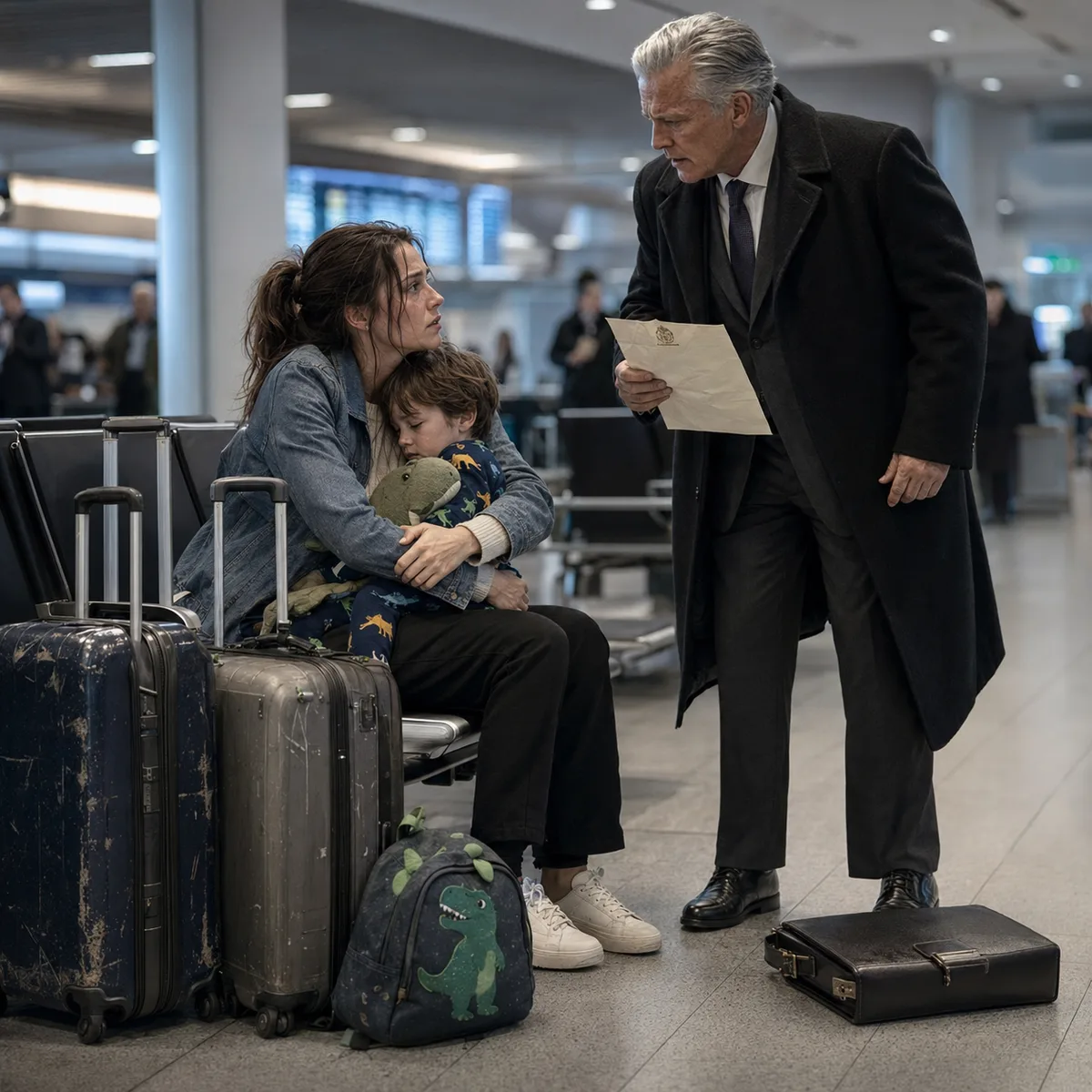
Then Elena appeared in the doorway with Leo on her hip.
She had washed her face. Her eyes were still red but her posture had changed, some inner door closed and braced. Marjorie stood just behind her, one hand resting near the doorframe with the quiet steadiness of a person holding a line.
Leo had a cookie in each hand.
Beatrice saw them and stiffened.
I walked to Elena.
“I’m sorry,” I said.
She looked startled.
“You don’t have to—”
“Yes,” I said. “I do.”
The room was silent at my back.
“I am sorry I left you vulnerable in a house where my name should have protected you. I am sorry you sat in an airport with your child and had to wonder whether grief had made you disposable. I am sorry my son trusted us to love you and we failed to make that trust visible enough to matter.”
Elena’s face crumpled, but she did not cry this time. She pressed her lips together and nodded once, a small, deliberate motion.
Leo looked from her to me with the careful attention of a four-year-old trying to read a room.
“Are we in trouble?”
“No, buddy,” I said.
Beatrice shifted as if to speak.
I turned.
“Say one word to him,” I told her, “and the car outside will take you to a hotel tonight.”
Her eyes widened.
“You would remove me?”
“I would remove anyone who frightened my grandson.”
A silence that felt like it could have lasted years.
Then Leo held one of his cookies out toward me in the gracious manner of a child who has not yet learned to be stingy with comfort.
“Grandpa Ray, can Mommy stay?”
I crouched so we were eye level.
“Your mommy can stay as long as she wants.”
“And me?”
“And you.”
“In Daddy’s house?”
I looked at Elena.
Then back at Leo.
“Yes,” I said. “In Daddy’s house.”
He considered this with the gravity of someone for whom dinosaur hierarchies and sleeping arrangements carry equal moral weight.
“Can we put my dinosaurs back?”
Elena made a sound halfway between a laugh and a sob.
“Yes, sweetheart,” she whispered. “We can put your dinosaurs back.”
Beatrice did not apologize that evening. She did not recognize the room had turned until everyone in it confirmed it for her. Judith Pell announced she supported immediate suspension before buttoning her coat. Peter Shaw nodded beside her. Malcolm stood and looked at his wife and said, “Beatrice, enough,” with the flatness of a man who has run out of a particular kind of patience. Then he left. Cecily followed him, murmuring something she did not finish. Grant slipped out without looking back.
Within minutes, the room emptied until only Beatrice, Victor, Elena, Leo, Marjorie, and I remained.
Beatrice stood alone beside the fireplace. For the first time since I could remember, the room made her look small.
“She will take everything,” Beatrice said. Her voice had lost its architecture.
Elena spoke before I could.
“I never wanted everything.”
Beatrice looked at her.
Elena stood straighter.
“I wanted my husband back. I wanted my son to sleep through the night without asking where his father was. I wanted to go one day without feeling like a guest who had overstayed by the simple fact of still being alive.” She did not raise her voice. “I wanted to keep Liam’s mug in the cabinet without someone moving it to storage because grief made the kitchen look untidy.”
She paused.
“I don’t want your world, Beatrice. I don’t want the committees or the seating charts or the friends who say terrible things with good napkins in their laps. I wanted my child to have the family his father promised him. That morning, you made him believe he was being sent away because I wasn’t enough. I can forgive a great many things eventually. But not that. Not today.”
Leo pressed his face into her neck.
Beatrice looked at him then. Not as a name or an heir or a chess piece to be positioned for the family’s benefit. For one fraction of a moment, she looked at him as a child.
Then she looked away.
I had Marjorie bring the car around.
Beatrice picked up her handbag from the sofa with a sharp motion that rattled the chain strap and walked to the door. She stopped once.
“You will regret this.”
“I regret not doing it sooner,” I said.
She left without another word.
The house stayed quiet after she was gone. Not peaceful, not yet. A house cannot be violated in the morning and restored by evening. But the quiet changed its quality. It stopped feeling like fear being carefully maintained and started feeling like everyone had stopped pretending.
Elena carried Leo to the library, where he fell asleep on the sofa under the old plaid blanket Liam had dragged around as a boy. She sat beside him with one hand on his back, and I poured her tea because I did not know what else to do with my hands. She accepted the cup but sat with it.
“She used to correct the way I said things,” Elena said after a while. “Little things. Supper instead of dinner. Couch instead of sofa. Once she told me my Christmas cookies were charming because they looked homemade.”
“They were homemade.”
“I know.”
Outside the windows, late afternoon was turning the light blue. Someone walked quietly past the hall carrying Leo’s dinosaur backpack, and in the distance a vacuum started and then stopped, as if the house had remembered it should be careful tonight.
“Liam told me once,” Elena said, “that you were kinder than you looked.”
I smiled a little.
“He exaggerated.”
“He said you didn’t always know where to put love, so you put it into arrangements. Trusts. Insurance. Repairs. Things people didn’t notice until something broke.”
I looked toward Leo’s sleeping shape.
“That sounds like him.”
“He loved you. He was angry with you sometimes too.”
“I know.”
“He wanted Leo to know you. Not the family name. You.”
That one took a moment to find its way in.
“I should have been here more,” I said.
Elena looked at me steadily.
“Yes.”
The honesty of it was clean, not cruel. Just true.
I nodded.
“I will be.”
She studied me, deciding whether to believe it.
“Not because of today. Not because of guilt.”
“No.”
“Because he needs steadiness. I can’t have people appearing when there’s a crisis and disappearing when it’s time for preschool pickup.”
There she was. Not the frightened woman from the airport bench. Liam’s Elena.
“You’re right,” I said.
“I know you’re busy.”
“I am.”
“Leo is four.”
“Yes.”
“Four-year-olds don’t understand economic summits.”
“No,” I said. “They understand cookies.”
“And dinosaurs.”
“And dinosaurs.”
Her mouth finally curved, fully, for the first time since I had found her.
The following week was unpleasant in the way that necessary corrections often are. Victor moved efficiently. Beatrice’s foundation access was formally revoked. The security company’s apology arrived in language so carefully lawyered it had clearly passed through several panicked revisions. Every staff member in the household was spoken to with clarity rather than threat: no one on that property would ever again act on an instruction that affected Elena or Leo without hearing directly from me.
Marjorie restored the guest house before Elena returned to sleep there. She put Leo’s dinosaurs back on his shelf in the precise chaotic arrangement he maintained was a parade. She found Liam’s boots in a storage bin where someone had deposited them and returned them to the back door without commentary.
Elena saw them and had to sit down.
Click the blue “PART 4” below to read the final part: 👉 PART 4 👈
Chapter complete
You have reached the end of this chapter.
Continue reading
A few more worlds to get lost in after this chapter.




