PART 2 — THE HOUSE MY SISTER TRIED TO CLAIM
I closed my eyes.
Chapter 2
PART 2 — THE HOUSE MY SISTER TRIED TO CLAIM
I closed my eyes.
For one moment I saw my son’s face.
Liam at sixteen, still in muddy lacrosse cleats, arguing with Beatrice in the driveway because she had called a scholarship student not our kind of people. Liam at twenty-five, bringing Elena home for the first time, watching my face with the nervous attention of a young man who had learned that approval in this family required careful reading. Liam at thirty-one in a hospital room, lifting newborn Leo from the bassinet with a gentleness so complete the nurses went quiet.
And Liam last year. A folded flag. Cemetery grass. Elena’s hand shaking in mine.
I opened my eyes.
“Did she touch you?”
“No.” Then, after a pause, “One of the guards took my phone when I tried to call you. Beatrice said I was becoming hysterical.”
That word.
The word people like Beatrice reach for when a woman’s grief becomes inconvenient.
“Where
is your phone now?”
“She gave it back at the car. I think she wanted me to have it once I was already here.”
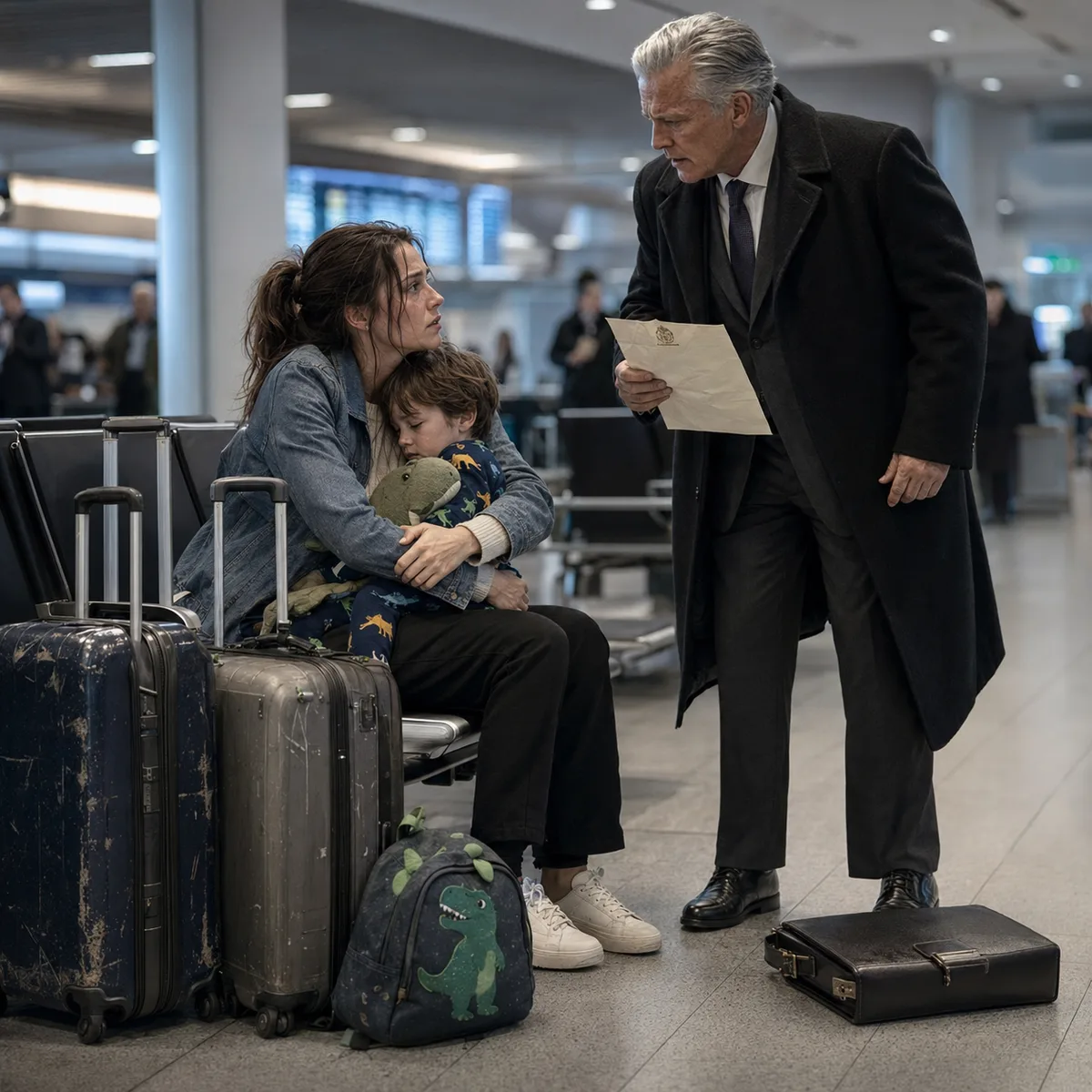
I looked at the ticket again. Dayton. Elena was from a small town outside Dayton, where her mother still lived in a two-bedroom ranch house with a porch swing and a mailbox shaped like a barn. Beatrice had chosen it with the tidiness of someone who believes cruelty becomes something else when you arrange transportation and call it care. Send the widow home. Retrieve the child later, under the language of concern. Let the family attorneys dress the whole thing in silk.
I stood up slowly.
The world came back around me. Loud and bright and entirely indifferent.
“Elena,” I said, and picked up Liam’s old leather bag. “Get in the car.”
She stared at me.
“But Beatrice said—”
“I know what Beatrice said.”
My voice
was quiet. That was usually when people who knew me well began paying close attention.
“She has forgotten something important.”
Elena held Leo tighter against her chest.
“What?”
I looked toward the glass doors where my driver had spotted me and was coming through with concern already on his face.
“She has mistaken the furniture for the house.”
Elena blinked, not yet understanding.
I picked up the dinosaur backpack from the floor and slung it over one shoulder.
“Come with me,” I said. “It’s time my sister remembered who built the roof over her head.”
The ride back to Long Island was the longest forty-seven minutes I can remember.
Elena sat in the back with Leo, her body angled toward him in the unconscious way mothers position themselves when fear has nowhere to go. Every few minutes she touched his hair, his cheek, his small hand, checking him in the
silent ongoing accounting of someone who cannot quite believe he is still there and still safe.
I sat in front beside Arthur, my driver of twenty-two years, and made calls.
The first was to Victor Lane, my attorney, the only man alive who had ever beaten me at chess without looking apologetic about it afterward.
He answered on the second ring.
“Raymond. You landed early.”
“I need you at Whitmore House in one hour.”
A brief silence. Victor had known me long enough not to waste time on foolish questions.
“Personal or corporate?”
“Family trust.”
“Who is in danger?”
“Elena and Leo.”
His voice changed.
“I’ll bring the trust documents.”
“Bring the security contracts too. And the foundation bylaws.”
Another pause. “What did Beatrice do?”
“She attempted to remove Liam’s widow and son from the property under my name.”
I heard a chair scrape on the other end.
“Forty minutes,” he said.
The second call was to Marjorie Bell, who had run Whitmore House longer than most marriages last. She had come to us as a young woman from Queens and worked her way to the only person on the estate who could terrify caterers, florists, and my sister with equal composure.
“Mr. Whitmore. We were told you were delayed.”
“I was not. Where is Mrs. Harlan?”
“West drawing room. She’s invited the family council for tea.”
Of course she had. Beatrice never committed cruelty without witnesses she could later call into evidence.
“Who is present?”
“Mrs. Harlan. Mr. Harlan. Cecily. Grant. Mr. Albright from security. Two members of the foundation board. She also requested that Elena’s rooms be cleared.”
My jaw tightened.
“Were you aware Elena and Leo were being taken to the airport?”
Marjorie’s voice dropped.
“I was told you had approved a relocation.”
“No.”
The word landed with enough weight that Arthur glanced at me in the rearview.
Marjorie inhaled carefully.
“I understand.”
“Lock the guest house. No one enters. Preserve everything exactly as it is. Any bags removed, any drawers touched, any staff who participated, I want names.”
“Yes, sir.”
“And Marjorie.”
“Yes.”
“When Elena arrives, she comes through the front door. Not the service entrance. Not the side portico. The front door.”
A small pause, and then her voice steadied with something that sounded almost like satisfaction.
“Yes, Mr. Whitmore.”
The third call was to the head of our private security firm and lasted nineteen seconds.
By the time we left the Van Wyck and the city thinned into the manicured quiet of Nassau County, my phone was face down on my knee and Elena was watching me in the rearview mirror.
“Raymond,” she said carefully. “I don’t want to cause trouble.”
“You didn’t cause it.”
“I don’t want Leo in the middle of a family war.”
“He is already in the middle of one. The difference is that someone on his side has arrived.”
Her eyes filled again, but she looked away before they could spill.
“I kept thinking Liam would be so ashamed,” she said.
“No.” I turned toward her. “Liam would be furious.”
She looked out the window. Past the glass, the island rolled by in late afternoon light, brick colonials and bare trees, a church sign announcing a pancake breakfast, a pharmacy with sale posters in the window. Ordinary life continuing without any awareness of what was happening in one car on the expressway.
It struck me, not for the first time but with new force, that Elena had never wanted the world Beatrice worshipped. She had never cared about benefit luncheons or donor plaques or whether the flowers in the front hall came from the right florist in the right neighborhood. She had wanted Liam. And after we buried him, she had wanted enough peace to raise his child.
That should not have required this.
Whitmore House sat at the end of a long drive outside Oyster Bay, not because I loved display but because my grandfather had purchased land when Long Island still had stretches where you could hear wind move through trees without machinery interrupting it. The house itself was rambling stone with ivy on the east wall and slate roofs that cost more to maintain than most people’s first homes. To Beatrice it was legacy. To me it was burden and memory and occasionally shelter.
Liam had hated the formal dining room. As a boy he used to take sandwiches into the library and read on the floor under the tall windows. As a man, he had chosen the guest house after marrying Elena because he said the main house felt like everybody’s expectations wearing shoes.
Elena had made that guest house into something that actually felt inhabited. Herbs on the kitchen windowsill. Leo’s finger paintings on the refrigerator held up by magnets from places she and Liam had visited before he died. A pair of his boots by the back door, kept there long after he was gone, because grief has its own housekeeping logic.
When we pulled into the drive, three extra cars sat near the front fountain. Beatrice had assembled exactly the audience I expected.
Elena saw them too.
Her shoulders went rigid.
I turned around.
“Listen to me,” I said. “You are Liam’s wife. Leo is Liam’s son. You do not lower your eyes in this house.”
She tried to look brave and didn’t quite manage it.
“I don’t know if I can do that.”
“Then borrow mine.”
Arthur opened the door.
I stepped out first, then helped Elena. Leo woke as she shifted him, his face creasing with confusion.
“Mommy?”
“I’m here, baby,” she murmured. “We’re okay.”
He blinked and found me.
“Grandpa Ray?”
I reached for him, and for the first time since the airport, Elena’s arms loosened. Leo came to me heavy and warm, his hair still damp from sleeping.
“Hi, soldier,” I said.
Liam used to call him that.
Leo rubbed his eyes with one small fist.
“Aunt Bea said we had to go on a plane.”
“I know.”
“I didn’t want to.”
“You don’t have to.”
He settled against my shoulder with the complete trust of a child who has not yet been taught that adults construct entire rooms out of lies. We walked up the front steps together.
Marjorie was inside before I could reach the bell, standing in the entry with her spine straight and her expression precisely controlled. Behind her the house looked as it always did, polished floors and fresh flowers and the portrait of my grandfather watching from the landing. But the air was wrong. Houses carry the residue of what happens in them. Even before voices reach you, you can feel where something has occurred.
“Welcome home, Mr. Whitmore,” Marjorie said.
Then she turned to Elena.
“Mrs. Whitmore.”
Elena went still beside me.
It was the first time anyone had called her that all day.
Marjorie’s gaze dropped briefly to Leo, and something in her face softened.
“Mr. Leo, I believe there are cookies in the kitchen.”
Leo’s head came up immediately.
“Chocolate?”
“Two kinds.”
I passed him back to Elena.
“Take them to the library,” I told Marjorie. “Something warm. No one enters without my permission.”
Elena looked at me.
“You don’t want me there?”
“I want you there when it matters. Right now I want Leo to have cookies before he watches adults behave poorly.”
That almost brought a smile. Almost.
She followed Marjorie down the hall. Leo peered over her shoulder at me until they rounded the corner.
I waited until the library door closed.
Then I walked to the west drawing room.
Beatrice’s voice reached me before I touched the door.
“We must be practical. Sentiment has cost this family enough already. Elena is not a bad girl, but she is unsuitable. Liam was grieving something in himself when he chose her, and Raymond’s attachment to the child has clouded his judgment.”
A teacup clicked. Someone murmured agreement.
My sister had always had the gift of making cruelty sound like stewardship.
I opened the door.
Every face turned.
Beatrice stood beside the fireplace in a cream silk blouse and pearls, one hand resting lightly on the mantel with the ease of someone who has long believed a room’s finest furnishings are there to frame her. She was sixty-eight, two years younger than me, perfectly groomed, silver hair swept into a low knot, her expression carrying the particular calm of someone about to cause significant harm and wanting witnesses to remember her as reasonable.
Her husband Malcolm sat stiffly on the sofa examining the carpet. My nephew Grant stood near the drinks table with his phone. Cecily occupied an armchair with the expression of expensive boredom. Two foundation board members sat with untouched tea. Near the window stood Mr. Albright, the security supervisor Beatrice had apparently deployed as muscle.
Three seconds of absolute silence.
Then Beatrice smiled.
“Raymond. You’re home early.”
“Yes.”
She recovered smoothly.
“We were discussing some necessary adjustments following the difficult year.”
“I heard.”
Her eyes sharpened almost imperceptibly.
“You must be exhausted from the flight. Perhaps this would be better after you’ve rested.”
“No.”
The room tightened around that single syllable.
I walked to the center of the rug, the crumpled airline envelope still in my hand.
“Who authorized the removal of Elena and Leo from the estate?”
Beatrice’s smile cooled but held.
“Removal is a dramatic word.”
“I asked who authorized it.”
She lifted her chin.
“I did.”
“On whose authority?”
“Raymond, please. This is precisely why I wanted the matter resolved before you returned. You’re too close to it to see clearly.”
Grant glanced at Cecily. Cecily studied her tea.
Beatrice stepped away from the fireplace and spoke with the tone she used when she believed the matter had already been decided.
“Elena is a sweet young woman, but she has no understanding of what comes with this family. She does not know how to raise a Whitmore heir. She lets Leo eat macaroni from a plastic bowl in the garden room. She avoids every significant event. She has made no effort to learn the protocols Liam should have taught her.”
“The protocols,” I said.
“You understand exactly what I mean.”
“I do. That’s what concerns me.”
Her nostrils flared.
“Someone had to think past emotion. Liam is gone. Leo is the future of this family. We cannot allow him to be shaped entirely by a woman who never belonged here.”
In my life I have sat in rooms where men smiled while concealing knives inside contracts. I learned early that noise gives people places to hide. So I kept my voice low enough that everyone had to stop breathing to hear it.
“You put my grandson and his mother on a one-way flight while I was out of the country.”
“I arranged for her to return to her people.”
“Her people.”
“Yes, Raymond. Her people. Her mother. Her hometown. A place where she can be herself.”
“And Leo?”
Beatrice paused for half a second too long.
“Leo would visit until more permanent custody arrangements could be discussed.”
There it was.
Not exile. Extraction. The exile was only ever meant to be the first step.
I looked around the room. One of the board members found something to examine on the table. Malcolm closed his eyes. Grant shifted his weight in the particular way people do when they want to be seen as peripheral.
“You were planning to separate a four-year-old from his mother.”
“I was planning to protect him.”
“No,” I said. “You were planning to own him.”
Her expression cracked for the first time.
“Do not speak to me that way in my own family home.”
A small intake of breath from somewhere near the sofa.
Beatrice realized what she had said a half second after saying it. She had lived inside that phrase so long it had simply come out.
My own family home.
I let the silence hold it.
Then I turned to Mr. Albright.
“Did you or your guards enter Mrs. Whitmore’s residence this morning?”
He swallowed.
“We accompanied Mrs. Harlan at her request.”
“Did you confiscate Mrs. Whitmore’s phone?”
“Temporarily.”
“For what reason?”
“Mrs. Harlan stated that Mrs. Whitmore was becoming unstable and might interfere with approved travel arrangements.”
“Approved by whom?”
His eyes moved to Beatrice.
“Mrs. Harlan.”
I nodded once.
“You’re relieved of duty pending termination. Your company’s owner has already been notified. Leave your badge with Marjorie on your way out.”
Click the blue “PART 3” below to read the next part: 👉 PART 3 👈
Chapter complete
You have reached the end of this chapter.
Continue reading
A few more worlds to get lost in after this chapter.




