PART 3 — THE BOARDROOM WHERE HER SECRET PLAN COLLAPSED
“Yes.
Chapter 3
PART 3 — THE BOARDROOM WHERE HER SECRET PLAN COLLAPSED
“Yes.
You’d be free of it.”
I looked at my daughter across my late husband’s sunroom table, and I thought about what free means and what burden means and who gets to decide which is which.
“What you’re describing,” I said calmly, “is a transfer of executive control to two people who have no ownership stake in the company.”
Craig smiled. That smooth, rehearsed smile.
“There are structures that could address that.”
“I know what structures exist, Craig. You’ve been researching them for eight weeks.”
I kept my voice entirely level.
“I have the records request. I have the HR document. I have your calls to outside counsel. Both of them declined. I have Dr. Cho’s evaluation, Francis Whitmore’s filings, and a board governance update that has already been approved.”
I looked at him.
“Which specific structure were you planning to propose?”
The smile did not leave his face.
But something
behind it did.
Diana stood up.
The softness was gone. Not dramatically, but completely, the way a mask goes when the situation no longer calls for it.
“This is why we’re worried, Mom. This paranoia—”
“It isn’t paranoia when there’s documentation,” I said. “Sit down, Diana.”
She did not sit down, but she also did not leave. She stood there, and I could see in her face the collision of two forces: the daughter who had grown up in this house and the executive who had learned to move through rooms as though she already owned them.
“We could make this harder for you,” Craig said quietly.
And that quietly was worse than if he’d raised his voice.
“The competency petition is still an option. It takes time, yes, but it creates disruption. It freezes accounts during review. It becomes public record. Think about what that does to your company,
to employee confidence, to your vendors, to the board.”
I felt it then. A cold current beneath my sternum, fast and specific. Not panic. Not weakness. The genuine, grounded fear of a person who has correctly identified a real threat.
He wasn’t wrong that a petition would cause disruption, even a baseless one. The legal protection I had built would prevail, but prevailing takes time, and time costs things.
I held his gaze.
“File it,” I said, “and then explain to the Ohio Probate Court why you requested confidential ownership documents through a third-party records service six weeks before petitioning your mother-in-law for incompetency. Francis will be delighted to present that timeline.”
Craig’s jaw shifted. One small movement.
“We’ll see ourselves out,” he said.
Diana walked past me without looking at me. I heard the front door close with too much care, the controlled restraint of real fury.
I sat
in the sunroom for a long time afterward, listening to the garden and my own heartbeat. The fear was still there. I named it honestly.
This is not over. They will try again. And it may become ugly before it becomes finished.
But the fear I found had a quality I hadn’t expected. It was directional. It pointed forward. It said, You know what this is now, and you know what you are, and those two things together are enough.
I went to my desk and called Francis.
We moved to phase three.
The board meeting was scheduled for the second Tuesday in April. It had been on the calendar since my visible visit to the office in March, framed at the time as a routine quarterly review. No one outside the company would have found it remarkable.
Diana, as vice president of operations, would be expected to present.
What Diana did not know, what Craig did not know, was that this meeting had been quietly restructured in the ten days prior with the full knowledge and consent of the board. Francis had prepared a comprehensive legal brief, compiled and reviewed by Bernard Okafor and Janet Lim, detailing a documented pattern of executive overreach, the unauthorized HR succession inquiry, the external asset mapping, the calls to outside counsel without board authorization, and, most recently, Craig’s direct verbal threat, witnessed by me and captured in a follow-up letter I had sent to Francis the evening of their Saturday visit, time-stamped and formally logged.
Arthur had prepared a separate financial-integrity report confirming no irregularities in company accounts, but flagging the attempts by an external party—Craig’s records service—to obtain proprietary ownership information.
Dr. Cho’s evaluation was on file.
Rosa’s affidavit was on file.
Everything was on file.
I arrived at the Harlo Group boardroom at 9:15 on a Tuesday morning wearing a charcoal blazer I had owned for eleven years and Gerald’s pearl earrings. I sat at the head of the table, which is where I always sit when I choose to attend in person, and which I noticed caused Diana to stop very briefly in the doorway when she entered.
She recovered quickly. She sat three seats to my left, opened her portfolio, and began reviewing her notes with the focused composure of someone who had prepared for a different meeting.
Craig was not in the building.
He had no right to be, and he knew it.
Bernard called the meeting to order. The first forty minutes proceeded normally. Financials. Regional reports. A brief on the spring expansion plan. Diana presented her operational summary with complete professionalism.
She is genuinely competent. That has never been the issue.
Then Bernard said,
“We have one additional item before we adjourn. Mrs. Harlo?”
I stood.
I spoke for twelve minutes.
I did not raise my voice. I did not editorialize. I presented the timeline: Arthur’s access logs, the HR document, the third-party records request, the calls to outside counsel, the Saturday conversation, and Craig’s explicit mention of a competency petition as leverage.
I told the board that I had taken comprehensive legal and medical steps to protect my position, and I presented Francis’s brief and Dr. Cho’s evaluation as supporting documentation.
And then I said something that I had decided to say only the night before.
“Harlo Group was built on one principle above all others: that trust is not given. It is demonstrated repeatedly over time. I have demonstrated it for forty years. I am here today to ask the board to consider whether the same can be said of the current vice president of operations.”
Silence.
Diana’s portfolio was closed. Her hands were flat on the table. She was looking at me with an expression I had never seen on her face in forty-four years.
Not anger. Not grief. But the raw exposure of someone whose private actions have been read back to them in a public room.
“These are misrepresentations,” she said.
Her voice was steady, but her hands were not.
“Mom, you’ve taken private family conversations—”
“The HR document was not a family conversation,” Bernard said. “It was an executive filing.”
“Craig’s records request was not a family matter,” Janet added. “It was a legal inquiry into proprietary ownership information.”
“I was trying to understand the structure,” Diana said, “for contingency planning in case something happened to you.”
“You filed a succession review,” I said, “while your husband mapped my assets, while you were recommending memory-care facilities to me and asking about my estate planning, and while Craig was researching the competency-petition process.”
I looked at her.
“That is not contingency planning, Diana. That is a strategy.”
The room was very quiet.
Diana looked around the table at Bernard, at Janet, at the two other board members who had said nothing but were listening with the careful attention of people who were forming permanent opinions. She looked at Arthur, who did not look away. She looked at me, and for a moment, just a moment, I saw her.
Not the executive. Not the antagonist.
The daughter who had grown up eating Sunday dinners at that mahogany table. Who had sat on Gerald’s lap and learned to count using the buttons in my sewing kit.
I felt grief.
Brief and real.
Then I finished.
“I am requesting a formal board review of Diana Harlo Sutherland’s executive conduct, and I am placing on record my authority as sole owner of Harlo Group LLC to initiate that review at my discretion.”
I set my folder on the table.
“That concludes my remarks.”
Bernard called for a motion. Janet seconded.
Diana gathered her portfolio, stood, and walked out of the boardroom without speaking. Her exit was controlled. Everything about her was controlled. But I had been her mother for forty-four years, and I knew the difference between composure and the effort it takes to hold composure together with both hands.
The vote was unanimous.
The formal board review took six weeks. Francis managed the legal side. Arthur managed the documentation. I did not interfere beyond what was required of me, which was to answer questions honestly and let the process run as processes are meant to run.
The findings were as follows.
Diana’s HR succession filing was classified as an unauthorized executive action taken without board knowledge or consent, a violation of company governance bylaws.
Craig’s third-party records request was found to have accessed filings through methods that, while technically legal, constituted a breach of the confidentiality expectations in Diana’s executive employment contract, which included a clause about spousal conflicts of interest.
His verbal threat regarding the competency petition, documented in my time-stamped letter to Francis, was reviewed by outside counsel as potential witness intimidation, ultimately not pursued criminally, but noted formally in the record.
The board voted to terminate Diana’s employment as vice president of operations.
It was not a firing in the way that word usually sounds—sudden, dramatic, heated. It was a letter delivered by Francis to Diana’s attorney on a Thursday afternoon in late May with a severance package that was fair, a nondisclosure agreement that was comprehensive, and a request to return her company property by the following Friday.
Diana called me that evening.
I answered.
“You destroyed my career,” she said.
I let a moment pass before I answered, because the thing I needed to say required the right weight.
“No,” I said. “You made a series of specific decisions over several months. I documented them and presented them to the people who had authority over them. The outcome followed from your actions, Diana, not from mine.”
“You’re my mother.”
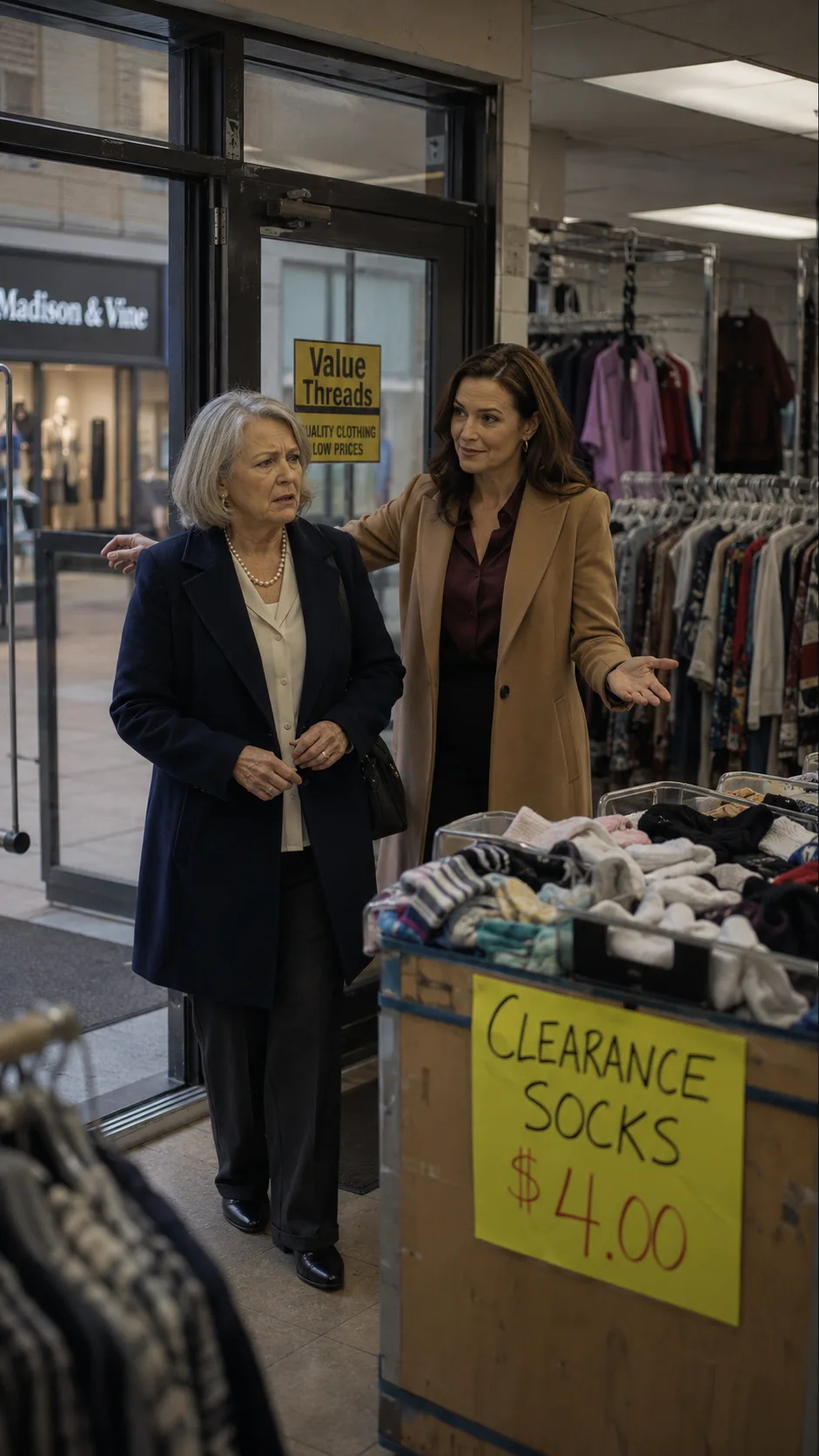
“I am,” I said. “And I’m also the person you took to a discount store and told to live more modestly while you were researching how to remove me from my own company.”
I paused.
“I love you. That has not changed. But love and accountability are not opposites.”
She hung up.
Craig’s situation was separate and, in some ways, more complicated. The breach-of-confidentiality finding exposed him to a civil-liability claim from Harlo Group. Not a criminal matter, but a real one. His firm, when informed, placed him on administrative leave pending an internal review of the conflict of interest his actions represented. He was not disbarred, but his standing at the firm, which had been considerable, was permanently altered.
The corner office on the fifteenth floor, which he had occupied for nine years, was reassigned by October.
I did not pursue the civil claim.
Francis recommended that I had grounds. I considered it for three days and decided against it, not out of sentiment—I had spent enough sentiment on this situation already—but because I wanted the matter concluded, not extended.
Every month of litigation would be a month in which Diana and Craig remained at the center of my life, and I had other things I wanted to do with the time I had.
The nondisclosure agreement covered the details. What it could not cover was the broader fact, which became known through the ordinary movement of professional reputation, that the vice president of operations at Harlo Group had been terminated for cause following a governance review.
In a city the size of ours, in an industry where people talk, that fact traveled without any assistance from me.
Arthur retired formally at the end of June. His own choice, long planned, delayed by loyalty to me through the preceding months. I threw him a dinner at the restaurant on Fifth, where Gerald and I had celebrated our twenty-fifth anniversary. He cried briefly, excused himself, returned, and then toasted me with a kind of simple generosity that made me feel, for the first time in a long time, properly seen.
I promoted three people from within the company. I hired a new vice president of operations, a woman named Lucinda Park, forty-one, who had been our regional director in the Southeast and who had twice recommended operational improvements Diana had dismissed.
Lucinda was excellent, and she knew it, and she didn’t require reassurance on the point, which I appreciated.
The spring collection sold well. The Michigan expansion I’d been planning since January moved forward on schedule. I attended the opening of the Cleveland location in early September and shook hands, ate bad canapés, and felt, in the ordinary noise of a business functioning as it was meant to function, something I can only call restoration.
Bernard Okafor sent me a short email that week.
“For what it’s worth, I’ve been on a lot of boards. I’ve never seen anyone handle something this difficult with more clarity. Gerald would have been proud.”
I read it twice.
Then I went home and walked to the end of my driveway and stood under the oak tree in the September air, and I thought that Gerald was probably having a quiet, long laugh somewhere, in the way he used to when things worked out despite themselves.
I was still standing.
The company was still standing.
That was enough.
That had always been enough.
The year that followed was the quietest and, I think, the most genuinely satisfying of my post-Gerald life. I rearranged it with intention. That’s the only way I know how to describe it. Not retirement, which sounds like absence, but rearrangement—a deliberate reordering of what I gave my attention to and when and why.
I kept the company. I always would. But I shifted my involvement from the daily operational weight that Diana’s departure had briefly redistributed toward the longer-horizon work I had always found most meaningful: strategy, expansion, the relationships with the people who had built Harlo Group alongside me over decades.
I attended board meetings with the pleasure of someone who has remembered why she built the table she is sitting at.
In October, I took Rosa to Portugal.
We had talked about Portugal for eleven years and found reasons not to go—the timing, the weather, the minor logistics that accumulate around people in their sixties until they become habits of postponement.
We went for three weeks.
We ate well and walked considerable distances and argued pleasantly about wine and history. And on a Tuesday afternoon in Lisbon, sitting at a café table overlooking a square full of November light, I felt something so uncomplicated and specific that I had to sit with it for a moment before I named it.
I was happy.
Not relieved. Not victorious.
Happy.
I came home to a company that was running well, to a house that was mine, to a life that was exactly as large as I had built it to be.
In January, Lucinda Park presented the Q4 projections at the board meeting, the strongest fourth quarter in Harlo Group’s history, driven in part by the Southeast regional restructuring she had championed.
Bernard caught my eye across the table, and I nodded. That small exchange carried everything that needed to be said.
Rosa came to dinner most Sundays. We cooked. We talked about books and gardens and the particular comedy of growing older in a world that keeps getting younger. And I found, reliably, that two hours with Rosa left me feeling more calibrated than almost anything else.
I also did something I had not done in a long time.
I began writing.
Not company reports. Not strategy documents. A journal in longhand on the yellow legal pads I have always kept in my kitchen drawer. I wrote about Gerald, about the early years, about the sewing machine in the rented room in Cincinnati.
I do not know if anyone will read it, but the writing helped me understand what I had been through in a way that the living of it couldn’t quite provide.
Diana and Craig, I knew through the ordinary permeability of a shared city and shared professional networks, were having a harder time of it.
Craig had been reassigned at his firm, not terminated, but effectively demoted, moved to a practice area with less prestige and fewer clients. His transition timeline for the firm’s annual partnership review was quietly extended. People in legal circles talk in the measured way professionals talk when they are being careful but not silent. His reputation for judgment had been permanently softened.
Diana took a position with a midsize retail consulting firm in Columbus. A reasonable organization, competent work, but a considerable step down from her VP role at a regional group of Harlo’s scale. I heard through Arthur, who still had occasional industry contact, that she had struggled in the early months, not with the work, but with the adjustment of no longer being in a room where people deferred to her.
She did not call me again after that evening in May.
I thought about calling her.
I thought about it on her birthday in August and at Thanksgiving and at Christmas, which I spent with Rosa and Rosa’s daughter and three grandchildren who took over my kitchen and improved it substantially.
Each time I thought about it, I asked myself honestly whether the call would be for her benefit or mine, whether I was reaching from love or from my own discomfort at the silence.
The answer each time was complicated enough that I waited.
What I felt toward Diana was not anger. Anger had come and gone in the early months, clean and specific, and had been replaced by something more patient and more difficult: a kind of sorrow for the gap between who she could have been and who she had chosen to become when she thought no one was watching her carefully enough.
I had watched.
I had always watched.
I hoped she would find her way back to herself, the self that was curious and capable and had once, a long time ago, sat on the floor of my Cincinnati workroom and asked me why I cared so much about making things well.
“Because something made with care outlasts the person who made it,” I had told her. “That’s enough reason.”
I still believed it.
The oak tree Gerald planted is taller than the roofline now. I walk past it every morning on my way to get the paper, and every morning it is still there, which I find continually and unreasonably comforting.
I am sixty-nine years old.
I own a company with 316 employees, 45 locations, and a Michigan expansion on track for spring. I have a house on Sycamore Hill and a friend named Rosa and a journal full of yellow pages and a plan for Tuscany in June.
I have not shopped at Value Threads, but if I did, I’d probably own that too.
So that is the story of the afternoon my daughter held open the door of a discount store and told me to live more modestly. She was not wrong that I had more than I needed. She was wrong about what to do with that fact.
I learned, or perhaps I remembered, that the most dangerous thing you can do to a woman who built something from nothing is assume she has forgotten how she did it.
Here is what I’d leave with you.
Your value is not determined by the room someone puts you in. And the people who underestimate you quietly are rarely the ones who know you best.
What would you have done in that store, holding that cardigan?
I’d love to know. Leave it in the comments.
And if this story meant something to you, share it with someone who might need to hear it today.
Thank you, truly, for listening.
THE END.
Chapter complete
You have reached the end of this chapter.
Continue reading
A few more worlds to get lost in after this chapter.




