PART 2 — THE QUIET WAR FOR CONTROL OF MY COMPANY
I am not a dramatic woman.
Chapter 2
PART 2 — THE QUIET WAR FOR CONTROL OF MY COMPANY
I am not a dramatic woman.
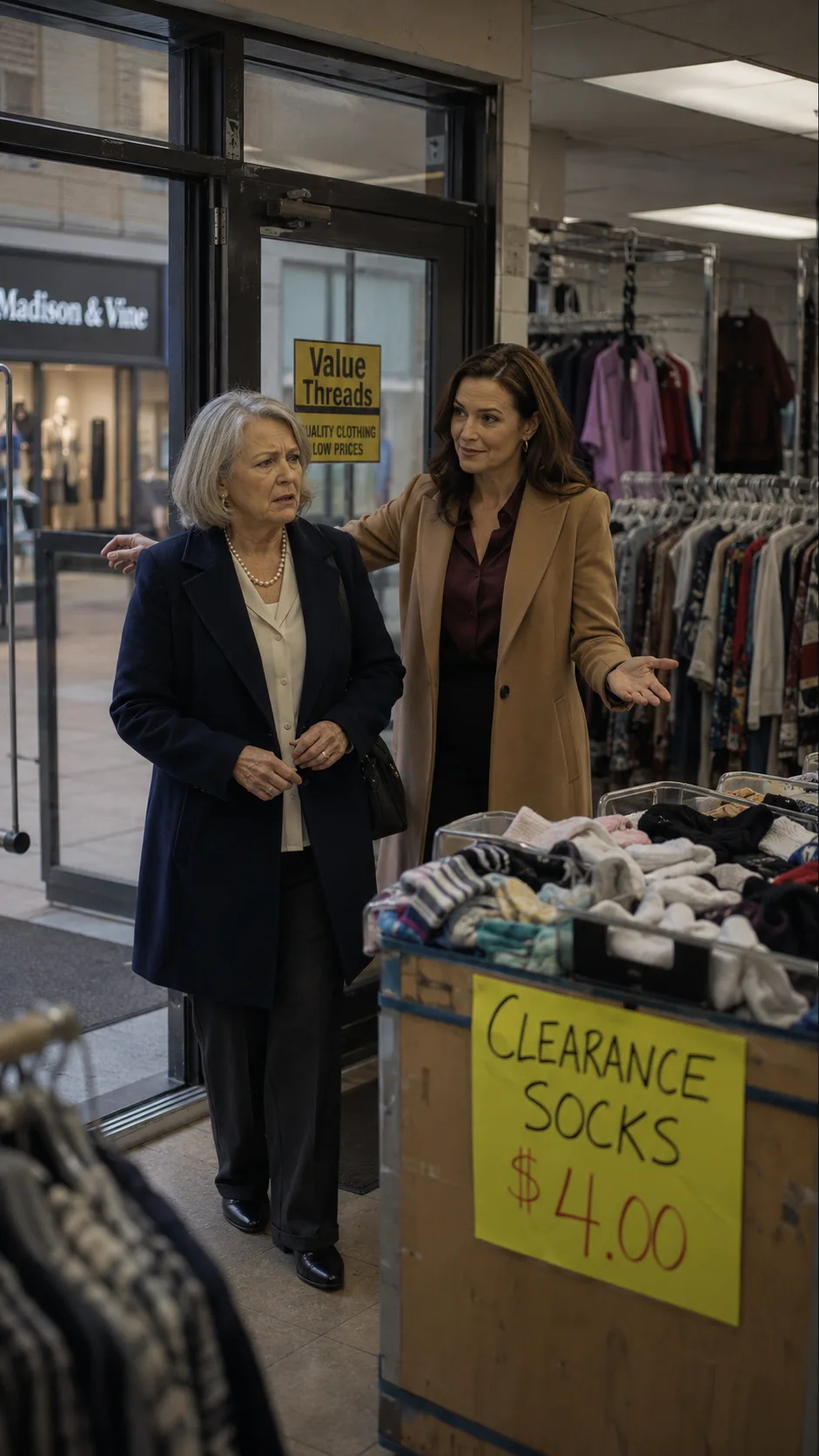
I have never mistaken feeling for fact, so I made myself be precise. My daughter had taken me to a discount-bin clothing store and instructed me to dress down, to live more modestly, to accept a smaller version of my life.
But why?
That was the question I had been circling for weeks without naming directly. And now I named it.
Diana and Craig were maneuvering.
For what exactly, I wasn’t certain, but I had spent forty years in business, and I recognized the architecture of a play when I was standing inside it: the casual mentions of estate planning, the unsolicited medical recommendations, the transition timeline Craig had mentioned at Thanksgiving before catching himself.
They wanted control of my assets, of the company, of me.
The question was whether they had already taken steps to make that happen or whether I was still ahead of them.
I went inside,
made a pot of chamomile tea, and sat at my kitchen table with the yellow legal pad I keep in the second drawer. I wrote three words at the top:
What do I know?
And then I wrote in the careful, itemized way I have always approached problems.
Everything I had observed over the past three months. The unannounced visits. The articles about memory-care facilities left on my reading table. I had assumed that was an accident. The questions about whether I still felt sharp. The way Craig had begun inserting himself into casual conversations about the company, asking specific questions about board structure and succession procedure with the patience of a man who was researching, not chatting.
I also wrote what I did not know.
I didn’t know whether they had consulted an attorney about a competency challenge, the legal mechanism by which a family member can petition to
have another declared mentally incapable of managing his or her own affairs. I didn’t know whether Diana had spoken to anyone at the company. I didn’t know whether my own CFO, Arthur Finch, who had been with me for nineteen years, was aware of any of this, or whether he had been approached.
I turned the page and wrote:
What can I do?
My first instinct, I’ll be honest, was to call Diana and ask her directly. That instinct lasted approximately four seconds before I dismissed it. A person engaged in this kind of quiet campaign does not respond to direct confrontation with honesty. They respond with reassurance, with deflection, with concern.
“Mom, I don’t know what you’re talking about. We just want what’s best for you.”
And then they accelerate.
No. I needed information before I made any move, and I needed it from sources Diana didn’t know I
had.
The first call I made the next morning was to my attorney, a woman named Francis Whitmore, whom I have retained for twenty-one years and who has the distinguishing quality of being impossible to rattle. I told her I suspected a potential competency challenge was being explored by a family member and that I wanted a full review of my legal position and the structural protections already in place.
I told her to say nothing to Craig’s firm, and she assured me, with some steel in her voice, that she had no intention of doing otherwise.
The second call was to Arthur Finch.
Arthur is seventy-one, semi-retired, but still our CFO in title and in practice. He and Gerald used to fish together in Manitoba every August. He’s the only person in the company who knows the full ownership structure.
“Arty,” I said when he answered, “have you spoken to Diana recently about anything other than operations?”
A pause. Just one beat too long.
“She’s asked some questions,” he said carefully. “About the holding structure. About whether certain ownership documentation was publicly accessible.”
I kept my voice steady.
“When?”
“About six weeks ago. I told her the structure was confidential and referred her to legal. I assumed you knew.”
I hadn’t known.
“Thank you, Arty. I need you to do something for me, and I need it done without any record in the company system.”
The plan forming in my mind was not dramatic. It was structural. I was going to document every move Diana and Craig were making. I was going to quietly reinforce every legal protection around my ownership, and I was going to wait patiently, precisely, for the moment when they exposed themselves fully.
Then I was going to remind them, and everyone who needed reminding, exactly who built Harlo Group.
Francis Whitmore’s office is on the fourteenth floor of the Carver Building downtown, and it has a view of the river that she has never once commented on in twenty-one years, which tells you everything about her priorities. She is a woman entirely focused on the document in front of her, and I have always found this deeply comforting.
I sat across from her on a Tuesday morning in early March, my hands folded on my handbag, and I laid out everything I had written on the yellow legal pad. She read it without interrupting, which is her habit. Then she looked up.
“You were right to call,” she said, “and right not to confront Diana directly.”
She confirmed what I had suspected. A competency challenge filed correctly in Ohio could temporarily freeze a person’s ability to conduct financial transactions while the petition worked its way through probate court. It was not a common maneuver, but it was a real one.
And if Craig was researching it, and the pattern of his questions to Arthur suggested that he was, he would know that the process moved more quickly when the subject appeared isolated and had not taken recent steps to demonstrate mental clarity and legal preparedness.
“So we take those steps now,” I said.
“We take those steps now,” Francis agreed.
We spent three hours that morning. I underwent a formal cognitive assessment with a neuropsychologist Francis had used before, a woman named Dr. Elaine Cho, who administered her evaluation with professional neutrality and concluded in writing that I demonstrated no cognitive impairment of any kind. That document went into a secured file.
Francis then prepared a comprehensive estate-planning update, not a change of substance, but a formal reaffirmation of my existing intentions, witnessed, notarized, and time-stamped. And she drafted a legal letter to Arthur Finch formalizing his understanding of the company’s ownership structure with my signature.
By noon, I had created a paper record demonstrating active, coherent control of my affairs.
Francis called it a prophylactic filing.
I called it insurance.
I drove from her office to the Harlo Group headquarters on the north side of town, which I rarely visited publicly. I had always preferred to exercise my oversight from a distance, reviewing reports, attending quarterly board meetings quietly. The staff knew me. They were fond of me, I believe. But I was not a daily presence.
That day, I was.
I walked in, said hello to the receptionist, visited the operations floor, spoke to three department heads about Q4 projections, and scheduled a formal board review for the following month.
Nothing alarming. Nothing dramatic. Just visible. Just present.
Diana was not in the building. She was at a regional conference in Columbus, but I knew she would hear about my visit within the hour. I counted on it.
What I did not expect was what Arthur found that same afternoon.
He called me at 4:30, his voice carrying the particular weight of a man who is about to tell you something he wishes were not true.
“Peggy,” he said, “I went back through the access logs on the ownership registry files like you asked. Craig Sutherland made a formal document request through a third-party record service six weeks ago. He was trying to map the full holding structure.”
That was not surprising. I had suspected as much.
“But there’s something else,” Arthur continued. “Diana submitted a request to HR three weeks ago. She asked for a formal review of”—he paused, then read directly—“executive succession protocols in the event of owner incapacitation or voluntary withdrawal.”
I sat down in the armchair by the window.
“She submitted it through HR?” I asked.
“Through the VP channel, yes. Technically within her authority. The HR director flagged it as unusual but processed it. She has the document.”
So it was no longer speculation.
Diana had, through official company channels, formally initiated a review of what would happen to Harlo Group if I were removed from the picture. She had done it using her own position, her own name, while her husband mapped my assets through a records service.
This was the evidence I needed.
It was also the moment there was no longer any question about what kind of situation I was in.
I thought about that afternoon in Value Threads. I thought about Diana’s encouraging smile. I thought about the cardigan I had touched and the plan I had started to build in my car in the dark.
“Buy your clothes here, Mom. Live more modestly.”
She had no idea what modesty had cost me to build and what it would cost her to dismantle.
I called Francis back.
“It’s confirmed,” I said. “We move to phase two.”
Phase two was not a confrontation. It was a correction.
Francis and I had identified three pillars.
First, formalize and reinforce the governance structure of Harlo Group so that no executive action—not Diana’s, not anyone’s—could affect ownership without explicit board consent.
Second, quietly surface Arthur’s findings to the independent board members, two of whom I had appointed personally and trusted without reservation.
Third, request through proper HR channels an internal audit of Diana’s succession inquiry, framing it not as a family matter but as a procedural one, which it was.
The board governance update was filed on a Wednesday. It was a routine amendment tightening the language around executive authority relative to ownership decisions, which had been somewhat loosely worded in the original bylaws. Any competent attorney reviewing it would understand what it meant.
Francis said it was airtight.
I met with the two independent directors, Bernard Okafor and Janet Lim, separately and in private. I told them what I had found, showed them the HR document, and explained Arthur’s findings about Craig’s records request.
Neither of them was surprised in the way that would have concerned me. They were surprised the way careful people are when a suspicion they had quietly held is suddenly confirmed.
Bernard said,
“I want to note that Diana presented a separate briefing to the operations committee in February that I found unusual at the time. She was describing certain leadership transition scenarios as though they were already under discussion. They hadn’t been. Not by the board.”
I had not known about that briefing.
I wrote it down.
The audit request went in on Thursday.
Diana called me Friday morning.
I was in my kitchen drinking coffee, watching the March light move through the oak tree Gerald had planted. Her name appeared on my phone screen, and I let it ring twice before answering. I wanted to be still when I picked up.
“Mom.”
Her voice was controlled, but something underneath it was not.
“I heard you came by the office this week.”
“I did,” I said pleasantly. “It was good to see everyone.”
“And I’m hearing there’s an internal audit being requested on a document I filed.”
“Yes,” I said. “Standard procedure when an executive-level succession document is filed without board authorization. You know that, sweetheart.”
Silence.
Then, “I think we need to talk in person.”
“Of course,” I said. “I’d like that.”
She came that Sunday with Craig.
I had expected that.
I made coffee, set out the good cups, and sat them in the living room where Gerald’s portrait hangs above the fireplace. I find that portrait useful in conversations that require me to remember that I am not someone who can be easily managed.
Craig spoke more than Diana did, which told me he had coached her to stay quiet. He was measured at first, expressing concern for my well-being, wondering aloud whether the stress of ongoing business involvement was appropriate for a woman of my age and health.
He mentioned the competency question without quite naming it, the way a person mentions a weapon by describing its shape.
“We just want to protect you,” he said.
“From what?” I asked.
He smiled.
“From making decisions that could be compromised by fatigue or stress.”
I looked at him. I thought about Francis’s documents, about Dr. Cho’s evaluation, about Bernard Okafor’s confirmation, about Arthur’s logs. I thought about thirty years of decisions that had built the company Craig’s wife now hoped to inherit without earning.
“Craig,” I said, “I have a neuropsychological evaluation on file dated three weeks ago, signed by Dr. Elaine Cho of the Midwest Cognitive Institute, confirming full cognitive function. I have updated estate documents witnessed and notarized by Francis Whitmore. I have board governance amendments filed and approved. And I have a documented record of the inquiry your wife filed through HR and the records request you made through a third-party service six weeks ago.”
I set my coffee cup down.
“I’m not fatigued. I’m not compromised. And I am not unprotected.”
Diana’s face had gone pale. Craig’s smile held for two more seconds.
Then it didn’t.
They left within twenty minutes. No raised voices. No ultimatums. Not yet.
But as I watched their car back out of my driveway, I felt the shape of what was coming. They had not expected this. They would regroup.
I called Arthur Monday morning and told him we were in a holding pattern. Then I closed my laptop, packed a small bag, and drove to the lake house in Michigan that Gerald and I had owned since 1998. I needed three days, not to recover from weakness, but to recover from the weight of being so relentlessly right.
The lake was still half frozen. I walked the dock in the mornings, watched the ice shift, cooked simple meals, read old novels, and did not check my email after seven.
On the third evening, sitting with a glass of wine while the sun went down over the water, I felt something settle back into its proper place.
I was ready.
I have a friend named Rosa Del Rio who has known me since we were both young mothers with too much determination and not enough sleep. She is seventy-two now, sharp as a letter opener, and she lives in a townhouse on the west side with a garden she calls her diplomatic corps because she says flowers negotiate better than people.
I called Rosa the evening I returned from Michigan.
“Tell me everything,” she said before I had finished saying hello.
I did.
It took most of a bottle of Riesling and two phone calls, one that evening and one the following morning when I remembered details I had forgotten the night before. Rosa listened the way she always does: without interrupting, without minimizing, without the particular horror people sometimes display when they discover that families can be complicated.
Rosa’s family is very complicated. She is not easily shocked.
“The shopping mall,” she said when I finished. “She took you to a discount store and told you to dress down?”
“Yes.”
“And she works for you?”
“Yes.”
“Peggy,” Rosa said, with the quiet emphasis she uses when she considers something to be not just wrong but categorically wrong, “that is one of the most condescending things I have ever heard.”
“I know.”
“What do you need from me?”
That question—simple, practical, without melodrama—was exactly what I needed someone to ask.
What did I need?
I needed a witness. Not a legal one. A human one. Someone who would confirm in the months ahead that I had been of sound mind and sound heart and sound purpose throughout everything that followed. I needed someone who knew the whole picture and could speak to it honestly if it ever became necessary.
Rosa said she would have her attorney prepare a brief affidavit attesting to my mental and emotional clarity. She said it with the matter-of-fact efficiency of a woman who has navigated enough of life’s unpleasant logistics to know when paperwork is the most affectionate thing you can offer someone.
I laughed for the first time in weeks.
In the meantime, Diana and Craig were quiet in the particular way that precedes regrouping. I knew this not from instinct alone, but from Arthur, who reported that Diana had taken two days of personal leave and that Craig had placed two calls to the company’s external legal counsel, calls that the attorneys had correctly declined without board authorization.
They were mapping their options.
What had they found? They had found, I suspected, that I had closed most of the doors. A competency challenge requires evidence of impairment, and I had a clinical evaluation on file. A board-level power shift requires a majority vote, and I had spoken personally to the two independent directors. A quiet asset inquiry had been logged and flagged.
There was no easy move left.
But I had been in business long enough to know that people with something to lose don’t stop when they run out of easy moves.
They escalate.
And the next move, I expected, would be designed not to overpower me legally but to destabilize me emotionally, to make me doubt myself, to make me feel that fighting was harder than yielding.
I had been in business long enough to know what that move looked like, too.
I was not afraid of it.
And here is the honest reason why.
I had been underestimated in that discount store by my own daughter in front of a rack of four-dollar irregular socks. I had already absorbed the worst thing Diana could do to me without intending to. The moment she smiled and held that door open, everything she did after that was smaller.
I had my attorney. I had my CFO. I had my board. I had my documentation. And I had Rosa Del Rio, who was at that moment calling her own attorney about an affidavit and who would, I knew, bring wine and complete honesty in whatever proportions were needed.
I sat in my house on Sycamore Hill on a quiet Thursday evening, made a pot of tea, and felt something I can only describe as the deep, specific calm that comes when you have stopped hoping the problem will go away and started trusting that you are the person who can end it.
Diana and Craig were watching.
I was waiting.
They came on a Saturday.
Of course they came on a Saturday. Craig is too strategic to conduct a personal offensive on a workday, when everything has official weight and can be documented. A Saturday has the texture of the informal, the improvised, the familial.
Diana called the night before. Her voice was different from the Friday call after the audit—softer, more careful, with a particular kind of effort that I recognized as practiced vulnerability.
“Mom, I think we’ve let this get out of hand. Craig and I would really like to come and just talk like a family. No lawyers, no company stuff. Just us.”
I said yes because I wanted to see exactly what they had decided to try.
They arrived at eleven. Diana brought muffins from the bakery on Elm, which she knows I like. Craig shook my hand with warmth that was one degree too firm. I led them to the sunroom, which has large windows and a view of the garden and feels, I think, less adversarial than the living room.
I offered tea.
We sat for fifteen minutes. It was almost gentle.
Diana talked about her childhood, about memories I had not heard her mention in years. She talked about how much Gerald had meant to her. She cried briefly with the precise amount of moisture that suggests emotion without losing composure.
Craig talked about how much they both admired what I had built.
Then he said,
“That’s actually why we’re worried, Peggy. Everything you’ve built—we don’t want to see it damaged by decisions made in a complicated moment.”
There it was.
“We think,” Diana said, leaning forward, “that it might be worth considering a formal transition. Not a handover, just a structure where Craig and I could help manage the day-to-day decisions so you’re not carrying this alone. You’d still be involved. You’d still be consulted. But the burden—”
“The burden?” I said.
To be continued… Click “PART 3” to read the final part: 👉 PART 3 👈
Chapter complete
You have reached the end of this chapter.
Continue reading
A few more worlds to get lost in after this chapter.




