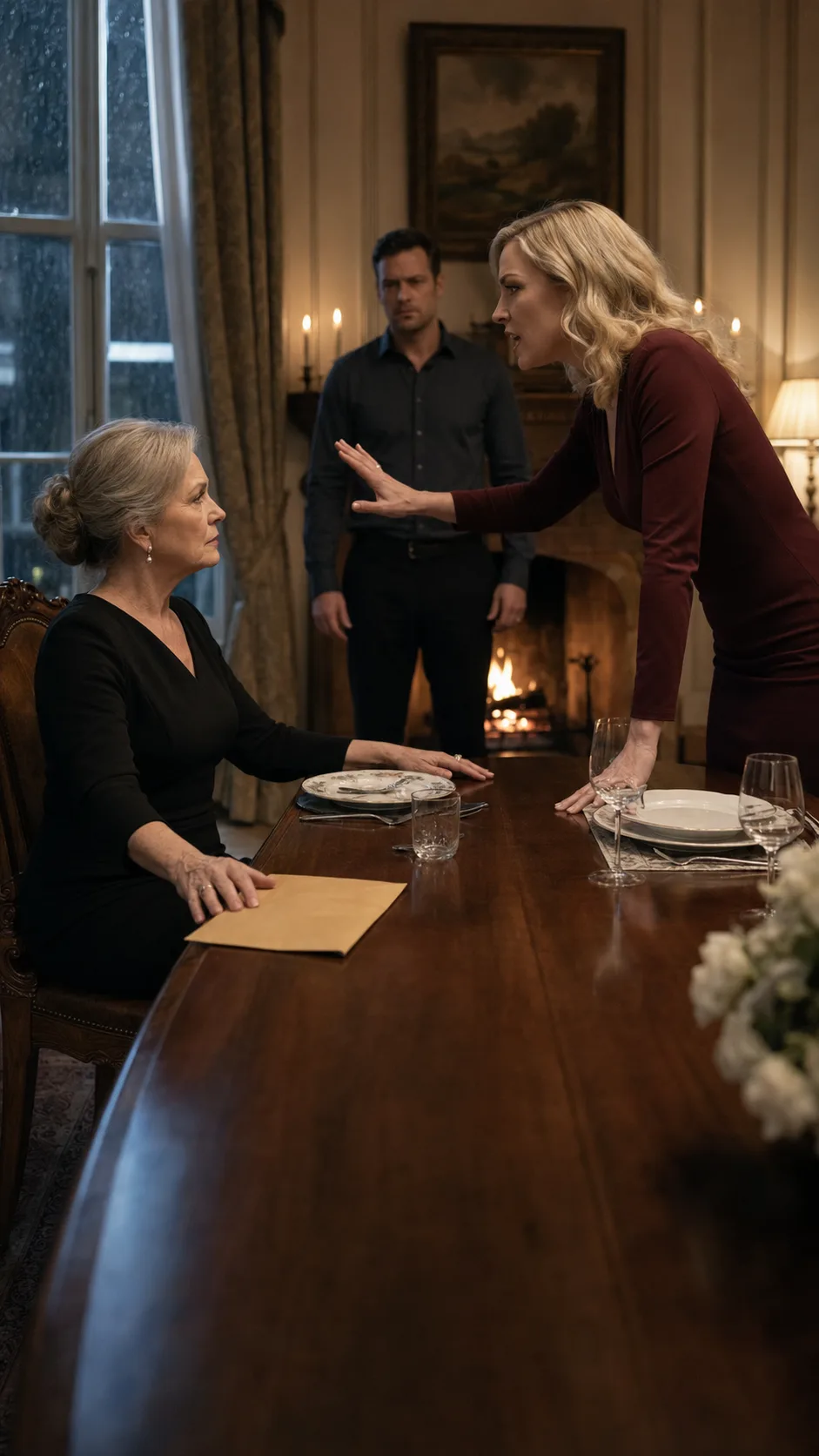
Thalia was arrested that evening at her sister’s apartment.
Chapter 3
Thalia was arrested that evening at her sister’s apartment.
Darren called me minutes after the police contacted him.
“Mom, they arrested her.”
“I know.”
“You knew this was going to happen?”
“I knew she had crossed a line the police could not ignore.”
His breathing was uneven.
“I went to your apartment, but it’s empty.”
I looked around the penthouse where I had actually lived for the past three years.
The modest apartment had never been my true home. It was a furnished property owned through one of my companies—a stage on which I had performed poverty for anyone who cared to watch.
“Come to Meridian Towers,” I said. “Penthouse level.”
Thirty minutes later, the elevator doors opened.
Darren stepped into my real life.
Floor-to-ceiling windows overlooked the city. Harold’s favorite paintings hung under soft gallery lights. The antique walnut cabinet we had bought in Paris stood beside the fireplace.
Darren walked slowly through the room.
“This is where
you live?”
“Yes.”
“All this time?”
“Yes.”
He sank into a leather chair.
“I don’t know who anyone is anymore.”
I poured him coffee.
“You know who Thalia is now.”
He covered his face with both hands.
“She tried to have you declared incompetent.”
“Yes.”
“She watched your apartment.”
“Yes.”
“She filed a false report and accused me of stealing from you.”
“Yes.”
“Why would she destroy both of us?”
“Because once she realized she could not control the situation, punishment became more important to her than profit.”
Darren looked older than he had a month earlier.
“What will happen to her?”
“The district attorney will decide the charges. Filing a false police report is only part of it. The authorities are reviewing possible attempted fraud, harassment, and unlawful surveillance.”
He leaned back.
“I feel stupid.”
“You were manipulated.”
“I let her humiliate you.”
“That was your failure,” I said
gently. “But it does not have to define the rest of your life.”
He looked at me.
“Can you forgive me?”
“Forgiveness is not the same as pretending nothing happened.”
“I know.”
“You will have to rebuild my trust.”
“I will.”
“And I owe you an apology, too.”
His eyebrows rose.
“For what?”
“For testing your love instead of speaking honestly.”
“You were protecting yourself.”
“I was also hiding behind a performance. Your father would have confronted Thalia directly. I watched and waited because I was afraid that if I revealed the truth, I would discover you loved my money more than you loved me.”
Darren’s eyes became wet.
“I never cared about the money.”
“No. But you cared more about keeping peace with your wife than protecting your mother.”
He nodded slowly.
“That’s true.”
The divorce proceedings began within days.
Thalia fought everything.
She claimed she had contributed to
the townhouse by decorating it. She claimed the furniture belonged to her. She claimed Darren had emotionally abandoned her and that I had manipulated him into ending the marriage.
But evidence has a way of cutting through performance.
The hidden debt was real.
The guardianship consultation was documented.
Her online searches had timestamps.
Her photographs of my apartment proved she had been watching me.
Most damaging of all, investigators recovered messages she had sent to a friend months earlier.
In one message, she complained that Darren’s salary was not enough.
In another, she wrote that Harold must have left me more money than I admitted.
Then came the sentence that ended any remaining doubt:
“If she’s losing her mind, Darren should control everything before she wastes it.”
Thalia had believed my fortune belonged to her before she even knew it existed.
Her lawyer advised her to accept a plea agreement.
Six months later, she was sentenced to six months in county jail, followed by three years of probation. She was ordered to pay restitution connected to the false report and barred from contacting Darren or me for two years.
The divorce became final shortly afterward.
Darren called me from the courthouse.
“It’s done.”
“How do you feel?”
“Free,” he said. “And terrified.”
“Freedom often feels frightening when someone else has been making your decisions.”
He laughed softly.
“That sounds like something Dad would have said.”
“He said it to me many times.”
I sold the townhouse.
Too much pain had settled into its walls. I no longer wanted to sit at the same table where my son had lowered his eyes while his wife called me a leech.
I gave Darren most of the proceeds.
Not as a reward.
Not as an apology.
As a clean beginning.
He used part of the money to buy a modest home closer to his office. For the first time, he chose the furniture himself.
The family members who had believed Thalia began contacting me.
Margaret called first.
“Eileene, I owe you an apology.”
“You do.”
“I believed her without asking for your side.”
“You did.”
“I was wrong.”
“Yes.”
She waited for me to make the moment easier.
I did not.
Eventually, I said, “I accept your apology. But acceptance does not erase what happened.”
“I understand.”
Some relationships recovered.
Others remained polite and distant.
I learned that forgiveness could open a door without inviting someone back into every room.
My nephew David apologized for suggesting I had dementia.
“I should have known better,” he said.
“Yes.”
“You paid for my education.”
“That is not why you should have defended me.”
He became quiet.
“You should have defended me because I was a person you claimed to love.”
That truth stayed with him.
It stayed with me, too.
One evening, Darren called while I was sitting on my terrace.
“I’ve been seeing someone,” he said.
My stomach tightened.
“Tell me about her.”
“Her name is Rebecca. She teaches third grade.”
“How did you meet?”
“At a coffee shop. She spilled tea on my jacket.”
“That sounds promising.”
He laughed.
“She drives an old Honda, volunteers at an animal shelter, and thinks chain restaurants are fancy.”
“Does she know about the money?”
“No. She thinks I’m a regular marketing manager who bought a small house after a divorce.”
“That is mostly true.”
“She knows you’re comfortable, but she doesn’t know how wealthy you are.”
I stared at the city lights.
“Are you testing her?”
There was a pause.
“I don’t want to.”
“Then don’t.”
“What if she changes when she finds out?”
“She might. But hiding the truth guarantees that fear will control the relationship.”
“Isn’t that what you did?”
“Yes,” I said. “And it cost me three years of honest living.”
Darren was silent.
“I don’t want you to repeat my mistake,” I continued. “Be sensible. Protect yourself. But do not turn love into an examination no one knows they are taking.”
“I’m afraid I can’t tell the difference between love and manipulation anymore.”
“Your father had a rule.”
“What was it?”
“Love makes you feel more like yourself. Manipulation makes you feel that you are never enough.”
He breathed out slowly.
“Rebecca makes me feel calm.”
“Then begin there.”
“When can you meet her?”
“Whenever you are ready.”
“And you’ll be yourself?”
“No thrift-store cardigan. No fake apartment. No hidden coffee.”
He laughed.
“Promise?”
“Promise.”
A month later, I met Rebecca at a small Italian restaurant.
She arrived ten minutes early and apologized because she thought she might be late.
She wore a simple blue dress and carried a handbag with a repaired strap. She asked me about Harold before she asked what I did for a living.
When Darren stepped away to answer a call, Rebecca leaned toward me.
“He talks about you constantly,” she said.
“Does he?”
“He says you saved his life.”
“I helped him see the truth.”
“He feels guilty that he did not protect you sooner.”
“He should feel some guilt. It teaches us where we failed.”
Rebecca nodded rather than defending him.
That impressed me.
Then she said, “But I hope you know he is trying very hard to become someone worthy of your trust again.”
I studied her face.
No performance.
No calculation.
Just honesty.
“I know,” I said.
When the bill arrived, Rebecca reached for it.
“I invited you,” she insisted.
Darren nearly choked on his water.
I smiled and allowed her to pay.
It was one of the kindest dinners I had experienced in years.
There was no chipped plate.
No bent fork.
No one measuring my worth.
On the anniversary of Harold’s death, Darren joined me at the cemetery.
We placed fresh flowers beside the headstone.
“I think Dad would be angry with me,” he said.
“He would.”
Darren nodded.
“But he would also believe you could become better.”
“Do you?”
I looked at my son.
The man beside me was not the same man who had remained silent at the dinner table. He had learned to question comfort, confront dishonesty, and accept responsibility without hiding behind excuses.
“Yes,” I said. “I do.”
That evening, I returned to my penthouse and poured a glass of wine.
Detective Martinez had sent a message earlier.
Thalia had attempted to call from jail, but the restraining order blocked the connection.
For a moment, I wondered what she wanted to say.
Perhaps she wanted to threaten me.
Perhaps she wanted to blame me.
Perhaps she wanted to apologize because she believed an apology might someday restore her access to the life she had lost.
I deleted the notification.
Some doors did not need to be reopened.
I stepped onto the terrace.
For three years, I had pretended to be smaller, poorer, and weaker than I was. I thought hiding would reveal the truth about everyone else.
It did.
But it also revealed something about me.
Fear had controlled me almost as thoroughly as Thalia had controlled Darren.
I had been afraid of being used.
Afraid of being abandoned.
Afraid that wealth was the only reason anyone stayed.
Those fears had protected my money, but they had nearly cost me my relationship with my son.
The victory was not that Thalia went to jail.
It was not that I kept my fortune.
It was not even that the house had always belonged to me.
The true victory was that I no longer needed to hide.
The next morning, I called my financial adviser and established a foundation in Harold’s name to assist elderly people facing financial exploitation.
No secret tests.
No elaborate performances.
Just help.
Real help.
Later that afternoon, Darren sent me a photograph of himself and Rebecca volunteering at the animal shelter.
He looked happy.
Not the polished, careful happiness he had performed during his marriage.
Something quieter.
Something real.
My phone rang moments later.
It was Darren.
“Mom, what are you going to do with the rest of your life?”
I looked around the home Harold and I had built, at the photographs, books, and artwork I had hidden from the world for too long.
“I’m going to live it.”
“As who?”
I smiled.
“As Eileene Holloway. A successful woman. A flawed mother. A widow who survived grief. And someone who finally understands that being kind does not require pretending to be powerless.”
“I love you, Mom.”
“I love you, too.”
After the call ended, I watched the sunset turn the city gold.
Tomorrow would bring new risks.
New people.
New reasons to trust carefully.
But I would face them openly.
No costume.
No test.
No apology for the life Harold and I had built.
Thalia had called me a leech because she believed I had nothing.
In the end, she lost everything because she never understood the difference between wealth and worth.
And I regained my family because I finally understood it myself.
THE END
Chapter complete
You have reached the end of this chapter.
Continue reading
A few more worlds to get lost in after this chapter.




