Darren stared at the documents for several minutes without speaking.
Chapter 2
Darren stared at the documents for several minutes without speaking.
He turned pages filled with investment portfolios, property records, and account balances larger than anything he had ever imagined.
Finally, he pushed the folder away.
“You were testing us.”
“I was protecting myself.”
“From me?”
“From anyone who valued me only for what I could provide.”
He stood abruptly and paced toward the window.
“You let us believe you could barely pay rent.”
“I never told you that.”
“You wore old clothes. You gave up your car. You lived in this place.”
“Every choice was deliberate.”
Darren turned toward me. His face showed anger, confusion, and something more painful—shame.
“Thalia thought she was helping you.”
I almost smiled.
“When did she help me?”
“She invited you to dinner.”
“She served me on a chipped plate and suggested I greet strangers at Walmart.”
“She can be blunt.”
“She can be cruel.”
He looked away.
I softened my voice. “When was the
last time your wife asked whether I was lonely after your father died?”
Darren said nothing.
“When was the last time she encouraged you to visit me?”
Silence.
“When was the last time you defended me?”
His shoulders lowered.
“I didn’t realize it had become this bad.”
“You chose not to realize.”
He flinched.
I hated hurting him, but the truth had been waiting for years.
“What happens now?” he asked.
“Now you decide whether you are still the man your father and I raised.”
“And Thalia?”
“She is going to learn that kindness and helplessness are not the same thing.”
Darren left with the folder’s contents burned into his memory.
A week later, Thalia called me.
Her voice was sharp enough to cut glass.
“Darren told me everything.”
“I assumed he would.”
“You pretended to be poor.”
“I lived privately.”
“You deceived your own family.”
“Did I? Or did
I simply allow you to draw your own conclusions?”
She demanded that I come to the townhouse that evening.
“You owe us an explanation,” she said.
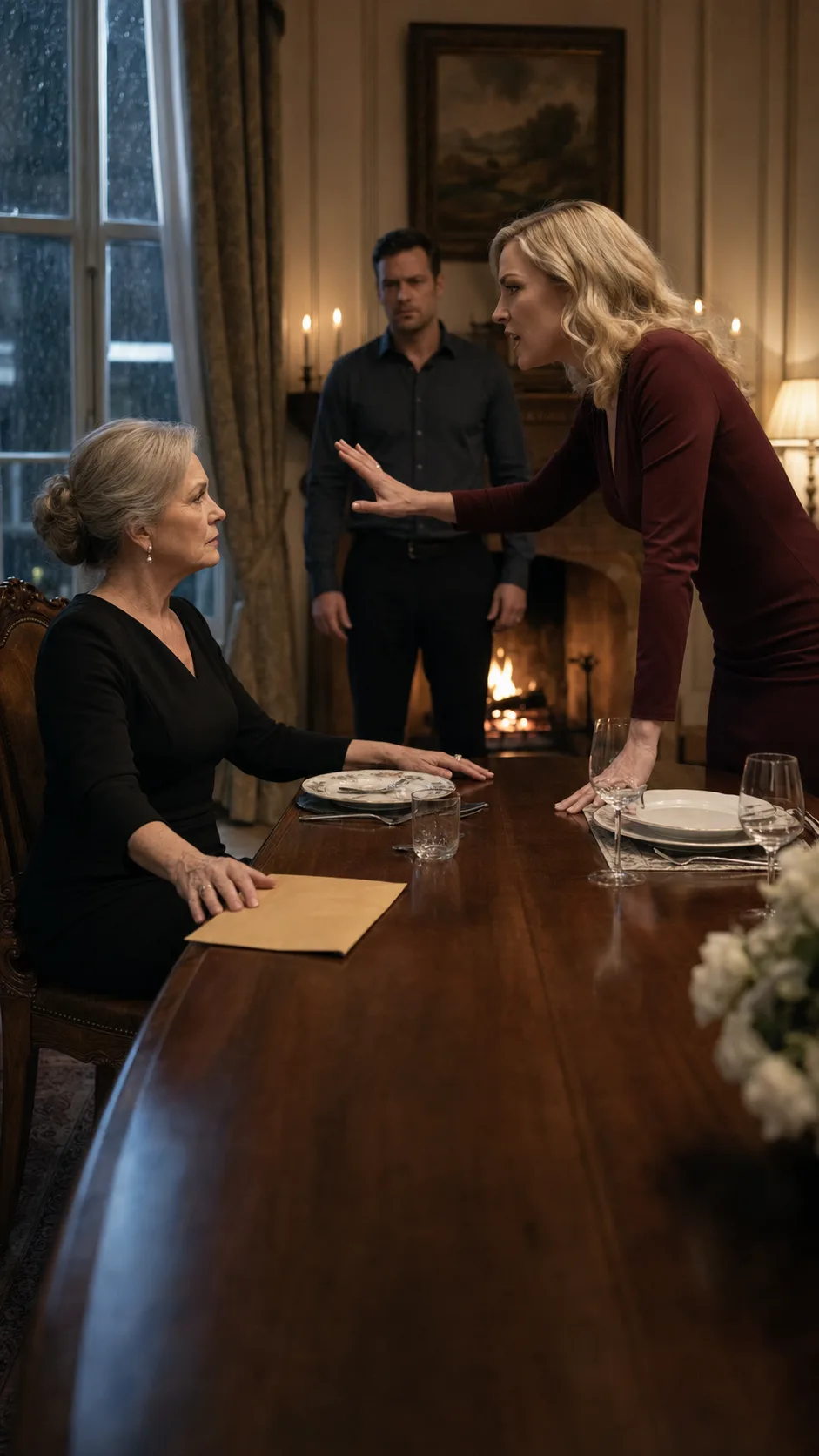
At seven o’clock, I arrived wearing an elegant black dress, pearl earrings, and the shoes I had once worn to business dinners with Harold.
Darren opened the door.
For a moment, he simply stared.
“You look like yourself again,” he said.
Thalia appeared behind him in a fitted burgundy dress.
“Well,” she said, looking me up and down. “The poor widow has been hiding quite a wardrobe.”
“Among other things.”
We entered the living room.
I sat on the walnut sofa I had helped select for the house I owned.
Thalia remained standing.
“How much money do you have?” she demanded.
“Enough.”
“How much?”
“Approximately five million dollars.”
Her eyes widened, but she quickly recovered.
“And you let us worry about you?”
“You never
worried about me.”
“We included you in family events.”
“You tolerated me when it suited you.”
Thalia folded her arms.
“Family does not lie to family.”
“Then perhaps you would like to explain why you told our neighbors I was developing dementia.”
Darren turned toward her.
“What?”
Thalia’s face went pale.
“I never said that.”
“You told Mrs. Henderson that I was showing signs of cognitive decline. You suggested to the mail carrier that I might soon need assisted living.”
“I was concerned.”
“You were preparing a story.”
“That’s ridiculous.”
I opened my purse and removed a thick manila envelope.
“Three months ago, you contacted an elder-law attorney.”
Thalia froze.
Darren looked between us. “What is she talking about?”
I placed copies of consultation notes on the coffee table.
“You asked how to obtain guardianship over an elderly relative. You wanted to know whether guardianship would give you control of bank accounts, investments, and property.”
Darren picked up the papers.
His lips moved as he read.
“Thalia?”
“It was only a consultation.”
“You asked whether assets could be liquidated quickly,” I continued. “You also asked how much evidence would be required to prove mental incompetence.”
She stepped backward.
“How did you get those?”
“Money opens doors, dear. Especially when someone is planning to have you declared incapable of managing your own life.”
Darren looked physically ill.
“Tell me this isn’t true.”
Thalia reached for him.
“I was worried about your mother.”
He pulled his arm away.
I removed another set of documents.
“These are statements for credit cards Darren does not know exist.”
Thalia’s face changed completely.
“No.”
“You owe forty-three thousand dollars.”
Darren turned another page.
His hands trembled.
“You told me we had no debt.”
“I was going to handle it.”
“With my money?” I asked. “Or with the fortune you hoped to seize from me?”
Thalia’s fear hardened into rage.
“You set me up.”
“I did nothing but document your choices.”
“You manipulated everyone.”
“No, Thalia. I stopped protecting you from the consequences of your behavior.”
She pointed at me.
“You wanted to destroy my marriage.”
“I wanted to protect my son.”
“I love Darren.”
“You love what he pays for.”
Darren lowered the papers.
His face had become strangely calm.
“Did you ever love me?” he asked.
Thalia turned toward him.
“Of course I did.”
“Then why did you hide forty-three thousand dollars in debt?”
“I was embarrassed.”
“Why did you investigate taking control of my mother’s finances?”
“I told you—I was concerned.”
“Why did you tell people she had dementia before she showed any signs of it?”
Thalia’s mouth opened, but no answer came.
I reached into the envelope one last time.
“This conversation is over.”
I placed the deed to the townhouse on the table.
Thalia looked down.
Then she laughed.
“What is that supposed to prove?”
“The house belongs to me.”
Her laugh stopped.
Darren picked up the deed.
My name appeared beneath the property description.
“Mom?”
“Your father and I bought this house before your wedding. You and Thalia have lived here as my guests for seven years.”
Thalia stared at me.
“This is our home.”
“It was provided for you. It was never yours.”
“I have tenant rights.”
“You have never paid rent, signed a lease, or contributed to the mortgage.”
“You can’t throw me out.”
“I can revoke permission for a guest to remain in my property.”
Her eyes flashed toward Darren.
“Tell her.”
He continued staring at the deed.
“Darren!”
He finally lifted his head.
For the first time in years, my son looked directly at his wife without fear.
“Get out of my mother’s house.”
Thalia’s face crumpled.
“You’re choosing her?”
“I’m choosing the truth.”
She ran upstairs, slamming doors as she packed.
Thirty minutes later, she dragged two suitcases through the living room.
“This isn’t over,” she told me.
“I know.”
She paused at the door.
My calm frightened her more than anger would have.
“This is only the beginning,” I said.
The next morning, the calls began.
Relatives accused me of cruelty. Thalia told everyone I was unstable, vindictive, and mentally unwell.
My nephew David even suggested that the family arrange a medical evaluation.
I reminded him that I had paid thirty-two thousand dollars toward his college tuition.
He hung up.
Thalia posted vague messages online about psychological abuse and manipulation. She contacted Darren’s employer and claimed he was distracted because of my supposed dementia.
Then she made her worst mistake.
One afternoon, a detective from the Sacramento Police Department called me.
“Mrs. Holloway,” she said, “a report has been filed alleging elder abuse and financial exploitation.”
I gripped the telephone.
“Who filed it?”
“Thalia Holloway.”
According to Thalia, Darren and I were conspiring to steal from a vulnerable elderly woman—me.
She had submitted photographs of my modest apartment and statements from the small checking account I used for household expenses.
She claimed the images proved I was being forced to live in poverty.
I called my attorney, Jonathan Reeves, and met him at the police station.
Detective Sarah Martinez looked surprised when I arrived in a tailored suit carrying documentation of my true finances.
“These records show assets of nearly five million dollars,” she said.
“Yes.”
Jonathan placed the guardianship notes on the desk.
“My client was not financially exploited,” he said. “She was the intended target of an attempted exploitation.”
I showed the detective Thalia’s legal inquiries, online searches about incompetency proceedings, hidden debt, and photographs taken through my apartment windows without permission.
Detective Martinez read every page.
Her expression grew colder with each one.
“If these records are authentic,” she said, “Ms. Holloway has filed a false police report and may have attempted fraud.”
“They are authentic,” Jonathan replied.
The detective closed the folder.
“What outcome are you seeking, Mrs. Holloway?”
I thought about the chipped plate.
The Walmart comment.
The rumors about dementia.
The attorney Thalia had contacted to strip away my rights.
“I want the truth recorded,” I said. “And I want her stopped before she does this to someone who cannot defend herself.”
Detective Martinez nodded.
“What happens now?” I asked.
She stood and reached for her phone.
“Now,” she said, “we arrest her.”
To be continued… Click “PART 3” to read the final part: 👉 PART 3 👈
Chapter complete
You have reached the end of this chapter.
Continue reading
A few more worlds to get lost in after this chapter.




