Rebecca recovered first.
Chapter 3
Rebecca recovered first.
People like her usually do.
Shock only silences them for a moment before pride drags words back into their mouths.
“This is ridiculous,” she said, but her voice had lost its smooth edges. “Mark, call the attorney.”
Mark did not move.
He was still staring at the deed in my hand.
I knew that look. I had seen it once when he was nine and broke Frank’s watch, then tried to hide the pieces under his pillow. It was the expression of someone who had already done wrong and was only now realizing the cost.
“Mark,” Rebecca snapped. “Call him.”
He looked at her.
Then at me.
“Mom,” he said, his voice barely above a whisper, “we can explain.”
I folded the deed carefully.
“I have heard enough explanations today.”
Rebecca stepped between us.
“No, you don’t get to do this. You don’t get to hold one paper over our
heads after everything we did to make this move happen.”
I tilted my head.
“Everything you did?”
“Yes,” she said. “We found the house. We arranged the movers. We handled the closing. We planned your care.”
“My care.”
“Yes.”
I placed the deed back into the envelope.
“You planned my removal.”
Her cheeks flushed.
“That is unfair.”
“Is it?”
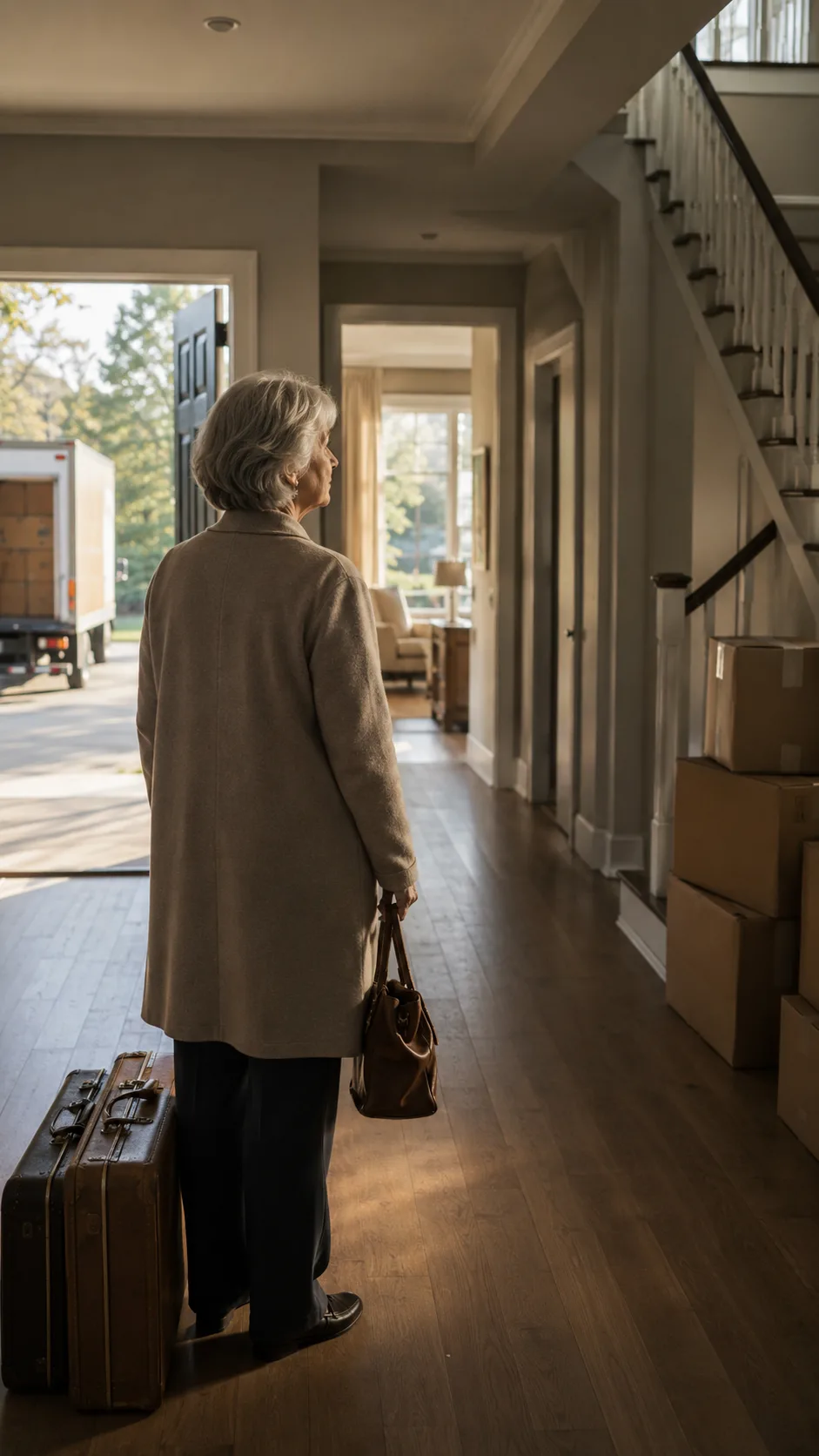
She pointed toward the open front door, where the movers were waiting uncertainly beside the truck.
“We uprooted our lives too, Helen. Mark got a transfer. I left my job. We moved here because this was supposed to work for everyone.”
“For everyone,” I repeated.
I looked toward the boxes labeled Master Bedroom.
Then toward the ones labeled Guest Room.
Then toward my two suitcases by the door.
“Everyone except me.”
Mark rubbed both hands over his face.
“Mom, I was going to visit you all the time.”
That almost broke
me.
Not because it was sweet.
Because it was so small.
A son who once cried when I left him at kindergarten was now offering visits as compensation for exile.
“Were you?” I asked. “Between work and Rebecca’s plans and whatever new life you built with my money?”
He flinched.
Rebecca grabbed his arm.
“Don’t let her twist this.”
I looked at her hand on his sleeve.
For years, I had blamed Rebecca for everything. It was easier that way. Easier to believe my son was weak, manipulated, pressured. Easier to believe he would never willingly hurt me.
But Mark had held the folder.
Mark had signed the facility forms.
Mark had stood at the bottom of that staircase and told me not to unpack.
Rebecca may have built the knife, but my son had carried it into the room.
I reached into my handbag again and took out my
phone.
Mark’s eyes widened.
“Who are you calling?”
“My attorney.”
Rebecca laughed sharply.
“Oh, please.”
I tapped the contact.
Martin Hale answered on the second ring.
“Helen?”
“Martin,” I said, keeping my eyes on my son, “I arrived at the new house.”
A pause.
Then his voice changed.
“Is there a problem?”
“Yes.”
Mark stepped closer.
“Mom, hang up. We can talk as a family.”
I lifted one hand, and somehow he stopped.
Maybe because I had never raised my hand to him in his life.
Maybe because he finally understood that calm is more frightening than anger.
I put the phone on speaker.
Martin’s voice filled the foyer.
“Helen, are Mark and Rebecca present?”
Rebecca’s mouth tightened.
“Yes,” I said.
“Good. Then I’ll be very clear. The property is titled in your name through the Whitmore Family Trust. No one may remove you from that residence, restrict your access, or dispose of your belongings without your written consent.”
Mark closed his eyes.
Rebecca went completely still.
Martin continued.
“If anyone has attempted to coerce you into leaving or has made care arrangements without your consent, document everything. I can be there in the morning.”
Rebecca whispered, “This is insane.”
Martin heard her.
“Mrs. Whitmore,” he said, coldly polite, “I reviewed the closing documents myself. You are not an owner of that property.”
Her face changed.
It was a small change, but I saw it.
The moment her world rearranged itself.
The moment the guest room became mine.
The moment the master bedroom became uncertain.
The moment the house she had decorated in her mind stopped belonging to her.
Mark opened his eyes.
“Martin, it’s Mark. We weren’t trying to hurt her.”
“No?” Martin said. “Then why was Helen not told about the senior residence before arriving?”
Mark looked at the folder.
No answer.
Rebecca cut in.
“We thought it was best.”
“For whom?” Martin asked.
Rebecca’s lips pressed together.
I almost smiled.
Frank would have liked Martin.
He had the kind of voice that made dishonest people feel overdressed.
“Helen,” Martin said, “do you feel safe staying there tonight?”
Mark looked stricken.
“Mom, of course you’re safe.”
I studied him.
The terrible thing was, I believed he would not physically harm me.
But safety is not only about locks and walls.
Sometimes the most dangerous place is a beautiful house where everyone has already decided you do not belong.
“I feel safe,” I said slowly, “because I now understand the situation.”
Martin understood the meaning underneath.
“I’ll come by at nine tomorrow morning. Do not sign anything else.”
“I won’t.”
I ended the call.
The foyer was silent again.
Outside, one of the movers shifted his weight.
“Ma’am?” he called gently from the doorway. “Should we keep unloading?”
Rebecca opened her mouth.
I answered before she could.
“Yes. Bring everything in.”
Mark looked at me.
“Mom…”
I turned to the movers.
“The boxes marked Helen’s Room go to the downstairs bedroom.”
Rebecca’s eyes flashed.
“That room is supposed to be my office.”
I looked at her.
“No. It is supposed to be my room.”
She stared as if I had slapped her.
For the first time all day, I walked past my suitcases.
I moved deeper into the house. Each step sounded steady on the polished floor. I passed the staircase, the guest room boxes, the framed mirror leaning against the wall. In the downstairs hallway, I found the bedroom they had promised me months ago.
It was empty.
No bed.
No curtains.
No chair by the window.
But sunlight poured across the floor exactly the way Mark had described when he wanted my signature.
A sunny room.
I stood in the doorway and let the grief come close.
Not enough to swallow me.
Just enough to remind me what had been stolen.
Behind me, Mark said, “I’m sorry.”
I did not turn around.
“Are you sorry because you hurt me,” I asked, “or because the house is mine?”
He did not answer quickly enough.
That was answer enough.
Rebecca appeared behind him, arms folded again, but weaker now.
“So what happens?” she asked. “You throw us out?”
The old Helen would have rushed to comfort her.
The old Helen would have said, No, no, of course not.
The old Helen would have made herself smaller so everyone else could breathe.
But the old Helen had been left somewhere between my sold house and this foyer.
“I am not throwing anyone out tonight,” I said.
Mark exhaled in relief.
Rebecca’s shoulders dropped.
Then I turned.
“But tomorrow morning, when my attorney arrives, we will put everything in writing. My room. My rights. My ownership. My boundaries.”
Rebecca stiffened.
“And if we don’t agree?”
I looked at her calmly.
“Then you will need to find another house.”
Mark whispered, “Mom, please.”
There it was again.
That little-boy word.
Mom.
Once, it could make me forgive almost anything.
Not anymore.
“You used my love as a contract I never read,” I said. “You counted on me being too grateful, too old, too lonely, and too afraid to fight back.”
His eyes filled with tears.
I wanted them to move me.
They didn’t.
“I raised you better than this,” I said.
He lowered his head.
Rebecca looked away first.
That was her apology.
The only kind she knew how to give.
The movers brought in my boxes. My chair came next — the blue wingback Frank bought me after my knee surgery. Then the small table that used to sit beside our bedroom window. Then the framed photograph of Frank standing in our old garden, smiling like he knew I would need courage someday.
I had them place the photograph in the sunny room.
Mark watched from the hallway.
Rebecca disappeared upstairs.
By evening, my bed was assembled. My clothes hung in the closet. My handbag sat on the chair. The cream envelope rested in the drawer beside Frank’s fountain pen.
At seven, Mark knocked softly on the open door.
“Can I come in?”
I looked at him for a long moment.
Then I said, “No.”
The word surprised both of us.
He stepped back as if it had weight.
“Tomorrow,” I added. “With Martin here.”
His face crumpled, but he nodded.
For the first time in his life, my son obeyed a boundary.
I closed the door.
Not locked.
Just closed.
Then I sat in the blue chair, facing the window, as the last light of evening stretched across the floor of the room they had promised me and tried to take away.
I picked up Frank’s photograph.
“You were right,” I whispered. “Always keep your own copy.”
Outside my door, the house moved quietly around me.
Boxes opening.
Footsteps upstairs.
A marriage whispering in panic.
But inside my room, there was peace.
Not forgiveness.
Not yet.
Maybe not ever in the way Mark wanted.
But peace.
Because I had crossed two state lines believing I was losing everything.
Instead, I arrived just in time to find out what still belonged to me.
The room.
The house.
The truth.
And finally, myself.
THE END.
Chapter complete
You have reached the end of this chapter.
Continue reading
A few more worlds to get lost in after this chapter.




